

Managing a vacation rental can be overwhelming, but hiring the right management company simplifies the process and boosts your revenue. Here’s what you need to know to make the best choice:
- Set your goals: Decide if you want hands-off management or partial support. Define financial targets like revenue or occupancy rates.
- Understand pricing: Compare fee structures – commission (10–30%), flat fees, or guaranteed income models. Watch for hidden costs like setup fees or cleaning charges.
- Check local expertise: Choose a company with proven success in your area. Verify compliance with local regulations, permits, and taxes.
- Evaluate services: Full-service plans include marketing, guest support, and maintenance but cost more (up to 50%). Basic packages are cheaper but require more owner involvement.
- Review technology: Look for tools like dynamic pricing software, smart home features, and real-time performance tracking.
- Ask key questions: Clarify fees, services, and contract terms. Ensure transparency and flexibility, such as month-to-month agreements.
Partnering with a management company can save time, reduce stress, and increase your rental income. Choose wisely by assessing your needs, understanding fees, and verifying their expertise.
How to Find a GREAT Property Management Company for Your Airbnb
Determine What You Need from a Management Company
Before diving into comparisons, it’s essential to figure out your goals, budget, and how involved you want to be. This step ensures you don’t overspend or overlook the support you actually need. By identifying these details upfront, you’ll have a solid foundation to evaluate pricing models, service offerings, and the level of involvement that works for you.
Set Clear Financial Goals
Start by defining what financial success means for your property. Are you aiming to maximize total booking revenue, or do you have a specific net profit target after fees and expenses? Your answer will guide you toward the right pricing model. For instance, if you need consistent cash flow to cover a mortgage, a guaranteed income model might be the safest bet [8]. On the other hand, if you’re okay with some variability and want to take advantage of peak seasons, a commission-based model could yield higher returns [1].
Also, set realistic occupancy rate goals based on your local market’s seasonal trends. Some companies adjust pricing dynamically, using anywhere from 75 to 150 “seasons” to capture shifts in demand [5]. If you own more than one property, consider negotiating lower commission rates for volume [1]. Don’t forget to account for onboarding fees, which can be as high as $300 – these initial costs should factor into your budget planning [1].
List the Services You Need
Not every property needs full-service management, so it’s important to outline which tasks you want to outsource versus handle yourself. Full-service options often include marketing, 24/7 guest communication, cleaning coordination, maintenance, and property inspections, but they typically come with commission rates of 40% to 50% [1]. If you’re local and enjoy interacting with guests but want help with pricing strategies, a basic or hybrid model with fees ranging from 10% to 20% might be a better fit [9].
Some companies also offer flat-fee options, such as a 10% fee that covers core marketing and booking services, leaving you to handle the logistics on the ground [9]. Think about whether you’ll need extras like professional photography, smart home features for keyless entry, or concierge services like grocery delivery [1] [9]. Creating two lists – one for your revenue and relationship goals, and another for the tasks you absolutely don’t want to manage – can help you quickly filter out companies that don’t align with your needs [2].
Decide How Involved You Want to Be
Your location and availability are key factors in deciding how hands-on you want to be. If you live far from your rental or have a demanding schedule, look for a management company that can handle emergencies without your input [1] [2]. Full-service management is ideal for non-local owners who want a hands-off approach, while local owners who enjoy staying involved might prefer a basic package that allows for more personal interaction.
Time commitment is another critical consideration. Managing your property yourself can take up to 30 hours a month, whereas a basic management package reduces your workload significantly, and full-service management nearly eliminates it [1]. Compare the potential income for each option – DIY (no fees but high time commitment), basic management (25%–35% fees), and full-service management (40%–50% fees) – to find the balance between income and time that best suits your situation.
Once you’ve clarified your needs, the next step is to evaluate local market expertise and the performance of potential management companies.
Check Local Market Knowledge and Experience
A management company might thrive in one city but stumble in another, making local expertise far more important than a nationwide reputation. It’s crucial to evaluate their track record in your specific area rather than relying solely on their overall portfolio. Companies that are well-versed in your area’s seasonal trends, pricing fluctuations, and regulatory landscape will consistently deliver better results than those applying a generic, one-size-fits-all strategy.
Review Performance in Your Market
Ask to see a portfolio of properties the company manages in your city or neighborhood, along with detailed performance metrics like average occupancy rates and year-over-year revenue growth for properties similar to yours. For instance, in April 2023, Savvy Vacation Rental Management reported over 40% year-over-year revenue growth for a property owner in Palm Springs. They credited this success to their dynamic pricing tools and intimate knowledge of the Greater Palm Springs area, where they boast a 100% owner retention rate [14].
To verify these claims, visit some of their managed properties to assess maintenance, curb appeal, and cleanliness firsthand [1][10]. Additionally, reach out to fellow investors, local real estate agents, or even community Facebook groups to gather feedback about the company’s reputation in your area [1][10].
Once you’ve confirmed their performance, ensure the company also complies with all local legal requirements.
Verify Compliance with Local Laws
Partnering with a company that lacks a solid understanding of local regulations can lead to fines, revoked permits, or even lawsuits. Confirm that they hold a valid business license to operate in your area and have secured the necessary short-term rental permits for your property [1][13]. In cities like New York City, Los Angeles, and Miami Beach, regulations are particularly strict, with rules such as primary residence requirements and annual limits on rental nights [11]. Missing a permit renewal in these locations could result in losing your license permanently [11].
Ask how the company handles tax responsibilities such as registration, collection, and remittance for occupancy, sales, and tourism taxes at the local and state levels [12][13]. Make sure they’re familiar with zoning laws, which may restrict rentals to specific neighborhoods or limit the number of properties allowed [11][12]. If your property is part of an HOA or a condo building, confirm that they review local bylaws and board rules, as these can often be stricter than city regulations [11][13]. Lastly, request proof of valid licensing and insurance. Professional liability coverage should range between $1 million and $2 million per occurrence [1].
Understanding these legal and operational factors can help you see the true value of professional management.
DIY vs. Professional Management Comparison
Weighing the pros and cons of self-management versus hiring a professional can clarify what you’re paying for. Here’s a side-by-side comparison:
| Feature | Self-Management (DIY) | Professional Management |
|---|---|---|
| Cost | 0% commission; owner handles all vendor payments | 10%–50% of gross revenue [1][10] |
| Local Compliance | Owner manages permits, taxes, and regulations | Company handles licensing, tax remittance, and regulatory updates [12][13] |
| Guest Communication | Owner deals with all inquiries, check-ins, and issues | 24/7 guest support included in full-service packages [1] |
| Maintenance & Cleaning | Owner coordinates vendors and inspections | Company oversees vendors and ensures quality control [1] |
| Market Expertise | Limited to owner’s research and knowledge | Access to local market data and professional networks [14][3] |
If you live near your property and have the time to handle emergencies, self-management might maximize your profits. However, if you’re far away, have limited availability, or want access to professional tools and compliance expertise, the fees for professional management often pay for themselves through higher occupancy rates and fewer legal headaches.
Local market knowledge, legal compliance, and understanding the trade-offs of management options are key to running a profitable and stress-free rental property.
Review Pricing Models and What’s Included
Vacation Rental Management Pricing Models Comparison Guide
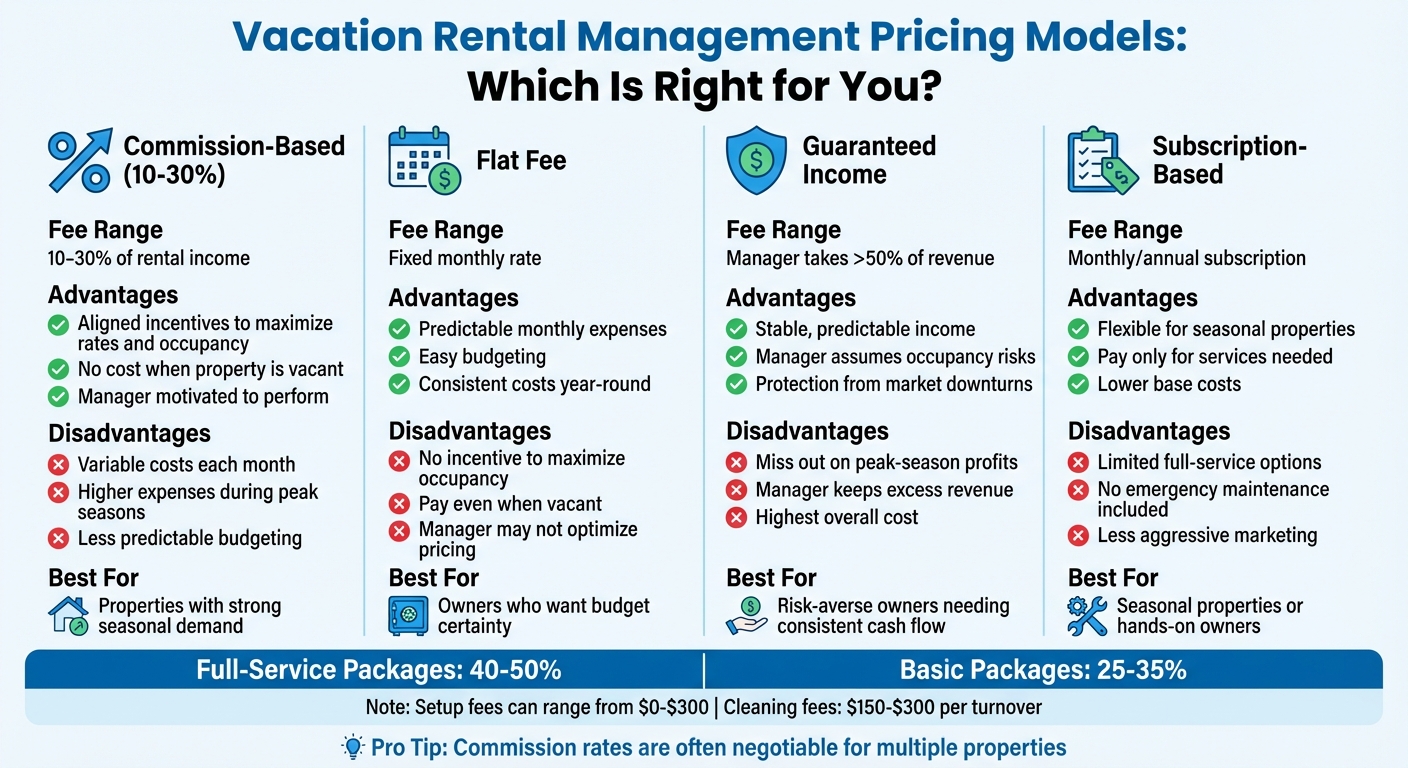
Once you’ve assessed your needs and the expertise available locally, the next step is understanding pricing models. Knowing how fees are structured can help you avoid unexpected costs and align with your financial goals. Most property management companies use one of four main pricing models, each with its own pros and cons depending on your property’s location, seasonality, and how involved you’d like to be.
Compare Different Fee Structures
Commission-based pricing is the most widely used model, where the management company takes a percentage – usually between 10% and 30% – of your rental income. This approach aligns the manager’s earnings with your property’s performance. As OwnerRez explains:
"The commission model promotes aligned incentives with management companies looking to maximize nightly rates and occupancy" [8].
However, the downside is that your costs can vary significantly. During peak seasons, you might end up paying much more than you would with a flat fee.
Flat-fee pricing offers a fixed monthly rate, no matter how many bookings you get [8]. This makes budgeting easier, but it removes any financial motivation for the manager to push for higher occupancy or optimize pricing – meaning your property could sit empty without much effort on their part.
Guaranteed income models provide stability by offering a set monthly payment, regardless of how well your property performs. The manager keeps any revenue above that fixed amount [8]. While this shields you from risks like low occupancy, it also means you might miss out on peak-season earnings. Additionally, managers often take more than 50% of the revenue to offset their risk.
Subscription-based models charge a recurring monthly or annual fee for specific services you can use as needed. These are great for seasonal properties, offering flexibility, but they often lack full-service options like emergency maintenance or round-the-clock guest support.
| Pricing Model | Advantages | Disadvantages |
|---|---|---|
| Commission (10–30%) | Encourages high occupancy and rates; no cost if property is vacant | Costs vary; higher expenses during peak seasons |
| Flat Fee | Predictable monthly expenses | No incentive to maximize occupancy; costs apply even when vacant |
| Guaranteed Income | Stable income; manager assumes occupancy risks | Miss out on peak-season profits; manager may take >50% of revenue |
| Subscription | Flexible for seasonal properties; pay only for needed services | Limited full-service options; less focus on aggressive marketing |
After choosing a pricing model, it’s essential to examine what services are included in the fees to get a complete understanding of the value offered.
Review What Services Are Included
It’s important to clarify which services are covered under the base fee and which come with extra charges. Full-service packages, typically costing between 40% and 50%, generally include everything: listing optimization on multiple platforms, 24/7 guest support, maintenance management, and access to owner reporting tools [1]. On the other hand, basic packages, which usually range from 25% to 35%, might only handle listing management, booking confirmations, and check-in coordination. This leaves tasks like cleaning and repairs in your hands [1].
Be aware of additional costs that can add up quickly. Setup fees or onboarding charges can go as high as $300 [1], while standard cleaning fees average around $150 per turnover. Deep cleaning costs can range from $200 to $300 [8]. Some companies also include markups on vendor costs rather than passing on the actual contractor rates [8][3]. Other potential expenses include platform fees from sites like Airbnb or Vrbo, advertising charges for premium placement, and service fees for repairs. These can add hundreds of dollars to your monthly expenses without being reflected in the base commission rate. On the bright side, property management fees are often tax-deductible, which can help offset some of these costs and improve your overall profitability [15].
With a clear understanding of pricing and included services, the next step is negotiating the best terms for your contract.
How to Negotiate Fees and Contracts
Commission rates are often negotiable, especially if you own multiple properties or are open to flexible contract terms [1]. Push for transparency on markups and aim to secure flexible, well-defined terms. Carefully review your contract to ensure it specifies exactly which services are included in the base fee and which will cost extra. Pay close attention to clauses about automatic renewals, cancellation notice periods, and fees for early termination. A thorough review now can save you from surprises later.
sbb-itb-103bddb
Technology and Performance Tracking
The technology your management company uses can have a direct impact on your property’s performance and revenue. Even the most comprehensive service packages can fall short if they lack the right tools to back them up.
Key Technology Features
- Dynamic pricing software: This tool adjusts rates based on nuanced factors like seasonal demand, local events, day of the week, and occupancy trends. Unlike basic seasonal pricing, it can capitalize on unexpected demand spikes, ensuring you don’t miss out on potential revenue [5].
- Channel managers: These tools synchronize your property’s listings across various booking platforms, helping to prevent double-bookings and maximize exposure. Research shows that up to 40% of bookings can come directly from a management company’s own website, reducing dependence on third-party platforms [5].
- Owner portals: These portals give you instant access to financial reports, booking calendars, and expense summaries. With real-time reporting, you stay informed about your property’s performance.
- Smart home tools: Features like remote entry, noise sensors, and doorbell cameras enhance security while cutting check-in costs. They also streamline operations, keeping your property running smoothly [1][5].
- Maintenance apps: These apps help coordinate cleaning schedules, track repairs, and use photo checklists to maintain quality standards [1][16].
Of course, no matter how advanced the technology, it’s only as effective as the people using it. Ensure the management company’s staff is well-trained in these tools. Additionally, check if their marketing efforts include professional photography and optimized listings to make the most of tech-driven strategies [1][4].
Once the right technology is in place, the next step is to focus on tracking performance metrics.
Performance Metrics That Matter
To truly measure success, you’ll need to monitor key metrics that reflect how well pricing and booking strategies are working:
- Occupancy rate, Average Daily Rate (ADR), and Revenue per Available Room (RevPAR): These metrics provide insights into booking consistency, pricing effectiveness, and overall revenue performance.
- Return on Investment (ROI): This is the ultimate measure of profitability, calculated after deducting all management fees, maintenance costs, and operating expenses [4]. Aim to review ROI monthly and keep unsellable nights (blocked or unavailable nights) below 5% to stay on track with revenue goals [17].
- Guest reviews and ratings: Positive reviews not only enhance your property’s visibility on booking platforms but also attract more bookings.
- Guest repeat rate: A high percentage of returning guests indicates operational success and helps cut down on customer acquisition costs [17].
Regularly reviewing these metrics through your owner portal ensures accountability and helps you gauge whether your management company is meeting performance expectations.
| Metric | What It Measures | Why It Matters |
|---|---|---|
| Occupancy Rate | Percentage of nights booked | Indicates booking consistency |
| Average Daily Rate (ADR) | Revenue per booked night | Reflects pricing effectiveness |
| Revenue per Available Room (RevPAR) | Total revenue ÷ available nights | Combines occupancy and pricing performance |
| ROI | Net profit after all expenses | Ultimate measure of profitability [4] |
| Unsellable Nights | Blocked or unavailable nights | Should be below 5% for optimal revenue [17] |
| Guest Repeat Rate | Percentage of returning guests | Helps reduce customer acquisition costs [17] |
Questions to Ask and Contract Terms to Review
Before committing to a property management company, it’s essential to ask the right questions and carefully review contract terms. This ensures you protect your investment and fully understand your obligations.
Questions to Ask Before Signing
Start by clarifying which services are covered in the management fee and which ones come with additional charges. For example, cleaning fees can vary widely – basic turnovers often cost around $150, while deep cleans might run up to $300. Confirm whether these fees are included in the agreement or billed separately [8].
Ask about the average occupancy rate and rental performance of similar properties in their portfolio. This information provides a realistic expectation of how your property might perform [14][4]. Additionally, find out how performance metrics will be reported to you. Do they offer real-time access to data like occupancy rates, average daily rates, and ROI through an owner portal? Transparency in reporting is key.
If the company uses dynamic pricing strategies, inquire about their approach. Advanced managers often rely on tools that adjust pricing across 75 to 150 seasonal variations to maximize revenue [5].
Insurance is another critical topic. Confirm whether you need to be listed as an "additional insured" on their policy [18]. Lastly, ask about their understanding of local regulations. In highly regulated areas, some companies include consulting on zoning laws, building codes, and safety regulations as part of their management fees [8][14].
Once you’ve addressed these questions, move on to the contract details.
What to Look for in Contracts
After your initial discussions, request a sample contract to evaluate the terms before signing. Pay special attention to termination clauses. Most contracts require 30, 60, or even 90 days’ notice to end the agreement. Make sure you understand the required notice period and check for any penalties tied to early termination [18].
Examine the fee structure carefully. Management fees are typically based on commission rates ranging from 10% to 30% of rental income. While commission-based models align the manager’s incentives with your revenue, flat-fee arrangements offer predictable costs but may not include as many services [8][2]. Look for a clear breakdown of fees, including setup costs, which can range from $0 to $300 [1].
Flexible contracts, such as those offering month-to-month agreements, are ideal. They give you the freedom to switch providers if the company’s performance doesn’t meet your expectations. Flexibility and transparency are key to ensuring a successful partnership.
Why Rank One Stays is the Right Choice

When it comes to vacation rental management, you want a partner that delivers results without tying you down with rigid contracts or inflated fees. After considering service quality, pricing, and market expertise, Rank One Stays emerges as a standout choice. They offer a combination of full-service management, competitive pricing, and a proven track record of boosting revenue.
Full-Service Property Management
Rank One Stays takes care of every aspect of managing your vacation rental. Their services include dynamic pricing strategies tailored to your market, 24/7 guest support to handle inquiries and resolve issues, and professional housekeeping coordination to keep your property in top condition. They even manage damage claims on your behalf, so you don’t have to deal with the hassle.
Unlike companies that only handle marketing and charge extra for listing your property, Rank One Stays provides comprehensive management. They ensure your property is listed on major platforms like Airbnb and VRBO, while also offering full operational support as part of their base fee. This all-inclusive approach not only simplifies management but also sets the stage for higher earnings.
Higher Revenue and Better Returns
Working with Rank One Stays can lead to a 38% increase in revenue, on average, compared to previous performance. This boost is achieved through optimized pricing strategies, enhanced property listings, and professional guest management that drives both higher occupancy rates and better nightly pricing.
Their commission structure is designed to align their success with yours. As noted by OwnerRez:
"The commission model promotes aligned incentives with management companies looking to maximize nightly rates and occupancy." [8]
This shared interest in maximizing your property’s revenue creates a win-win partnership. The more your property earns, the more they earn – making your success their priority. And beyond revenue growth, their flexible contract terms add another layer of appeal.
Flexible Contracts with Low Fees
One of the standout features of Rank One Stays is their month-to-month contracts, which come without the long-term commitment typically required by other management companies. Their management fees start at just 10% of your rental income, significantly lower than the industry average for full-service providers. Plus, there are no setup fees – saving you the $300 onboarding costs that many companies charge.
This flexibility means you can test their services risk-free. If they don’t meet your expectations, you’re not locked into a lengthy agreement. To top it off, their transparent owner portal allows you to monitor your property’s performance in real-time, giving you peace of mind while enjoying professional management at a fraction of the usual cost.
Conclusion
Making a smart choice starts with understanding your needs, evaluating local expertise, and ensuring clear pricing. Begin by deciding whether you need just basic distribution services or comprehensive property management. Then, review the company’s track record in your specific market and confirm property maintenance standards through trustworthy reviews [1][10]. It’s also helpful to check ratings and service feedback [1].
Be sure to clarify fee structures and what’s included to avoid hidden costs [1][6]. Confirm that staffing levels can genuinely provide 24/7 support, and don’t hesitate to negotiate commissions when necessary [1][5].
A reliable management company should offer transparent reporting, flexible pricing strategies, and excellent guest support – all without tying you down with rigid contracts. As Josh Cissell, Broker/Owner at Cissell Management, wisely advises:
"If you’re going to hire a property manager, you need to go in with your eyes wide open" [7].
This means asking for full transparency on fees, understanding what services you’re paying for, and ensuring your manager’s goals align with yours.
For those seeking a dependable partner, Rank One Stays delivers on every front. With management fees starting at just 10%, no setup costs, month-to-month contracts, and a proven 38% revenue increase, they combine profitability with peace of mind. Their full-service management includes dynamic pricing, 24/7 support, and top-tier housekeeping – offering a truly hands-off solution while maximizing your property’s earnings.
FAQs
What should I keep in mind when setting financial goals for my vacation rental?
When planning financial goals for your vacation rental, focusing on a few essential factors can help you set realistic and attainable objectives. Start by calculating your expected return on investment (ROI). To do this, compare potential rental income and property value growth against expenses such as management fees, maintenance, taxes, and insurance.
You should also establish occupancy rate targets that strike a balance between generating revenue and aligning with market demand and operational costs. A solid understanding of your local market and seasonal patterns will help you set accurate income expectations. Additionally, think about your personal financial priorities – whether you’re looking for extra income or building long-term wealth – and adjust your goals accordingly.
Partnering with a professional management company like Rank One Stays can be a smart move. They can help you regularly analyze performance metrics and refine your strategy to boost profitability while keeping risks in check.
How do I make sure a vacation rental management company follows local laws?
To make sure a vacation rental management company follows local laws, start by checking if they fully understand the regulations in your area. They should be familiar with rules about zoning, permits, occupancy limits, licensing, and safety standards. A dependable company will also stay informed about any updates to these laws, helping you avoid fines or unexpected issues.
Ask about their compliance experience and request specific examples of how they handle legal requirements. It’s also a good idea to look into their track record or talk to other property owners they’ve worked with to see how reliable they are. A company that’s serious about compliance will have systems in place for managing permits, registrations, and safety inspections. This ensures your property runs smoothly and stays legally compliant, giving you one less thing to worry about.
What are the benefits of using dynamic pricing software for my vacation rental?
Dynamic pricing software brings a host of benefits to vacation rental owners, starting with its ability to optimize your revenue. By automatically adjusting nightly rates based on factors like market demand, seasonal fluctuations, local events, and your property’s occupancy levels, it ensures your pricing remains competitive and appealing to potential guests.
It also offers a huge advantage in terms of time-saving automation. Instead of spending hours manually tweaking rates and analyzing market trends, the software handles it all for you. This not only eliminates the guesswork but also frees you up to focus on other critical aspects of running your rental, like enhancing guest experiences or maintaining the property.
With dynamic pricing in place, you can improve both your occupancy rates and overall profits, making it an invaluable tool for managing a successful vacation rental.