

Should you manage your Airbnb yourself or hire a property manager? Here’s the short answer:
- Self-managing saves you money (no management fees) and gives you full control, but it demands significant time and effort. Expect to spend 3–40 hours per week, depending on how many properties you manage and your setup.
- Hiring a property manager costs 15–40% of your revenue but frees up your time and can increase bookings through professional tools like dynamic pricing and multi-platform marketing.
Key Considerations:
- Time Commitment: Self-managing can take hours weekly; property managers handle everything for you.
- Costs: Self-managing avoids fees but involves software and labor costs. Property managers charge fees but may boost revenue.
- Control: Self-managing lets you make all decisions. Hiring a manager limits control but reduces stress.
- Location: If you live far from your property, a manager can handle local tasks like cleanings and repairs.
Quick Comparison:
| Factor | Self-Managing | Hiring a Property Manager |
|---|---|---|
| Cost | No fees, but software and time costs | 15–40% of gross revenue |
| Time Commitment | 3–40 hours/week | Minimal (passive role) |
| Control | Full control | Limited control |
| Revenue Potential | Risk of underpricing | Optimized with professional tools |
| Best For | Hands-on, local owners | Passive investors, remote owners |
If you enjoy being hands-on and have the time, self-managing might work for you. If you prefer a hands-off approach or own multiple properties, hiring a manager could be worth the cost.
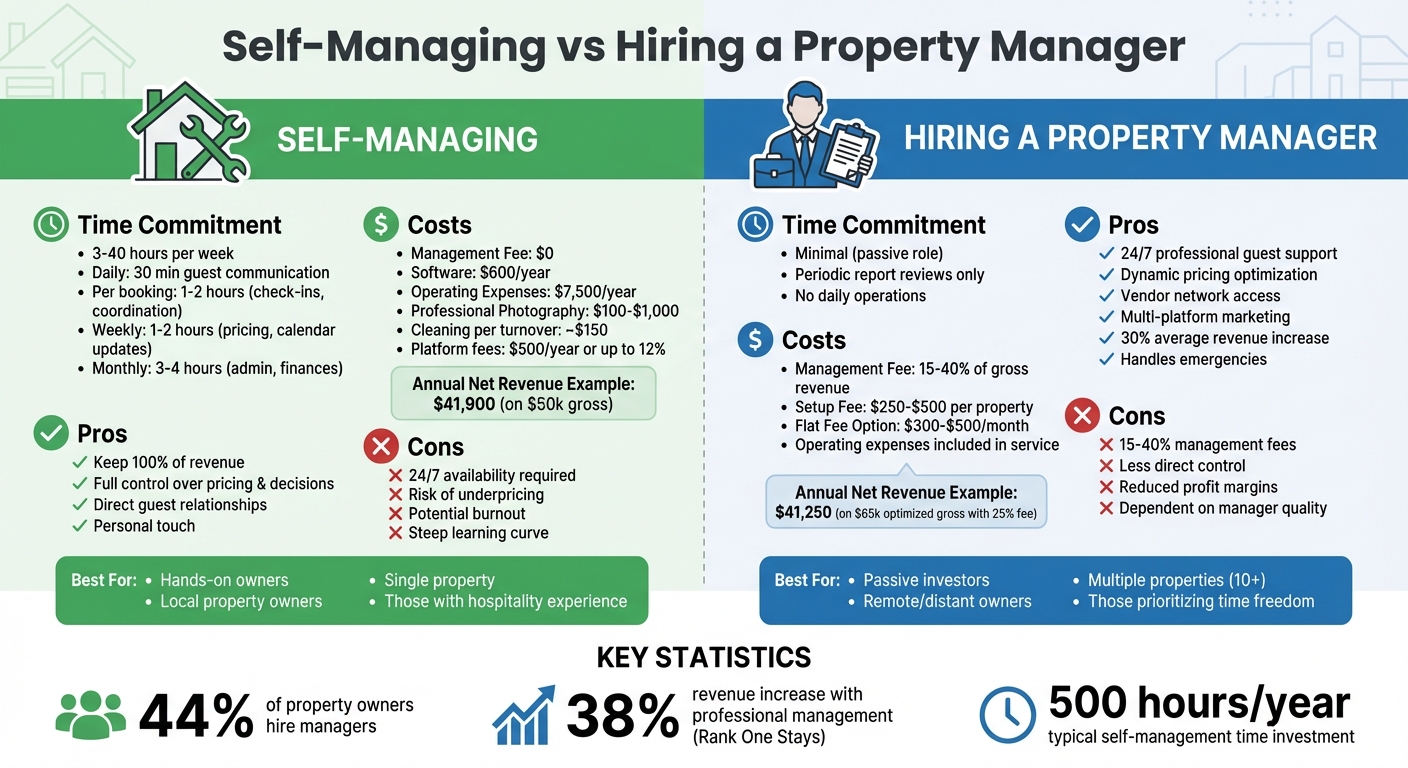
Self-Managing vs Hiring Property Manager: Cost and Time Comparison
Self-Managing Your Airbnb: Pros and Cons
Benefits of Self-Management
Taking the reins of your Airbnb can be rewarding. For starters, you keep 100% of the booking revenue, giving you full control over your earnings. You also have the freedom to set your own pricing and service standards. Want to adjust rates for a big local event or an unexpected weather change? You can do it instantly, without waiting for approval from a third party [1][4][5].
Another perk? Personal guest interactions. By welcoming guests yourself and offering local tips, you can create memorable experiences that lead to glowing reviews and repeat bookings. Plus, there’s a potential tax advantage: self-managing may qualify you for "material participation" status, which could offer some financial benefits [1][2][5].
Mays Kuhail from Mashvisor sums it up well:
"If you’re the type of Airbnb investor who likes to personally check-in guests, give them a tour around the house, and tips for visiting the area, you should definitely DIY" [2].
Once you’ve set up reliable systems and automation tools, the time commitment can be surprisingly manageable – dropping to about 3-4 hours per week on average [1]. However, this level of control and flexibility comes with its own set of challenges.
Challenges of Self-Management
Self-managing your Airbnb isn’t all smooth sailing. It often demands an unpredictable schedule, with some hosts spending 15 to 40 hours a week on tasks. You’ll need to be ready 24/7 for emergencies – anything from a broken heater to a malfunctioning door code can pop up at the worst times [1][4][5][6]. This constant availability can quickly lead to burnout, especially if you’re managing multiple properties [1][5].
Sarah, an Airbnb Superhost managing four condos in Florida, shares her experience: she stays accessible around the clock – even when traveling internationally – to ensure her guests are taken care of [6].
Another hurdle is pricing. Without deep market knowledge, manually adjusting rates can be tricky. You might underprice during busy seasons or miss out on bookings during slower periods [4]. These are areas where professional management services, with their experienced teams and local expertise, can make a big difference.
Self-managing your Airbnb gives you control, but it also requires dedication, flexibility, and a solid strategy to handle the challenges that come with it.
Hiring a Property Manager: Pros and Cons
Benefits of Hiring a Property Manager
Bringing in a professional property manager can turn your Airbnb into a truly hands-off income source. In fact, about 44% of property owners opt for this solution[8]. It frees you from dealing with late-night emergencies, last-minute cleaning tasks, or the constant juggling of guest communications.
One major perk is the access to reliable vendor networks. Property managers typically have trusted connections with cleaners, handymen, and maintenance professionals, ensuring issues are addressed quickly and efficiently[3][5]. They also take on the more challenging aspects of hosting, like handling difficult guests or urgent repairs[7][8].
Beyond operational help, professional managers can boost your property’s performance. They excel in dynamic pricing strategies and multi-platform marketing, listing your property across Airbnb, Vrbo, Booking.com, and similar platforms. Rates are adjusted based on local events, seasonal demand, and market trends. Many managers offer all-inclusive packages that cover professional photography, round-the-clock guest support, cleaning coordination, and regular property inspections[10][11].
The time savings are undeniable. While self-managing a property can take up to 48 hours annually, hiring a manager slashes this commitment significantly[8]. This setup is especially beneficial if you live far from your rental property or oversee multiple units.
Challenges of Hiring a Property Manager
However, hiring a property manager isn’t without its downsides. The most significant drawback is cost. Management fees usually fall between 15% and 40% of your gross rental income[11], which could reduce your overall profit by 20% to 30%[9]. As J Scott and Dave Meyer explain in Real Estate By the Numbers:
"With compounding, even slightly higher returns can make a big difference in the outcome… If you’re investing for the long term, the strategy is simple: Continuously reinvest your profits at the highest possible rate of return"[9].
Additionally, there are upfront expenses to consider. Setup fees can range from $250 to $500 per property, while eviction handling and legal fees may add another $500 or more[3][10]. Some managers opt for flat monthly fees between $300 and $500, while others use hybrid pricing models – a fixed base fee combined with a smaller commission percentage[10].
Another challenge is the loss of direct control. By outsourcing management, you’re handing over decisions about pricing, guest approvals, and daily operations. This limits your ability to make quick adjustments or implement personalized strategies.
Here’s a breakdown of common management fee structures:
| Management Model | How it Works | Best For |
|---|---|---|
| Flat Fee | Fixed monthly charge, regardless of income | Rentals with steady, predictable revenue |
| Percentage-based | Manager takes a percentage of monthly income (10%–40%) | Owners who want managers motivated to maximize bookings |
| Hybrid | Combination of a base fee and a lower income percentage | Those looking for a balance between predictability and performance |
Time Commitment Comparison
Daily and Weekly Tasks for Self-Managing
Managing an Airbnb on your own requires consistent effort and attention. On a daily basis, you’ll spend around 30 minutes communicating with guests – answering questions, addressing concerns, and ensuring their stay goes smoothly[5]. Each booking also adds 1 to 2 hours for tasks like check-ins, coordinating cleaning services, and resolving any issues that arise[5]. When it comes to turnovers, the time required depends on the size of your property. For example, resetting a one-bedroom condo might take about 2 hours, while a larger five-bedroom vacation rental could demand an entire day to prepare[12].
Beyond daily responsibilities, there are weekly tasks like adjusting dynamic pricing, syncing calendars across platforms, and updating listing photos. These take an additional 1 to 2 hours per week[5]. On a monthly basis, expect to dedicate 3 to 4 hours to administrative work, such as reviewing performance metrics, reconciling finances, and tweaking your overall strategy[5].
Kate Stoermer, Founder of The CEO Host, captures the essence of this commitment:
"Self-managing isn’t just day to day; it’s being a professional – attending meetings, conferences, learning, staying plugged into the industry plus the software and tools to learn, implement, and update"[1].
While automation tools can reduce the workload to around 3–4 hours per week, hosts managing multiple or distant properties may still find themselves spending up to 40 hours per week[1][4]. These ongoing tasks are crucial for maintaining smooth operations and ensuring guest satisfaction – key elements of a successful Airbnb strategy.
Tasks Delegated to Property Managers
Hiring a property manager offers a completely different experience. Instead of handling the daily grind, your role shifts to that of a passive investor. Your primary responsibility is limited to periodically reviewing financial reports and keeping an eye on your property’s performance[1][2].
Property managers take care of 24/7 guest communication, ensuring quick responses and seamless service without you needing to monitor messages or meet response time goals[13]. They also handle all vendor coordination, including sourcing, vetting, scheduling, and paying cleaners, handymen, and contractors[13][5]. Additionally, they stay informed about local rental regulations and market trends, sparing you the hassle of ongoing legal and market research[13].
Other tasks like professional photography, listing optimization, automated check-ins, and dynamic pricing adjustments are also managed without your involvement[4][13].
As Stoermer succinctly puts it:
"If the property is purely an asset (investment), then property management is the only way to go (skip adding another job to your resume!)"[1].
For owners who live far from their rental or juggle multiple properties, property managers provide a much-needed solution by taking on all the time-consuming operational duties[4][5].
Cost Breakdown and ROI Analysis
Costs of Self-Managing
Managing a property yourself can help you skip commission fees, but it comes with its own set of expenses. For instance, professional photography can cost anywhere from $100 to $1,000, and cleaning services typically run about $150 per turnover. Add to that consumables, which average around $900 annually, maintenance costs of $800 per year, and utilities that can climb as high as $5,200 annually [14].
You’ll also likely need software tools for tasks like calendar management and guest communication. These range from free plans to $9 per unit per month [15]. Booking platforms like Airbnb or Vrbo add another layer of cost, charging either an annual fee of $500 or commissions of up to 12% [14].
And then there’s your time. While some hosts manage to keep their weekly commitment to 3–4 hours after setting up efficient systems, others find themselves dedicating as much as 40 hours per week, depending on the number of properties they manage and their location [1][4]. This time investment is often an overlooked yet significant cost of self-management.
Now let’s look at how outsourcing compares.
Costs of Hiring a Property Manager
Opting for a professional property manager typically comes with fees ranging from 15% to 40% of your gross rental income [11]. For a property earning $50,000 annually, management fees can total anywhere between $7,500 and $20,000. Some managers charge a flat monthly rate – usually $300 to $500 per property – along with onboarding fees of $250 to $500 per unit [10][15].
These fees generally cover a range of services, including software subscriptions, round-the-clock guest communication, vendor coordination, and dynamic pricing strategies. As Wise points out:
"If a qualified property manager can help you earn 30% more in revenue, then their 25% fee is usually well worth it" [11].
Comparison Table: Annual Costs and Net Revenue
Here’s a side-by-side look at the financials for self-management versus professional management:
| Metric | Self-Managed | Professionally Managed (25% Fee) |
|---|---|---|
| Gross Revenue | $50,000 | $50,000 (Base) / $65,000 (Optimized*) |
| Management Fee | $0 | $12,500 / $16,250 |
| Operating Expenses | $7,500 | $7,500 |
| Software Costs | $600 | $0 |
| Net Revenue | $41,900 | $30,000 / $41,250 |
*Assumes a 30% revenue boost from professional management optimization [11].
This comparison highlights a key tradeoff: while self-management might result in higher net revenue for a base property, professional management’s ability to increase gross revenue by about 30% can level the playing field. Plus, outsourcing significantly reduces the time and effort required. For property owners who view their rental as a passive investment rather than a hands-on job, hiring professional vacation rental management can be a smart move [1].
sbb-itb-103bddb
Key Factors to Consider: Location, Experience, and Property Count
Location and Local Market Knowledge
The location of your property plays a major role in deciding if self-management is practical. If your property is nearby, tasks like guest check-ins, routine inspections, and handling emergency repairs are much easier to manage. However, if you’re far away, overseeing the property becomes more challenging.
For remote management, you’ll need to build a reliable local team that includes a cleaner, handyman, and someone to handle key exchanges. Keep in mind the additional expenses, such as travel costs for quarterly inspections, which can add up over time [4][5][1].
In high-demand areas like Scottsdale or Denver, having a deep understanding of the local market becomes even more critical. Professional managers in these regions are well-versed in seasonal pricing trends, local regulations, and guest preferences – details that can be harder for remote owners to grasp. If you’re managing properties across multiple regions, the complexity increases significantly, often making professional management the better option for maintaining consistent quality [4].
A potential compromise is using co-hosting services, which typically charge 10% to 20% of booking revenue. This is less than the 15% to 40% charged by full-service management companies, while still covering local guest interactions [5].
Ultimately, beyond location, your skills and long-term goals will play a big role in deciding whether to manage your property yourself or hire professionals.
Experience Level and Owner Goals
Your experience and personal objectives are just as important as your property’s location. Self-management requires an array of skills, including hospitality, digital marketing, basic accounting, and knowledge of local real estate laws [17][9]. You’ll need to stay informed about eviction laws, short-term rental regulations, and safety standards to avoid potential legal pitfalls.
Self-management is not a "set it and forget it" approach – it demands continuous learning and a hands-on attitude.
For those new to property investing, trying out self-management for a short period can be a valuable learning experience. This trial run helps you understand the day-to-day responsibilities and reveals whether you enjoy the work or find it overwhelming [2]. If your priority is generating passive income rather than taking on a second job, professional management might align better with your goals [1]. However, if you have experience in hospitality and genuinely enjoy interacting with guests, self-management might feel like a natural fit.
Managing Multiple Properties
Owning multiple properties adds another layer of complexity. Just as location influences management decisions, the number of properties you manage determines whether a hands-on or outsourced approach makes sense. A single property can often be managed as a side project, but managing several units can quickly turn into a full-time commitment. Depending on the number of bookings and the distance between properties, some owners find themselves dedicating up to 40 hours a week to management tasks [4]. On average, self-management requires 3–4 hours per week per property, but these hours can be unpredictable [1].
Professional management companies, on the other hand, have the advantage of scale. They employ full-time cleaning crews, maintain 24/7 communication teams, and have established vendor networks. This allows them to handle back-to-back bookings efficiently, while DIY hosts may face delays if their cleaner or handyman isn’t available.
For owners with fewer than 10 properties, self-management combined with property management software can help maintain higher profit margins. However, once you exceed that number, the time commitment and operational challenges often make hiring professionals a more practical choice. As BiggerPockets puts it:
"Property managers usually oversee the management of multiple properties… This eliminates the need to ‘outsource’ labor every time there is an issue." [17]
In short, managing a small portfolio yourself can be more profitable, but it comes at the cost of your time. Professional management, while pricier at 10% to 40% of revenue, allows for smoother operations and scalability [1][5].
Why Rank One Stays Delivers Better Results
Services Offered by Rank One Stays
Rank One Stays provides a comprehensive solution for property owners, taking the hassle out of daily management. They use proprietary software for dynamic pricing, which adjusts rates based on factors like local events, seasonal trends, and competitor pricing. Their 24/7 guest support ensures you’re not dealing with late-night emergencies, such as lockouts or urgent maintenance issues.
The company also takes care of housekeeping coordination to maintain high guest standards and handles damage claims to safeguard your investment. Unlike basic services that focus solely on listing optimization, Rank One Stays manages all operational aspects. From scheduling cleaning crews and managing vendor networks to responding to emergencies, they ensure your property runs smoothly without your constant involvement.
Revenue and Cost Advantages
Rank One Stays doesn’t just simplify property management – they also deliver measurable financial benefits. Clients see a 38% increase in revenue compared to market averages, with management fees starting as low as 10% of rental income. For comparison, traditional property management firms often charge between 15% and 40%. Self-managing owners, on the other hand, face hidden expenses like annual cleaning costs ($3,000), supplies ($1,500), and software subscriptions ($500)[16].
This revenue boost comes from professional pricing strategies and a distribution system that ensures maximum exposure. Their multi-channel approach covers 99% of short-term rental traffic across platforms like Airbnb, VRBO, and Booking.com, driving more bookings and higher visibility[18].
Local Expertise in Key Markets
Rank One Stays also stands out by leveraging deep local knowledge in high-demand markets. They currently operate in Scottsdale, Denver, Pittsburgh, and Lighthouse Point. This focused approach allows them to apply insights that directly enhance property performance.
Take Scottsdale, for instance. The average daily rate ranges from $250 in the winter to $429 in the summer, with 94% of rentals being entire homes and 2-night stays being the most common[18]. Rank One Stays uses this knowledge to navigate local regulations and tailor marketing strategies for specific neighborhoods like Old Town Scottsdale, McCormick Ranch, and DC Ranch. By aligning with seasonal trends and guest preferences, they ensure your property thrives in its unique market. This localized expertise directly addresses operational challenges while maximizing your return on investment.
Should I Self Manage or Hire a Property Manager for Airbnb?
Conclusion: Choosing the Right Approach
Deciding between self-managing your property and hiring a property manager boils down to three main factors: how much time you can dedicate, your financial objectives, and the size of your property portfolio. If you live close to your rental, can handle weekly tasks after automating systems, and want full control over your income, self-management might be the way to go. As Kate Stoermer aptly states, "There is only one reason [to self-manage]; you are willing to trade your time for money" [1].
On the other hand, professional management is a better fit for those with multiple properties, who live far from their rentals, or who prioritize passive income over hands-on involvement. Managing properties yourself can take up to 40 hours a week, depending on the size of your portfolio [4]. For example, if you’re spending 500 hours a year to save $10,000 in management fees, it’s worth asking whether the time investment is justified [16].
If you’re unsure about committing to either path, consider testing self-management for a month or two. This trial period will give you a clearer picture of the workload involved [2]. Alternatively, you can tackle specific challenges – like 24/7 guest communication or coordinating cleanings – by hiring a co-host. Co-hosts typically charge 10–20% of your revenue, offering a middle ground between full DIY management and outsourcing everything [5].
For those who want to skip the hassle altogether, a turnkey solution like Rank One Stays can take over the heavy lifting. They promise a 38% revenue increase compared to market averages, with management fees starting at just 10%. Their services include everything from dynamic pricing to round-the-clock guest support in key markets like Scottsdale, Denver, Pittsburgh, and Lighthouse Point. Their local expertise ensures your property reaches its full potential.
Ultimately, the decision comes down to how much time and effort you’re willing to invest. If you see your property as a side hustle and enjoy being involved, self-management could be rewarding. But if your goal is to step back and let your property generate income with minimal effort, professional management can transform your rental into a truly passive asset [1].
FAQs
What are the advantages of hiring a property manager for my Airbnb?
Hiring a property manager for your Airbnb can take a huge load off your plate by handling the day-to-day responsibilities. From guest communication to cleaning, maintenance, and managing bookings, they cover the tasks that can quickly become overwhelming – especially if you’re juggling multiple properties or have limited free time. This setup lets you enjoy a more hands-off approach while still generating income.
Beyond convenience, professional property managers bring a lot to the table. They’re skilled at adjusting pricing to maximize revenue, ensuring your property complies with local regulations, and creating a seamless experience for guests. These efforts often translate into better reviews, happier guests, and potentially higher earnings. Plus, their established networks for cleaning and repairs mean your property stays in top shape without you having to lift a finger.
Of course, this service comes at a cost, typically ranging from 25% to 40% of your rental income. But for many property owners, the time saved, reduced stress, and professional expertise make it a worthwhile investment – especially if your goal is to step back and let someone else handle the heavy lifting.
Can managing my Airbnb myself help me save money?
Managing your own Airbnb can save you a good chunk of money by cutting out property management fees, which typically eat up 10% to 35% of your rental income. By handling responsibilities like guest communication, cleaning arrangements, and marketing yourself, you get to pocket more of the revenue.
That said, self-management does come with its challenges. It demands your time, energy, and the ability to address things like maintenance problems or guest issues promptly. If you’re well-organized and comfortable using tools to streamline tasks like booking management and pricing updates, managing your property yourself can be a smart, budget-friendly option – all while ensuring your guests have a positive experience.
Should I self-manage my Airbnb or hire a property manager?
Deciding whether to manage your Airbnb yourself or hire a property manager boils down to a few key considerations. First, evaluate how much time and energy you’re ready to dedicate. Self-management means taking charge of guest communication, cleaning, maintenance, and all the day-to-day tasks. While it can be time-intensive, it’s also rewarding if you enjoy being hands-on and directly involved in the process. On the flip side, hiring a property manager lets you offload these responsibilities, freeing up your time – especially helpful if you own multiple properties or have a packed schedule.
Another critical factor is cost. Property managers typically charge 25-40% of your rental income, which can eat into your profits. However, they often bring valuable expertise, using tools to adjust pricing effectively, streamline operations, and enhance guest experiences. This professional touch might even boost your overall earnings, offsetting the management fees.
Lastly, think about your personal and financial goals. If you’re aiming for a passive income stream with minimal effort, bringing in a property manager could be the way to go. But if you’re keen on staying actively involved and want to keep a closer eye on your profits, self-managing might align better with your priorities.