

Pittsburgh’s short-term rental market is growing fast, making it a great option for property owners. Here’s what you need to know to get started:
- Strong demand: In 2024, hosts earned an average of $33,400 annually, with daily rates around $176 and 52% occupancy. Visitor numbers are expected to increase by 5% annually through 2026.
- Top neighborhoods: Oakland, North Shore, and Friendship rank high for revenue and occupancy. Friendship leads with a 72% occupancy rate and $33,000 in annual revenue.
- Regulations: You’ll need permits, a Certificate of Occupancy, a business license, and compliance with zoning laws. Taxes include a 14% combined rate (state, county, and local).
- Setup costs: Furnishing a 2-bedroom property costs $15,000–$25,000, while a 3-bedroom can run $30,000–$50,000. Expenses like utilities, cleaning, and maintenance also apply.
- Management options: DIY management requires significant time for guest communication, maintenance, and tax compliance. Services like Rank One Stays handle everything for a 10% fee, often increasing revenue by 38%.
Whether you’re self-managing or hiring professionals, Pittsburgh’s rental market offers strong opportunities if you navigate the regulations and prepare your property effectively.
Stephanie West’s Journey in Short-Term Rentals | RockSTR Series | Turno Stories
Pittsburgh Short-Term Rental Regulations and Compliance
If you’re planning to operate a short-term rental in Pittsburgh, you’ll need to navigate a detailed regulatory process. Local authorities require every rental property to pass inspections before hosting guests. This process includes licensing, zoning compliance, meeting safety standards, and fulfilling tax obligations – all aimed at ensuring guest safety and preserving neighborhood standards. Below, we break down the key aspects of licensing, safety inspections, and tax requirements.
License Application and Zoning Rules
The first step is verifying that your property’s zoning allows short-term rentals. Pittsburgh’s zoning system categorizes residential areas into tiers, ranging from R1-A (single-unit detached homes) to R3 (three-unit residential buildings) and R4+ (multi-unit residential buildings). Each zone has its own set of requirements, with stricter rules often applying to low-density areas. If your property is in a historic district, be aware that additional preservation rules may apply. Consult the Department of City Planning’s zoning maps before purchasing or listing a property.
Once zoning eligibility is confirmed, you’ll need to apply for a short-term rental license through the Department of Permits, Licenses, and Inspections (PLI). The application process requires submitting property details, proof of ownership, and paying licensing fees. You’ll also need to designate a local contact who can respond to emergencies or guest issues 24/7. Since processing times can vary, it’s wise to submit your application well ahead of your intended start date.
After securing your license, the next step is ensuring your property meets safety requirements and passes inspections.
Safety Requirements and Property Inspections
To host guests, your property must pass an inspection conducted by the PLI. These inspections focus on fire safety, structural soundness, and the functionality of electrical and plumbing systems. For compliance, make sure to:
- Install smoke detectors in every bedroom and on every floor.
- Place carbon monoxide detectors and fire extinguishers in easily accessible locations.
- Clearly mark and maintain emergency exits to ensure they are fully operational.
Additionally, your property must meet the standards outlined in the International Property Maintenance Code (IPMC). This includes maintaining heating systems and ensuring plumbing fixtures are sanitary and in working order. Schedule your inspection only after all safety equipment has been installed to avoid delays.
Tax Collection and Penalties
Short-term rental operators in Allegheny County are required to collect a 7% Hotel Room Rental Tax on all stays. Even if platforms like Airbnb or VRBO handle tax collection, you’re still responsible for registering with the Allegheny County Special Tax Division and reporting your taxable revenue. The Allegheny County Treasurer’s Office emphasizes:
"Although Booking Agents are permitted to collect and remit the Tax on behalf of Short-Term Rental Operators, each Operator is required to register… and is obligated to report their taxable revenue" [6].
Taxes for properties with fewer than 15 rooms are due quarterly, with deadlines on April 20, July 20, October 20, and January 20. Even if your booking platform submits the tax, you must still report revenue and provide proof of payment. Missing these deadlines can result in your name being added to the public "Delinquent Special Tax Accounts" list. Continued non-compliance could lead to civil complaints, asset seizure, or even the loss of your rental license [6].
To avoid these pitfalls, consider working with Rank One Stays, a service that ensures all tax obligations are handled accurately and on time.
Best Pittsburgh Neighborhoods for Short-Term Rentals
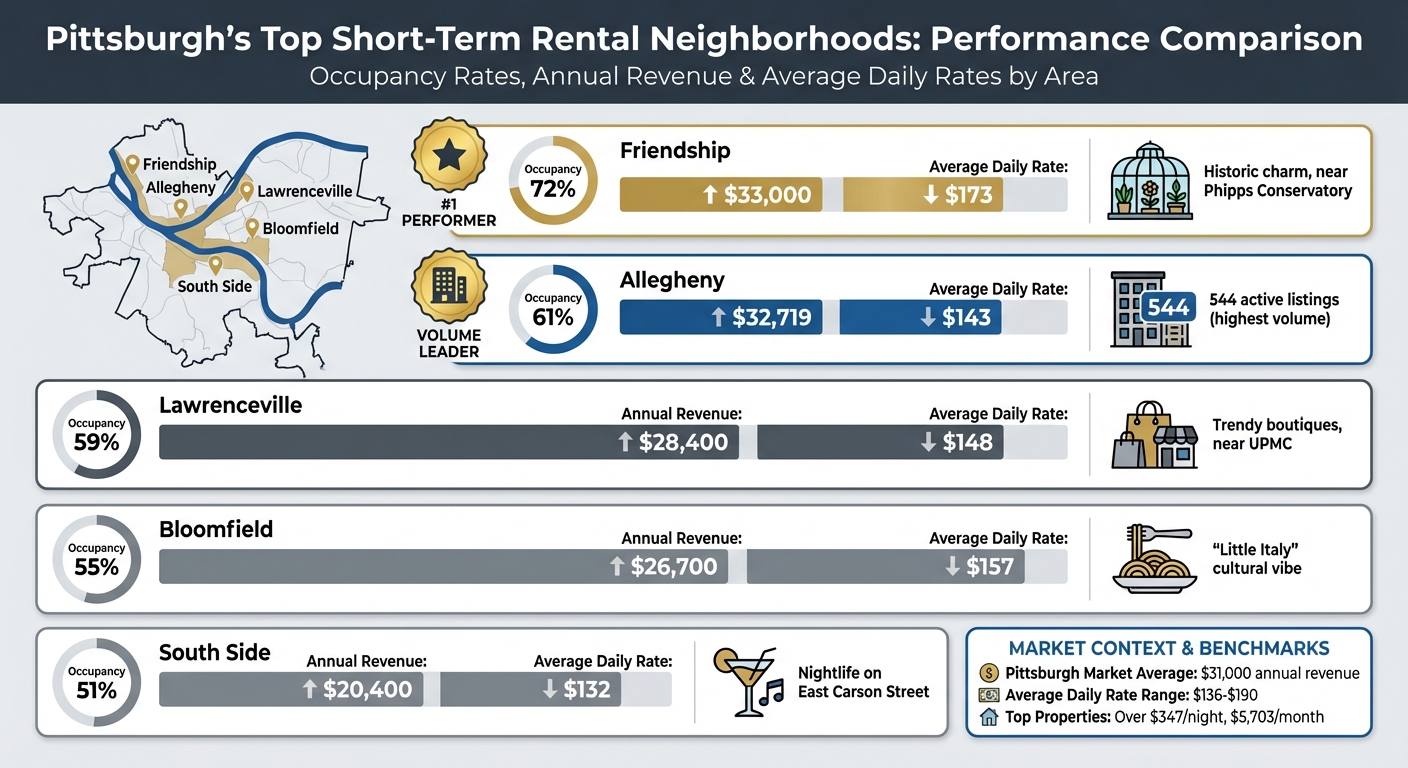
Pittsburgh Short-Term Rental Neighborhoods: Occupancy Rates and Revenue Comparison
Top Neighborhoods by Guest Demand
When it comes to short-term rentals, location can make or break your success. In Pittsburgh, some neighborhoods stand out due to their proximity to major attractions like universities, sports venues, and medical centers. Oakland, for instance, is a hotspot for visitors heading to the University of Pittsburgh and Carnegie Mellon University, making it the city’s academic epicenter [8]. Sports fans flock to the North Shore, drawn by PNC Park and Acrisure Stadium, while the Strip District entices guests with its vibrant food markets and diverse experiences [8].
If you’re looking at numbers, Friendship boasts an impressive 72% occupancy rate and generates $33,000 annually [7]. Its historic charm and proximity to Phipps Conservatory make it a favorite. Lawrenceville isn’t far behind, with a 59% occupancy rate and $28,400 in annual revenue. Its walkable streets, trendy boutiques, and closeness to UPMC facilities make it appealing to both tourists and medical professionals [7]. Allegheny leads in sheer volume, with 544 active listings pulling in $32,719 annually at a 61% occupancy rate [5]. Meanwhile, Bloomfield – affectionately known as Pittsburgh’s "Little Italy" – sees a 55% occupancy rate and $26,700 in annual revenue, thanks to its cultural vibe and nearby hospitals [7]. On the other hand, the South Side, despite its bustling nightlife along East Carson Street, trails with lower figures: a 51% occupancy rate and $20,400 in annual revenue [7].
These neighborhood insights provide a foundation for understanding financial opportunities and navigating local regulations.
Occupancy Rates and Revenue Data by Area
Across Pittsburgh, the average daily rate (ADR) falls between $136 and $190, with median annual revenue sitting around $31,000 [5][8]. High-performing properties can command rates of over $347 per night, bringing in more than $5,703 monthly [8].
| Neighborhood | Occupancy Rate | Annual Revenue | ADR |
|---|---|---|---|
| Friendship | 72% | $33,000 | $173 |
| Allegheny | 61% | $32,719 | $143 |
| Lawrenceville | 59% | $28,400 | $148 |
| Bloomfield | 55% | $26,700 | $157 |
| South Side | 51% | $20,400 | $132 |
October is the revenue champion, driven by fall tourism and local events, while February tends to slump [5][8]. Interestingly, nearly 40% of listings in the city now require a minimum 30-night stay, catering to corporate travelers and professionals on extended visits [8]. One-bedroom rentals dominate the market, accounting for 33% of listings, and a whopping 84.3% of active rentals are entire homes rather than shared spaces [8].
Before diving in, it’s critical to understand zoning rules to ensure your property is eligible for short-term rentals.
Zoning Maps and Location Restrictions
To legally operate a short-term rental, you’ll need to consult Pittsburgh’s zoning maps. These maps clearly outline residential zones and any restrictions that may apply. A valid Certificate of Occupancy is a must, confirming that your property complies with zoning laws, building codes, and, where applicable, historic preservation requirements.
For confirmation, reach out to the Department of Permits, Licenses, and Inspections at (412) 255-2175. Neighborhoods like Downtown, Lawrenceville, Oakland, Shadyside, and the Strip District enforce specific permit requirements and periodic inspections for short-term rental operators [9]. Partnering with Rank One Stays can help ensure your property meets all compliance and zoning standards from the start.
Property Setup and Guest Optimization
Furnishings and Amenities for Pittsburgh Visitors
Furnishing a rental property goes beyond simply adding furniture. Essentials like high-speed internet, fully equipped kitchens, quality linens, and a variety of entertainment options are the starting point for listings in Pittsburgh [9]. To stand out, tailor your property to meet specific guest preferences. For instance, sports fans will appreciate convenient parking and access to game venues, business travelers look for dedicated workspaces with fast WiFi and smart features, while families visiting universities prefer quiet, cozy spaces with plenty of parking [8].
Safety compliance is a must, but adding thoughtful design elements can elevate your space. Consider incorporating Pittsburgh’s industrial-chic vibe with touches like exposed brick and metal finishes, reflecting the city’s Steel City heritage [2]. A welcome basket featuring local Pittsburgh products is another way to enhance your listing and leave a lasting impression on guests [9].
For budgeting, expect to spend around $15,000–$25,000 to furnish a 2-bedroom condo or $30,000–$50,000 for a 3-bedroom home [11]. Plan to allocate 3–5% of your gross revenue annually for furniture updates, replacing items approximately every 3–5 years [11]. The good news? These expenses are typically tax-deductible in Pennsylvania [10].
A well-thought-out setup like this creates the perfect foundation for a seamless guest experience, which can be further enhanced with professional services.
Turnkey Design and Furnishing Services
Once you’ve decided on the right furnishings and amenities, simplify the design process with turnkey solutions. Many property owners don’t have the time or expertise to source furniture, coordinate deliveries, and stage a space that’s ready to perform as a top-tier listing. That’s where Rank One Stays’ vacation rental design services come into play. From selecting durable, high-quality furniture to designing spaces that appeal to Pittsburgh’s key guest demographics, we handle it all [9].
Our team understands what resonates with Pittsburgh visitors. For example, half of the city’s guests belong to post-2000 generations (Gen Z/Alpha), who prioritize smart home features and reliable WiFi [8]. Additionally, properties with outdoor spaces – like patios, balconies, or rooftop decks offering city views – are particularly popular [2]. By partnering with Rank One Stays in Pittsburgh, you’ll have a guest-ready property from day one, saving you months of trial and error.
Professional Photography and Listing Creation
Once your property is fully furnished and designed, the next step is securing bookings with high-quality visuals and a compelling listing. In a competitive market with 2,210 active listings, professional photography isn’t optional – it’s essential [8]. The impact is clear: top-performing listings with outstanding visuals achieve occupancy rates of 82% or higher, compared to a median rate of just 48% [8]. These properties also generate over $5,703 in monthly revenue, more than twice the typical earnings of $2,309 [8].
Professional photos showcase your property’s unique features, such as dedicated workspaces, hot tubs, or EV chargers, while accurately representing its layout and size. This is especially important since 84.3% of Pittsburgh listings are entire homes, where guests expect privacy and ample space [8]. With an average booking lead time of 38 days – stretching to 56 days for May stays – having a polished, professional presentation can make all the difference [8].
At Rank One Stays, professional photography and listing optimization are included in our full-service management package. We know how to highlight your property’s standout features, craft engaging descriptions, and update photos seasonally to align with peak booking months like October and June [8]. This meticulous attention to detail is why our properties consistently outperform market averages.
sbb-itb-103bddb
Pricing Strategies and Revenue Management
Getting your pricing right is essential for boosting your Pittsburgh rental’s ROI. It’s one of the biggest factors in ensuring the success we’ve discussed earlier.
Adjusting Prices for Pittsburgh Events and Seasons
Pittsburgh’s rental market is heavily influenced by the seasons. For instance, October is the peak month, with average monthly revenues soaring to $3,933, while February dips to just $1,653 [8]. High-demand periods like October, June, and August are fueled by events such as professional sports at Acrisure Stadium and PNC Park, university activities at Pitt and CMU, and festivals like Little Italy Days in Bloomfield and the Deutschtown Music Festival [14,15]. During these times, daily rates often climb to $211, compared to $153 during the slower months of January through March [8].
Booking lead times also vary significantly. May stays, for example, are typically reserved 56 days in advance, whereas January bookings average just 21 days ahead [8]. Fall bookings generally require about 47 days of lead time, while winter averages closer to 26 days. What does this mean for you? Pricing your rentals higher well ahead of busy seasons like spring and fall, and lowering them closer to arrival dates during winter, can help you get the most out of your property. In neighborhoods like the North Shore and South Side, you can often charge even more during Steelers home games or big concerts [7].
These patterns make a strong case for using dynamic pricing tools to capture every revenue opportunity.
Dynamic Pricing Tools and Revenue Impact
Manually adjusting rates for multiple properties can be a daunting task. This is where automated revenue management tools come in, making a noticeable difference in earnings. In Pittsburgh, properties in the top 10% of the market that use dynamic pricing tools bring in over $5,703 per month – more than double the market median of $2,309 [8].
Rank One Stays’ vacation rental management system in Pittsburgh is a prime example, delivering 38% more revenue than the market average. It achieves this by using real-time rate adjustments based on demand, competitor pricing, and local events [13]. The platform is designed to align with Pittsburgh’s booking trends, accounting for longer lead times in the fall (around 47 days) and shorter ones in the winter (about 26 days), ensuring your rates remain competitive. Unlike Airbnb’s Smart Pricing, which tends to undervalue listings by 15–25%, professional revenue management tools focus on maximizing your profits [12].
While dynamic pricing tools are a game-changer, the way you manage them can further influence your revenue.
DIY vs. Professional Revenue Management
Managing pricing on your own involves constant tracking of local events, competitor rates, and seasonal fluctuations. You’ll need to calculate a price floor (monthly expenses divided by 30 days) and adjust for demand spikes manually [12]. This approach not only demands significant time but also increases the risk of missed opportunities.
| Feature | DIY Pricing Management | Professional Revenue Management |
|---|---|---|
| Revenue Performance | Often undervalued by 15–25% via platform tools [12] | Generates 38% above the market average [13] |
| Time Investment | High; requires constant manual updates [12] | Fully automated and managed [13][14] |
| Accuracy | Based on limited data and manual comparisons [12] | Data-driven with real-time market analysis [13] |
| Peak Season Optimization | Requires manual event tracking and rate changes | Automatic adjustments for local events and demand [8] |
With professional management, you can eliminate the guesswork. However, it is important to ask the right questions before hiring a manager. Rank One Stays takes over the entire process, from maximizing October’s peak rates to fine-tuning February’s promotional pricing. This allows you to step back and focus on expanding your portfolio instead of spending time crunching numbers.
Self-Management vs. Professional Management
Deciding how to manage your Pittsburgh rental is a crucial step in ensuring its success.
Common Challenges of Self-Management
Managing a short-term rental in Pittsburgh on your own can be a demanding task. For starters, the city requires you to be available 24/7 as a local contact for handling guest concerns [3]. That alone can be a huge commitment.
Then there’s the maze of regulatory requirements. You’ll need to navigate Pittsburgh’s mandatory registration process, schedule safety inspections to meet fire and structural standards, and stay on top of tax compliance [3][4]. Missing any of these steps? That could lead to fines, which can quickly eat into your profits.
On top of compliance, the operational side of things adds to the workload. You’ll need to arrange professional cleaning after every checkout (typically $50–$100 per booking), handle maintenance issues as they arise, and stay mindful of neighborhood-specific rules like parking permits and trash schedules to avoid penalties. And don’t forget the ongoing monthly expenses: utilities ($150–$300), maintenance ($100–$200), and insurance ($50–$100) [3]. Keeping track of all this can feel like a full-time job.
These challenges highlight why many owners opt for professional property management services.
Full-Service Management with Rank One Stays
If you’re looking to ease the burden, Rank One Stays offers a streamlined, full-service solution. Their professional management service takes care of everything, from guest communication to compliance, for a 10% management fee [15]. And with a 4.93-star rating from over 1,860 guests, they’ve built a solid reputation for quality [15].
The process starts with getting your property ready for the market. Rank One Stays handles professional photography, offers interior design consultations, and provides furnishing solutions [15]. Once your property is ready, it’s listed across major platforms like Airbnb, VRBO, Booking.com, and Expedia. They also synchronize calendars and optimize descriptions to maximize visibility [15].
"Our Pittsburgh short term rental management services start at a competitive 10% management fee. This transparent pricing covers the full spectrum of Airbnb management, from guest communication and dynamic pricing to professional cleaning coordination and 24/7 support."
– Rank One Stays [15]
Rank One Stays also manages all compliance requirements, ensuring your property stays in line with Pittsburgh’s regulations and tax laws [15]. They provide 24/7 guest support and have a team of vetted maintenance professionals ready for any repairs. Owners even get access to an online portal to track bookings, revenue, and block personal dates [15].
The results speak for themselves. A 3-bedroom property in Lawrenceville generated $108,000 in annual revenue with 84% occupancy and a $362 average daily rate. Meanwhile, a 4-bedroom property in the South Side brought in $122,000 annually with 86% occupancy and a $402 average daily rate. On the North Shore, a 3-bedroom property achieved 91% occupancy and $92,000 in annual revenue [15].
Comparison: DIY vs. Rank One Stays Management
The differences between self-management and professional management become clear when you compare the daily responsibilities and potential outcomes:
| Feature | DIY Management | Rank One Stays Management |
|---|---|---|
| Availability | 24/7 on-call requirement | Professional 24/7 dedicated support |
| Time Commitment | High – managing guest messages, cleaning, and maintenance | Minimal – monitored via an owner portal |
| Compliance | Owner handles permits, inspections, and taxes | Full compliance management |
| Pricing Strategy | Manual adjustments using platform tools | Dynamic pricing algorithms based on local demand |
| Marketing Reach | Limited to one or two platforms | Listed on multiple platforms with synchronized calendars |
| Maintenance | Owner coordinates all repairs | Access to vetted professionals 24/7 |
| Management Cost | No fee (but significant time and direct expenses) | 10% fee |
Here’s the kicker: professionally managed properties in Pittsburgh typically generate 38% more revenue than the market average [15]. Even after accounting for the 10% management fee, you’re likely to earn more while saving yourself a ton of time and stress.
Getting Started with Your Pittsburgh Short-Term Rental
To kick off your short-term rental in Pittsburgh, you’ll need to tackle some essential regulatory steps. Start by registering your property with the City of Pittsburgh. This involves submitting proof of ownership and detailed floor plans[1]. Next, secure a Certificate of Occupancy, which ensures your property complies with local building and safety standards, and obtain a Business License to operate legally[1].
Make sure your property aligns with local zoning rules and tax requirements. Double-check your zoning allowances to confirm short-term rentals are permitted in your area. Then, register with the Pennsylvania Department of Revenue through myPATH to get a tax license, enabling you to collect the 7% occupancy tax (6% for the state and 1% for Allegheny County)[4]. Keep in mind, stricter rules may apply to non-owner-occupied properties, and some residential zones may completely restrict short-term rentals[1].
Safety compliance is another critical step. Install functional smoke and carbon monoxide detectors, and ensure fire extinguishers are easily accessible. Passing safety inspections is required to obtain your Certificate of Occupancy[1]. Additionally, you’ll need liability insurance and must designate a local contact who’s available 24/7 to handle guest emergencies[1].
Once these regulatory hurdles are cleared, it’s time to consider how you’ll manage your rental. Many owners find that professional management services are worth the investment, especially given the complex compliance requirements. Rank One Stays, for example, handles everything from permits to tax registration while managing daily operations. Their clients see properties earning 38% more revenue than the market average, with management fees starting as low as 10%[13]. Partnering with a service like this allows you to focus on your goals while ensuring compliance and profitability are expertly handled.
FAQs
What steps should I take to comply with Pittsburgh’s short-term rental regulations?
To legally run a short-term rental in Pittsburgh, there are a few important steps to follow. Start by securing a rental permit through the city’s Rental Permit Program. This involves submitting an application, passing a property inspection, and ensuring your rental meets Pittsburgh’s building, fire, health, safety, and zoning codes. Keep in mind, permits need to be renewed every year and updated if the property ownership changes.
You’re also required to collect and pay a 7% hotel room rental tax on all bookings. Beyond that, it’s crucial to stay updated on Pittsburgh’s changing short-term rental regulations, including recent adjustments to the city’s ordinances. Make sure to comply with fair housing laws and foster positive relationships within your community – this can go a long way in ensuring your rental’s success.
By managing permits, taxes, and local requirements, you can keep your short-term rental running legally and without any hiccups in Pittsburgh.
What role do zoning rules play in starting a short-term rental in Pittsburgh?
Zoning regulations play a crucial role in setting up a short-term rental in Pittsburgh. These rules dictate where such rentals are permitted and outline specific conditions for operation. In some neighborhoods, short-term rentals might face restrictions or even outright bans. For property owners, it’s essential to ensure their plans comply with local zoning laws to steer clear of potential legal troubles.
Additionally, Pittsburgh mandates that short-term rental properties obtain a rental permit through the city’s Rental Permit Program. This process includes an inspection to verify the property meets safety and zoning requirements. Permits must be renewed every year to maintain compliance. Navigating these regulations and securing the necessary permits are fundamental steps to legally run a short-term rental in the city.
What are the advantages of hiring a professional management service for your short-term rental in Pittsburgh?
Hiring a professional management service for your short-term rental in Pittsburgh comes with plenty of perks. For starters, these services make sure your property meets all local rules and regulations – things like registration, licensing, and safety standards. This not only saves you time but also helps you steer clear of legal headaches. Plus, they handle the nitty-gritty administrative stuff, like securing permits and coordinating inspections, so you can focus on what matters most to you.
On top of that, professional managers know how to boost your rental income. They use market data to set the right pricing and keep your property booked more often. From handling guest communication and property upkeep to screening guests, they ensure everything runs smoothly for both you and your visitors. Their know-how also helps minimize risks, like property damage or operational hiccups, making it easier for you to enjoy a better return on your investment without the stress.