
Airbnb complaints can hurt your rental’s reputation and revenue, but most issues are preventable with the right approach. Here’s what you need to know:
- Top complaints include booking/pricing issues (34.87%), check-in/out problems (14.89%), and cleanliness concerns (25% of U.S. travelers report unclean rentals).
- Scams and misrepresentation (22.27%) frustrate guests; accurate photos and detailed descriptions help.
- Cleanliness and safety complaints (e.g., unwashed linens, broken locks) require professional cleaning and regular maintenance.
- Noise disturbances (73% of guests cite noise as a major issue) can be reduced with quiet hours, noise monitors, and clear communication.
- Refunds and cancellations (74% of complaints) highlight the need for quick responses and clear policies.
- Accessibility and discrimination issues (2.27% for disability access) impact trust; compliance with accessibility standards is key.
Solutions: Invest in professional management, use digital tools for cleaning and communication, and address issues proactively. Services like Rank One Stays offer 24/7 guest support, dynamic pricing, and maintenance to help hosts reduce complaints and boost revenue by 38% on average.
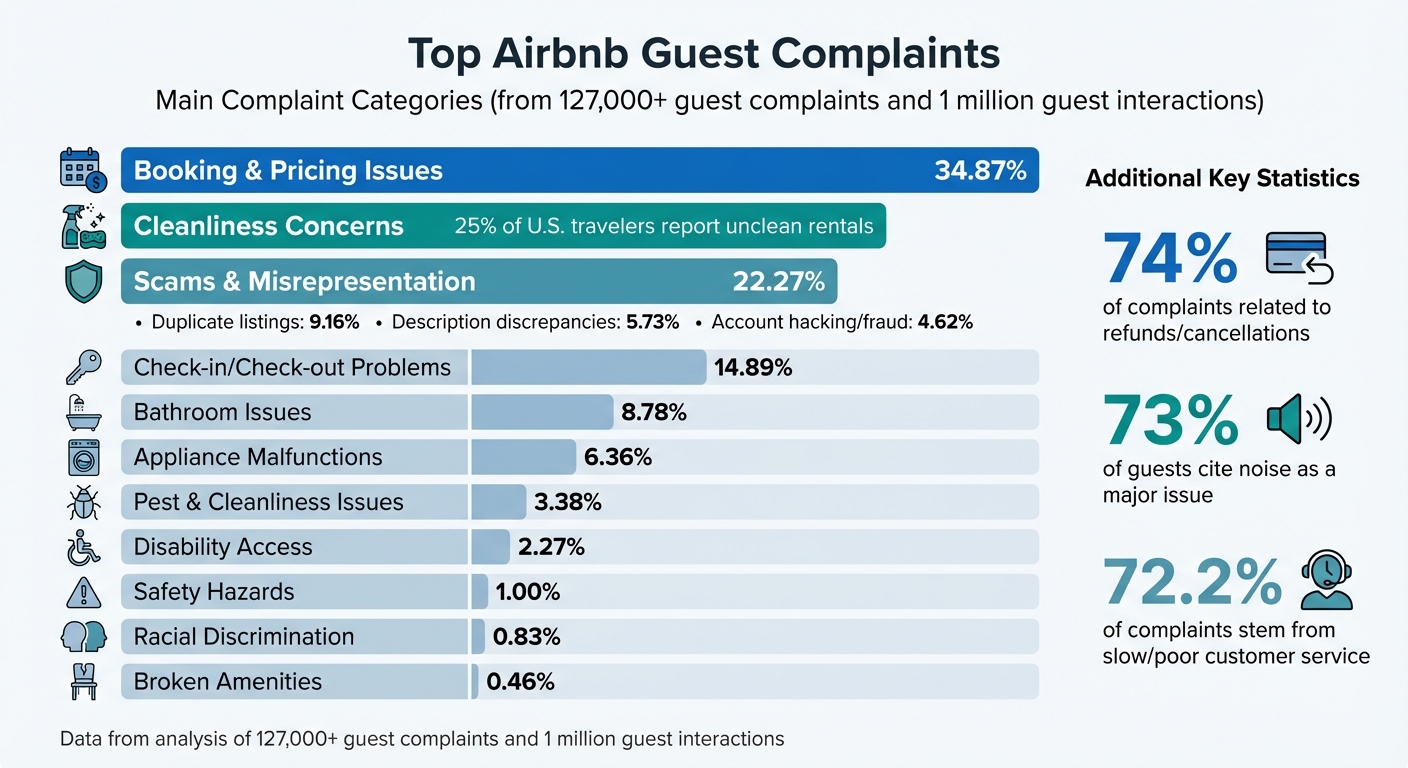
Top Airbnb Guest Complaints by Category with Percentages
Every Airbnb guest complains about these 6 things. Here’s how to fix them.
Scams and Misleading Listings
Fraudulent listings and deceptive property descriptions are a persistent problem in the vacation rental market. A review of over 127,000 guest complaints revealed that 22.27% were related to scams, including fake listings and misleading photos [7]. These issues don’t just frustrate guests – they harm the reputation of honest hosts and erode trust in the platform overall. Let’s take a closer look at these scams and explore practical ways to prevent misrepresentation.
Common Scam and Listing Accuracy Problems
Guest complaints often highlight recurring issues like duplicate listings (9.16%), discrepancies between descriptions and reality (5.73%), and account hacking or fraudulent transactions (4.62%) [7]. As Asher Fergusson, a researcher in the field, puts it:
"The honest hosts should be just as angry as anyone about how poorly Airbnb guests are being treated by their competing hosts because it devalues the whole service and costs them credibility and potential customers" [8].
How to Prevent Scams and Listing Misrepresentation
To tackle these problems effectively, consider these actionable steps:
- Use accurate, unedited photos: Ensure your property photos are current and reflect its true condition. Airbnb’s policy states: "We will ask hosts to remove content if AI or other digital technology has been used to edit flaws, hide damage, add amenities or attributes that are not part of a listing, or otherwise misrepresent the listing" [6].
- Provide detailed descriptions: Be upfront about potential drawbacks like nearby construction, WiFi dead zones, or street noise. Clear expectations lead to happier guests.
- Stay competitive without duplicating listings: Use dynamic pricing tools to adjust rates rather than creating multiple listings for the same property.
- Secure your account: Enable two-factor authentication to protect against hacking and unauthorized charges.
For hosts managing properties in various locations – such as Scottsdale, Denver, Pittsburgh, or South Florida – keeping listings accurate can be particularly demanding. Professional management services can help by regularly verifying amenities, refreshing photos seasonally, and ensuring all details align with guest expectations.
Unsafe and Unsanitary Conditions
Neglecting cleanliness and safety doesn’t just upset guests – it can destroy trust, tank your reviews, and cripple your bookings. Issues like pest infestations, unsanitary conditions, and safety hazards may seem minor, but they leave a lasting mark. Guest complaints show that pest problems and cleanliness issues make up 3.38% of reports, safety hazards account for 1%, and broken or malfunctioning amenities contribute 0.46%. Even one incident can trigger cancellations, refund requests, and a flood of negative reviews. Let’s break down the most common problems guests report.
Most Reported Safety and Cleanliness Problems
Guest feedback reveals that bathroom issues lead the pack, making up 8.78% of reported problems, followed by appliance malfunctions at 6.36% [1]. The biggest cleanliness offenders? Unwashed linens, stained towels, leftover food, hair in sinks or tubs, and mold [2]. Sarah Whitley from Village Realty points out the challenges with appliances:
"Appliances are a big complaint with guests in vacation rental homes because they get so much more use than a residential home – whether it is user error or an actual issue" [2].
Even smaller annoyances, like a slow-draining sink or a broken towel bar, can snowball into serious frustrations if left unaddressed. Safety concerns are equally critical, ranging from broken locks and non-functioning smoke detectors to poorly lit exteriors, which can leave guests feeling uneasy during nighttime arrivals.
Recognizing these recurring issues is the first step toward resolving them effectively.
Steps to Maintain Clean and Safe Properties
To prevent problems from slipping through the cracks, hire professional cleaners who use digital checklists and photo verification to ensure thoroughness. Pay extra attention to overlooked areas like baseboards, under beds, and frequently touched surfaces. Bringing in a third-party inspector before check-in can help catch anything missed [4]. Tea Popaja from PRIME Vacations highlights the importance of presentation:
"The best way to ensure guest satisfaction is by presenting a home that is clean, functional, and visually appealing – one that matches, if not mirrors, the photos shown online" [2].
Routine maintenance is key. Regularly inspect high-use items like smoke detectors, HVAC systems, and pool filters to prevent inconvenient breakdowns. Smart locks with unique codes and motion-sensor lighting can boost nighttime security [3]. For added convenience, adopt a "spare tank" policy by keeping two propane tanks on-site for grills and stock up on essentials like high-quality linens and toiletries [9].
Professional property management can simplify these tasks, helping you keep your rental safe, clean, and welcoming for every guest.
Noise and Neighborhood Disturbances
Noise complaints can wreak havoc on a rental’s reputation. Guests disturbed by excessive noise often leave negative reviews or request refunds. In fact, noisy surroundings are among the top guest complaints, with 73% of guests citing it as a major issue.
What Causes Noise Complaints
Most noise complaints stem from external sources like traffic, nearby construction, or loud neighbors [12]. However, internal factors also play a role. Neighbors of short-term rentals often express concerns about noise more than issues like parking or trash [15]. Airbnb’s Community Disturbance Policy specifically prohibits gatherings or noise that disrupts the surrounding community [11][14].
Certain types of bookings – such as one-night weekend stays, last-minute reservations, or guests with no prior reviews – are more likely to result in noise problems. Tools like Autohost or Superhog can help identify these high-risk bookings before they lead to trouble [12][13].
The financial consequences of unchecked noise can be steep. A single night without proper monitoring can lead to unexpected costs of up to $2,500 [15]. For instance, in 2024, a San Diego host tackled recurring noise complaints by installing decibel monitors and reinforcing quiet hours through guestbooks and welcome messages. This proactive approach stopped late-night disruptions and prevented neighbor complaints altogether [10]. These examples highlight how monitoring and prevention can make a big difference.
How to Handle Noise Complaints
The first step in managing noise issues is clear communication and setting expectations. Be upfront about potential noise sources in your listing description to help guests make informed decisions and avoid surprises [12]. Establish quiet hours – such as 10:00 PM to 8:00 AM – and include them in your house rules, digital guidebooks, and physical property signage [10][12].
Noise monitors can be a game-changer. These devices send automated alerts via SMS or calls when noise levels rise, prompting guests to address the issue. Remarkably, over 70% of noise incidents are resolved with just one automated reminder [12][13][16]. For more persistent issues, systems like Minut offer features such as "Call Assist" and "Guard Assist", where trained professionals step in to handle the situation if automated messages don’t work [13].
In naturally noisy locations, providing white noise machines or earplugs can help guests feel more comfortable [12]. Additionally, setting a minimum stay of two or three nights during holidays or festivals can discourage party-goers from booking [10][12].
For hosts managing multiple properties or dealing with ongoing noise issues, professional management services can be invaluable. Companies like Rank One Stays offer 24/7 guest support to resolve problems before they escalate, ensuring a peaceful environment for everyone involved. Combining these strategies creates a solid framework for reducing guest complaints and maintaining a positive rental experience.
sbb-itb-103bddb
Refund, Cancellation, and Customer Service Issues
Refunds, cancellations, and customer service problems can quickly harm your rental’s reputation. Just like safety measures or noise control, handling these issues promptly is essential to keeping guests satisfied. When guests feel ignored or mistreated, they often leave harsh reviews that can deter future bookings.
Common Complaints About Refunds and Support
A review of 1 million guest interactions found that 74% of complaints were tied to refunds or cancellations, while 72.2% stemmed from slow or poor-quality customer service [1].
Refund disputes often arise from situations like last-minute cancellations, incorrect door codes, missing keys, or misleading property descriptions [17][6]. Hidden fees – such as unexpected cleaning charges or extra guest fees – are another major frustration, leading guests to cancel bookings or demand refunds [3][4].
"When it takes a host even an hour to reply to an urgent matter (such as check-in issues!), this can breed resentment and make the guest a lot less likely to leave you a positive review." – Cait Kontalis [3]
Quick responses are key. Airbnb requires hosts to reply to urgent issues within 1 hour during local daytime hours [6]. Guests must also report problems within 72 hours of discovering them to qualify for Airbnb-mediated refunds [17].
These trends show the importance of having clear refund policies and a proactive approach to guest support.
Improving Refund Policies and Support Systems
Clearly outline your refund and cancellation policies in your listing. Transparency can help avoid disputes before they arise [4][18]. While stricter policies may protect your income, flexible cancellation terms often attract more bookings – find the balance that works for your property and risk level [18].
Sometimes, offering a small gesture like a partial refund ($20–$50) or waiving the cleaning fee can prevent a damaging 1-star review and help rebuild trust [19]. Non-monetary solutions, such as late checkouts, local gift cards, or attraction passes, can also quickly resolve disputes [4].
If you manage a high-volume rental or can’t always respond immediately, consider professional management services. These services provide 24/7 support to handle emergencies and refund requests before they escalate. Tools like digital guidebooks and automated messaging systems can also ensure you maintain response times under an hour [4][3].
"With good communication and responsive replies, any guest complaint can be turned around." – Miles Hobson, Hospitable [5]
Discrimination and Accessibility Complaints
Guest experiences involving discrimination and accessibility issues can deeply affect trust and reputation, even though these complaints make up a smaller share of overall reports – 2.27% for disability access and 0.83% for racial discrimination. Despite the lower percentage, the impact on guest confidence and a property’s standing can be profound.
Discrimination and Accessibility Complaint Data
Airbnb’s Project Lighthouse initiative monitors booking success rates across racial groups. In 2021, guests identified as Black had a booking success rate of 91.4%, compared to 94.1% for guests perceived as white – a gap of 2.7 percentage points [22]. By 2023, this disparity dropped to 1.4 percentage points, with all racial groups achieving success rates exceeding 94% [25].
"Airbnb is built on trust, and we will continue to innovate and design new products and initiatives that increase acceptance and combat bias." – Brian Chesky, Co-founder and CEO, Airbnb [22]
Accessibility complaints often stem from hosts refusing accommodations to guests with disabilities, denying service animals, or inaccurately advertising accessibility features [21]. Airbnb’s nondiscrimination policy prohibits hosts from declining bookings based on factors like race, religion, national origin, disability, sex, gender identity, sexual orientation, age, or familial status [21]. When violations occur, Airbnb’s "Open Doors" policy steps in to assist affected guests in securing alternative accommodations [21].
This data underscores the importance of proactive measures to improve accessibility and inclusivity.
Making Properties More Accessible and Inclusive
To align with accessibility standards, ensure your property complies with ADA Title III regulations. For private lodging facilities with more than five rooms, this includes features like:
- Doorways at least 32 inches wide
- Bed heights between 20 and 23 inches (from the floor to the top of the mattress)
- Securely mounted grab bars in bathrooms [24][23]
In areas like Scottsdale, Denver, Pittsburgh, and South Florida, familiarize yourself with local accessibility requirements to ensure compliance.
Upload clear, detailed photos showcasing accessibility features such as step-free entrances, wide doorways, and grab bars for Airbnb’s verification process [23]. Enabling Instant Book can also help reduce unconscious bias during bookings [22]. Welcome service animals without charging pet fees, as they are exempt from standard pet policies [20]. Additionally, train staff on respectful communication and making reasonable adjustments, such as rearranging lightweight furniture to create wider pathways [20].
"Airbnb has presented a powerful example of how to design products and build a community that is more welcoming for everyone. It’s the right thing to do and it’s good for business." – Laura W. Murphy, President of Laura Murphy & Associates [25]
For hosts managing multiple properties or those unsure about accessibility compliance, partnering with a professional vacation rental management company like Rank One Stays can help ensure your listings meet legal standards while offering inclusive experiences. Addressing these issues not only protects guest trust but also boosts overall property performance.
Professional Management as a Solution
Addressing the challenges of solo hosting, professional management offers a structured approach to reducing guest complaints. From cleanliness issues to delayed responses, many common problems stem from the limited resources of individual hosts.
How Professional Management Reduces Complaints
Professional vacation rental management focuses on staying ahead of potential problems. Routine maintenance, such as checking pool filters or servicing HVAC systems, ensures properties remain in top condition. Plus, 24/7 guest support tackles concerns before they escalate. For example, an analysis of 1 million guest communications revealed that booking and pricing issues make up 34.87% of concerns, while check-in and check-out problems account for 14.89% [1]. Automated check-in solutions, like smart locks with unique codes, not only eliminate key-related hassles but also provide entry logs for resolving disputes [3].
Another key strength is quality control. Cleaners can upload photos as proof of completed tasks, ensuring high standards. This proactive approach not only fixes problems faster but also boosts guest satisfaction.
"With good communication and responsive replies, any guest complaint can be turned around." – Miles Hobson, Hospitable [5]
What Rank One Stays Offers Property Owners
Rank One Stays takes care of every aspect of vacation rental management to prevent complaints from arising in the first place. Their services include:
- 24/7 guest support to handle issues immediately
- Professional housekeeping coordination with photo verification to ensure cleanliness
- Dynamic pricing strategies to maximize revenue while staying competitive
Additionally, they enhance property listings with accurate descriptions and high-quality photos, reducing complaints tied to misrepresentation, which account for 8.35% of guest communications [1].
For property owners, the results speak volumes. Those partnering with Rank One Stays see 38% higher revenue than the market average, with management fees starting at just 10% of rental income. Operating in key locations like Scottsdale, Arizona, Denver, Colorado, Pittsburgh, Pennsylvania, and Lighthouse Point, Florida, the company also offers interior design and staging services to help investors launch cash-flowing properties from day one.
DIY Hosting vs. Professional Management
Here’s how professional management stacks up against DIY hosting:
| Factor | DIY Hosting | Professional Management |
|---|---|---|
| Resolution Speed | Limited by host availability; often slow after hours [4] | 24/7 support ensures immediate responses [4] |
| Maintenance Approach | Reactive – fixing problems as they arise [4] | Proactive – regular maintenance and preventative checks [4] |
| Pricing Strategy | Static or manually adjusted | Dynamic pricing with optimized listings |
| Revenue Performance | Standard market rates | 38% higher revenue on average |
Professional management stands out by addressing issues quickly, preventing problems through structured processes, and offering dedicated support. These advantages are hard for solo hosts to replicate, making it a smarter choice for property owners aiming to enhance both guest satisfaction and revenue.
Conclusion
Tackling Airbnb complaints head-on can lead to better guest satisfaction, glowing reviews, and increased revenue. How you respond to issues often leaves a lasting impression – prompt and effective communication can even turn a potential complaint into a five-star review [9].
"The research clearly demonstrates the business case for proactive issue management: Properties with streamlined operations command higher nightly rates." – Alexander Caravitis, CEO of Hosthub [1]
The data highlights the importance of reliable and proactive systems. For example, adopting preventative measures for high-risk items like HVAC systems and kitchen appliances, along with digital cleaning checklists that include photo verification, can help address common guest concerns efficiently. These frequently reported issues include booking or pricing problems (34.87%), check-in or check-out complications (14.89%), and bathroom-related complaints (8.78%) [1]. These aren’t just nice-to-have practices – they’re essential for maintaining your reputation and keeping occupancy rates high.
If managing these systems feels overwhelming, professional vacation rental management might be the answer. Companies like Rank One Stays handle everything from preventative maintenance and dynamic pricing to round-the-clock guest communication. Their services have been shown to help property owners earn 38% more revenue than the market average, with management fees starting at just 10%. They operate in Scottsdale, Denver, Pittsburgh, and Lighthouse Point. For investors launching new properties, they also offer interior design and staging services.
Whether you choose to self-manage or partner with a professional service, turning complaints into opportunities is a smart strategy for long-term success.
FAQs
How can I avoid common Airbnb complaints like noise and cleanliness issues?
To reduce common Airbnb complaints like noise and cleanliness issues, focus on clear communication and regular property maintenance. For noise concerns, establish clear house rules about quiet hours and acceptable noise levels, and make sure guests are aware of these rules before their stay begins. Tools like noise monitoring devices can be helpful for addressing potential disturbances early on while still respecting guest privacy.
When it comes to cleanliness, make sure the property is professionally cleaned and inspected before every guest arrives. Detailed cleaning checklists can help maintain high standards, and promptly addressing maintenance problems ensures a smooth experience for guests. Additionally, accurately describing your property’s cleanliness and amenities in the listing can help set realistic expectations, reducing potential misunderstandings.
If managing these responsibilities feels like too much, working with a professional service like Rank One Stays can simplify the process. They offer full-service management, handling tasks like cleaning, guest communication, and property maintenance, which can help minimize complaints and improve guest satisfaction.
How can I make sure my Airbnb listing is accurate and avoids misleading guests?
When it comes to your Airbnb listing, accuracy is everything. Guests rely on your description to decide if your property meets their needs, so it’s crucial to provide truthful, detailed, and up-to-date information. Be clear about the type of accommodation, the number of rooms, available amenities, and any unique features. If there are potential downsides – like nearby construction noise or seasonal quirks – mention them upfront.
Photos play a big role too. Use realistic images that genuinely represent your space. Avoid heavy edits or distorted angles that could set unrealistic expectations. Guests appreciate honesty, and accurate photos go a long way in building trust.
Don’t forget to review and update your listing regularly. Things change – whether it’s new furniture, updated amenities, or even temporary issues. Keeping your details current ensures guests know exactly what to expect. Be upfront about any limitations or quirks your property might have and set clear expectations in your descriptions.
Finally, ensure all advertised amenities are in working order. Routine maintenance is essential to match what you’ve promised in your listing. By prioritizing transparency and accuracy, you’ll not only reduce complaints but also encourage positive reviews and repeat bookings.
How can professional property management enhance guest satisfaction and boost Airbnb host revenue?
Professional property management plays a key role in boosting guest satisfaction and driving higher revenue for Airbnb hosts. By ensuring a smooth, top-tier experience for both guests and property owners, these services take care of everything – from fine-tuning listings and adjusting pricing to professional cleaning and round-the-clock guest support. The result? Better reviews and more bookings.
When consistent standards are upheld and guest concerns are tackled proactively, properties tend to climb higher in search rankings. This increased visibility attracts more guests and allows hosts to set competitive prices, leading to higher earnings. For property owners aiming to simplify their workload and achieve better outcomes, teaming up with a reliable management service can make all the difference.