

When hosting on Airbnb or VRBO, understanding how damage claims work is critical to protecting your property with professional Denver vacation rental management. Both platforms have distinct processes, deadlines, and coverage limits.
- Airbnb provides AirCover, offering up to $3 million in damage protection per stay. Claims must be filed within 14 days of checkout, with a detailed escalation process involving guest communication and documentation.
- VRBO relies on a damage deposit system. Hosts collect deposits upfront and file claims within 14 days of checkout, with up to 30 days to submit supporting documentation. Approved claims are paid within 3–7 business days.
Key differences include Airbnb’s higher coverage limit and more complex process, while VRBO’s system is simpler but depends on the deposit amount. VRBO has a higher claim approval rate (68.3% vs. Airbnb’s 56.8%) but fewer claims overall.
Quick Comparison
| Feature | Airbnb | VRBO |
|---|---|---|
| Coverage Limit | Up to $3 million (AirCover) | Up to damage deposit amount |
| Claim Approval Rate | 56.8% | 68.3% |
| Filing Deadline | 14 days from checkout | 14 days from checkout |
| Escalation Deadline | 30 days from checkout | N/A |
| Payout Speed | Varies | 3–7 business days |
Bottom Line: Airbnb offers broader protection with AirCover, while VRBO’s deposit system provides faster payouts and higher approval rates. Choose based on your priorities – coverage or simplicity.
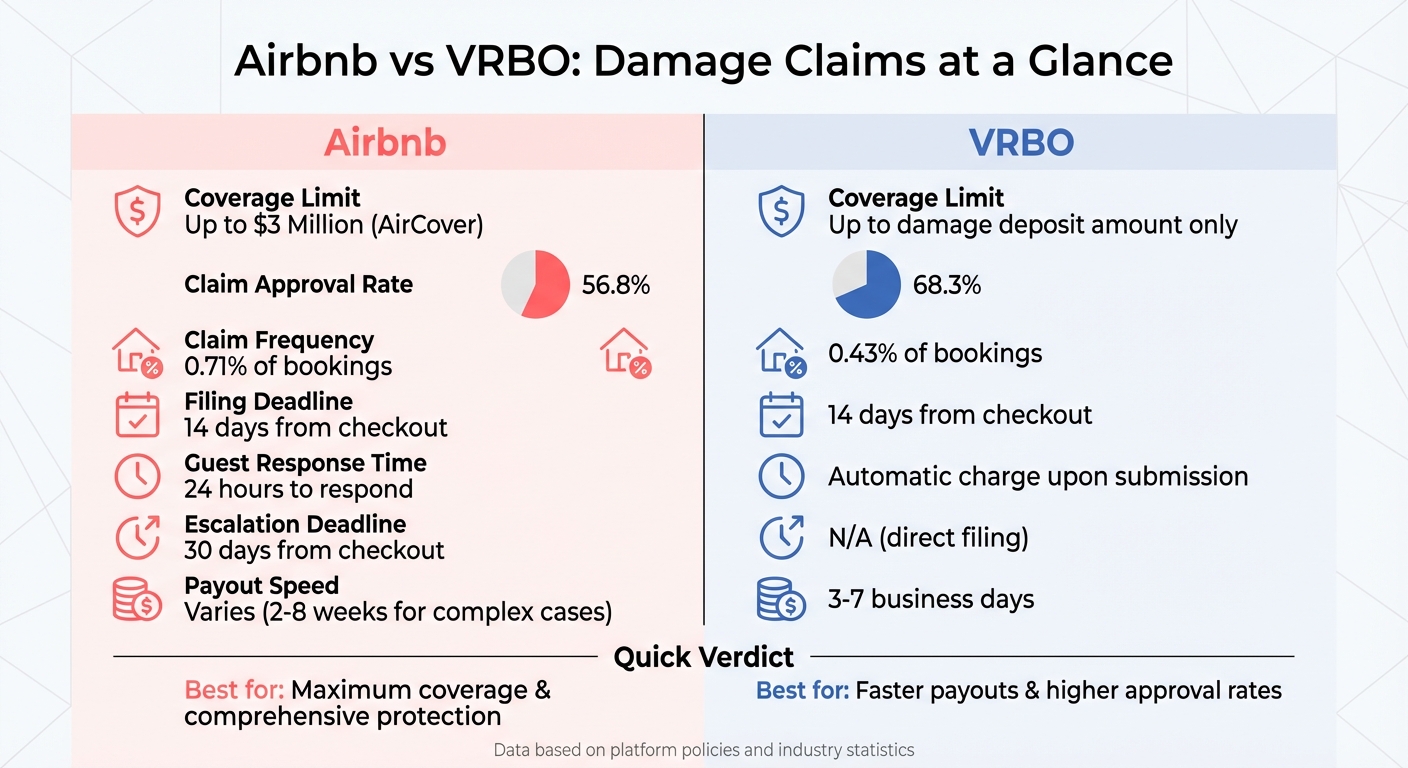
Airbnb vs VRBO Damage Claims Comparison Chart
How To Claim Damage From Airbnb Guest – Real Life Example – Hosting Tips
sbb-itb-103bddb
How Airbnb’s Damage Claim Process Works
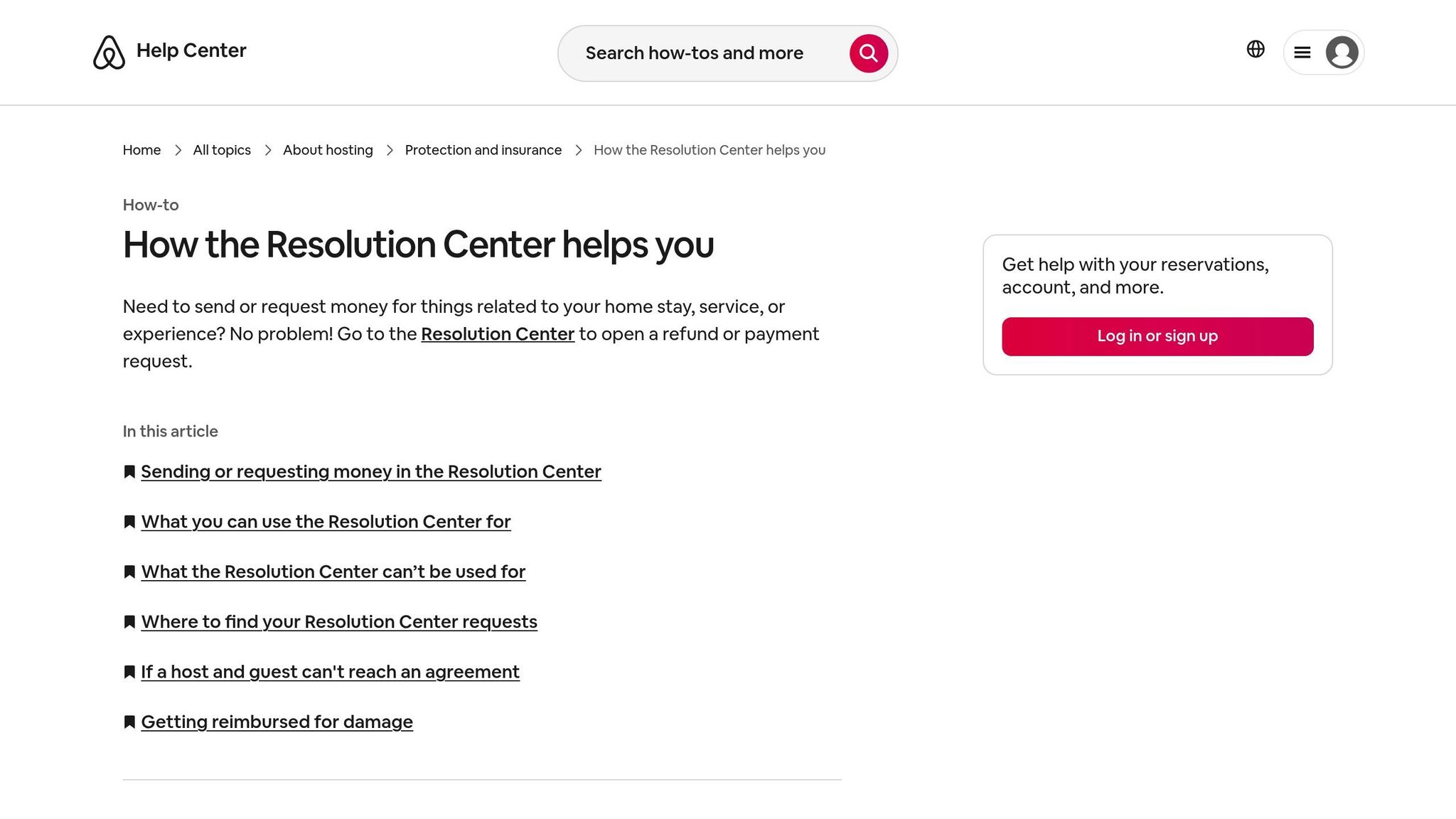
Airbnb’s damage claim process is managed through the Resolution Center, where hosts must follow a set of specific steps within strict timeframes. The process starts with direct communication between the host and guest and can escalate to Airbnb mediation if no resolution is reached. Missing any of the deadlines can result in losing eligibility for compensation.
Filing a Claim Through the Resolution Center
The first step is to document the damage thoroughly. Take clear photos and videos, and gather repair estimates. Use Airbnb’s messaging system to contact the guest and record the issue.
After that, submit a reimbursement request through the Resolution Center within 14 days of checkout. The guest then has 24 hours to respond by either paying in full, offering a partial payment, or declining the request.
If the issue isn’t resolved, you’ll need to file a formal claim by submitting the Host Damage Protection Payment Request Form within 30 days of checkout. This form requires detailed information about each damaged item, including its make, model, purchase date, and original condition. Airbnb will review the evidence provided, but claims can be denied if the documentation isn’t thorough or appears questionable. For damages involving theft or criminal activity, you must also provide a certified police report.
| Action | Deadline |
|---|---|
| Submit initial claim in Resolution Center | Within 14 days of checkout |
| Guest response time | 24 hours after filing |
| Escalate to Airbnb Support | Within 14 days of damage/loss |
| Submit Host Damage Protection Form | Within 30 days of checkout |
Once a claim is submitted, Airbnb’s AirCover program automatically adds an extra layer of protection.
AirCover: Coverage for Hosts

AirCover is Airbnb’s built-in damage protection program, included with every booking at no additional cost. It offers up to $3 million in coverage per stay, protecting hosts against physical damage to their property, furnishings, and personal belongings – even damage caused by pets. It also covers unexpected expenses, such as deep cleaning to remove smoke odors or pet stains.
AirCover even extends to income loss if guest damage forces you to cancel confirmed bookings. It can also cover damage to assets like parked vehicles (cars or boats) on your property. However, it does not cover normal wear and tear, lost cash, or damage caused by natural disasters like hurricanes or earthquakes. For hosts managing properties in cities like Denver or Pittsburgh, understanding these exclusions is key to setting realistic expectations for damage recovery.
Filing Deadlines and Guest Response Times
Timing plays a crucial role in the claims process. Once a claim is filed, guests have 24 hours to respond. If they decline or fail to respond, you must escalate the issue to Airbnb Support within the same 14-day window to remain eligible for AirCover protection.
Smaller disputes are often resolved within a week, while more complex cases involving significant damage may take anywhere from two to eight weeks. Guests also have up to 60 days to appeal any charges after they’ve been billed. For hosts, working with professional property management services can help ensure compliance with these strict timelines and requirements.
How VRBO‘s Damage Claim Process Works
VRBO offers a straightforward way for hosts to handle property damage claims. After a guest checks out, hosts have up to 14 days to inspect the property and submit a claim for damages if necessary [1].
Using VRBO’s Damage Protection System
The process begins by logging into your account, selecting the relevant listing, and locating the guest’s reservation. From there, click Report Damage to provide details about the damage and the amount being claimed. This information is sent directly to the guest [1]. Claims for standard damage deposits are processed quickly, with approved funds typically reaching the host’s account within 3 to 7 business days [1]. VRBO has an approval rate of 68.3%, which is higher than Airbnb’s 56.8%. However, damage claims are less common on VRBO, occurring in just 0.43% of bookings compared to Airbnb’s 0.71% [6].
To support a claim, hosts need to provide clear evidence, such as before-and-after photos, which are often a byproduct of professional vacation rental design, videos taken immediately after discovering the damage, repair estimates, and receipts for any replacements. Communicating with guests through VRBO’s secure messaging system before filing a claim is also recommended. This creates a written record that can be useful if disputes arise. Once a claim is submitted, hosts must ensure all required documentation is completed within the specified timeframe.
30-Day Filing Window
While the damage must be assessed within 14 days, VRBO allows up to 30 days to submit all supporting documentation for some claims [6]. Filing a claim halts any scheduled refund of the guest’s damage deposit. It’s important to note that VRBO doesn’t allow partial withholding of deposits – claims must be handled in one transaction. This makes careful initial inspections essential. The extended filing window is another way VRBO differentiates itself from Airbnb, which has stricter deadlines.
Automatic Guest Charges
One standout feature of VRBO’s system is its automated financial recovery process. If a guest paid with a card, VRBO automatically charges the approved amount to the guest’s payment method once the claim is submitted. As outlined in VRBO’s help documentation:
If a host submits a claim, we’ll send you an email… We’ll apply the charge to your booking payment method on behalf of the host.
Even if the guest’s card is maxed out or expired, VRBO covers valid claims up to the deposit amount. Guests can dispute charges by contacting VRBO support, which triggers a mediation process requiring additional documentation from both sides. For hosts working with professional property management services, this automated process reduces the hassle of chasing payments and simplifies recovery efforts.
Airbnb vs VRBO: Side-by-Side Comparison
Understanding how Airbnb and VRBO handle damage claims can make a big difference in managing costs. Key factors like claim approval rates, deadlines, and documentation requirements influence how quickly you can recover damages.
Claim Approval Rates
VRBO has a higher claim approval rate, approving 68.29% of claims compared to Airbnb’s 56.75% [10]. However, damage claims are rare on both platforms. They occur in just 0.43% of VRBO bookings and 0.71% of Airbnb bookings [10]. As Avada Properties emphasizes:
Damage claims are not the norm, but they happen, so you need to know how to handle them
[10].
Next, let’s look at how filing deadlines can impact the claim process.
Filing Deadlines
Both platforms require action within 14 days of a guest’s checkout. On Airbnb, hosts have 14 days to contact the guest and request reimbursement [3]. If the guest declines or doesn’t respond, hosts can escalate by filing a formal Host Damage Protection Payment Request Form through AirCover within 30 days [3].
VRBO’s process also allows 14 days to file a claim, but this overlaps with the guest review period. This overlap can create risks, as Ryan Drew from RentalRecon explains:
The 14-day review period is a key timeframe to watch as a host… if you request additional funds for damages after a guest has already submitted a review, you risk receiving a negative review as a result
[4].
Documentation Requirements
Documentation is a critical factor in claim approval. Airbnb requires more detailed evidence compared to VRBO. Hosts must submit "Legitimate and Verifiable Evidence", including photos, videos, receipts, and professional repair estimates [5][3]. For damaged items, Airbnb also demands a complete inventory with details like make, model, purchase date, and condition at the time of loss [3]. They explicitly prohibit altered or AI-generated images, and failing to meet documentation standards results in immediate denial [3].
While VRBO also requires photos, receipts, and repair estimates, its documentation rules are less strict. For hosts using professional property management services, maintaining detailed inventories and capturing before-and-after photos can significantly improve the chances of claim approval.
These differences in documentation requirements and deadlines highlight the varying levels of effort involved in filing claims on each platform.
Quick Comparison Table
Here’s a side-by-side look at the key differences between Airbnb and VRBO:
| Feature | Airbnb | VRBO |
|---|---|---|
| Claim Approval Rate | 56.75% [10] | 68.29% [10] |
| Filing Deadline | 14 days from checkout [3] | 14 days from checkout [1][4] |
| Escalation Deadline | 30 days from checkout [3] | N/A (Claim filed directly) [1] |
| Claim Frequency | 0.71% of bookings [10] | 0.43% of bookings [10] |
| Guest Response Time | 24 hours to accept/decline [2] | Automatic charge upon submission [10] |
| Coverage Limit | Up to $3,000,000 (AirCover) [5] | Up to damage deposit amount [1] |
| Payout Speed | Varies | 3–7 business days [1] |
These distinctions set the groundwork for evaluating insurance options and overall risk management strategies.
Insurance and Liability Coverage Comparison
Both Airbnb and VRBO provide $1 million in liability insurance for third-party claims. However, they differ significantly when it comes to protecting hosts from damage to their own property. Here’s a closer look at how each platform handles coverage limits and addresses various types of damage.
Coverage Limits and Damage Types
Airbnb offers AirCover, which provides up to $3 million in protection for guest-caused physical damage. This includes coverage for property, furnishings, cleaning costs (such as pet accidents or smoke odors), and even reimbursement for lost income if guest damage forces you to cancel confirmed bookings [2][3][8].
On the other hand, VRBO does not include a built-in damage protection plan for hosts. As Autohost explains:
Unlike Airbnb, VRBO does not offer a protection plan for the host’s property damage caused by guests. This means that any damage to the host’s property would need to be covered by the host’s own insurance.
VRBO instead encourages hosts to purchase specialized vacation rental insurance from providers like Proper Insurance or CBIZ, as standard homeowner or landlord policies rarely account for the specific risks associated with short-term rentals [9].
Coverage Gaps and Risk Management
Airbnb’s AirCover isn’t without its limitations. It excludes normal wear and tear, loss of currency, natural disasters (like earthquakes or hurricanes), and items that mysteriously disappear during inventory checks [2][8]. Consumables are only eligible for reimbursement if they are clearly labeled as off-limits, locked away, or explicitly mentioned in your house rules [3]. Additionally, the policy doesn’t apply to listings in Japan or bookings made through Airbnb Travel LLC [2].
For VRBO hosts, property damage coverage is entirely absent unless they secure their own short-term rental insurance. This type of policy typically covers risks like fire, theft, and guest-caused damage [11][12]. VRBO also partners with services like Rank One Stays to help hosts find tailored insurance solutions. It’s worth noting that VRBO’s liability policy often acts as secondary coverage, meaning it supplements any existing homeowner or commercial insurance you already have [12].
The table below highlights the key differences between the two platforms:
| Feature | Airbnb AirCover | VRBO |
|---|---|---|
| Host Property Damage Limit | $3 Million [2] | $0 (Not covered by platform) [11][12] |
| Liability Insurance Limit | $1 Million [2] | $1 Million [12] |
| Extra Cleaning (Smoke/Pets) | Included [2] | Not covered [12] |
| Income Loss Coverage | Covered for canceled bookings [2] | Requires a separate policy [9] |
| Vehicle/Watercraft Damage | Covered [2] | Requires a separate policy |
Conclusion: Which Platform Is Right for You?
Deciding between Airbnb and VRBO often comes down to the level of protection and claim management you prefer. Airbnb’s AirCover stands out by offering up to $3 million in host damage protection at no extra cost. This comprehensive coverage includes everything from damaged furniture to parked vehicles and even lost income from canceled bookings [5][3]. On the other hand, VRBO relies on damage deposits set by hosts and doesn’t include built-in property damage protection [1]. If all-encompassing coverage is your priority, Airbnb takes the lead.
Both platforms require hosts to file claims within a strict 14-day window, but their claim approval rates tell a different story. VRBO approves 68.3% of claims and processes payments within 3–7 business days. Meanwhile, Airbnb’s approval rate is slightly lower at 56.8%, and the process includes a mandatory 24-hour response period for guests before escalation [6][1][2][7]. These differences can make navigating claims more challenging, especially when meeting documentation standards.
Gathering proper documentation – like photos, videos, and repair estimates – can be a tedious task, particularly for hosts managing multiple properties or dealing with uncooperative guests. Missing deadlines or submitting incomplete evidence may lead to denied claims [2][3]. Filing claims can also open the door to retaliatory negative reviews from guests during the review window [4].
To sidestep these complications, many property owners turn to a professional vacation rental management company. Rank One Stays takes the hassle out of damage claims for both Airbnb and VRBO. They ensure inspections are conducted immediately after checkout, documentation meets platform standards, and deadlines are never missed. Their team also handles guest communication to reduce disputes and protect your property. On average, property owners working with Rank One Stays earn 38% more revenue than the market average, with management fees starting at just 10%. Their services are available in Scottsdale, Denver, Pittsburgh, and Lighthouse Point.
FAQs
What should I do first if I find damage after checkout?
The first thing you should do is reach out to the guest. Discuss the damage with them directly, share any photos or evidence you have, and let them know you plan to file a claim. Keeping the lines of communication open can help avoid misunderstandings and also serves as proof of your efforts.
After that, log into your account and submit a damage claim through the platform’s official process. This ensures everything is properly recorded and managed in line with their policies.
What proof is most likely to get my claim approved on each platform?
Clear photos and detailed documentation of any damage are essential when dealing with both platforms. On VRBO, the focus is on providing high-quality photos and maintaining clear communication with the guest. On the other hand, Airbnb places more weight on presenting solid evidence and promptly reporting the issue through their Resolution Center. Submitting well-organized and timely proof can greatly improve the likelihood of your claim being approved.
When should I rely on AirCover or a deposit, and when do I need my own insurance?
When it comes to protecting your property, you have a couple of solid options. AirCover or a security deposit can help manage most damages caused by guests. However, for added protection – especially for situations not covered by Airbnb or VRBO – it’s worth looking into your own insurance policy. This can provide extra coverage and even higher liability limits, giving you broader protection and greater peace of mind beyond what the platforms typically offer.