
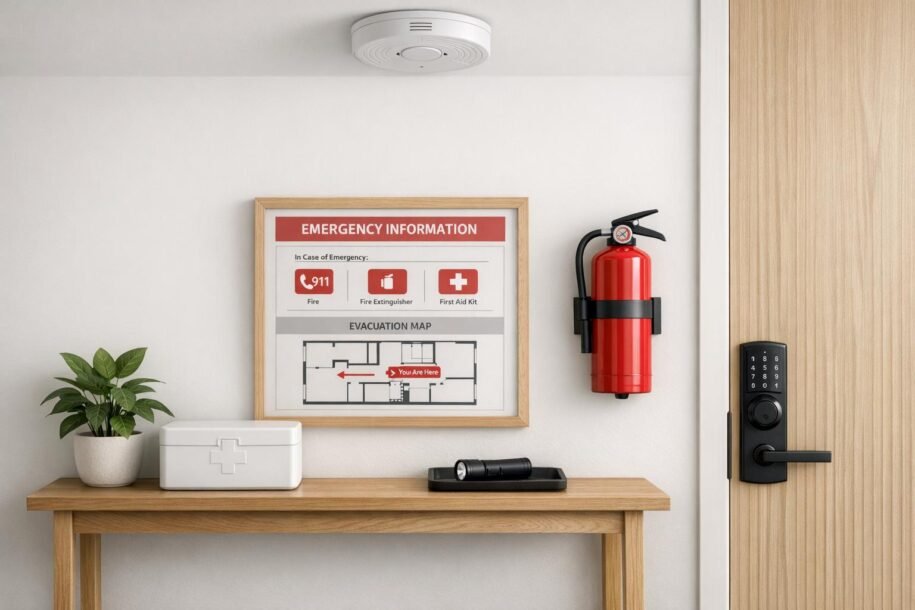
Want to keep your rental guests safe? Here’s the bottom line: Safety isn’t just a legal requirement – it’s what keeps your business running smoothly. From preventing accidents to managing emergencies, this guide breaks down exactly what you need to do to protect guests and your property.
Key Takeaways:
- Slips, trips, and falls cause 83% of vacation rental accidents, with claims averaging $350,000.
- Child safety is critical: Pools were linked to over 150 child deaths in short-term rentals in early 2023.
- Insurance matters: Most homeowner policies don’t cover rentals. Specialized insurance can cost $2,000–$3,000 annually.
- Safety boosts revenue: Clear safety measures can lead to better reviews and higher nightly rates.
Quick Checklist for Safer Rentals:
- Install smoke and CO detectors on every floor and test them monthly.
- Use smart locks for secure, keyless entry.
- Ensure fire extinguishers are accessible and inspected annually.
- Reduce falls with non-slip mats, handrails, and motion-activated lights.
- Maintain pools, hot tubs, and grills with strict safety protocols.
Professional management services can handle inspections, compliance, and maintenance, saving you time and reducing liability risks. Whether you manage one property or many, prioritizing safety protects your guests, reputation, and income.
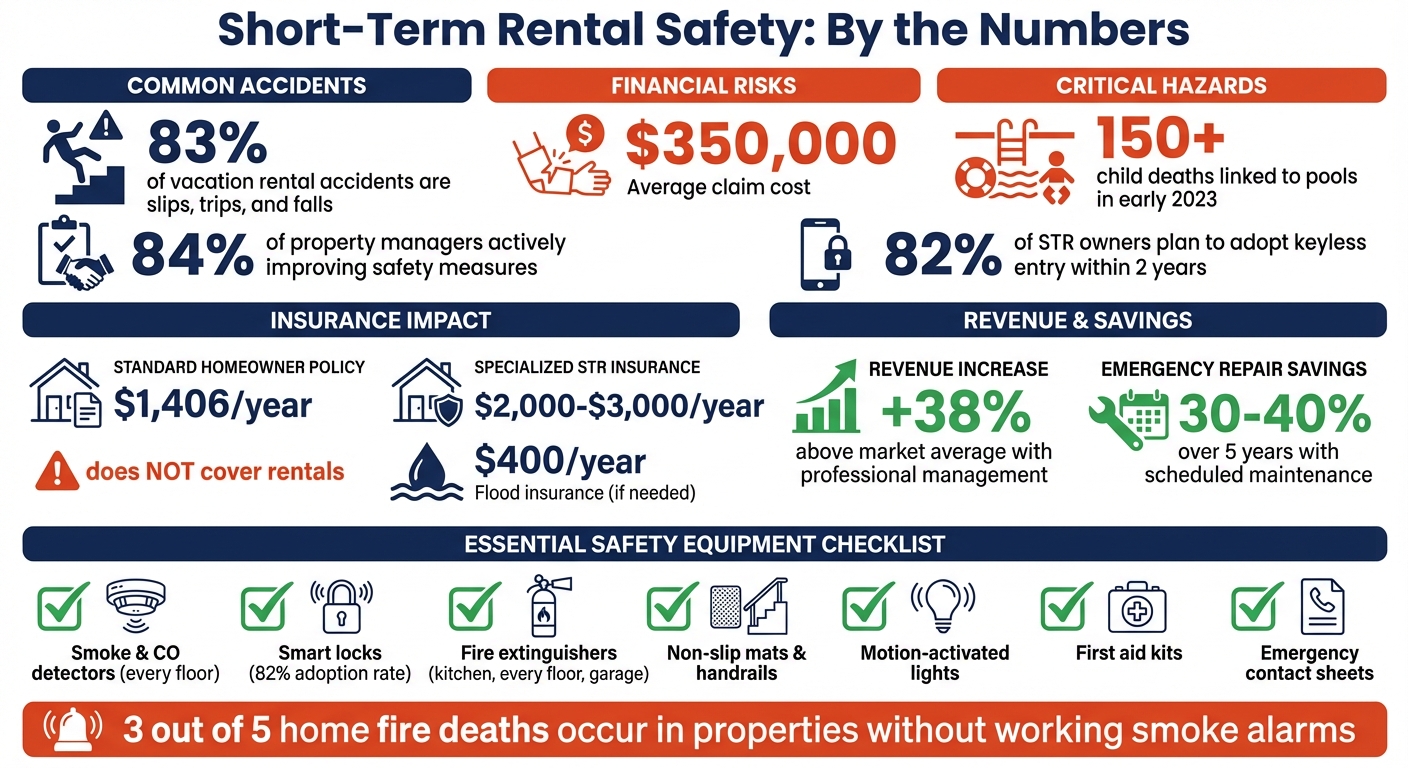
Short-Term Rental Safety Statistics and Essential Equipment Guide
Top 9 Safety Mistakes NEW Airbnb Hosts Make and How to Fix with Safety Expert Justin Ford
sbb-itb-103bddb
Property Design for Guest Safety
The layout of your rental plays a key role in ensuring guest safety. A well-thought-out design can prevent accidents from the moment guests arrive. In fact, over 84% of property managers are actively working to improve safety measures[9]. These design elements complement the safety equipment and emergency protocols discussed later.
Entry Security and Outdoor Protection
Good exterior lighting is essential for preventing both accidents and unauthorized access. Motion-activated floodlights should illuminate all pathways, entrances, and stairs. Take a nighttime walk around your property to confirm that driveways and walkways are well-lit and free of shadows that could pose risks[3][9].
Make sure the address markers on your property are at least 4 inches tall and visible day and night, ensuring emergency responders can locate the property quickly[9]. Trim back any overgrown plants or bushes that could obstruct visibility.
Smart locks are a great way to eliminate the risks associated with traditional keys. About 82% of short-term rental owners plan to adopt keyless entry systems within the next two years[12]. These locks generate unique codes for guests that automatically expire at checkout.
Sasha Barak from Enso Connect explains: "Smart locks simplify STR property management, reduce staff needs, improve guest experience, and open up new revenue opportunities"[12].
Outdoor security cameras placed on porches and along building perimeters can deter intruders. Just be sure to disclose their presence in your listing and house rules[1][5][8]. For outdoor amenities, safety is key: grills should be at least 10 feet away from flammable structures with 9 feet of vertical clearance, and fire pits need at least 21 feet of overhead clearance[3][9].
Check decks and stairs for any signs of rot or structural damage. Guardrails should stand between 36 and 42 inches high, with gaps no larger than 4 inches to prevent children from slipping through[9]. If your rental caters to families, consider adding close-mesh netting or Perspex to the inside of deck railings for added safety. Indoors, similar safety-focused design choices can further enhance the guest experience.
Interior Safety Design
Emergency exits are a must. Each bedroom should have two ways to exit, such as a door and an egress window. These windows should provide at least 5.7 square feet of opening and be no more than 44 inches from the floor[9]. For rooms located more than 20 feet above ground, keep a folding escape ladder under the bed[5][9]. Regularly test all windows to ensure they open easily during emergencies[7][2].
Handrails are critical for stair safety. Install them on at least one side of any staircase with three or more steps. They should be continuous and capable of withstanding a 200-pound force[9][10]. This is especially important for stairs taller than 30 inches, as they can be hazardous for elderly guests or those carrying luggage.
To prevent slips and falls, secure area rugs with non-slip backing. Anchor heavy furniture to walls to reduce the risk of tipping accidents[9][10].
Justin Ford, Director of Safety Programs at Breezeway, emphasizes: "Using sturdy products that are as close to commercial-grade products as possible helps protect guests from mishaps. Use wall anchors and arrange furniture to reduce the risk of something tipping over"[3].
Ceiling fans should not be installed in rooms with bunk beds to avoid head injuries[9][1]. If your property includes bunk beds, ensure the tops of guardrails are at least 5 inches above the mattress to meet federal safety standards[10]. Store cleaning supplies and fire starters in high, locked cabinets, out of children’s reach[9][7][1]. Additionally, install safety gates near stairs and use outlet covers throughout the home.
Fire extinguishers should be mounted 3 to 5 feet off the floor using their provided brackets and placed within 30 feet of cooking appliances[9][10]. Ensure all hallways and staircases are well-lit, ideally with automated or motion-sensor lighting[9][10]. In markets such as Denver vacation rental management or Scottsdale vacation rental management, professional managers often conduct regular safety audits to address these details before guests arrive.
Safety Equipment and Regular Maintenance
Short-term rental properties must be equipped with essential safety devices, such as smoke and carbon monoxide (CO) detectors. These should be installed on every floor, outside all sleeping areas, and in living spaces near gas appliances [13]. According to the Centers for Disease Control and Prevention (CDC), carbon monoxide is an "invisible, odorless, and colorless gas that can be lethal without detection" [14]. Using interconnected alarms is highly recommended – if one alarm is triggered, all detectors in the property will sound simultaneously [13].
Regular testing and upkeep of these alarms are crucial. Test alarms monthly using the test button, and replace batteries every 6–12 months. To stay organized, mark the installation date on each device to ensure timely replacement before they expire. Most smoke and CO alarms last between five and ten years [16]. The CDC also suggests replacing batteries during daylight saving time changes in the spring and fall [14].
Fire safety equipment, such as fire extinguishers, is another key component. Multipurpose extinguishers (Class A, B, and C) should be placed in the kitchen, on every floor, and in the garage [13]. Check the pressure gauge annually to ensure they are fully charged and not expired. Fire extinguishers generally have a five-year shelf life [16]. If you use a one-time discharge extinguisher, replace it immediately after use [8]. To help guests locate safety equipment, place stickers on cabinet doors marking the locations of fire extinguishers and first aid kits [8].
Preventing scalding hazards is equally important. Water heaters should be set to 120°F, which is hot enough for daily needs like showers and dishwashing but safe enough to prevent burns [14]. Annual servicing of water heaters is recommended, along with the installation of smart water sensors to monitor temperature and detect leaks [1]. Other systems, such as chimneys and HVAC units, should also receive professional maintenance every year [14]. This not only reduces risks but also ensures a safe and comfortable experience for guests.
For rental properties managed in areas like Pittsburgh vacation rental management or Lighthouse Point vacation rental management, professional managers often handle these maintenance schedules as part of their service.
| Equipment | Maintenance Task | Frequency |
|---|---|---|
| Smoke/CO Alarms | Functional test (test button) | Monthly [8] |
| Smoke/CO Alarms | Battery replacement | Every 6–12 months [8] |
| Fire Extinguishers | Pressure check and inspection | Annually [13] |
| First Aid Kit | Inventory and restocking | After every stay [8] |
| Water Heater | Professional service/flush | Annually [14] |
Hazard Prevention and Health Standards
Preventing Slips and Falls
Slips, trips, and falls are among the most common injuries in short-term rentals, especially in areas like bathrooms, stairways, entryways, and outdoor pathways [3][17]. The CDC reports that one in five falls results in a serious injury, such as a head injury or broken bone [17].
To reduce these risks, start with the flooring. Use non-slip mats near toilets, tubs, and showers, and add adhesive strips inside bathtubs for extra traction [13][17]. Keep walkways and stairs clear of cords, clutter, and other obstacles [3][4].
Lighting is another key factor. Test your property’s lighting at night to ensure guests won’t need to rely on their phone flashlights [3]. Consider motion-sensor or solar-powered lights for outdoor pathways, parking areas, and entrances [2][13][17]. Indoors, make sure hallways and staircases are well-lit, and replace any burned-out bulbs promptly [13][6].
As a legal expert from Resident Magazine explains, "Reasonable care means taking common-sense steps, like replacing burned-out stair lights, fixing cracked handrails, removing slippery algae, or providing non-slip mats" [6].
Structural upkeep is just as critical. Regularly inspect indoor and outdoor handrails and balcony railings to ensure they’re secure and meet local height codes [1][13][6]. Remove slippery algae or moss from outdoor decks and steps [6]. Check decks, balconies, and docks for loose boards or steps that could pose a hazard [3][6][4]. Property owners are legally obligated to inspect for hazards, address them promptly, and warn guests about any dangers that can’t be immediately fixed [6].
While preventing physical falls is essential, don’t overlook air quality – it’s just as important for guest safety.
Controlling Mold and Air Quality
Keeping indoor humidity levels between 40% and 50% is the best way to prevent mold growth [18]. Mold thrives in damp environments, so maintaining a dry interior is key [18]. Smart sensors can monitor humidity around the clock and alert you before levels become problematic [18].
Ventilation and dehumidification are your best tools here. Install high-capacity exhaust fans with humidistats in bathrooms to automatically remove moisture after showers [18]. In basements or laundry areas, use automated dehumidifiers with continuous drain hoses to eliminate the need for manual emptying [18]. Smart thermostats can help maintain consistent temperatures and circulate air, even when the property is unoccupied, to prevent stagnation [18]. Simple adjustments, like leaving gaps between furniture and walls or using slatted shelves in closets, can also improve airflow [18].
Carbon monoxide (CO) monitoring is another must. CO is an invisible, odorless gas produced by appliances like gas stoves, water heaters, and furnaces [14].
The CDC cautions, "Signs of carbon monoxide poisoning include headaches, weakness, dizziness, nausea, and vomiting. If you or your guests experience these and you suspect CO poisoning… exit the building immediately and call 911" [14].
Schedule annual professional cleaning and inspections for wood stoves, fireplaces, chimneys, and furnaces [14].
Exterior drainage also plays a role in moisture control. Clean gutters regularly and ensure the soil around your property slopes away from the foundation to prevent water pooling [18]. Downspouts should direct water at least 6.5 feet away from the foundation [18]. Use weatherstripping and caulk to seal air leaks around windows and doors, keeping humid outdoor air out [18]. For properties in humid areas, like those managed by Lighthouse Point vacation rental management, these measures are even more critical.
Once slip hazards and air quality are addressed, focus on specific amenities to ensure all aspects of guest safety are covered.
Amenity Safety Protocols
Amenities like pools, hot tubs, grills, and fitness equipment require strict safety measures. Water-related accidents, particularly involving children, are a leading cause of injuries in vacation rentals [19]. Install secure barriers with self-latching gates around pools, post clear rules, and provide rescue tools like life rings and safety poles [19][10].
Hot tubs demand careful maintenance to prevent waterborne illnesses. Keep water chemistry balanced and sanitize after each guest stay [20]. The CDC advises maintaining water temperatures between 100°F and 104°F to avoid burns or fainting [19]. Drain and clean the hot tub every 30 days – or after 4 to 6 guest bookings – and use a plumbing purge product before refilling [20]. Locking covers can prevent unauthorized use by children [19].
| Amenity | Key Safety Protocol | Maintenance Frequency |
|---|---|---|
| Pool | Self-latching gates & depth markers | Inspect water/drains before every stay |
| Hot Tub | Locking covers & 104°F max temperature | Drain/clean every 30 days or after 4–6 stays |
| Grill | 10-foot clearance from buildings | Clean and check after each guest |
| Fitness Gear | Age limits (18+) & usage instructions | Regular mechanical inspections |
Grills and fire pits should always be placed at least 10 feet away from buildings, deck railings, and overhanging branches [19][10][17]. According to statistics, grilling accidents cause an average of 8,800 home fires annually [17]. For fitness equipment, provide clear instructions and post safety warnings near machines. Laminated signs detailing maximum occupancy, emergency shut-offs, and "no solo use" rules can further enhance safety [19][20].
Lastly, keep detailed logs of maintenance tasks, including chemical testing, repairs, and safety checks. These records can serve as a legal safeguard in case of any incidents [20][1].
Emergency Planning and Guest Instructions
Having a clear emergency plan in place can save lives. Guests, especially those unfamiliar with a property, might forget crucial details like the address during a high-stress situation [22].
Emergency Contacts and Evacuation Plans
Make emergency contact information impossible to miss. Place it in highly visible spots such as the refrigerator, entry door, and bedside tables [21]. Always include the property’s full address at the top – this detail can be easily forgotten during a crisis [22].
Your emergency contact sheet should cover the essentials: 911 for emergencies, the nearest hospital (with its address and directions), urgent care facilities, a 24-hour pharmacy, and your direct contact information as the property manager [21]. Expand the list to include numbers for Poison Control, animal control, and the non-emergency police line for less urgent situations [21]. Additionally, provide instructions for shutting off utilities like gas, water, and electricity in case of leaks or other emergencies [21].
"Every property and geographic location is different, so be mindful that guests are not familiar with the area… and, in the event of an emergency, may require your guidance", says Nick Massey, Chief Sales Officer at Proper Insurance [22].
Presentation matters in emergencies. Use bold, large fonts for critical numbers like 911, and organize the information clearly with bullet points [21]. To ensure guests always have access, send a digital copy of the contact sheet via email or messaging platforms before their arrival [21]. For properties that attract international visitors, such as those managed for Lighthouse Point vacation rentals, consider offering the guide in multiple languages [21].
Evacuation planning is just as important. In 2024, the U.S. experienced 27 weather and climate disasters, each causing damages of at least $1 billion [22]. Create a floor plan that highlights two exits from every room and designate an outdoor assembly point where guests should gather after evacuating. Display this map alongside the emergency contact list in common areas like the kitchen and near the main entrance.
| Contact Category | Essential Information to Include |
|---|---|
| Emergency Services | 911 (Police/Fire/Ambulance), non-emergency police line |
| Medical | Nearest hospital (address and directions), urgent care, pharmacy hours |
| Property Support | Host/manager phone number, 24/7 plumber, 24/7 electrician |
| Safety/Hazards | Poison Control, animal control, utility shut-off instructions |
| Location Details | Property address, nearest cross-streets, GPS coordinates |
These steps ensure guests can quickly access help and follow a clear evacuation plan, reinforcing overall safety preparedness.
Safety Guides for Guests
Beyond emergency contacts and evacuation maps, provide guests with detailed safety guides. Share this information through multiple formats: send a digital house manual before arrival and include a printed version in a visible spot inside the property [22]. Visual aids like charts and maps can help overcome language barriers and make instructions easier to understand during emergencies.
The safety guide should highlight the locations of key safety items like fire extinguishers, first aid kits, and flashlights [14]. Include easy-to-follow, illustrated instructions for shutting off utilities and locating emergency supplies such as extra batteries, bottled water, non-perishable food, and flashlights [14].
To build trust, include the dates of your most recent safety checks and battery replacements in the manual [23]. If your property is in an area prone to natural disasters – like Denver vacation rentals that face heavy snow or coastal properties at risk of hurricanes – add a clause in your rental agreement requiring guests to comply with local evacuation orders [22].
Emergency Exit Lighting
Power outages can complicate evacuations, turning them into dangerous situations. Install battery-powered emergency lights throughout the property, or ensure flashlights and spare batteries are easy to find [5]. For multi-story properties, provide emergency fire escape ladders and clearly mark their locations in the safety guide [5]. Lastly, verify all emergency contacts and property details annually to keep your information up-to-date [21].
Insurance and Legal Requirements
After setting up strong safety measures, addressing insurance and legal requirements is a crucial step to protect your rental property from unexpected liabilities.
When you start accepting short-term rental guests, your standard homeowners insurance won’t cut it. At that point, you’re no longer just a homeowner – you’ve stepped into the role of a hospitality business owner. Jason Miller, Founder of Florida All Risk Insurance, explains it clearly:
"The moment you accept your first booking, you are no longer just a homeowner; you are the proprietor of a hospitality business" [25].
Short-Term Rental Insurance
Specialized short-term rental insurance is necessary and typically costs between $2,000 and $3,000 annually – roughly double the average $1,406 for standard homeowners policies [24]. This higher premium covers risks like guest injuries, theft, vandalism, and liabilities tied to features like pools, hot tubs, or bikes [27]. For occasional hosts, some policies start as low as $8 per night [25].
When choosing coverage, opt for Replacement Cost Value (RCV) over Actual Cash Value (ACV). RCV reimburses the full cost to replace damaged items with new ones, while ACV only pays the depreciated value [25]. If your property is in a flood-prone area, such as South Florida, adding flood insurance is essential since standard policies won’t cover storm surge or rising water. Flood insurance typically costs around $400 annually [24][22].
To strengthen your insurance claims, document the condition of your property before and after each guest stay. Use time-stamped photos or video walkthroughs – this evidence is critical for damage claims [25][26][6]. It’s also worth noting that three out of five home fire deaths occur in properties without working smoke alarms, so keeping safety equipment in top shape is vital for both guest safety and legal protection [26].
Safety Audits and Record Keeping
Maintaining a written safety log can help shield you from liability claims. Record every smoke detector test, battery replacement, and fire extinguisher inspection, as this demonstrates you’ve exercised “reasonable care” [26]. Conduct regular inspections, including quick checks after each guest stay, quarterly deep dives, and seasonal audits to tackle tasks like winterizing pipes or servicing HVAC systems [15][26].
| Inspection Type | Frequency | Key Tasks |
|---|---|---|
| Turnover | Between every guest | Test smoke/CO detectors, check locks, replenish first aid supplies, take time-stamped photos [26] |
| Quarterly | Every 3 months | Deep-clean HVAC filters, inspect plumbing for leaks, check furniture stability, test all appliances [15][26] |
| Seasonal | Twice a year | Service HVAC, clean gutters, check weatherstripping, inspect roof and exterior lighting [15][26][5] |
Fire codes and zoning laws can vary significantly depending on your location. While only a small percentage of U.S. cities require professional inspections for short-term rentals, cities like Nashville, Denver, and Austin have strict permit and safety requirements [10][26]. Additionally, check your HOA bylaws or lease agreements to ensure short-term rentals are allowed. Violating these rules could lead to foreclosure or eviction [28][27].
Properties that follow a scheduled maintenance plan save 30–40% on emergency repair costs over five years compared to properties with reactive management [26]. Make sure to replace smoke alarms every 10 years, carbon monoxide detectors every 7–10 years, and fire extinguishers every 5 years [16]. These proactive measures not only meet legal standards but also simplify insurance claims and reduce risks.
Self-Management vs Professional Management
Handling safety compliance on your own requires researching local regulations, performing inspections, and manually tracking maintenance tasks. On the other hand, professional management companies can take care of these responsibilities, offering expertise and automated systems that minimize liability.
| Feature | Self-Management | Professional Management |
|---|---|---|
| Inspection Frequency | Often reactive or between stays [26] | Scheduled quarterly and seasonal audits [15] |
| Record-Keeping | Manual logs and photos [26] | Automated platforms for tracking and compliance [10][16] |
| Compliance | Owner researches local laws independently [1] | Dedicated teams for regulatory and fire code adherence [26] |
| Insurance Claims | DIY evidence gathering [5] | Professional documentation and claims support [10] |
In cities with evolving regulations, like Denver or Pittsburgh, professional management services – such as those from Rank One Stays – can ensure your property remains compliant while also reducing legal risks and optimizing revenue. These services handle everything from maintaining safety logs and conducting audits to managing all compliance paperwork.
Professional Management for Guest Safety
Managing guest safety on your own can feel like a never-ending task – constant updates, regular inspections, and the need for quick action during emergencies. Professional management companies take these responsibilities off your plate, while also boosting your revenue and reducing liability risks. Their approach combines seamless safety practices with rigorous inspections and documentation, which we’ll explore further in this guide.
Around-the-Clock Support and Repairs
Handling safety issues at all hours is no small feat. Professional managers provide 24/7 support and coordinate repairs quickly to address safety concerns before they escalate. Imagine a smoke detector failing in the middle of the night or a guest reporting a gas smell – companies like Rank One Stays ensure these emergencies are handled immediately. They maintain open communication channels with guests and work with trusted contractors to resolve issues promptly, keeping your property safe and your guests reassured.
Safety Compliance and Documentation
Staying compliant with local fire codes, zoning laws, and accessibility standards is a job in itself – especially in cities like Denver and Pittsburgh where regulations change frequently. Amanda Martins, VP of Product at Safely, explains, "meeting safety codes protects guests and minimizes liabilities" [29]. Professional managers ensure your property adheres to these evolving standards. They also maintain detailed records, including time-stamped inspection photos, maintenance logs, and guest communication histories. This documentation not only ensures compliance but also creates a solid legal trail that can be invaluable during disputes or insurance claims.
Higher Revenue with Lower Risk
Professional management doesn’t just keep your property safe – it also improves your bottom line. Owners working with Rank One Stays report earning 38% more revenue than the market average. Why? Because well-maintained safety features lead to better guest reviews, higher occupancy rates, and the ability to charge premium prices. Additionally, documented compliance and swift repairs build trust with guests, directly impacting profitability.
Conclusion
Guest safety is a continuous effort that influences every aspect of your short-term rental business. From smart locks and interconnected smoke detectors to clear evacuation plans and specialized insurance, every measure contributes to safeguarding your guests and your property. As Justin Brodin, Chief Marketing Officer at Proper Insurance, aptly states:
"A safe guest is a happy guest, and a happy guest is more likely to leave positive reviews and return for future stays" [11].
These efforts not only provide peace of mind but also protect your investment, creating a strong foundation for effective safety management.
Prioritizing safety does more than prevent liability issues – it enhances your reputation. Properties with robust safety protocols are more likely to gain trust and attract repeat bookings. In fact, professionally managed rentals with documented safety measures can generate up to 38% more revenue [30].
For many owners, staying compliant with changing fire codes and zoning regulations – especially in cities like Denver and Pittsburgh – can feel overwhelming. This is where professional management becomes invaluable. Companies like Rank One Stays offer systematic safety audits, maintain compliance records, handle 24/7 emergency repairs, and provide guests with clear safety guidelines. Their comprehensive approach ensures every safety aspect is addressed.
Whether you choose self-management or professional support, strong safety protocols are essential. Safety builds trust, and trust drives revenue. Every working fire extinguisher, every well-lit pathway, and every thorough inspection protects your guests – and strengthens your business.
FAQs
What safety items are legally required for my short-term rental?
In the United States, short-term rental properties must include certain safety essentials by law. These include smoke detectors and carbon monoxide detectors, which should be installed outside of each sleeping area. They need to be tested regularly to ensure they have working batteries. Additionally, fire extinguishers should be easily accessible, particularly in areas like kitchens and near fireplaces. It’s crucial to ensure all these devices comply with local safety regulations and are well-maintained to prioritize guest safety.
How do I create a simple emergency plan guests will actually follow?
To build a solid emergency plan, start by ensuring all exit routes on your property are clearly marked and free of obstacles. Install and maintain essential safety devices like smoke detectors and carbon monoxide alarms. Provide guests with a written emergency guide that includes step-by-step instructions for handling fire, medical issues, and other potential hazards. Place this guide where it’s easy to find – like in a guest binder or as part of a digital welcome message.
Don’t forget to routinely test alarms, inspect signage, and keep emergency supplies, such as first aid kits, well-stocked. These small but crucial steps can help ensure your guests are prepared for unexpected situations.
Do I need short-term rental insurance if I already have homeowners coverage?
Yes, having short-term rental insurance is essential, even if you already have homeowners insurance. Standard homeowners policies typically don’t cover damages or liabilities that arise from short-term rentals. This gap in coverage could leave both your property and your guests at risk. A specialized short-term rental policy addresses these rental-specific risks, ensuring you’re protected and providing added peace of mind.