

When hiring an Airbnb management company, expect to share 15% to 40% of your rental income. This percentage covers services like guest communication, cleaning coordination, and pricing management. The exact fee depends on your property type, location, and service level. For example:
- Basic services (e.g., guest communication): 10–15%
- Standard services (e.g., cleaning, maintenance): 15–25%
- Premium services (e.g., marketing, management across multiple locations): 25–40%
While percentage-based fees align the manager’s incentives with your property’s performance, some companies offer flat fees or hybrid models for cost predictability. Flat fees range from $300 to $800/month, while hybrid models combine a base fee with a smaller percentage.
Key Takeaway: Understand all costs, including hidden fees, and calculate your Effective Take Rate (ETR) to gauge your true expenses. A transparent management partner can maximize your revenue while saving you time.
Common Revenue Split Models in the U.S.
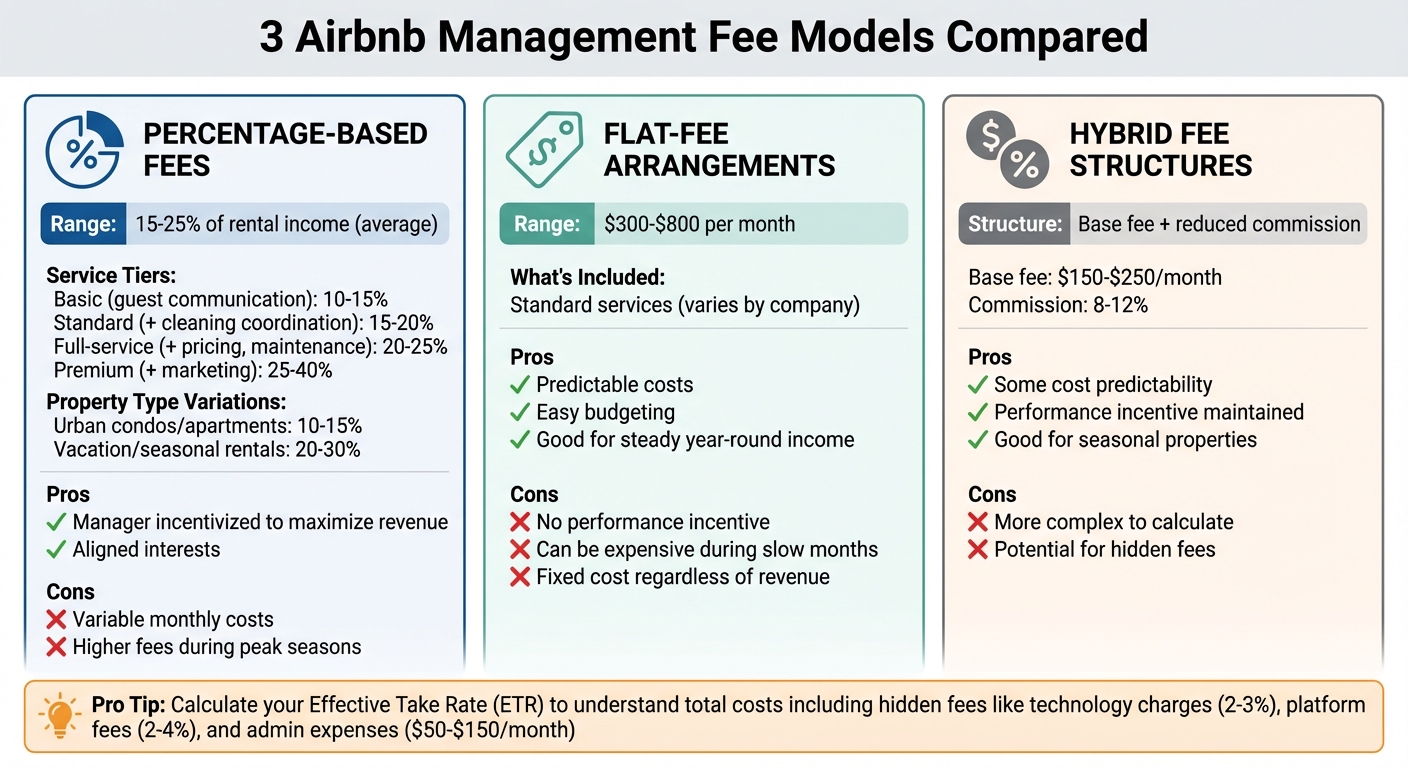
Airbnb Management Fee Structures and Revenue Split Comparison
Understanding how different fee structures work can help you evaluate management costs effectively. Most companies in the U.S. rely on one of three main models. Each offers distinct advantages depending on your property’s needs and your financial goals. Let’s break them down.
Percentage-Based Fees
This is the most commonly used model across the country. Here, managers take a percentage of your gross rental income as their fee. According to Scott Sage, Senior Vice President of Marketing & Customer Experience at AirDNA:
On average, Airbnb management companies charge between 15% to 25% of rental income [3].
The exact percentage depends on the level of service provided:
- Basic guest communication: 10–15%
- Standard service (including cleaning coordination): 15–20%
- Full-service management (pricing, maintenance, etc.): 20–25%
- Premium packages with marketing: 25–40% [5]
For urban condos and apartments, fees typically range from 10–15%. Vacation or seasonal rentals in areas like Denver or Scottsdale often see higher rates, around 20–30% [7]. This model aligns the manager’s incentives with your property’s performance – better results mean higher earnings for both parties. Still, some owners may prefer a more fixed-cost approach.
Flat-Fee Arrangements
Flat fees involve paying a set monthly amount, regardless of how much revenue your property generates. These fees usually range from $300 to $800 per month for standard services [5]. This model provides predictable costs, making it ideal for owners with steady, year-round income or those who prefer simplified budgeting.
However, there’s a catch: managers under this model don’t have a direct incentive to maximize your bookings. During slow months, a flat fee – say $500 – can feel steep if your revenue is minimal. For some, a hybrid approach might offer the best of both worlds.
Hybrid Fee Structures
Hybrid models combine elements of both percentage-based and flat-fee systems. Typically, you’ll pay a small base fee (around $150–$250 per month) along with a reduced commission rate (usually 8–12%) [5]. This setup provides some cost predictability while still encouraging managers to boost performance.
This model works especially well for owners with properties that see seasonal fluctuations or for those managing a mix of property types. However, be mindful of additional fees that might not be immediately obvious. To get a clear picture, calculate your Effective Take Rate (ETR) to understand the total cost [8].
sbb-itb-103bddb
What Affects Revenue Split Percentages
After breaking down common fee models, it’s important to understand what drives those revenue split percentages. Several factors influence these rates, and knowing them can help you manage expectations and negotiate smarter.
Location and Market Conditions
Where your property is located has a huge impact on management fees. For instance, urban condos in big cities often see lower rates, typically around 10–15%. Why? These properties are easier to book and maintain, and the high density of properties creates competition among management companies, which pushes fees down [2][7].
On the flip side, vacation rentals in seasonal hotspots – think Scottsdale or mountain towns near Denver – operate under different dynamics. Here, fees can jump to 20–30%. The reason? Managers need to balance the slower off-season with the heavy workload during peak tourist months [2][7].
Regulations also play a part. In areas with strict licensing rules, tourism taxes, or complicated permits, management companies charge more to cover the time and effort spent on compliance [9]. For remote or international properties, fees can climb as high as 40% because managers handle all the local logistics that owners can’t oversee themselves [1].
Property Type and Size
The kind of property you own also shapes your management costs. Smaller condos or apartments are easier to maintain, so fees are generally lower. In contrast, single-family homes or luxury properties demand more effort – interior design and staging, landscaping, pool upkeep, specialized cleaning – which leads to fees in the 15–25% range [2].
"Smaller condos or apartments are usually easier to handle, so management fees tend to be lower. Larger homes or luxury rentals, on the other hand, often require more work… which naturally increases the cost" [2].
Revenue potential also plays a role. Globally, houses and villas generate an average of $130 in revenue per available rental, compared to $80 for apartments and condos. While the higher revenue is appealing, it comes with increased operational demands, which drives up management fees [10].
Services Included in Management
The scope of services offered by a management company is often the biggest factor in determining fees. Basic packages that cover guest communication and listing creation usually cost 8–15%. If you add services like cleaning coordination, maintenance, and quality checks, fees rise to 15–25% [5][3].
Be mindful of hidden costs. A company might advertise a 20% fee, but additional charges for technology (2–3%), platform fees (2–4%), and admin expenses ($50–$150 monthly) can significantly increase your actual rate [6]. Properties with complex amenities – like pools, hot tubs, or outdoor kitchens – also require more intensive management, which justifies higher percentages [5].
To get a clear picture of your total costs, calculate your Effective Take Rate (ETR). This metric includes all hidden fees and gives you a better understanding of your true expenses.
Benefits of Professional Airbnb Management
Understanding how fees work is one thing, but the real question is whether professional Airbnb management is worth the cost. For many property owners, the answer lies in three key benefits: higher earnings, saved time, and improved property care.
Higher Revenue and Occupancy
Take this example: a February 2026 analysis of a 2-bedroom condo in Denver revealed that self-management brought in $40,917 annually, based on a $165 daily rate and 68% occupancy. After switching to professional management, the daily rate jumped to $205 – a 24% increase – and occupancy rose to 78%. Even after deducting a 20% management fee, the net income grew to $46,728, an annual gain of $5,811 [13].
This boost comes from dynamic pricing tools, multi-platform exposure, and round-the-clock guest support. Property owners working with Rank One Stays reportedly earn 38% more than the market average, with management fees starting as low as 10%.
But the financial perks aren’t the only draw – professional management also saves owners a significant amount of time.
Less Time and Effort for Owners
Managing a property yourself can take 15–25 hours a week. If you value your time at $45–$60 per hour, that’s $2,700–$6,000 a month in lost time [13]. Professional managers handle everything – guest communication, cleaning schedules, maintenance requests – turning what could be a part-time job into passive income [1].
"Professional management means that all of the day-to-day operating tasks are taken off your hands. This saves you time, but it also often makes you more money, because your property listing is optimized." – Wise [1]
For those managing properties in high-demand areas like Scottsdale or Pittsburgh, this hands-free approach is especially appealing.
And there’s another critical advantage: better care for your property and guests.
Better Guest Experience and Property Care
Professional managers ensure high standards with regular cleaning and maintenance checks [11]. According to Airbnb’s Co-Host Network, professionally managed listings earn nearly double what comparable self-managed properties bring in [12]. With expertise in guest screening, 24/7 support, and smooth check-in processes, professional managers protect your property while boosting reviews and repeat bookings [11][8].
"Many owners net more with professional management due to pricing discipline and fewer costly mistakes." – Adam Knight, Founder & CEO, Recreation Stays [8]
Whether your property is in South Florida or another competitive market, the combination of higher revenue, saved time, and better care makes professional management an option worth considering. For owners who want to maximize their property’s potential, professional management delivers results that self-management often can’t match.
How to Choose the Right Management Company
Once you’ve understood fee structures and the factors that influence them, the next step is finding a management company that offers genuine value.
Comparing Fees to Services
A fee advertised as 20% can quickly balloon to 35–40% when hidden charges for technology, platform distribution, and administrative tasks are added in [6]. To avoid surprises, ask upfront: "What is your all-inclusive cost?" and "Are there any fees beyond the management rate?" [6].
Request a sample owner statement that breaks down every deduction. If you see multiple fee types (typically 5–8), it’s often a warning sign [6]. Some companies tack on onboarding fees over $500, early termination fees exceeding $5,000, or mark up repair costs [17][8]. In contrast, companies like Rank One Stays keep things simple, with management fees starting at 10% and no hidden charges.
"Our rate is 20%, all-inclusive. That’s it. No platform fees, no technology fees, no booking fees, no administrative charges, no surprise deductions." – Titan Beach Rentals [6]
Consider the value of your time as well. For example, if a $800 fee saves you 15 hours of work, that’s about $53 per hour [5]. Once you’ve compared fees, take the time to review contracts carefully to avoid unexpected costs.
Reading Contracts and Fee Structures
The language in your contract can have a big impact on your earnings. For instance, does the management fee apply to "Gross" revenue (total guest payment) or "Net" revenue (after Airbnb platform fees and taxes)? This distinction can affect your income by 15% or more [16].
"The wording in your contract states ‘25% of gross rental proceeds’… Proceeds is clearly an amount received NOT an amount paid by the guest." – Mike-And-Jane0, Top Contributor, Airbnb Community [16]
Transparent contracts are essential for protecting your bottom line. Look for agreements that allow flexibility, such as "30-day out clauses" or month-to-month terms, so you’re not stuck with a company that underperforms [8]. Be cautious of vague contracts, poor communication, or companies unwilling to provide detailed financial reports [1]. After reviewing the contract, turn your attention to the company’s track record.
Checking Performance Records
A reliable management company should have a proven track record. Look for metrics like occupancy rates above 75%, guest ratings over 4.8/5, and NOI margins of at least 30% [15]. Additionally, the "Owner Churn Rate" – the percentage of owners leaving a company – should be under 5% annually [15].
For example, in January 2022, TechTape founder John An took over a 12-bedroom mansion in New Jersey that had been earning $185,000 annually under independent management. By using a "mosaic comp set" pricing strategy and leveraging market data, the property’s revenue jumped to $345,000 by the end of 2023 – a 36% year-over-year increase [14].
"Revenue management is implementing a strategy and then consistently shifting and adjusting that strategy based on market conditions and risk comfort." – John An, Founder, TechTape [14]
Performance metrics like these demonstrate whether a company’s strategies are truly effective. For example, property owners partnering with Rank One Stays earn 38% more revenue than the market average. With tools like real-time performance tracking, owners can easily monitor their property’s success. Whether your rental is in Denver or Pittsburgh, choosing a company with proven results and transparent reporting can help turn your property into a source of passive income instead of a constant headache.
Conclusion
Grasping the details of revenue splits is key to turning your vacation rental into a profitable, hands-off investment. In the U.S., most full-service management companies charge between 20% and 35% of total revenue. However, the stated fee often doesn’t tell the whole story. To get a complete picture, calculate your Effective Take Rate (ETR) by factoring in all additional charges [8].
When it comes to fee structures, percentage-based models often create a win-win situation. These agreements align the manager’s earnings with your property’s performance, encouraging better occupancy rates and smarter pricing strategies [5][2]. As Ben Tutewohl from Zenara explains:
"A good manager doesn’t just save you time, they multiply your returns. If you’re paying 20% but earning 40% more revenue, that’s a great deal" [4].
Professional management goes beyond just collecting payments – it includes guest support, cleaning coordination, and handling emergencies [2][1][4]. Wise sums it up well:
"If a qualified property manager can help you earn 30% more in revenue, then their 25% fee is usually well worth it, since they’ll also save you a major amount of time" [1].
These benefits highlight the importance of clear contracts and transparent fee structures. It’s crucial to confirm what’s included in the base fee and what might incur extra costs. Look for agreements that offer transparency in owner statements, flexible terms like a 30-day exit clause, and evidence of proven performance [2][7][1].
With performance-based incentives driving better occupancy and pricing, the right management partner can help turn your property into a steady source of passive income. Whether you’re managing a rental in Scottsdale or South Florida, partnering with a company like Rank One Stays – which offers management starting at just 10% – can help you earn up to 38% more revenue than the market average. Transparent pricing and no hidden fees make it easier to maximize your returns.
FAQs
What’s the easiest way to calculate my Effective Take Rate (ETR)?
To figure out your Effective Take Rate (ETR), use this straightforward formula: divide your net income by your gross revenue and then multiply the result by 100 to express it as a percentage. This calculation helps you understand the portion of your revenue you keep after covering expenses.
Does the management fee apply to gross revenue or net revenue?
The management fee is typically calculated as a percentage of gross revenue – that’s the total income generated before any expenses are subtracted. This approach is a common practice within the vacation rental industry.
Which fee model is best for a seasonal Airbnb: percentage, flat fee, or hybrid?
For Airbnb properties that experience seasonal fluctuations, a hybrid fee model can be a smart choice. This approach combines a percentage of revenue with a flat monthly fee, offering both flexibility and performance-driven incentives.
Percentage-based fees, typically ranging from 10% to 25%, align the property manager’s goals with the owner’s income, as higher earnings benefit both parties. On the other hand, flat fees – usually between $300 and $800 per month – provide predictable costs but may not encourage managers to push for higher revenue during peak seasons.
By blending these two structures, the hybrid model strikes a balance. It ensures steady costs while still motivating managers to maximize income during high-demand periods, making it particularly well-suited for properties with varying rental income throughout the year.