
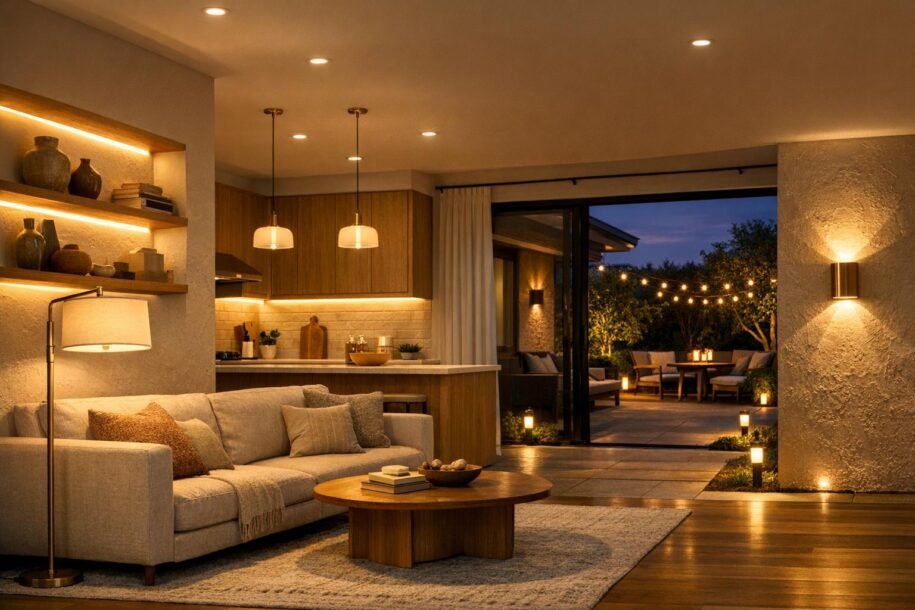
Lighting can make or break a guest’s experience in your vacation rental. The right lighting not only creates a welcoming atmosphere but also boosts bookings and reviews. Here’s what you need to know:
- Three-Layer Lighting Strategy: Combine ambient, task, and accent lighting to create depth and functionality.
- Room-Specific Tips: Kitchens need bright task lighting (e.g., under-cabinet LEDs), while bedrooms benefit from dimmable warm lighting for relaxation.
- Color Temperature Consistency: Use 2700K–3000K bulbs in living areas for a cozy feel, and 3000K–4000K in bathrooms for clarity.
- Dimmable and Remote-Control Options: Allow guests to adjust lighting easily for comfort and convenience.
- Outdoor Lighting: Ensure pathways and entrances are well-lit for safety and appeal.
Investing in proper lighting design not only improves guest satisfaction but also increases your rental’s profitability. Keep reading for detailed room-by-room strategies and practical tips.
Budget DIY Lighting for Furnished Small Rental That Looks Coastal Chic Designer
sbb-itb-103bddb
The Three-Layer Lighting Approach
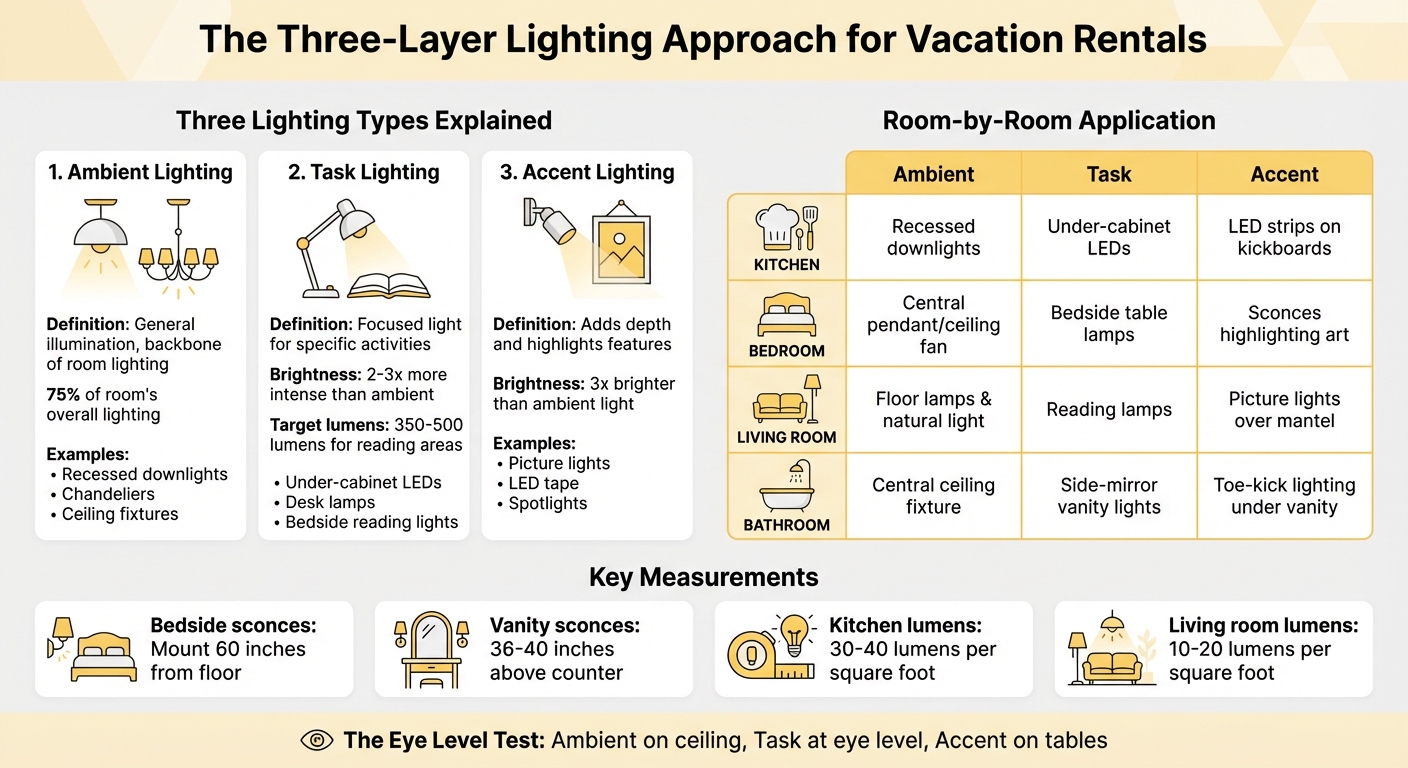
Room-by-Room Vacation Rental Lighting Guide: Ambient, Task, and Accent Strategies
Ambient, Task, and Accent Lighting Defined
Ambient lighting is the backbone of any room’s lighting setup. It provides the general illumination that sets the tone and ensures safe movement throughout the space. Think of recessed downlights, chandeliers, ceiling-mounted fixtures, or even natural daylight streaming through windows. This layer typically makes up about 75% of the room’s overall lighting [11].
Task lighting, on the other hand, focuses on specific activities like reading, cooking, or applying makeup. It’s brighter – about 2 to 3 times more intense than ambient lighting – to minimize eye strain during detailed tasks. Examples include under-cabinet LED strips in the kitchen, desk lamps for workspaces, and bedside reading lights. For a reading area, 350 to 500 lumens is a good target [10].
Accent lighting is where the magic happens. It adds depth and drama by drawing attention to architectural details, artwork, or decorative pieces. To be effective, accent lighting should be at least three times brighter than the surrounding ambient light [10]. Examples include picture lights, LED tape under toe-kicks, or strategically placed spotlights.
Why Layered Lighting Works in Vacation Rentals
Relying solely on a single overhead fixture – often called "The Big Light" – can make a space feel flat and uninviting. Interior designer Maria Lorena puts it bluntly:
"The Big Light… is a vibe-killer. It flattens textures, creates harsh shadows, and turns a curated home into something that feels more like a sterile office" [8].
Cecilia Ramos, Senior Director at Lutron, adds:
"If you were to paint a room with only one typology of light at a singular intensity, it would feel really flat. You wouldn’t feel depth" [9].
Layering light sources changes the game. It adds dimension and gives guests the freedom to adjust the atmosphere – bright and energizing for mornings, soft and calming for evenings. Plus, well-layered lighting makes your property photos pop, helping your listing stand out and potentially boosting bookings. For those looking to perfect this setup, professional vacation rental design services can ensure all three layers work in harmony.
This approach isn’t just about aesthetics; it’s a functional strategy that adapts beautifully to different rooms.
Using the Three-Layer Approach in Different Rooms
The three-layer method shines (pun intended) when tailored to specific spaces. In kitchens, pair recessed ceiling lights (ambient) with under-cabinet LED strips (task) to eliminate countertop shadows. Add LED strips under base cabinets (accent) for a chic nightlight effect that doubles as a safety feature [9].
For bedrooms, a dimmable central fixture or ceiling fan (ambient) can set the mood, while bedside lamps or wall-mounted swing-arm sconces (task) are perfect for reading. For optimal comfort, mount bedside sconces about 60 inches from the floor [12].
In living rooms, floor lamps can soften shadows and create cozy nooks. Picture lights over artwork or within bookshelves (accent) add character and visual interest [9].
Bathrooms demand precise task lighting. Vanity lights placed at mid-face level on either side of the mirror reduce unflattering shadows during grooming [13]. Position sconces 36 to 40 inches above the counter for the best results [12].
To maintain a balanced look, try the "Eye Level Test": place ambient fixtures on the ceiling, task lighting at eye level, and accent pieces like lamps or candles on tables [8].
| Room Type | Ambient Strategy | Task Strategy | Accent Strategy |
|---|---|---|---|
| Kitchen | Recessed downlights | Under-cabinet LEDs | LED strips on kickboards |
| Bedroom | Central pendant/ceiling fan | Bedside table lamps | Sconces highlighting art |
| Living Room | Floor lamps & natural light | Reading lamps | Picture lights over mantel |
| Bathroom | Central ceiling fixture | Side-mirror vanity lights | Toe-kick lighting under vanity |
Lighting Strategies for Each Room
Kitchen and Dining Areas
Kitchens need 30–40 lumens per square foot to ensure proper visibility. Recessed downlights, each providing 800–1,000 lumens, should be evenly spaced and installed at about half the ceiling height. This creates a solid ambient lighting foundation [14][15][16].
For task lighting, under-cabinet LED strips are a game-changer. Mount them 1–3 inches from the cabinet edge to avoid glare and ensure the entire counter is well-lit [15][16]. Position recessed lights slightly away from counter edges to prevent shadows while working [16].
Pendants over islands or dining tables help define these areas, especially in open-concept spaces [14]. Hang them at least 2.5 feet above the surface to avoid glare while keeping the light functional [16]. Fixtures with diffused shades or frosted lenses are ideal for reducing bulb glare, making them more comfortable for seated guests [14][15]. As JP Bedell points out:
"Under-cabinet lighting is essential for functional, professional-grade kitchens. It eliminates shadows on countertops and provides both utility and ambiance" [15].
Dimmers are a must in both task and ambient zones, allowing you to switch from bright task lighting during meal prep to softer, more intimate lighting for dining [14][17]. Catherine Williamson puts it simply:
"Put ALL lights on dimmer switches. Period" [17].
For added flair, install LED strips at the base of cabinets to create a floating effect and double as a nightlight [14][15]. And since LED bulbs last around 35,000 hours, they minimize maintenance hassles for rental properties [17].
Choose 2700K bulbs for dining areas to create a cozy, inviting vibe, and 3000K bulbs for kitchen tasks where clarity is key [14][4]. If hardwiring isn’t an option, plug-in pendant lights or battery-powered puck lights can provide quick fixes [17][3]. For rentals in cities like Denver or Pittsburgh, professional vacation rental design services can ensure a cohesive lighting plan.
Bedrooms and Bathrooms
Bedrooms and bathrooms benefit from thoughtful lighting choices that balance function and comfort.
In bedrooms, stick with 2700K–3000K (Warm White) lighting to create a relaxing atmosphere that helps guests unwind [4][7][18]. Combine a dimmable ceiling light with bedside lamps or wall sconces, making it easy for guests to adjust lighting without leaving bed [4][7].
Bathrooms require 3000K–4000K (Neutral White) lighting near mirrors to mimic natural light, which is essential for tasks like grooming. This setup avoids the unflattering shadows caused by overhead lights. Adding a subtle nightlight is a smart touch, helping guests navigate unfamiliar spaces safely at night [3]. As Bee Setups emphasizes:
"A well-lit space can transform a simple overnight stop into a memorable experience, while poor lighting can lead to discomfort and even negative reviews" [7].
For bedrooms, light-blocking roller shades under sheer curtains ensure guests can sleep in despite early morning sunlight [2]. In bathrooms, a solar tube can flood the shower area with natural daylight, reducing electricity use during the day [2]. If hardwiring isn’t feasible, plug-in sconces, battery-operated puck lights, and LED strips can add functional lighting without permanent installations [3].
Living Spaces and Reading Nooks
Living rooms thrive on layered lighting and smart placements to suit various activities.
Use the Rule of Thirds: chandeliers for ambient light, sconces or picture lights for accent lighting, and floor or table lamps for tasks. Ambient lighting should provide 1,500–3,000 lumens, or 10–20 lumens per square foot. For reading nooks, aim for 450–600 lumens total, or 30–40 lumens per square foot, using task-specific lights like floor, table, or pendant lamps [19][5].
For reading areas, select lamps or pendants with metal shades that direct light downward. Hang pendants 30–36 inches above surfaces for optimal illumination [19].
Dimmers are essential for ambient lighting, allowing guests to shift between bright settings for socializing and softer lighting for cozy evenings [19][4]. Stick with 2700K–3000K (Warm White) bulbs throughout living spaces to maintain a warm, inviting atmosphere [19][4]. To make spaces feel larger and brighter, place mirrors opposite light sources or windows [2][3]. For safety, use cord covers or recessed floor outlets to prevent tripping hazards from lamp cords [19][3]. If existing bulbs feel too cool, try fabric lampshades to soften and warm the light [19].
Lighting Solutions for Spaces with Installation Restrictions
Using Mirrors and Reflective Surfaces
Mirrors can do wonders for brightening up a space, especially when installation options are limited. Placing a large mirror directly across from a window can reflect sunlight, increasing brightness by as much as 30–50% [25]. In tighter areas, positioning mirrors next to windows creates a wraparound effect, amplifying the light flow [25]. For spaces with 8–9 foot ceilings, mounting mirrors 4–6 feet off the ground ensures even light distribution [25]. Interior design expert Molly Britt highlights their dual purpose:
"Mirrors are more than decoration as they can also be used to convert a rented place into a home" [24].
Beyond wall mirrors, reflective furniture like polished marble or glass coffee tables can keep light bouncing around the room. If you’re renting or dealing with installation restrictions, lean mirrors against walls using non-slip pads or secure them with damage-free adhesive strips [25]. To avoid unpleasant glare, test mirror placement during peak sunlight hours.
Plug-in and Battery-Powered Lighting Options
Hardwiring might not always be an option, but plug-in and battery-powered lighting can fill the gap beautifully.
Plug-in pendant and swag lights are great for rentals. These fixtures plug into a standard outlet and hang using ceiling hooks or clips, meaning no junction box is required [21][22]. Prices range from $69.00 for adjustable wall sconces to $314.00 for pendant chandeliers [21]. To keep cords out of sight, use paintable plastic covers or wrap them in decorative fabric [22].
Rechargeable wall sconces offer a sleek, wire-free look. These lights can be mounted with adhesive strips or small screws, leaving minimal marks behind [20][22]. Options include styles like a blush pink sconce for $25.99, a simple gold design for $54.99, or a set of rattan sconces for $58.99 [23]. Designer Kristen McGowan recommends:
"For a bright, cozy, and balanced look, try to incorporate three light sources in every space" [22].
Another clever approach is the "magic light trick", which involves placing battery-powered, remote-controlled puck lights inside non-functional fixtures [21][22]. Adhesive LED strip lights are also a versatile choice for under-cabinet lighting, headboard backlighting, or even toe-kicks [21][22]. Cordless portable lamps can be placed on shelves, window sills, or outdoor tables, perfect for areas without outlets [20].
While battery-powered options are easy to install, they do require regular recharging or battery changes. Plug-in fixtures, on the other hand, offer more consistent brightness and are better for long-term use [21]. To avoid issues when moving out, photograph the original fixtures and save any removed parts for reinstallation [20][21]. Use a product like Goo-Gone to clean up adhesive residue after removing temporary lighting [22].
These flexible lighting options pair well with layered lighting techniques, giving you the freedom to create a well-lit, inviting space.
Maintaining Consistent Color Temperature
The type of light fixture matters, but so does the color temperature. Consistency is key to creating a harmonious look.
All light sources in a room should share the same color temperature to avoid a jarring, unbalanced appearance [26][27]. Instead of relying on vague terms like "soft white", check the Kelvin (K) number on the packaging of your fixtures and bulbs [26][29]. Casa di Luce explains:
"It is very important that all light sources in the same room have the same temperature. Mixing Kelvin and temperature can throw your design off balance and make your room feel uncomfortable" [27].
For spaces like vacation rentals, stick to 2700K to 3000K (Warm White) for living areas and bedrooms. This range creates a cozy, welcoming vibe and photographs well [27][4]. To ensure consistency, buy all bulbs and portable fixtures at the same time and, if possible, from the same manufacturer or production lot to minimize color variation [26].
Consider color-tunable lights or dimmers to adjust the ambiance as needed. Lowering the brightness often gives the light a warmer feel, even if the Kelvin rating remains unchanged [26][28]. Avoid using lights above 5000K (Daylight) in bedrooms, as the cooler tones can interfere with sleep [30][3]. For vacation properties in areas like Scottsdale or Lighthouse Point, professional vacation rental design services can help ensure all lighting elements work together seamlessly.
Design Choices That Improve Lighting Effectiveness
Selecting Paint Colors with High Light Reflectance Value (LRV)
The color of your walls plays a big role in how bright a room feels. Light Reflectance Value (LRV) measures how much light a paint color reflects, on a scale from 0 to 100 [31]. Pure black (LRV 0) absorbs all light, while pure white (LRV 100) reflects all of it. Choosing colors with a high LRV – typically between 60 and 100 – can help bounce natural and artificial light around the room, making spaces feel bigger and brighter.
This is especially useful in vacation rentals. High-LRV paints can make small spaces like bathrooms or hallways feel more open, while also cutting down on the need for artificial lighting during the day. As AlittleDelightful explains:
"Walls with higher LRV need fewer lights on during the day. The paint works like a mirror, sending natural light around the room" [32].
For practical use, aim for an LRV of 60 or higher in kitchens to improve visibility, and 65 or above in small bathrooms to create a sense of cleanliness and openness. Ceilings painted with an LRV between 70 and 90 can make them feel higher, thanks to their ability to reflect light downward. Some of the brightest white paints even reach an LRV of 94. In rooms with cooler, bluish light – like north-facing spaces – pair high-LRV paints (60–80) with warm undertones, such as yellow-toned whites, to balance the temperature. Meanwhile, south-facing rooms with stronger sunlight might benefit from slightly lower LRVs or cooler shades. Always test paint samples on different walls, as lighting changes throughout the day can alter how colors appear.
Once you’ve selected your paint, the next step is to choose fixtures that enhance light diffusion.
Choosing Fixture Materials and Finishes
The materials and finishes of your light fixtures can make a big difference in how light spreads through a room. Reflective surfaces like glass and polished metals help distribute light more evenly, boosting brightness. Finishes in gold, silver, or brass not only diffuse light but also add a touch of style.
For design themes like coastal or boho-chic, consider natural materials such as rattan, light wood, or linen. These add texture without absorbing too much light. Even swapping out plain lampshades for woven ones can create a statement piece. Avoid heavy, dark fixtures in small spaces – they absorb light and can make the room feel cramped.
High-gloss finishes are excellent for reflection but can highlight imperfections. Eggshell finishes strike a balance, offering subtle sheen while hiding minor flaws. Additionally, placing glass or polished marble surfaces near light sources can help keep light bouncing throughout the room. In vacation rentals, where durability is key, opt for commercial-grade fixtures. Properties with well-thought-out lighting designs have been shown to see revenue increases of up to 40% and an ROI boost of around 20% [33].
To tie everything together, focus on standardizing light temperatures across the space.
Avoiding Mismatched Light Colors
Inconsistent light temperatures can disrupt a room’s overall harmony. Make sure all your fixtures use bulbs with the same Kelvin rating. If a fixture has built-in LEDs with a fixed color temperature, use that as your reference point when choosing additional lighting. For a cohesive look, 2700K LEDs are a great match for the warm glow of traditional incandescent bulbs.
For living rooms and bedrooms, stick with 2700K–3000K bulbs to create a cozy atmosphere. For task-oriented spaces like kitchens and bathrooms, go slightly cooler with 3000K–4000K bulbs.
Guest-Focused Lighting Features
Lighting that prioritizes guest needs can transform a rental property, offering comfort, convenience, and safety through flexible, easy-to-use controls.
Dimmable Lighting and Warm-Dim Technology
Dimmable lighting gives guests the power to customize the ambiance of a room with ease. A single space can shift from bright, task-oriented lighting for activities like reading or cooking to a cozy, subdued glow perfect for relaxing or watching a movie [6][7].
This feature isn’t just about aesthetics – it also promotes better sleep. Adjustable lighting helps signal the body to wind down, which is especially helpful for guests battling jet lag [7]. Kerrie Kelly, an interior lighting expert at The Home Depot, emphasizes its importance:
"Dimmers rule! They are the best, simplest and most effective way to take control of your lighting, which allows your guests to instantly create a mood that makes them feel like they’re at home." [6]
For bedrooms and living spaces, consider warm white bulbs (2700K–3000K) to avoid the stark, clinical feel of cooler tones. Installing dimmer switches or 3-way switches on lamps gives guests localized control over their environment. For a more sophisticated touch, you might explore smart lighting solutions with the help of a vacation rental design service.
Remote-Controlled and Battery-Powered Options
Remote-controlled and app-based lighting systems, such as Philips Hue or Poplight, allow guests to adjust brightness and color temperature directly from their phones or a remote. This is especially convenient for individuals with limited mobility [34].
Battery-powered lighting is another versatile option, ideal for spaces without permanent wiring. Rechargeable sconces or portable table lamps are practical and stylish, while battery-operated puck lights are perfect for tight spots like deep closets or under cabinets. For emergencies, battery-powered lights that activate during power outages can guide guests safely along pathways [3].
Poplight, for instance, boasts a 4.8/5 rating from over 100 reviews, showcasing its reliability [34]. To ensure a seamless experience, provide USB-C charging cables or check batteries periodically.
Lighting isn’t just about interiors – outdoor lighting plays a critical role in safety and curb appeal.
Outdoor Pathway and Entry Lighting
Proper outdoor lighting is key for guest safety and security, particularly in unfamiliar surroundings. Well-lit pathways prevent accidents, while motion-sensor lights near entrances and along paths provide targeted illumination without wasting energy.
Prioritize high-risk areas like stairways and uneven walkways. Wall sconces near doors and LED strip or puck lights at ground level can make a big difference. Avoid harsh, bluish lights at entry points; instead, use warmer tones (2700K–3000K) for a welcoming atmosphere, and neutral white (3000K–4000K) for general pathway lighting.
For added safety, consider automatic battery-powered emergency lights along main paths to guide guests during power outages [3]. Ensure the road leading to your property and the parking area are well-lit, making it easier for guests – and emergency services – to locate your rental. In 2023, a 14% rise in seasonal break-ins in France highlighted the importance of well-lit exteriors as a deterrent [35]. Including photos that win bookings of a well-lit exterior in your listing can reassure safety-conscious travelers and make your property more appealing.
Conclusion
Lighting goes beyond mere functionality – it’s an investment that directly impacts guest satisfaction and profitability. When done right, the combination of ambient, task, and accent lighting can elevate a rental property from average to exceptional. This creates spaces that not only feel inviting but also earn glowing reviews and encourage repeat bookings. As Scott Sage, Senior Vice President of Marketing & Customer Experience at AirDNA, explains: "Lighting can take your short-term rental (STR) space–and guest reviews–from grayscale to glowing" [1]. Data supports this, showing that professionally designed vacation rentals can see revenue increases of up to 40% [36].
The strategies outlined in this guide – like layered lighting, consistent color temperatures, dimmable options for guest comfort, and well-lit outdoor areas – are proven to enhance occupancy rates, increase average daily rates (ADR), and improve safety. Each thoughtful upgrade works together to create spaces that are not only visually appealing but also highly functional and photogenic.
To maximize your property’s potential, consider working with a trusted partner like Rank One Stays. They offer everything from vacation rental design services to full property management, ensuring these lighting strategies are seamlessly implemented while you focus on expanding your portfolio.
Every lighting improvement should be viewed as an investment – one that pays off through better photos, happier guests, and stronger financial returns.
FAQs
How many lumens should each room have?
To create a balanced and welcoming atmosphere, aim for 100-150 lumens per square foot in each room. For instance, a 215-square-foot living room would typically require about 3,000 lumens. You can adjust this based on how the room is used and the amount of natural light it receives to achieve the right level of brightness and comfort.
What’s the best bulb color temperature for each room?
The best bulb color temperature varies based on how you use the room. For spaces like bedrooms and living rooms, a warmer tone of 2700K–3000K (warm white) creates a relaxing and inviting atmosphere. On the other hand, 3500K–4000K (soft to bright white) is ideal for kitchens and bathrooms, offering the clarity needed for tasks and everyday functionality.
What lighting upgrades work if I can’t hardwire fixtures?
If rewiring isn’t possible, think about plug-in pendant lights or wall-mounted lamps that connect to outlets for hassle-free setup. For a more flexible option, rechargeable wall sconces with adhesive mounts are perfect – they’re easy to install and just as easy to remove. You can also use smart LED bulbs or battery-powered string lights to create a cozy atmosphere without making permanent alterations. These choices bring style and practicality to your space while staying within the limits of rental agreements.