

Calculating the break-even point for your Airbnb rental is essential to ensure you’re not losing money. The break-even point is where your rental income matches your total costs, including fixed expenses like mortgages and taxes and variable costs like cleaning fees and utilities. Here’s a quick overview:
- Fixed Costs: These are consistent monthly expenses, such as your mortgage, property taxes, insurance, and HOA fees.
- Variable Costs: These change based on guest activity, like cleaning fees, supplies, and platform fees.
- Key Formulas:
- Break-Even Occupancy: The percentage of the year your property needs to be rented to cover costs.
- Break-Even Nights: The number of nights you must book to cover fixed costs after accounting for variable costs.
For example, if your annual fixed costs are $23,400, your nightly rate is $150, and your variable costs per night are $104.50, you’d need about 515 nights to break even. If your required occupancy rate exceeds 65%, your investment may be at risk due to seasonal fluctuations.
To lower your break-even point, consider professional property management services, which can optimize pricing, increase occupancy, and reduce costs.
Understanding these numbers helps you plan better, set realistic goals, and avoid financial losses. Let’s break down the details.
Mastering Airbnb: The Ultimate Guide to Calculating Your Property’s Breakeven Point in 2025
Costs Involved in Running an Airbnb Rental
When managing an Airbnb property, it’s essential to categorize your expenses as either fixed or variable. This distinction helps you understand your financial obligations and how they fluctuate with occupancy levels [5][6].
Fixed costs are your baseline expenses – those you must cover even if your property sits empty. On the other hand, variable costs depend on guest activity and directly affect your profit per booking [4][5].
"Most new hosts underestimate expenses by 30-40%. They see the gross revenue potential, subtract the mortgage, and think the rest is profit." – STRNumbers [5]
Many hosts fail to account for smaller recurring expenses or the extra wear-and-tear caused by frequent turnovers [5][7]. Below is a breakdown of both fixed and variable costs to help you budget accurately.
Fixed Costs
These expenses remain steady regardless of how often your property is booked:
- Mortgage Payments: Likely your largest fixed cost, this includes your principal and interest. Use an amortization calculator to pinpoint the exact monthly amount [5].
- Property Taxes: These typically range from 0.3% to 2.5% of your property’s assessed value annually. Check with your local tax assessor for precise figures [5].
- Short-Term Rental Insurance: STR insurance costs between $2,500 and $4,000 annually (roughly $200 to $350 monthly). This is 15–30% higher than standard homeowner policies since regular insurance often excludes coverage for rental activity [2][5].
- HOA Fees: If your property is in a community with a homeowners association, review the rules carefully. Some HOAs prohibit short-term rentals entirely [2].
- Base Utilities: Essential services like internet, water, and basic electricity typically cost $200 to $500 per month [5].
- Permit and Licensing Fees: These fees vary from $50 to $500 annually, depending on your location [5].
If you’re considering markets like Denver or Pittsburgh, research local permit requirements early. Some cities have caps on short-term rental licenses or lengthy application processes.
Variable Costs
Unlike fixed costs, these expenses fluctuate based on guest activity:
- Cleaning Fees: Often the largest variable expense. Costs range from $75 to $120 for a one-bedroom property, $100 to $175 for two to three bedrooms, and $150 to $250 for larger homes. Your net cost depends on how much you charge guests versus what you pay cleaners [7].
- Guest Supplies and Restocking: Items like toiletries, kitchen essentials, and paper products typically cost $10 to $25 per turnover [5].
- Platform Fees: Airbnb charges a 3% host fee on your booking subtotal. For example, if you earn $3,000 monthly, this fee adds up to $1,100–$1,250 annually [4].
- Maintenance Reserves: Set aside 5–10% of your gross revenue for unexpected repairs and extra wear-and-tear. Additionally, budget 1–2% of your property’s value annually for maintenance – higher than for long-term rentals [2][6].
- Variable Utilities: Guest usage can increase electricity, water, and gas bills by 30–50% compared to long-term rentals [5][7].
- Laundry and Linens: Whether you handle laundry yourself or hire a service, this is another cost to factor in [5][7].
| Cost Category | Monthly Range | Impact During Vacancy |
|---|---|---|
| Fixed Costs | $2,000 – $5,000+ | Must be paid regardless of bookings |
| Variable Costs | $0 – $2,000+ | Drops to $0 with no guest stays |
If you’re managing your property independently, expect variable costs to take up 30–40% of your gross revenue. Professional management increases this to 50–60%, but higher occupancy rates and nightly prices often offset the added expense [7].
Formulas for Calculating Break-Even
Once you’ve worked out your fixed and variable costs, you can use two key formulas to measure profitability: one for determining the annual occupancy percentage and another for calculating the number of nights you need to book to cover expenses. The occupancy formula helps you figure out the percentage of the year your property must be rented, while the nights formula pinpoints the minimum number of nights needed to cover fixed costs.
Break-Even Occupancy Formula
This formula shows the percentage of the year your property needs to be rented to break even:
Break-Even Occupancy = (Total Annual Costs ÷ (Average Nightly Rate × 365)) × 100
In this equation, multiplying your average nightly rate by 365 gives your gross potential annual rent. Dividing your total annual costs by this figure provides your break-even occupancy percentage.
It’s a good idea to aim for a break-even occupancy rate below 55%, as this gives you a comfortable safety margin. If your rate exceeds 65%, your investment becomes riskier – seasonal slowdowns or unexpected vacancies could eat into your profits quickly [3]. For context, typical Airbnb occupancy rates in the U.S. range from about 48% to 65% [2]. If your break-even rate falls above this range, it leaves little room for error.
Break-Even Nights Formula
This formula calculates the exact number of nights your property needs to be booked to cover fixed costs:
Break-Even Nights = Total Annual Fixed Costs ÷ (Average Nightly Rate – Variable Cost Per Night)
The key here is the contribution margin, which is the difference between your average nightly rate and your variable cost per night. For instance, if you charge $150 per night and spend $40 on cleaning and supplies, your contribution margin is $110 [2].
These formulas provide a solid foundation for determining your break-even point, setting the stage for practical application in the next section.
How to Calculate Your Break-Even Point
How to Calculate Airbnb Break-Even Point in 3 Steps
To figure out your break-even point, you’ll need accurate numbers for your property. This involves working through three clear steps to determine how many nights you need to book and the occupancy rate required to cover your costs. Let’s dive in.
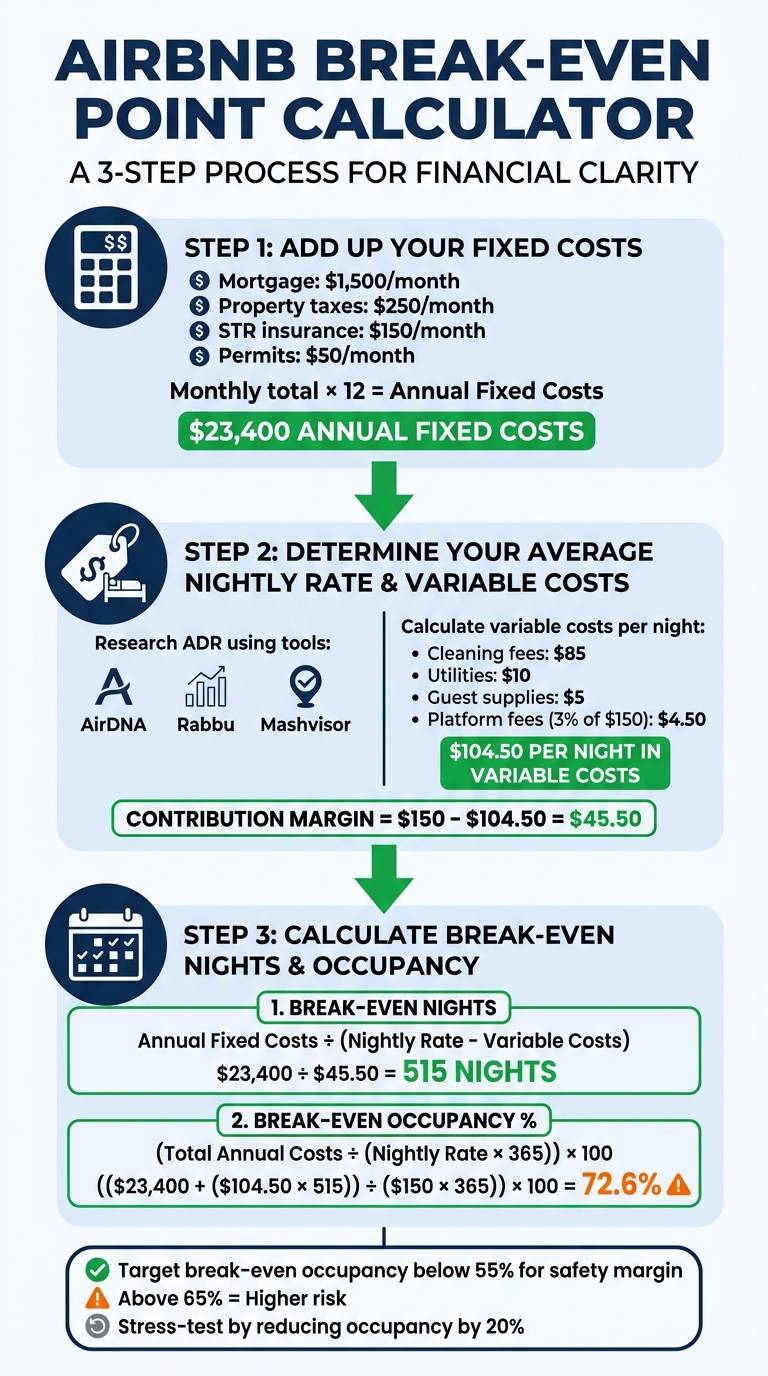
Step 1: Add Up Your Fixed Costs
Start by listing all your predictable, recurring expenses. These include your mortgage, property taxes, short-term rental (STR) insurance, HOA fees, and permits. Once you have the monthly total, multiply it by 12 to calculate your annual fixed costs. Remember to include the mortgage principal payments, as they represent actual cash outflows, even if they build equity over time [1].
For example, if your monthly expenses look like this:
- Mortgage: $1,500
- Property taxes: $250
- STR insurance: $150
- Permits: $50
Your annual fixed costs would total $23,400.
Step 2: Determine Your Average Nightly Rate and Variable Costs
Next, research comparable properties in your area using tools like AirDNA, Rabbu, or Mashvisor to find a realistic Average Daily Rate (ADR) for your rental [2][3]. Keep in mind that new properties often achieve only 40% to 60% of the average occupancy for the market [2].
Then, calculate your variable costs per night. These include:
- Cleaning fees: Typically $80 to $85 per turnover
- Utilities: Average cost per night
- Guest supplies: Items like coffee, soap, and linens
- Platform service fees: For example, Airbnb charges around 3% of each booking
If your cleaning fees are $85, utilities average $10 per night, guest supplies cost $5, and platform fees are 3% of a $150 nightly rate ($4.50), your total variable cost per night would be about $104.50.
Step 3: Calculate Break-Even Nights and Occupancy
Now, use the earlier formulas to find your break-even point.
- Break-even nights: Divide your annual fixed costs by your contribution margin (nightly rate minus variable costs).
Example: With $23,400 in fixed costs, a $150 nightly rate, and $104.50 in variable costs, you’d need to book around 515 nights annually ($23,400 ÷ $45.50). - Break-even occupancy: Divide your total annual costs (fixed + variable) by your potential annual rent, then multiply by 100.
Example: If your gross potential annual rent is $150 × 365 = $54,750, use the formula to find your break-even occupancy.
It’s a good idea to stress-test your calculations. For instance, reduce your target occupancy by 20% to see how your numbers hold up [2]. If your break-even occupancy is above 65%, the investment carries higher risks since seasonal dips could wipe out profits [3].
"The break-even point isn’t just a number; it’s your investment’s baseline for survival. Any income above this point is profit, while falling short means you’re paying to own the property." – Property Scout 360 Team [1]
sbb-itb-103bddb
Break-Even Calculation Example
Let’s break this down with a practical example. Imagine a mid-market property with $1,750 in monthly fixed costs. This scenario highlights how seasonal changes can impact your break-even point and the potential financial risks.
During the high season (summer), the property charges an average nightly rate of $200 with variable costs of about $65 per booking (including cleaning and platform fees). To break even, the property needs to book 10 nights, equating to an occupancy rate of around 33%. However, the picture shifts dramatically during the low season (winter).
In the low season, the average nightly rate drops to $110, which pushes the break-even requirement to 18 nights or 60% occupancy. This steep increase in required occupancy during slower months could potentially erase profits accumulated during busier times [1].
Low-Season vs. High-Season Comparison
Here’s a clear comparison of the property’s performance across seasons:
| Metric | High Season (Summer) | Low Season (Winter) |
|---|---|---|
| Average Nightly Rate | $200 | $110 |
| Fixed Costs | $1,750 | $1,750 |
| Variable Cost per Booking | ~$65 | ~$65 |
| Break-Even Nights | ~10 Nights | ~18 Nights |
| Break-Even Occupancy % | ~33% | ~60% |
This comparison highlights the challenges of maintaining profitability in a seasonal market. A simple $90 drop in nightly rate nearly doubles the number of bookings required to break even. This is why dynamic pricing strategies are critical. Sticking to flat rates could mean losing out on 15% to 25% of potential revenue [2].
For property managers in seasonal markets, it’s wise to stress-test your financials. Calculate your break-even point based on 20% lower occupancy than your target to understand potential risks [2]. Targeting a break-even occupancy below 55% can provide a cushion during slower periods [3].
How Professional Management Lowers Your Break-Even Point
Working with seasoned property managers can significantly lower your break-even point by boosting revenue and keeping costs under control. While management fees typically range from 15% to 40% of gross revenue, top-tier companies often make up for these fees by achieving higher occupancy rates and nightly rates through strategic adjustments [11]. This increase in revenue reduces the number of nights you need to book to cover your fixed expenses.
What Professional Management Provides
Rank One Stays takes care of all daily operations, including listing optimization, dynamic pricing, 24/7 guest support, and professional housekeeping coordination. They claim to help property owners increase revenue by 38%, with fees starting as low as 10% [9][2].
Dynamic pricing plays a key role by adjusting nightly rates based on market demand, ensuring maximum revenue [2]. Additionally, professional photography and well-crafted descriptions can boost market rates by up to 49% without affecting search visibility [10]. For properties in popular markets like Denver or Scottsdale, these strategies are especially valuable during peak tourism seasons. By improving your net revenue per night, these tactics directly lower your break-even point.
Reducing Costs and Increasing Revenue
Professional management doesn’t just focus on increasing revenue – it also optimizes costs, further lowering your break-even threshold. Efficient networks ensure quick property turnovers and consistent quality, which helps maintain high ratings. Properties with average ratings of 4.8 stars or higher consistently achieve better occupancy and pricing power [11].
On top of that, smart technology like automated messaging and smart thermostats can reduce utility waste and save property owners 8–15 hours each month [4][8]. By cutting down on labor and operational expenses, your profit margin per booking grows, speeding up the path to break-even.
"Professional management becomes cost-effective at 4+ properties or when operating remotely – management fees of 20-30% are justified by time savings and operational systems that maintain high occupancy." – Emir Dukic, CEO, Rabbu [8]
With a mix of increased revenue and streamlined operations, you can hit your break-even point faster each month and enjoy more profit from every additional booking. If you’re looking to lower your break-even occupancy and maximize your returns, find out how Rank One Stays can optimize your property.
Conclusion
A solid break-even analysis is a must-have for anyone serious about making Airbnb investments worthwhile. Understanding your break-even point can mean the difference between running a profitable operation and unknowingly losing money. As Robin4 from the Airbnb Community pointed out, "Many hosts have absolutely no idea if they are making money or losing it! … [One host] suddenly realised by using Airbnb’s pricing tips she had been operating in negative equity for almost 4 months" [10]. By calculating your fixed and variable costs and applying the right formulas, you can build a strong financial foundation.
If your required occupancy rate creeps above 60–65%, that’s a red flag. National average occupancy rates typically hover between 48% and 65% [2], so it’s wise to stress-test your numbers. Try modeling a 20% dip below your target; aiming for a break-even occupancy below 55% offers a buffer [3]. Don’t forget to set aside 1–2% of your property’s value annually for maintenance expenses [1].
Feeling overwhelmed by the math? Professional management services, like those offered by Rank One Stays, can take the guesswork out of the equation. These services use dynamic pricing and efficient operations to help reduce your break-even point by increasing occupancy rates and fine-tuning pricing strategies. Whether you’re hosting in Denver, Scottsdale, or elsewhere, knowing your numbers puts you in control and sets you up for success.
Take the time to crunch the numbers and figure out where your property stands in terms of profitability.
FAQs
What costs should I include in my break-even calculation?
To figure out your Airbnb rental break-even point, you need to factor in both fixed costs and variable costs. Fixed costs include expenses like your mortgage, property taxes, insurance, utilities, HOA fees, and management fees. On the other hand, variable costs cover expenses tied to each booking, such as platform fees, cleaning services, and setting aside reserves for maintenance. Including these will give you a clear picture of the recurring and occupancy-related expenses required to run your property smoothly.
How do I find a realistic average nightly rate (ADR) for my area?
Setting a competitive average nightly rate (ADR) starts with understanding your local market. Begin by analyzing market data and historical trends in your area. Look at nearby listings that are similar to your property to compare their rates and occupancy levels. Platforms like Airbnb and Vrbo are great resources for checking out what comparable properties are charging.
You can also use market analysis tools to gain deeper insights. These tools can help you forecast potential earnings by identifying local trends, giving you a solid starting point for pricing your property competitively.
How can I lower my break-even occupancy if my numbers look too high?
To bring down your break-even occupancy, focus on cutting operating costs and increasing revenue per booking. Start by negotiating better deals on essentials like utilities, internet, and cleaning services. At the same time, refine your listing to attract guests willing to pay more. Enhancing your property’s charm and improving marketing efforts can help fill more nights, spreading fixed costs across additional bookings.
Take a closer look at your expenses to pinpoint where you can save. For instance, you could adjust cleaning schedules to be more efficient or work on reducing platform fees – all without sacrificing the quality of the guest experience.