
Looking to rent your property? Choosing between Airbnb and VRBO depends on who you want to host. Here’s a quick breakdown:
- Airbnb: Popular with younger travelers (60% Millennials & Gen Z), solo visitors, couples, and digital nomads. Stays are shorter (2.9–4.2 nights), with bookings made closer to travel dates (31-day average). Guests are budget-conscious and favor unique, urban properties.
- VRBO: Appeals to families (87% travel in groups), older guests (68% Gen X & Boomers), and those planning ahead (67-day booking window). Stays are longer (5.7–7 nights), and guests prioritize privacy, space, and comfort, often booking larger homes.
Key takeaway: Match your property type to the platform’s audience. Urban studios thrive on Airbnb, while larger vacation homes perform better on VRBO. Dual-listing on both platforms can boost earnings by 34%.
Quick Comparison
| Factor | Airbnb Guests | VRBO Guests |
|---|---|---|
| Age Range | 18–44 (Millennials & Gen Z) | 35–65 (Gen X & Boomers) |
| Group Size | 1–2 people (61% of bookings) | 4+ people (87% of bookings) |
| Stay Length | 2.9–4.2 nights | 5.7–7 nights |
| Booking Window | Average 31 days | Average 67 days |
| Budget | Price-sensitive | Higher budgets; value space & amenities |
Pro tip: Listing on both platforms and using professional property management can maximize your revenue.
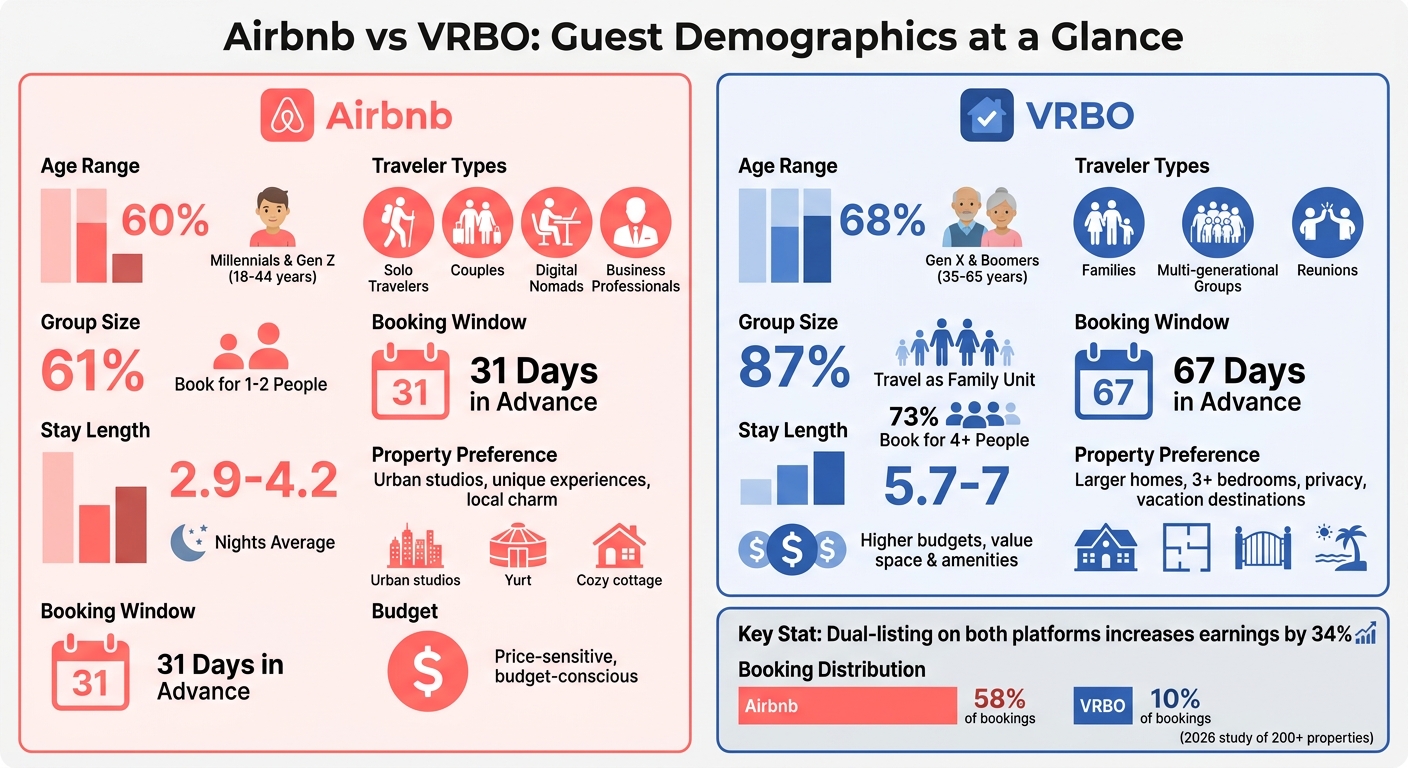
Airbnb vs VRBO Guest Demographics Comparison Infographic
Airbnb Guest Demographics
Age Groups and Traveler Types
Airbnb’s user base skews young, with over 60% falling into the millennial and Gen Z age brackets (18–34). Around 54% of its core users are aged 25–44 [2][7]. These guests often include solo travelers, couples on short getaways, business professionals, and digital nomads [1][6].
The booking data supports this demographic profile: 61% of Airbnb reservations are for groups of just 1–2 people [7]. This contrasts sharply with VRBO, where 73% of bookings are for parties of 4 or more [7].
"Airbnb guests want to live like a local. They’re not planning a family vacation. They’re exploring the city, attending events, or visiting friends."
- Marcus, urban property host in downtown Seattle [7]
These preferences influence how guests approach their stays, from trip duration to how far in advance they book.
Booking Preferences and Stay Length
Airbnb guests tend to book closer to their travel dates and stay for an average of just 2.9 nights [7], much shorter than VRBO’s 5.7-night average [7]. However, a growing segment of Airbnb users – remote workers and digital nomads – are booking extended stays. In fact, 20% of nights booked on Airbnb are for stays of 28 days or longer [2]. For property owners in cities like Denver or Pittsburgh, these long-term bookings can provide consistent income between shorter reservations.
This trend highlights Airbnb’s appeal to travelers seeking flexibility and urban convenience, particularly for spur-of-the-moment trips.
Budget Sensitivity and Experience Focus
Airbnb guests often balance affordability with the desire for an authentic, local experience. Instead of prioritizing luxury, they seek accommodations with charm, character, and unique appeal [4][2]. For example, they might choose a converted shipping container over a standard condo.
"Emotional logic trumps price: Guests book based on narrative and identity."
The platform’s "Categories" feature caters to this mindset, helping guests discover distinctive stays like treehouses or A-frame cabins [2]. These travelers are mobile-first, often comparing options on their phones, and are drawn to listings that tell a story rather than simply listing features [8].
This focus on individuality and experience sets Airbnb apart from platforms like VRBO, which often cater to a more family-oriented audience.
sbb-itb-103bddb
VRBO Guest Demographics
Family-Oriented Travelers
VRBO has carved out a niche among families, with 87% of guests traveling as a group and 73% of bookings accommodating four or more people [2][7]. The platform’s exclusive focus on entire property rentals ensures privacy and ample space – key priorities for families who want to avoid shared spaces with hosts or strangers.
This setup appeals especially to multi-generational groups planning reunions, beach getaways, or theme park adventures. These travelers value what the industry refers to as "functional luxury", which includes features like large kitchens, multiple bathrooms, and family-friendly amenities such as private pools or game rooms. Unlike Airbnb guests who might seek out quirky spaces like treehouses or tiny homes, VRBO users prioritize comfort and predictability.
"VRBO guests know what they want. They’re planning a family trip months in advance, often seeking vacation rental design that caters to large groups. They book, they pay, and they show up. Less drama, more money."
- Jennifer, Property Owner [7]
This family-centric approach also shapes how guests plan and book their trips, as outlined below.
Longer Stays and Advanced Planning
Since families often plan vacations around school schedules and holidays, their booking habits naturally differ. VRBO guests make reservations an average of 67 days in advance, compared to Airbnb’s 31-day average [7]. This extended planning window benefits property owners by reducing frequent turnovers, which can cut cleaning and restocking costs. For instance, eliminating just two turnovers per month can save around $3,600 annually [3]. Vacation destinations like Scottsdale or Lighthouse Point are particularly well-suited to these longer stays, making them attractive to VRBO hosts.
Higher Budgets and Luxury Preferences
Another key distinction lies in the financial profile of VRBO guests. They tend to be older and wealthier, with 68% aged 35 to 65, primarily from the Gen X and Boomer generations [7]. This demographic often has higher disposable incomes, which is reflected in the platform’s average booking value of $2,340 in 2026. These travelers are willing to pay more for spacious, upscale accommodations.
"VRBO’s core strength remains catering to families and larger groups seeking spacious, private accommodations, leading to a higher ADR than Airbnb in many markets."
Many VRBO guests also take advantage of loyalty rewards through the One Key™ loyalty program offered by Expedia and Hotels.com. With access to over 168 million loyalty members within the Expedia Group network, VRBO has successfully drawn traditional hotel guests into the vacation rental market. These travelers often expect hotel-quality service and amenities, making professional property management critical for those targeting this audience. For property owners aiming to attract affluent, family-focused travelers, VRBO often presents a more suitable platform than Airbnb.
Airbnb vs VRBO Guest Demographics Comparison
When comparing Airbnb and VRBO, guest demographics reveal striking differences that influence revenue potential. Airbnb tends to attract a younger audience, with over 60% of its bookings coming from Millennials and Gen Z travelers aged 18–34 [2]. Most Airbnb bookings (61%) are for smaller groups of 1–2 people [7], with trips planned an average of 31 days in advance and stays lasting 2.9–4.2 nights [3][7]. In contrast, VRBO appeals to an older demographic, with 68% of its guests aged 35–65 [7]. The majority (87%) travel as family units, planning trips 67 days ahead and staying for 5.7–7 nights on average [2][7]. The table below provides a detailed comparison of guest profiles for each platform.
Comparison Table: Airbnb vs VRBO Guest Profiles
| Factor | Airbnb Guest Profile | VRBO Guest Profile |
|---|---|---|
| Primary Age Range | 18–44 (Millennials & Gen Z) [2][3] | 35–65 (Gen X & Boomers) [2][7] |
| Traveler Types | Solo travelers, couples, business professionals, digital nomads [1][3] | Families, multi-generational groups, reunions [1][3] |
| Average Stay Length | 2.9–4.2 nights [3][7] | 5.7–7 nights [2][7] |
| Booking Window | Short (avg. 31 days); high last-minute bookings [7] | Long (avg. 67 days); advanced planning [7] |
| Group Size | 61% book for 1–2 people [7] | 87% travel as a family unit [2] |
| Price Sensitivity | Budget-conscious; often filter by price [2] | Generally higher budgets; value space and amenities [2][7] |
These demographic trends directly impact market outcomes. A study of over 200 properties across 34 U.S. states in early 2026 found that 58% of guests booked through Airbnb (2,043 reservations), while only 10% booked through VRBO (365 reservations) [9]. Interestingly, hosts who listed on both platforms saw a 34% increase in earnings compared to those who used just one [7]. In cities like Denver and Pittsburgh, understanding these guest preferences can help hosts adjust their strategies to boost occupancy and improve property management decisions.
Revenue and Management Implications for Property Owners
Understanding your guests’ preferences isn’t just about better service – it’s about boosting your bottom line.
Matching Properties to Platform Demographics
The type of property you own can significantly influence your revenue, depending on the platform you choose. For instance, urban studios and one-bedroom units thrive on Airbnb, largely because their audience skews younger and includes solo travelers or couples. These guests prioritize design, unique experiences, and vibrant neighborhoods [3]. On the other hand, larger homes with three or more bedrooms perform better on VRBO, where 87% of guests are families seeking space and privacy in vacation destinations [2].
Another key factor is the length of stay, which directly affects costs like cleaning and maintenance. VRBO guests average 5.8 nights per booking, compared to Airbnb’s 4.2 nights. Fewer turnovers mean lower annual operating expenses [3]. For example, a 2024 analysis of a two-bedroom beach house in Panama City Beach revealed that listing exclusively on Airbnb resulted in 65% occupancy at $185 per night, generating $43,845 in gross revenue. By adding VRBO to the mix, occupancy jumped to 78%, with a higher nightly rate of $195, netting the owner an extra $8,065 annually [3].
Tailoring your property to the right platform and audience can significantly impact your revenue, especially when combined with expert management.
Maximizing Revenue Through Professional Management
Dual-listing your property on platforms like Airbnb and VRBO can increase bookings by 15%-30% and occupancy by 15%-25% compared to sticking with just one platform [3][5]. But managing multiple platforms is no small feat – it requires real-time calendar syncing, platform-specific pricing strategies, and seamless guest communication to avoid double-bookings and maximize opportunities.
Property owners who team up with Rank One Stays see an average revenue increase of 38% compared to the market, thanks to their expertise in multi-platform listing, dynamic pricing, and professional staging. Whether you own a Denver mountain getaway suited for VRBO’s family travelers or a Scottsdale urban rental that appeals to Airbnb’s younger crowd, professional management ensures your property connects with the right audience. And with management fees starting at just 10%, it’s a smart investment for maximizing your property’s potential.
Choosing the Right Platform Based on Guest Demographics
Selecting the right platform for your property isn’t just a checkbox – it’s a key factor in driving revenue. Martin Maxwell, Founder & Head of Research at REI PRIME, sums it up perfectly:
"The platform debate is mostly a distraction… What actually drives your revenue is which platform connects you with the right guest for your specific property" [3].
Understanding guest demographics can help you align your property with the platform that fits it best.
Key Takeaways for Property Owners
Match your property type and location to the platform. For example, urban apartments often thrive on Airbnb. That’s because 60% of Airbnb bookings come from Millennials and Gen Z (ages 18–34), who tend to book just 31 days in advance [2][7]. These properties typically see high occupancy rates with short booking windows. On the other hand, larger homes with multiple bedrooms perform better on VRBO, which caters to families – 87% of its guests travel as family groups [2]. With longer stays averaging 5.8 nights and booking windows of 67 days [7], these properties benefit from reduced turnover costs and increased revenue from extended stays.
Dual-listing is still the winning strategy for 2026. Hosts who list on both Airbnb and VRBO can boost their earnings by 34% compared to those using only one platform. Total bookings also increase by 15–30% [3]. The trick is to use a reliable channel manager to sync calendars in real time, avoiding double-bookings. Pricing adjustments also help: VRBO hosts often charge slightly higher rates to account for longer stays and its 8% effective host fee [7].
How Rank One Stays Can Help
Managing multiple platforms while tailoring strategies to your target audience can be a challenge, but that’s where Rank One Stays comes in. They handle everything – from dual-listing your property on Airbnb and VRBO to optimizing listings, setting dynamic pricing, and running platform-specific marketing campaigns. Whether you have an urban rental in Pittsburgh or a waterfront home in Lighthouse Point, their professional management ensures you attract both last-minute Airbnb bookers and advance-planning VRBO families.
With management fees starting at just 10% and an average revenue increase of 38% compared to market rates, Rank One Stays helps turn these demographic insights into real, measurable results.
FAQs
Should I list on Airbnb, VRBO, or both?
When deciding between Airbnb and VRBO – or even using both – it’s all about understanding your audience and what you aim to achieve. Airbnb tends to draw in younger travelers, solo adventurers, and digital nomads who often book shorter stays. On the other hand, VRBO is a favorite among families and larger groups planning longer vacations.
Interestingly, many hosts report a 15–30% boost in bookings by listing on both platforms. To streamline the process and get the most out of your listings, you might want to explore working with a full-service vacation rental management company, like Rank One Stays. They can help handle the details while you focus on growing your rental income.
Which platform fits my property type best?
The right platform for your rental depends on your property type and the audience you’re targeting. Airbnb is a great fit for city-center apartments or smaller units, appealing to younger travelers who typically book shorter stays of about 3 to 5 nights. On the other hand, VRBO is better suited for larger vacation homes in resort destinations, often chosen by families planning longer stays of 5 to 8 nights. Many property owners choose to list on both platforms to reach a broader audience. Collaborating with Rank One Stays can help fine-tune your listings and boost your revenue potential.
How do booking windows affect my pricing and cleaning costs?
Booking windows play a key role in shaping both pricing strategies and cleaning costs by affecting occupancy and turnover rates. In urban areas, shorter booking windows are more common. These often lead to higher cleaning costs because frequent turnovers and last-minute bookings demand quick adjustments and dynamic pricing models. On the other hand, longer booking windows provide more time for planning, which can lower cleaning expenses per turnover by streamlining operations.
Professional property management can make a big difference here. By analyzing booking patterns and implementing effective strategies, managers can help control costs while ensuring top-notch service – no matter how short or long the booking window might be.