

Scaling a vacation rental portfolio requires a business-first mindset. The U.S. vacation rental market hit $100 billion in bookings in 2025, with top properties earning $150,000 annually. To succeed, focus on these key steps:
- Treat Rentals Like a Business: Build systems for cleaning, guest communication, maintenance, and pricing, or leverage professional property management to handle these operations.
- Set Clear Goals: Aim for cash-on-cash returns of 12–20% and identify property/location criteria like proximity to attractions or private pools.
- Research Markets: Use tools like AirDNA to analyze demand, occupancy, and revenue trends. Diversify across markets to minimize risks.
- Secure Financing: Start with traditional loans, then explore DSCR or portfolio loans as you grow.
- Leverage Technology: Automate guest communication, dynamic pricing, and operations to manage properties efficiently.
- Optimize Listings: Invest in professional photos, clear titles, and accurate amenity tags to attract bookings.
- Deliver Quality Experiences: Ensure spotless properties, seamless check-ins, and thoughtful touches to gain five-star reviews.
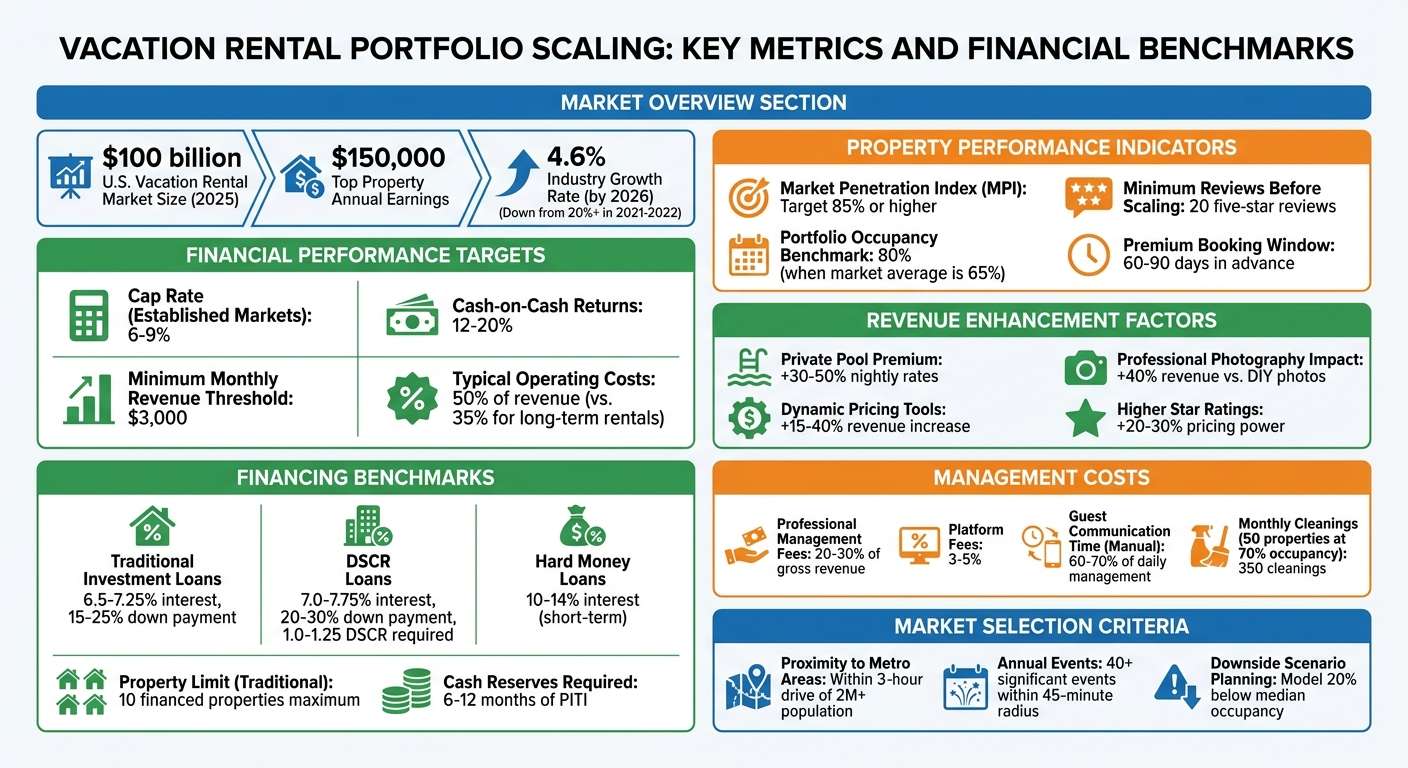
Vacation Rental Portfolio Scaling: Key Metrics and Benchmarks for Success
Scaling Your Short Term Rentals Portfolio
sbb-itb-103bddb
Building a Strong Foundation Before Scaling
Before you even think about scaling, make sure your first property is running like a well-oiled machine. Every aspect – cleaning, guest communication, maintenance, and pricing – should be documented and streamlined for efficiency. These systems are the backbone of scalable operations.
"The hosts winning right now aren’t luckier than you. They’re more intentional. They treat their rental like a business – and they built it that way from day one." – Eric Ravenscroft, CRS, GRI, ABR, The Ravenscroft Group [4]
Your first property should serve as a prototype for future ones. If you can’t hand someone a detailed playbook to manage it without your constant involvement, scaling could become a nightmare. Standard operating procedures (SOPs), checklists, and automation are essential. Without these, many operators hit a wall at around 20 properties [2].
Set Clear Investment Goals
Before diving into your next property, clarify your financial goals. For example, a Cap Rate of 6–9% is considered solid in established markets, while cash-on-cash returns of 12–20% are often targeted by successful investors [4][6]. Many operators set a minimum monthly revenue threshold – commonly around $3,000 – and decide if their focus is on maximizing revenue, boosting average daily rates, or minimizing wear-and-tear on the property.
Beyond the numbers, define specific property and location criteria. You might look for properties with a bedroom-to-bathroom ratio of at least 1:2 or prioritize locations near key attractions like beaches, stadiums, or entertainment hubs [4]. Private pools, for instance, can increase nightly rates by 30–50% in competitive markets [4]. Whether you’re eyeing markets like Pittsburgh or Lighthouse Point, having written standards can help you avoid emotional decisions.
Once you’ve set your financial and property criteria, evaluate whether your current operations align with these benchmarks.
Review Your Current Property’s Performance
With your investment goals in place, it’s time to assess how your current property is performing. Start with a 90-day audit to determine if you’re truly ready to expand. Calculate your Market Penetration Index (MPI) – divide your occupancy rate by the market average and multiply by 100. An MPI below 85% suggests your property may need some fine-tuning before scaling [5]. Beyond occupancy, pay attention to Revenue Per Available Room (RevPAR), which is calculated by multiplying your average daily rate by your occupancy percentage. Also, examine your booking windows; aim for premium reservations booked 60–90 days in advance rather than last-minute, discounted stays [5].
Another key metric? Reviews. Ensure your property has at least 20 five-star reviews, as these are critical for maintaining strong search rankings [2]. If your property doesn’t meet these benchmarks, focus on optimizing it before expanding.
"Portfolio occupancy can be at 80% when the market’s at 65%, and the owner thinks they’re crushing it. But what they don’t know is they’re selling at way too low ADR and leaving 20 to 30% on the table." – Jasper Ribbers, Head of Revenue Management, Freewyld Foundry [5]
Finally, test the scalability of your systems. If you’re still manually sending check-in instructions or coordinating cleanings through text messages, managing multiple properties will quickly become overwhelming. Automate key guest touchpoints, such as booking confirmations, pre-arrival instructions, day-of check-ins, mid-stay check-ins, checkout instructions, and post-stay review requests [2]. Partnering with a professional vacation rental management company can also help you implement these systems effectively across different markets.
Finding Profitable Markets Through Research
Once your first property is up and running successfully, the next challenge is figuring out where to expand. Markets can differ significantly – some deliver steady income throughout the year, while others experience seasonal dips that could disrupt your cash flow. The key to making a smart investment lies in conducting detailed market research before committing to a new property. By focusing on specific metrics, you can identify the best locations for your next venture.
Study Local Market Data
A good starting point is analyzing Revenue Per Available Night (RevPAN) – a metric that combines the average daily rate with occupancy levels. This figure provides a clear way to compare different markets [8][10].
"RevPAN is the single best number for comparing markets – it combines what people pay with how often they book" [10].
Look for markets with steady, year-round demand rather than those that rely on short seasonal peaks. For example, mountain destinations like Denver attract visitors in both winter (for skiing) and summer (for hiking). Similarly, college towns often see consistent bookings tied to sports seasons and university events from August through March [7].
Another factor to consider is proximity to large cities. Locations within a 3-hour drive of metropolitan areas with populations over 2 million tend to draw weekend travelers regularly. Additionally, markets with 40+ significant annual events within a 45-minute radius often see reliable booking patterns [7].
Pay attention to the supply–demand balance in your target area. Short-term rental growth in the U.S. is expected to slow to 4.6% by 2026, a sharp contrast to the 20%+ growth rates seen in 2021–2022 [10]. Markets where demand is growing faster than supply often allow for higher pricing and better revenue opportunities [10].
To dig deeper, use platforms like AirDNA, Mashvisor, and AirROI to access data on occupancy rates, average daily prices, and revenue trends. These tools can help you uncover micro-trends and spot areas that may be oversaturated [11]. You can also run a 90-Day Booking Calendar Test by reviewing 10–15 comparable properties. Look for patterns of consistent weekend bookings with scattered midweek stays, rather than relying solely on overall occupancy averages [7].
Lastly, verify local regulations directly instead of relying on summaries from third-party sources. Reviewing city council minutes and ordinances can reveal pending short-term rental (STR) restrictions or bans. For instance, New York City’s Local Law 18 caused a 92% drop in STR listings in just one year [9]. Regulatory changes like this can have an immediate impact on your income [8][10].
Beyond analyzing market data, expanding into diverse locations can add another layer of stability to your portfolio.
Spread Properties Across Different Markets
Diversifying your portfolio across multiple locations reduces the risk of being overly affected by local regulatory changes or economic downturns [7]. If one market faces a sudden slowdown or restrictions, properties in other areas can help balance your overall revenue. It also lets you take advantage of different peak seasons. For example, while your Scottsdale property might see slower bookings in the summer, your Lighthouse Point rental could be in high demand.
You can also diversify by market type. Walkable Water markets near beaches often command higher rates, while Supply Dry markets like Jersey City benefit from limited competition due to nearby STR restrictions [8]. Larger group rentals (6+ bedrooms) can earn 30–40% more when they include features like multiple primary suites and commercial kitchens [7]. On the other hand, smaller units in college towns tend to maintain steady occupancy throughout the academic year.
When considering new markets, always model a downside scenario – assume occupancy rates will be 20% below the median. This approach ensures your investment can withstand market downturns [7][10]. If you’re managing properties in different states, working with a professional vacation rental management company can help streamline operations and provide local expertise without requiring you to build separate teams in every market.
Financing Your Portfolio Expansion
Once you’ve identified profitable markets, the next step is securing the right financing to grow your portfolio. The financing strategy you choose will directly impact how quickly you can scale and whether your investments remain profitable when market conditions shift.
Choose the Right Financing Method
At the start, traditional investment loans are a common choice, offering interest rates between 6.5% and 7.25% with down payments ranging from 15% to 25% [12]. However, these loans come with strict debt-to-income (DTI) requirements, and most lenders limit individual investors to 10 financed properties – some even cap it at 4 to 6 properties [12][16].
"The difference between those two outcomes [owning 1 vs. 20 rentals] is not luck, market timing, or having wealthy parents. It is financing strategy."
- Georgey Tishin, Founder, Sinai Capital [12]
As your portfolio grows, consider moving to DSCR (Debt Service Coverage Ratio) loans after acquiring two or three properties. These loans qualify based on the property’s rental income rather than your personal income, enabling you to acquire more properties without hitting personal income limits. DSCR loans typically carry interest rates between 7.0% and 7.75%, with down payments of 20% to 30% [12][14]. Lenders often require a DSCR between 1.0 and 1.25, meaning the property’s income must cover its debt by 20% to 25% [13][14].
If you’re managing properties across multiple markets – like adding a Denver mountain rental to complement a Pittsburgh property – portfolio loans may be a smart option once you own five or more properties. These loans group several properties under one mortgage, simplifying management with a single payment and often providing better rates than individual DSCR loans [12][14].
For properties that need renovations, hard money or bridge loans can provide quick access to capital. These short-term loans (6–24 months) come with higher interest rates, typically 10% to 14%, and 2 to 4 origination points. After stabilizing the property, you can refinance to secure more favorable terms [13][14]. Additionally, tapping into your existing properties’ equity through a HELOC (Home Equity Line of Credit) or cash-out refinance can help fund down payments for new investments [13][14].
Once you’ve chosen your financing method, it’s essential to carefully evaluate all costs and expected returns before purchasing a property.
Calculate Costs and Returns Before Buying
Before committing to a purchase, break down all upfront costs and project potential income. For example, in May 2026, purchasing a $350,000 cabin in Blue Ridge, GA required $103,000 upfront: $70,000 for the down payment, $8,000 in closing costs, and $25,000 for furnishings. With a nightly rate of $225 and 65% occupancy, the property generated $53,381 in gross revenue. After deducting 40% for operating costs and $21,240 for annual debt service at 6.5%, the property delivered $10,789 in cash flow – a 10.5% cash-on-cash return [1].
To assess a property’s financial performance, calculate its Net Operating Income (NOI) by subtracting all operating expenses from the gross rental income. Keep in mind that vacation rental operating costs typically run around 50% of revenue, significantly higher than the 35% seen with long-term rentals [15]. Be sure to budget for expenses like:
- Professional management fees (20% to 30% of gross revenue)
- Platform fees (3% to 5%)
- Cleaning costs
- Utilities
- Insurance
- Ongoing maintenance [1]
Next, determine your cash-on-cash return by dividing the annual cash flow (NOI minus debt service) by the total cash invested. Use conservative estimates for occupancy – around 60% to 65% in your first year – rather than the 75% to 80% that experienced hosts often achieve [1]. Also, remember that lenders generally require cash reserves equivalent to 6 to 12 months of PITI (Principal, Interest, Taxes, and Insurance) for investment properties [14].
To accelerate growth, consider using the BRRRR strategy: Buy, Rehab, Rent, Refinance, Repeat. This approach allows you to refinance a renovated property, pulling out equity to fund future down payments. Maintaining at least 25% equity in each property can also provide a safety net during market downturns and help avoid over-leveraging [12].
A well-thought-out financing strategy is key to scaling your portfolio while maintaining profitability and stability as you expand.
Managing Multiple Properties Efficiently
After securing financing and acquiring vacation rentals, the real work begins: managing multiple properties without feeling overwhelmed. For example, guest communication alone can take up 60–70% of daily management time if handled manually [17]. As your portfolio grows past three or four properties, you’ll need to decide whether to manage everything yourself with the help of automation or rely on professionals who can scale alongside you. It’s all about finding the right balance between outsourcing and streamlining processes.
Work with a Professional Management Company
Scaling a vacation rental business can quickly become a logistical headache. For instance, managing 50 properties at a 70% occupancy rate means coordinating around 350 cleanings every month – a monumental task [2]. That’s why many property owners turn to professional management companies. These experts take care of everything: from optimizing your listings and setting dynamic pricing to providing 24/7 guest support, scheduling maintenance, and coordinating housekeeping.
It’s worth noting that vacation rental management fees are higher than those for long-term rentals. While long-term rental managers typically charge 8–12% of monthly rent, vacation rental managers charge 20–30% of gross revenue due to the more complex operations involved [2]. However, this higher fee often pays off. Professional managers use dynamic pricing tools that can increase revenue by 15–40% compared to static pricing. They also employ professional photography, which can boost bookings by 20–40% [2].
Expanding to new markets? A professional management company can provide local expertise, saving you from the hassle of building vendor networks, understanding market dynamics, or juggling time zones.
Use Technology and Automation Tools
Technology makes it possible to manage 15–25 or more properties efficiently by cutting down on manual tasks [17].
Start with automating guest communication. AI-powered tools like Hospitable, Jurny, or Guesty can handle 80–90% of guest messages, saving you 1–2 hours of manual replies every day [17].
Dynamic pricing tools, such as PriceLabs, Beyond, or Wheelhouse, adjust rates automatically based on local demand, events, and competitor pricing. These tools can increase your revenue by 15–40% compared to manually setting prices [2][17].
On the operational side, smart access control systems from brands like Schlage, Yale, August, or Operto eliminate the need for physical key exchanges and prevent lockout emergencies. In fact, 96.4% of hospitality professionals report that guests either expect or appreciate keyless entry technology [18]. Tools like Turno or Breezeway can also automate cleaning schedules, maintenance, and even noise monitoring, helping you address issues before they escalate [17].
That said, automation isn’t a one-size-fits-all solution. Keep human oversight for critical situations, such as major guest emergencies (fires, flooding, or security concerns), owner relationships, and initial property onboarding, including interior design and photography [17]. Even with 90% of operations automated, establish a 24/7 escalation protocol for emergencies requiring immediate human intervention [17].
Increasing Bookings Through Marketing and Guest Service
Once you’ve got your property management systems humming along, the next big step is filling those properties with guests. This is where marketing and guest service come into play. Together, they’re the driving force behind more bookings, glowing reviews, and a reputation that keeps your properties busy year-round. The truth is, the difference between a vacant property and one that’s consistently earning income often boils down to how well it’s showcased online and the experience you deliver to your guests.
Create High-Quality Property Listings
Your property listing is your first (and sometimes only) chance to turn a casual browser into a paying guest. The combination of the hero photo and the title is what grabs attention and drives clicks. If these elements don’t stand out, the rest of your listing might not even get a glance. As Mike, a 13-year Superhost at ListingLab, says, “The first photo is the single most important pixel on your listing” [19].
Investing in professional photography can make a huge difference. Listings with professional photos generate 40% more revenue compared to those with DIY images [4]. While a professional photo session may cost around $400, it typically pays for itself in just a few days through increased bookings [4]. Always use horizontal photos as your main listing images – vertical ones often get cropped awkwardly by search algorithms [19]. And when choosing your lead image, highlight your property’s best feature, whether it’s a scenic mountain view, a cozy fireplace, or a sparkling pool. Avoid starting with less appealing areas like bathrooms or cluttered spaces.
Your title is like a mini billboard, and with Airbnb showing only the first 50 characters in search results, every word matters [19]. Highlight specific features like “Hot Tub,” “Dog-Friendly,” or “Ocean View” rather than using vague adjectives like “beautiful” or “stunning” [19]. Similarly, the first two sentences of your description are crucial since platforms often truncate text with a “Show more” button. Use these lines to share concrete details, such as “Five minutes to downtown” or “Fast WiFi for remote work,” instead of generic welcomes [19].
Don’t forget about your amenity tags – they’re not just for show. Accurate tags for things like Wi-Fi, kitchen appliances, or self-check-in options ensure your property doesn’t get filtered out by guests searching for specific features [19][20]. If you’re managing properties in competitive markets like Scottsdale, highlighting amenities that cater to local preferences can make a big difference. For instance, properties with private pools in Arizona often command 30% to 50% higher nightly rates [4].
While a great listing gets guests in the door, it’s the overall experience that keeps them coming back.
Deliver Quality Guest Experiences
An eye-catching listing is just the start. To keep your properties fully booked, you need to deliver experiences that guests rave about. Marketing may bring them in, but it’s the quality of their stay that earns five-star reviews and repeat bookings. In fact, higher ratings can allow you to charge up to 20–30% more [23]. As Dr. Suzanne Godfrey, an independent branding expert, explains, “The difference between a forgettable visit and a lifelong loyal guest rarely comes down to pillow menus or room service speed; it’s all about how your guests feel” [21].
First impressions matter, and cleanliness is non-negotiable. Digital checklists can help ensure every property meets the same high standard, every single time [22][23]. Providing smart technology like keyless entry not only simplifies the check-in process but also gives guests more independence by eliminating the need for physical key exchanges [22][2]. Mid-stay check-ins are another great way to catch and resolve potential issues before they turn into bad reviews [2][23].
Small, thoughtful touches can leave a lasting impression. Simple gestures like welcome baskets filled with local treats, handwritten notes, or practical items like sunscreen can make guests feel special [22][3]. These little extras often lead to glowing reviews, repeat bookings, and positive word-of-mouth.
If managing all these details across multiple properties feels daunting, companies like Rank One Stays can step in to help. They specialize in listing optimization, guest communication, and property maintenance, ensuring that your guests receive a consistently excellent experience – no matter how many properties you’re managing. That way, you can focus on expanding your business while keeping your guests happy and coming back for more.
Tracking Performance and Making Improvements
When growing your vacation rental portfolio, keeping a close eye on performance metrics is essential to maintaining profitability. Booking properties is just the first step. To scale effectively, you need to regularly track key metrics and adapt your strategy. Neglecting this can lead to a revenue loss of 20–30% when managing 20–50+ listings [25].
Monitor Key Performance Metrics
Focus on metrics that directly influence your revenue. For example, high occupancy rates might look good on the surface, but they don’t tell the whole story. A better metric is RevPAR (Revenue Per Available Room), which combines Average Daily Rate (ADR) and occupancy. This can highlight pricing inefficiencies that could cost you 20–30% of revenue [25].
Another critical metric is MPI (Market Penetration Index), calculated as:
(Property Occupancy / Market Occupancy) × 100
If your MPI falls below 85%, it’s a red flag for underperformance [25].
Keep an eye on booking windows too. This helps you avoid last-minute gaps. Ideally, dedicate about 80% of your revenue management efforts to bookings 30–120 days in advance. For example, a one- or two-bedroom condo might aim for 40% occupancy 90 days ahead, while larger luxury homes (5+ bedrooms) might target just 20% at the same point [25].
To assess profitability, calculate NOI (Net Operating Income). This is gross revenue minus expenses, typically 55–70% of revenue [24]. From there, determine your cash-on-cash return by subtracting debt service from NOI and dividing the result by your total cash investment [1].
These metrics provide a foundation for making proactive adjustments.
Adjust Your Approach Based on Data
The data you collect should inform your strategy. As Jasper Ribbers, Head of Revenue Management at Freewyld Foundry, explains:
"Portfolio occupancy can be at 80% when the market’s at 65%, and the owner thinks they’re crushing it. But what they don’t know is they’re selling at way too low ADR and leaving 20 to 30% on the table by not leveraging the earlier part of the booking window" [25].
If your performance metrics reveal issues, don’t immediately slash prices. Instead, tweak non-price factors like updating your listing’s hero image, revising cancellation policies, or reducing minimum stay requirements. These changes can boost bookings without cutting into your revenue [25].
Dynamic pricing tools, such as PriceLabs or Beyond, can also help. These tools adjust rates daily based on demand, leading to revenue increases of 15–40% [2][17].
For new listings, prioritize earning five-star reviews and building booking momentum during the first 60–90 days. Optimizing ADR too early can backfire. As Ribbers puts it:
"For new listings, the only thing you need to worry about for the first couple months is getting five-star reviews. Those early reviews are worth so much money long-term that optimizing ADR is completely the wrong focus" [25].
If managing performance data for multiple markets feels overwhelming, you might consider working with a professional vacation rental management company like Rank One Stays. They specialize in revenue management and portfolio tracking, helping you spot underperforming properties before they hurt your overall returns. This lets you focus on growing your business strategically.
Conclusion
Expanding your vacation rental portfolio requires careful planning, solid systems, and a willingness to adapt. Start by laying a strong foundation with clear investment goals and properties that demonstrate solid performance. Market research is critical – about 70% of your investment success depends on selecting the right market [6]. Diversifying across different regions and securing the right financing options will ensure sustainable growth. This groundwork sets the stage for smoother operations and smarter decision-making.
As your portfolio grows, having efficient systems in place becomes non-negotiable. Managing multiple properties without standard operating procedures and automation can quickly become overwhelming. Use performance metrics like RevPAR (Revenue Per Available Room), MPI (Market Penetration Index), and cash-on-cash returns to guide your strategy and improve profitability. Focusing on these metrics, rather than just occupancy rates, will help you refine your approach and achieve better results.
For those looking to scale without being bogged down by daily management tasks, partnering with experts like Rank One Stays can make a significant difference. Their clients earn 38% more revenue than the market average, and with management fees starting at just 10%, they provide a cost-effective way to focus on strategic growth while leaving the operational headaches to seasoned professionals.
FAQs
When am I actually ready to buy my next vacation rental?
When you’re prepared to purchase your next vacation rental, it’s crucial to have reliable systems in place for leasing, maintenance, and guest management. Make sure your current operations can handle growth smoothly, avoiding unnecessary complications. Additionally, ensure you have access to the right financing options. With well-established procedures and a solid grasp of market opportunities, expanding your portfolio can be a structured and profitable venture.
How do I choose a market that won’t crash from seasonality or new STR rules?
To reduce risks tied to seasonality or short-term rental (STR) regulations, target markets that attract visitors throughout the year or have multiple high-demand seasons. For example, destinations offering both summer and winter activities can provide more consistent income. It’s also essential to research local STR laws and gauge community attitudes to avoid surprises from sudden regulatory shifts. Look for areas with reliable demand drivers, such as nearby airports or expanding tourism industries. Partnering with professional management companies, like Rank One Stays, can also help maintain steady operations and profitability.
Which loan type should I use as I grow past a few properties?
Debt Service Coverage Ratio (DSCR) loans are a go-to option for investors looking to expand their property holdings. Unlike traditional loans that often assess your personal income, DSCR loans focus on the rental income generated by each property. This approach makes it easier to qualify, especially as the number of properties in your portfolio grows.
Another advantage? There’s no cap on the number of properties you can finance. Traditional lending often imposes limits on how many mortgages you can have at once, but DSCR loans let you sidestep those restrictions. This flexibility means you can continue scaling without hitting a ceiling.
Plus, the qualification process is much more straightforward. Instead of digging deep into your personal financials, lenders assess whether the property’s rental income covers its debt obligations. This streamlined method saves time and makes securing financing for multiple properties far less stressful.