
If you host often, platform coverage and a plain homeowners policy usually are not enough. In many cases, the only policy type built for fires, guest injuries, storm damage, shutdowns, and lost booking income is dedicated short-term rental insurance.
Here’s the short version:
- Platform programs like AirCover and Vrbo protection are not insurance. They are reimbursement programs with filing deadlines and coverage gaps.
- Standard homeowners insurance can deny claims once your home is used as a short-term rental.
- Home-sharing endorsements can work for light, part-time hosting, but they often cap rental nights and liability.
- Landlord policies fit long-term tenants better than night-by-night guest turnover.
- Dedicated STR insurance is usually the best fit for frequent hosts, direct bookings, and multi-property setups.
A few facts stand out:
- Airbnb advertises up to $3 million for host damage and $1 million for liability, but coverage is limited by program rules.
- Some cities require $1 million in liability insurance for a short-term rental permit.
- Named-storm deductibles can hit 2% to 5% of insured value. On a $500,000 home, that means $10,000 to $25,000 out of pocket before coverage starts.
- Major rebuilds after hurricanes or wildfires can take 18 to 24 months, which can leave hosts short on income coverage.
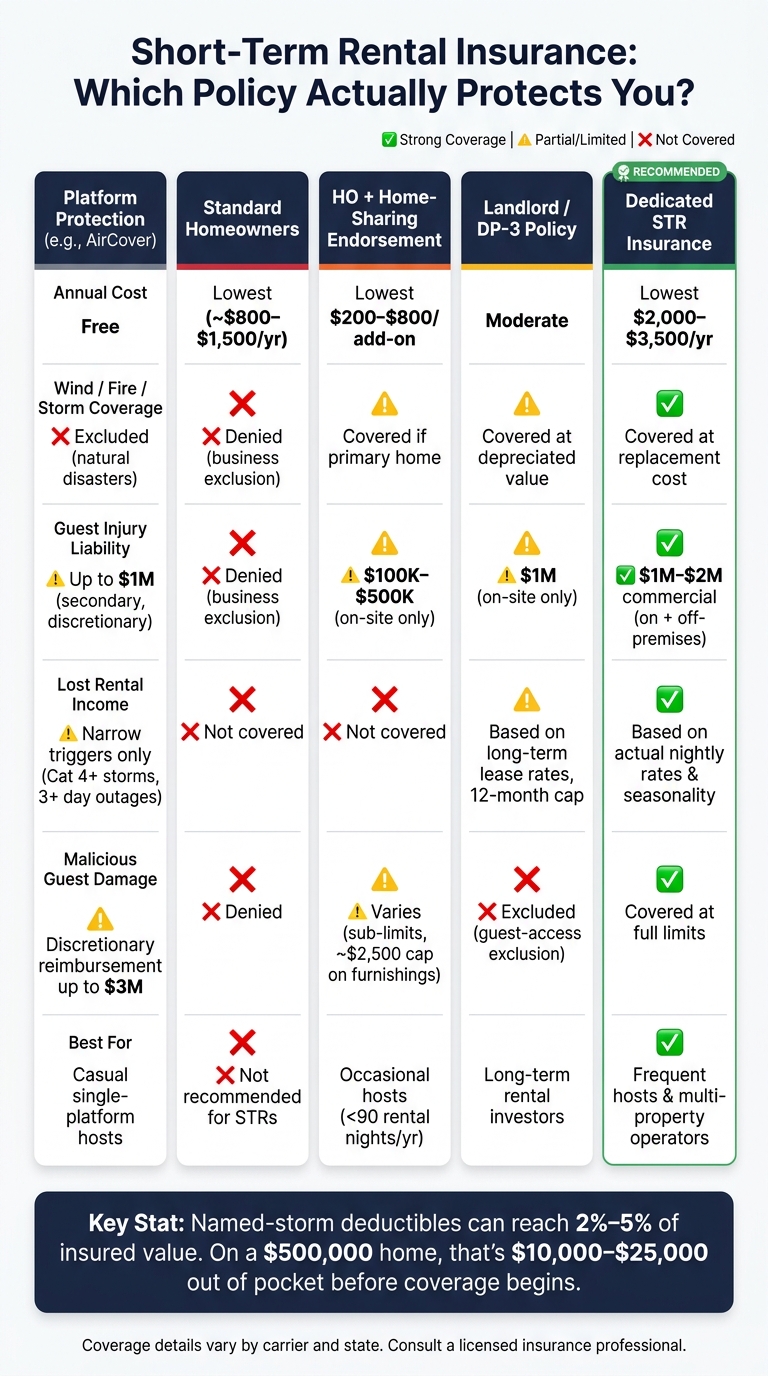
Short-Term Rental Insurance Options Compared: Coverage, Cost & Crisis Gaps
Short-Term Rental Insurance Explained: What Every Airbnb & Vrbo Host Needs to Know
sbb-itb-103bddb
Quick Comparison
| Option | Main Use | Main Problem | Best Fit |
|---|---|---|---|
| Platform programs | Backup for guest-related issues | Not insurance; many exclusions | Casual hosts on one platform |
| Standard homeowners | Owner-occupied home | STR activity can void claims | Usually a poor fit for STRs |
| Homeowners + endorsement | Light home-sharing | Low limits; rental-night caps | Occasional hosts |
| Landlord policy | Long-term rental home | Built for lease tenants, not guest turnover | Long-term rental owners |
| Dedicated STR insurance | Short-term rental business | Higher premium | Frequent hosts and investors |
If I boil the article down to one point, it’s this: the issue is not whether you have some coverage – it’s whether your policy matches how you rent the property.
1. Platform Protection Programs
Airbnb and Vrbo both include protection programs with bookings [1]. On paper, that sounds reassuring. But the details matter a lot.
Airbnb AirCover includes up to $3 million in Host Damage Protection and $1 million in Host Liability Insurance [1][10]. Vrbo Host Protection is much narrower. It offers $1 million in liability coverage only [1].
Crisis Property Coverage
AirCover can help with damage caused by guests, but it does not cover natural disasters, vandalism during vacant periods, or theft of cash or securities [1][10]. Vrbo goes even further and excludes property damage altogether [1][4].
That leaves a clear gap during a crisis. If a wildfire leads to an evacuation, or a burst pipe floods your unit between stays, neither program pays for that property loss [1][10]. Big dollar limits may look good in a headline, but gaps in what’s covered can hit just as hard.
Liability Protection
Both platforms carve out some major claim types. They exclude assault, battery, liquor liability, and invasion-of-privacy claims [1][10].
That matters because local rules can be stricter than the platform language. At least seven major U.S. cities require $500,000 to $1 million in liability coverage for STR permits and do not accept platform programs as enough on their own [1]. So even if a platform offers liability coverage, that doesn’t mean it meets permit rules. And even when liability coverage exists, protection for lost income is still limited.
Loss of Rental Income
Free AirCover only pays lost income when guest-caused damage forces confirmed upcoming bookings to cancel [1][11]. That’s a narrow lane.
Airbnb’s paid Earnings Protection product stretches that coverage to more types of crises, but the triggers are tight. Utilities must be out for more than 3 days, road closures must last more than 7 days, and hurricanes must reach Category 4 or higher with sustained winds of 130+ mph [11][12]. Category 1 to 3 storms are usually excluded [11][12].
So if the property is unusable but the event doesn’t clear those bars, the host may still be stuck with the loss.
Disclosure and Claim Reliability
When something goes wrong, speed matters. So does certainty. That’s where many hosts get uneasy.
Both Airbnb and Vrbo describe these programs as discretionary reimbursement plans, not regulated insurance [1][11]. In plain English, claims are discretionary, and hosts do not have policyholder rights or insurance-regulator oversight [11].
The deadlines are tight too:
- AirCover requires damage documentation within 14 days [1][11]
- Earnings Protection claims must be filed within 30 days [1][11]
Miss the deadline, and the claim is gone. For hosts running six or more listings, there’s another catch: Airbnb’s liability insurance becomes secondary as of March 2025, which means the host’s own insurance has to respond first [10].
That’s why many hosts use platform programs as a backstop, not the main plan. For many operators, they’re a supplement only.
2. Standard Homeowners Insurance
A standard homeowners policy is regulated insurance, but it’s built for owner-occupied living. The moment you start renting the home on a short-term basis, that protection can fall apart fast.
And that’s the key difference from platform protection: this is a real insurance policy, but it only works inside tight residential rules.
Crisis Property Coverage
Most HO-3 policies can deny claims for fire, storm, theft, or water damage once short-term rental use crosses into what the insurer sees as commercial activity [13][15].
There’s another catch. If damage happens after you hand over the keys, the insurer may treat it as entrusted property instead of a covered loss, which can leave the claim unpaid [14][16].
Liability Protection
The same issue shows up with guest injuries. If someone gets hurt during a rental stay, that claim is often excluded because it happened during rental activity. And if the homeowners claim gets denied, a personal umbrella policy usually won’t step in and save the day [13][14].
Loss of Rental Income
Loss of use coverage helps pay for your temporary housing if you have to move out after a covered event. It does not replace income from canceled bookings [14][16].
Disclosure and Claim Reliability
Claims can get shaky fast if short-term rental use wasn’t disclosed upfront. During a claim review, the insurer may find that the home was being rented and then deny the claim, cancel the policy, or even void the policy back to its start date [1][13][15].
That gap is why many hosts switch to a home-sharing endorsement or a policy built for rentals.
3. Homeowners Insurance with a Home-Sharing Endorsement
A home-sharing endorsement sits somewhere in the middle. It goes further than a standard homeowners policy because it recognizes that you rent the home. But it only does that in a pretty limited way. So yes, it’s better than leaning on a plain homeowners policy alone. Still, the crisis coverage is narrow.
Crisis Property Coverage
This type of endorsement may pay for guest-caused damage and theft [13]. But the dollar limits are often low. In many cases, coverage for landlord furnishings is capped at $2,500 [3]. On top of that, claims are often paid at depreciated value instead of replacement cost [3].
That matters more than it sounds. If a guest ruins a couch, table, or TV, the payout may reflect what the item is worth today, not what it costs to buy a new one. After a covered loss, that can leave a clear gap.
Liability Protection
These endorsements often come with liability limits from $100,000 to $500,000 [1]. That may sound like a decent amount at first glance. The catch is where the coverage applies.
Most of the time, it stops at premises liability, which means on-site only [3]. So if a guest gets hurt while using a bicycle or kayak you provided away from the property, that claim is likely excluded [3][1]. That’s a problem for hosts who offer extras as part of the stay. Professional vacation rental management services can help navigate these liability gaps by ensuring proper insurance and safety protocols are in place.
There’s another issue here: local permit rules. Some cities now ask for much more coverage than these endorsements usually provide. Denver and Houston, for example, require $1 million in liability insurance for STR permits [1]. In that case, a home-sharing endorsement may leave a host underinsured during a claim, not just out of step with permit rules.
So this is more of a patch than a full answer.
Loss of Rental Income
Most home-sharing endorsements do not cover lost rental income [1].
"A homeowners policy’s loss-of-use coverage is the wrong instrument: it was priced for a family displaced from a residence, not for a host losing $9,000 a month in platform revenue." – Nate Jones, CPCU, Founder of Wexford Insurance [9]
That distinction is easy to miss until there’s a shutdown, repair, or covered event that blocks bookings.
Disclosure and Claim Reliability
This type of endorsement only works if you tell the insurer about your rental activity before any claim happens. If you don’t disclose it, you’re on shaky ground from the start.
Many endorsements also limit how many nights you can rent the property each year, often between 30 and 90 days [1]. Go past that cap, or fail to disclose the rental use, and the business-use exclusion can void coverage [1][13].
For occasional hosts, paying $200 to $500 per year for an endorsement can be a better deal than sticking with a bare homeowners policy [1]. But if bookings are regular, the weak spots are hard to ignore.
For hosts with steady rental activity, the next move is usually a policy built for rental use from day one.
4. Landlord and Dwelling Policy for Rental Property
Landlord policies can look a lot like rental coverage at first glance. But there’s a big catch: they’re built for a long-term tenant, not a steady stream of new guests.
A landlord or dwelling policy – usually a DP-1 or DP-3 form – is meant for long-term renters, most often people on 12-month leases [7][2]. That assumption sits at the core of the policy. Once the home starts operating as a short-term rental, the coverage can stop lining up with how the property is being used.
Crisis Property Coverage
DP-1 and DP-3 policies assume long-term occupancy, so short-term rental use can lead to a denied claim even when the damage itself would normally be covered [7][2]. That’s where many hosts get blindsided.
Some losses can fall into common gap areas, including:
- Theft or vandalism tied to someone given access by a guest [2][17]
- Water damage caused by a guest [17]
Put simply, the policy may treat the risk very differently once guest turnover enters the picture.
Liability Protection
Landlord policies usually cover liability on the property itself, but not risks tied to guest amenities or incidents away from the premises [7][2].
"Common insurance gaps in a DP-3 policy are that it only provides coverage for liability incidents on-premises… if you have a waterfront property and the guest drowns while swimming in the lake, you’d have no coverage." – Nick Massey, Chief Sales Officer, Proper Insurance [2]
There’s another problem here. If the insurer finds out the home was being used as a short-term rental, it may deny the claim under a commercial-use exclusion.
Loss of Rental Income
DP policies calculate lost rent using long-term market rent, not nightly booking income [7][2]. So even if the policy responds, the payout may not match what the property was earning as a host business.
Most landlord policies also limit lost-rent coverage to 12 months [7][2].
Disclosure and Claim Reliability
Carriers often check for short-term rental activity through public listings and permit records [7]. If that use was not disclosed, the carrier may void the policy retroactively [1][7].
A landlord policy is often cheaper than short-term rental insurance because it assumes less risk [7]. That lower price can look good on paper. But for hosts with regular guest turnover, it can leave a much bigger gap when a claim hits.
That’s the core issue: a policy priced for long-term tenants may not hold up well for a property booked night after night.
5. Dedicated Short-Term Rental Insurance
Dedicated STR insurance is built for short-term rental risk. It uses commercial policy forms, so the business-use exclusion that can sink a standard claim does not apply [1][7]. In plain English: the policy expects rental activity from day one. That changes the whole claims process when something goes wrong.
Crisis Property Coverage
It covers fire, wind, and water damage, including during vacancy periods between bookings [6][8]. That matters more than it may seem. A standard policy may void coverage after 30 vacant days, while dedicated STR policies usually do not [3][8].
There’s also a big difference in how losses are paid. Dedicated STR policies generally use replacement cost instead of actual cash value [2][8]. So if a major loss hits, you’re less likely to be left filling the gap out of pocket.
Property damage is only one side of the story. Guest injury is the other major risk.
Liability Protection
Dedicated STR policies provide Commercial General Liability (CGL) coverage, usually in the $1 million to $2 million range [7][1]. That type of coverage fits hospitality-style risks, including pools, hot tubs, and other amenities that are often highlighted in vacation rental design that standard homeowners policies often leave out [7][2].
Some carriers also extend coverage off-premises for guest-use items like bicycles and kayaks [3][2]. That can matter if your setup goes beyond “just the house.”
Many U.S. cities now require $500,000 to $1 million in commercial liability coverage as part of the STR permit process [1][4]. In many cases, dedicated STR insurance is the only option that clears that hurdle.
Coverage also needs to deal with lost revenue, not just the cost to fix the property.
Loss of Rental Income
When a covered event shuts the property down, dedicated STR policies usually calculate lost rental income based on actual nightly rates and seasonality, not a flat monthly estimate tied to long-term lease pricing [7][11]. That’s a much closer match to how STR income works in practice.
Some policies offer actual loss sustained with no fixed time cap, while others limit lost rental income coverage to 12 months [1][6]. The limit can vary, but the method is still much closer to the way hosts earn money.
Disclosure and Claim Reliability
Dedicated STR insurance is an enforceable contract, not a discretionary reimbursement program [1]. So claims are handled under policy terms, not case-by-case discretion.
Carriers may review platform listings, municipal permits, and guest records when they investigate claims, so full disclosure upfront is a must [7][1]. That’s the trade-off: you need to be direct about how the property is used, but in return, the policy treats short-term rental activity as expected instead of a problem. That usually makes claims more dependable than they are under standard residential coverage.
How Each Insurance Option Handles Specific Crisis Scenarios
The fastest way to compare these policies is to look at what happens when things go wrong.
| Crisis Scenario | Platform Protection | Standard Homeowners | HO + Endorsement | Landlord (DP-3) | Dedicated STR Insurance |
|---|---|---|---|---|---|
| Wind/Fire Loss | Excluded (natural disaster) | Denied (business exclusion) | Covered (if primary home) | Covered (depreciated value) | Covered (replacement cost) |
| Guest Injury | Secondary coverage, up to $1 million | Denied (business exclusion) | Limited ($100K–$500K) | On-site only ($1M) | $1M–$2M (commercial) |
| Malicious Guest Damage | Reimbursement (up to $3M) | Denied (business exclusion) | Varies (sub-limits) | Excluded (guest-access exclusion) | Covered (full limits) |
| Burst Pipe | Excluded (no guest present) | Denied (business exclusion) | Covered | Covered | Covered (full peril) |
| Evacuation/Closure | Not covered | Not covered | Not covered | Not covered | Covered (government-ordered evacuation or closure) |
That table gives you the short version. The details below show where the weak spots usually show up.
Crisis Property Coverage
In hurricane-prone states like Florida, named-storm deductibles often jump to 2%–5% of insured value. On a $500,000 home, that puts $10,000–$25,000 on you before coverage even kicks in.
That’s a painful number, especially after a major storm. A policy may say the loss is covered, but the deductible can still leave a big hole in your cash flow.
Liability Protection
Dedicated STR insurance includes Commercial General Liability coverage built for risks tied to pools, balconies, hot tubs, and off-premises guest use.
That matters because guest risk doesn’t stop at the front door. If your setup includes features people use for fun or convenience, the odds of an injury claim go up fast.
Loss of Rental Income
DP-3 policies pay long-term rent, not nightly STR revenue. They also usually cap loss-of-rent coverage at 12 months.
Here’s the problem: major rebuilds after hurricanes or wildfires can take 18 to 24 months [3]. So even when a DP-3 policy pays, the timing may not match the way a short-term rental business earns money.
Disclosure and Claim Reliability
Claim review is often where non-dedicated policies fall apart first. If short-term rental use wasn’t disclosed, a non-dedicated policy can be voided during claim review.
Paperwork matters too. A manager like Rank One Stays can help keep booking history, income reports, and timestamped photos organized to back up an actual-loss claim, but it does not replace proper insurance.
Pros and Cons of Each Insurance Option
Each option here comes with a tradeoff. Pay less, and you usually take on more risk when something goes badly wrong. The table below strips it down to the big things that matter: cost, fit, and where the coverage can fall short.
| Insurance Option | Primary Pros | Key Cons | Best For | Major Crisis Gap |
|---|---|---|---|---|
| Platform Protection | Free; automatic enrollment | Discretionary; platform-specific; strict 14-day filing window [1] | Casual single-platform hosts | Natural disasters; direct bookings; theft of cash or valuables |
| Standard Homeowners | Lowest annual cost | Business activity exclusion can void the entire policy if STR activity is discovered [1] | Not recommended | Any STR-related claim – fire, storm, or guest injury |
| Homeowners with Home-Sharing Endorsement | Affordable add-on ($200–$800/yr) [1] | Caps on rental nights (30–90 days); excludes high-risk amenities | Occasional hosts | High-frequency use; pools or hot tubs; guest theft |
| Landlord/Dwelling Policy (DP-3) | Built for rental properties; structure coverage | Assumes long-term tenants; income based on lease rates, not nightly revenue [2][7] | Long-term rental investors | Guest-caused vandalism; liability limited to on-premises incidents; lower loss-of-rent payouts |
| Dedicated Short-Term Rental Insurance | Broadest coverage; all booking channels; actual business income loss | Highest annual premium ($2,000–$3,500/yr) [1][10] | Full-time hosts and multi-property investors | None comparable to other options |
The weakest setup for an active STR is often a standard homeowners policy. On paper, it may look like the cheap path. In practice, a business-use exclusion can knock out the claim if the insurer finds short-term rental activity [1].
That risk gets even more serious in places with permit rules tied to liability limits. In cities like Denver, $1 million liability minimums can make dedicated STR coverage the only option that fits the rules cleanly [1][5].
Documentation matters more than most hosts think. Claims often turn on what you can prove, not just what happened. Clean booking records, timestamped photos, and income reports can make a big difference for damage and lost-revenue claims. Rank One Stays handles that paperwork as part of its management service.
Conclusion
No single policy works for every host. The right setup comes down to how often you rent, where your bookings come from, and how much risk you’re willing to carry.
Once short-term rental activity or regular guest turnover enters the picture, standard homeowners and landlord policies can leave gaps. A home-sharing endorsement makes sense for people who host once in a while. Dedicated STR insurance is a better fit for frequent hosts and operators with more than one property.
The simplest way to decide is to look at hosting frequency and portfolio size. Then match the policy to the way you host:
| Host Scenario | Recommended Insurance Structure | Key Benefit |
|---|---|---|
| Occasional Room-Share Host | Homeowners Policy + Home-Sharing Endorsement | Low cost; limited liability |
| Single-Property Investor | Standalone STR Insurance | All booking channels covered |
| Multi-Property Operator | Commercial STR Policy + Umbrella Liability | Scalable; catastrophic liability |
For multi-property operators, Rank One Stays helps keep pre- and post-stay photos, guest-screening records, and incident logs in one place, which can make insurance claims easier to support.
FAQs
How do I know if my current policy excludes short-term rentals?
Most standard homeowners and landlord policies include a business activity exclusion. That means they may not cover the commercial risks that come with short-term rentals.
Check your policy for language about business use or short-term rental activity. Then contact your carrier or broker and let them know you’re renting the property out. If you skip that step, a claim could be denied or your policy could be canceled.
When is a home-sharing endorsement enough for my rental?
Usually, this only applies if you’re a casual host renting out your main home once in a while.
These endorsements are built for low-frequency hosting, and the limits can be pretty tight. They often cap the number of rental nights, offer lower liability coverage, and leave out things like business income or higher-risk features such as pools.
If you host often or treat the property like a business, you could end up with some big coverage gaps.
What documents should I keep for a short-term rental insurance claim?
Keep records that show what happened and how much money you lost. That can include:
- Photos or other proof of the damage or loss
- Past tax returns or platform statements that show lost business income
- Any documents required within a platform’s 14-day filing window
Rank One Stays can help owners gather the needed claim documents and submit them accurately.