
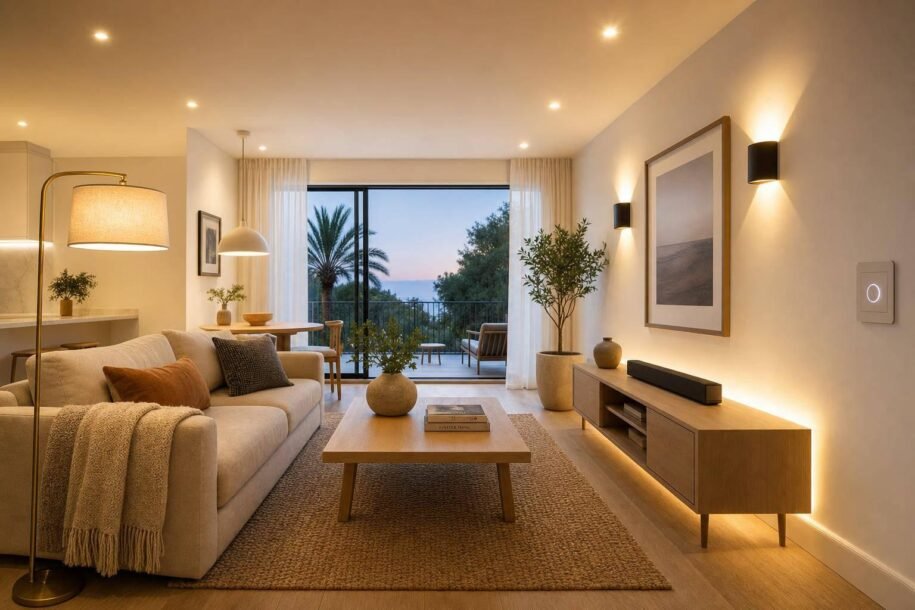
Good Airbnb lighting can change how your place looks, feels, and books. In many cases, a small update costs just $50–$150, yet it can improve listing photos, make check-in safer, and help guests feel more comfortable.
If I were setting up an Airbnb, I’d keep it simple:
- Use layered lighting: overhead, task, and mood lighting
- Pick LED bulbs to cut power use and reduce bulb changes
- Use 2,700K–3,000K in bedrooms and living areas
- Use 3,000K–4,000K in kitchens, bathrooms, and work areas
- Add dimmers where possible
- Keep bulb color matched within each room
- Make smart lights work from a normal wall switch
- Check every light before each guest arrives
A few numbers stand out. Listings with adjustable lighting get 18% more positive reviews, and rooms with adjustable lamps score better for comfort in 62% of cases. Layered lighting in photos has also been linked to 10%–15% higher nightly rates.
The main idea is simple: I’d choose lighting that looks good in photos, works well for guests, and stays easy to replace and maintain.
Airbnb Staging Tips: How to Design a Rental That Guests Love
sbb-itb-103bddb
Lighting Basics to Know Before You Buy Fixtures or Bulbs
Before you buy fixtures or bulbs, get the basics down first. In a rental, a few smart lighting choices can save you from buying the wrong stuff, dealing with guest complaints, and swapping bulbs all the time.
How to Layer Ambient, Task, and Accent Lighting
If a room has only one ceiling light, it usually feels flat. Photos look harsher, shadows get stronger, and the space can seem smaller than it is. That’s why layered lighting matters. You combine three types of light so the room feels balanced and easier to use.
Ambient light is the base layer. It’s the main overhead light that helps guests move around safely. Task light is more focused. Think bedside lamps for reading or under-cabinet lighting in the kitchen. Accent light adds mood and depth, like LED strips, wall sconces, or a floor lamp in the right corner.
This isn’t just about style. Multi-source layered lighting in listing photos has been linked to 10% to 15% higher nightly rates because guests see the space as more boutique or luxury [8].
Here’s a quick way to match each layer to its job:
| Layer | Common Fixtures | Best Rooms | Pros | Cons |
|---|---|---|---|---|
| Ambient | Recessed lights, flush mounts, chandeliers | All rooms | Needed for safety; fills the space | Can look flat or institutional if used alone |
| Task | Under-cabinet LEDs, desk lamps, vanity lights | Kitchen, bathroom, office | Very useful for guests | Can create glare if placed poorly |
| Accent | LED strips, wall sconces, picture lights | Living room, entryway, bedroom | Adds depth; works well in photos | Mostly decorative; limited utility |
Once you have the right layers in place, the next thing that matters is bulb specs.
Brightness, Color Temperature, and Bulb Type: What to Use
For most rentals, LED bulbs are the best default. They last longer, use less power, and hold up well when guests switch them on and off all day.
One spec you need to pay attention to is color temperature, which is measured in Kelvin (K). Use 2,700K–3,000K in living rooms and bedrooms. For kitchens, bathrooms, and workspaces, use 3,000K–4,000K [3][4]. Skip cool daylight bulbs in living spaces. They can make a room feel sterile and clinical [1][7].
"A well-lit space can transform a simple overnight stop into a memorable experience, while poor lighting can lead to discomfort and even negative reviews." – Bee Setups [3]
It also helps to choose dimmable LEDs and high-CRI bulbs. Dimmers give guests control. They can go bright when they need to cook or get ready, then softer at night when they want to wind down. High-CRI bulbs make décor colors look more natural instead of faded, which helps both the guest experience and your listing photos [2].
One last thing: keep the color temperature the same within each room. Mixing warm and cool bulbs in one space feels off, even if people can’t explain why.
With those basics in place, the next move is matching each room’s lighting to how guests will use it.
Room-by-Room Lighting Guide for Airbnb Properties
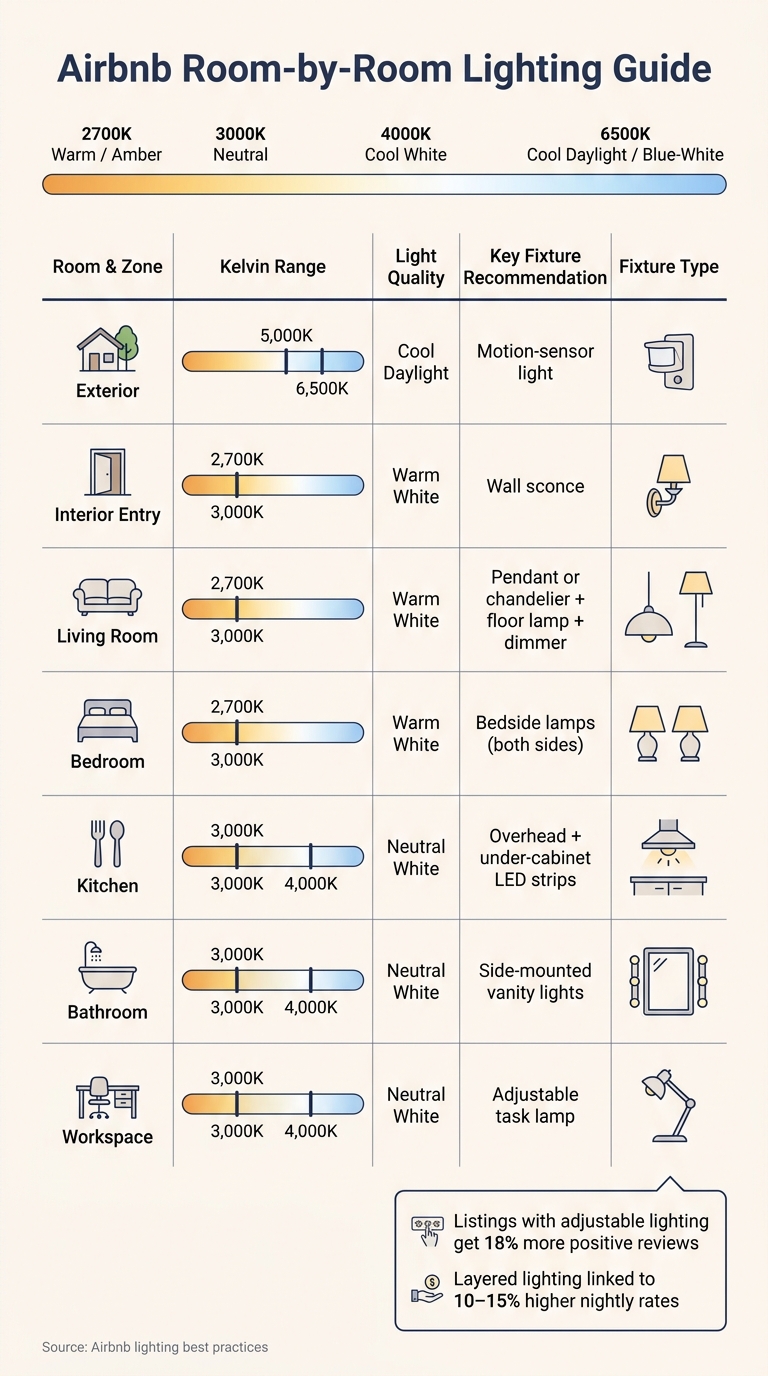
Airbnb Lighting Guide: Room-by-Room Kelvin & Fixture Cheat Sheet
Apply those lighting layers room by room, starting with arrival spaces.
Entry, Living Room, and Bedroom Lighting
The entry sets the tone the moment guests arrive. Motion-sensor or scheduled exterior lights make the door easier to find at night and help people get in safely. Just inside, a wall sconce adds a soft glow that feels warm right away.
In the living room, a single ceiling light usually falls flat. It leaves corners dark and gives guests only one mood setting. A better setup is to pair a central pendant or chandelier with a floor lamp in a darker corner and a table lamp on a side table. That way, guests can turn things up for hanging out or keep it low for a movie. A dimmer on the main overhead light makes that switch simple.
Bedrooms deserve extra attention. One overhead light can feel harsh and unflattering, especially late at night. Put bedside lamps on both sides of the bed, with switches that are easy to reach while lying down. If you want a cleaner setup, mount wall sconces about 20 inches above mattress height. They open up nightstand space and are less likely to get bumped or knocked over [9]. From there, it makes sense to move into the rooms where function comes first.
Kitchen, Dining, Bathroom, and Workspace Lighting
After the main living areas, shift to the rooms where people need light to do things, not just relax.
Kitchens should feel bright and easy to work in. Use a strong overhead fixture, then add under-cabinet LED strips to cut shadows on the countertop. In the dining area, a centered pendant or chandelier on a dimmer helps mark the space in open-floor-plan rentals. It also lets guests move from a brighter dinner setup to a softer evening feel without much effort.
Bathrooms need light that works with faces, not against them. Vanity lights placed at eye level on both sides of the mirror help reduce shadows for grooming. For a workspace, add an adjustable desk lamp with neutral white light so guests can focus without straining their eyes.
| Room | Kelvin Range | Key Fixture |
|---|---|---|
| Exterior | 5,000K–6,500K | Motion-sensor light |
| Interior entry | 2,700K–3,000K | Wall sconce |
| Living Room | 2,700K–3,000K | Pendant or chandelier + floor lamp + dimmer |
| Bedroom | 2,700K–3,000K | Bedside lamps (both sides) |
| Kitchen | 3,000K–4,000K | Overhead + under-cabinet LED strips |
| Bathroom | 3,000K–4,000K | Side-mounted vanity lights |
| Workspace | 3,000K–4,000K | Adjustable task lamp |
Fixtures, Smart Controls, and Budget Planning
Once your room plan is locked in, the next step is picking fixtures that are easy to clean, easy to replace, and consistent across the property.
How to Pick Fixtures That Look Good and Last
A simple rule works well here: use one focal fixture in each main room, then standardize the rest. That usually means a pendant or chandelier as the main visual piece, with simpler fixtures everywhere else so upkeep doesn’t become a headache.
The fixture types that matter most are:
- A focal fixture, such as a pendant or chandelier
- A low-profile ceiling light for secondary spaces
- Wall sconces for hallways and bathrooms
- Under-cabinet LED strips for kitchens
- Weather-resistant fixtures for outdoor areas
Try to keep the fixture style consistent across the property. That makes replacements easier and helps the space feel pulled together. And yes, use LED bulbs throughout. They use less power and last longer, which matters a lot in a rental.
Bedside lamps and basic room lighting should take a modest part of your total furnishing budget. Go too cheap on fixture quality, and it tends to show almost right away in a short-term rental.
After you choose fixtures, the next piece matters just as much: controls.
How to Use Smart Lighting Without Confusing Guests
Smart lighting should feel like normal lighting. If a guest walks into the room and can’t figure out how to turn on a lamp, you’ve already lost.
The best uses for smart lighting are pretty simple: exterior porch lights on a schedule, remote shutoff for lights left on between stays, and a turnover mode that sets everything to full brightness during cleaning [3][6]. Those tools cut energy waste and reduce guest complaints without asking guests to learn anything new.
The main rule is non-negotiable: never require guests to download an app or create an account to control the lights [3].
Use smart switches or smart plugs that still work like regular switches when someone taps them manually [3]. Smart plugs are an easy option for floor lamps and table lamps because they let you send an "all off" command from afar without rewiring [3]. In living rooms and bedrooms, dimmable smart bulbs paired with a simple wall switch give guests control over brightness without any app at all [3][5].
Once the setup is easy for guests, you can decide whether to handle the planning yourself or bring in help.
DIY Lighting Plans vs. Professional Design Support
Doing the lighting plan yourself keeps upfront costs lower. But it also takes time: researching fixtures, comparing bulbs, making shopping runs, and fixing the stuff that doesn’t work the first time.
For one property, that’s often doable. For owners with two or more units, things can start to drift. One room ends up warm-toned, another cool-toned. Fixture styles stop matching. The lighting works, but it doesn’t feel pulled together.
| Feature | DIY | Professional |
|---|---|---|
| Design Consistency | Variable; often mismatched | Cohesive and photo-ready [10] |
| Maintenance | Ad-hoc; hard to track | Standardized; easy to replace |
| Guest Experience | Functional | Experiential; higher reviews [6] |
For multi-unit owners or turnkey staging, Rank One Stays can handle vacation rental interior design and full-service management.
How to Maintain Lighting and Keep Your Property Guest-Ready
Once your lighting plan is in place, upkeep is what keeps the property ready for guests. Bulbs burn out. Smart bulbs drop off Wi-Fi. Fixtures pick up dust. Small checks like these help keep the space clean-looking, dependable, and energy-efficient.
Keep Bulbs Consistent and Easy to Replace
Before your first guest checks in, standardize bulb base types and match the color temperature in each room. That makes replacements simple and keeps the lighting from feeling off.
Keep a labeled bin of spare LED bulbs onsite. If you have more than one fixture type, sort them by room. For example: "Master Bedroom Bedside – 2700K." That way, your turnover team doesn’t have to guess.
Ask your cleaning or turnover staff to test every light switch during each turnover. If a bulb is flickering or dead, they should replace it right away. It’s a small task, but it saves guests from arriving to a room that feels neglected.
Dust matters too. Wipe bulbs and fixtures now and then to clear off buildup that can make light look weaker over time. And if you use smart bulbs, add a fast connection check to the routine. If a smart bulb is offline, guests won’t care why – it just looks like a broken light.
Final Checklist for a Guest-Ready Airbnb Lighting Setup
Use this quick turnover check before every arrival:
- Overhead light works and lights the full room
- Beds, desks, counters, and vanities have working task lights
- Bulbs match within each room
- Cords are secured and out of the way
- Light switches are easy to find and control the correct fixtures
- Smart controls still work from the physical switch
If you’d rather have someone handle this every turnover, owners who want turnkey lighting, staging, and upkeep can work with Rank One Stays for vacation rental interior design and staging and professional property management.
FAQs
How bright should each room be?
Balance ambient light with task lighting so a room feels good and still works for daily life.
Living rooms and bedrooms usually do best with a soft, warm glow from 2700K to 3000K bulbs. It feels calmer, less stark, and easier to live with at night. Kitchens and bathrooms, on the other hand, need a cleaner white light in the 3000K to 4000K range so you can see what you’re doing without straining.
For brightness, aim for 500 to 1,000 lux on kitchen work surfaces and 200 to 300 lux for desks or reading spots. In bedrooms, bedside lamps are often a better pick than harsh overhead fixtures, which can make the space feel too bright and flat.
Are smart lights worth it for Airbnb?
Yes. Smart lighting can be a smart upgrade for Airbnb properties because it helps with efficiency, security, and the guest experience.
With smart bulbs or switches, you can track energy use, turn lights off after checkout, set lighting to come on before guest arrivals, and give guests control over brightness or mood. That can make the space feel a bit more polished, without much extra effort from you.
What lighting upgrades offer the best ROI?
Lighting is often one of the highest-return, lowest-cost upgrades you can make to an Airbnb.
One of the easiest wins is swapping cool, harsh bulbs for warm white bulbs in the 2700K to 3000K range across the rental. That small change can make a place feel less sterile and far more inviting.
Dimmer switches can also add strong value. They let guests adjust the mood for different moments, whether they want bright light for work or a softer glow at night.