
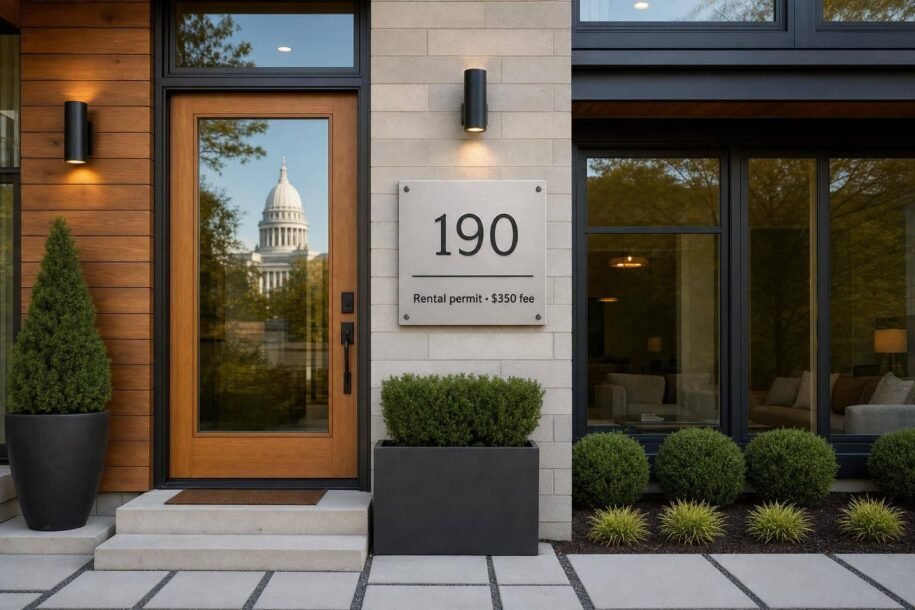
Madison is moving to regulate short-term rentals for the first time, advancing a proposal that would cap permits at 190 properties and charge a $350 application fee for operators of homes listed on platforms such as Airbnb and VRBO.
The proposal passed on a 5-2 vote after a public hearing at Madison City Hall that drew roughly 20 speakers on June 22. Residents, short-term rental owners, and council members offered sharply different views on how the growing north Alabama city should handle the properties. Operational rental owners now have 90 days to file an application to legally run a short-term rental in the City of Madison.
First city rules for short-term rentals
Short-term rentals are legal in Madison, and the Planning Commission estimated there are between 60 and 150 short-term rentals are operating in Madison. Before this ordinance, the article said, those properties were not subject to specific rules.
Under the new ordinance, the city would limit short-term rental permits to 190, or .75% of housing units in Madison. Owners would pay a $350 application fee, which covers the cost of a home inspection, and would also need a business license that costs $150. Both must be renewed annually.
Owners will also pay lodging tax.
Other requirements in the ordinance include one parking spot per bedroom, neighbor notifications, Homeowners Association approval, if applicable, and a local contact person that live within 30 minutes of the short-term rental.
The city would also impose a "three-strike rule." If an operator receives three credible complaints within a year, then the city will suspend their permit.
Council Vice President Maura Wroblewski said this was the "most difficult" topic in her 10 years on the council.
sbb-itb-103bddb
Residents describe neighborhood concerns
Several residents who spoke at the hearing opposed short-term rentals or said they were concerned about their effect on neighborhoods.
Madison Olsen, who said the home across the street and next to her home are both short-term rental properties, told council members she was also worried about another house on her street that is going on the market.
"He (Olsen’s husband) told me if it becomes an Airbnb or VRBO, he wants to move", she said. "I chose to live in a family neighborhood in one of the best school districts in Alabama. I don’t want to raise children next to and around full-time hotels with strangers coming and going, strangers who blast loud music outside on weeknights, and party outside on a Monday night when you’re trying to sleep."
Frank Tatum also raised concerns about activity tied to rental homes.
"One of our neighbors has already moved out of the neighborhood because they had small children, and they didn’t want the children playing in the street, the people coming and going, and not only that, as I mentioned, but also people smoking marijuana", Frank Tatum said.
The article said other residents complained about parties and noise, while some longtime homeowners said they feared neighborhood character and home prices would decline.
Owners split on the proposal
Short-term rental owners did not present a single view. Several spoke in favor of the regulations and said they screen renters and provide a needed option for families and visitors.
"Short-term rentals are a newer concept, and we’ve learned that they are a critical solution to housing", Mary Howard said. "Families need a temporary residence to house their family, or a hotel is just not a viable option. (…) This meets a crucial need for Madison residents, as well as visitors who have limited funds."
Other owners opposed the ordinance because they were concerned the fees were too high or that they would not be among the 190 approved properties.
Two council members voted no
Councilmembers Michael McKay, of District 3, and Kenneth Jackson, of District 7, opposed the legislation, saying they believed short-term rentals would end up in their neighborhoods because many homes are not part of HOAs and that most of their constituents oppose the ordinance.
"Residents repeatedly described to me that they chose Madison because of its reputation as a family-oriented city where neighbors know one another and residents take pride in maintaining stable, connected communities", McKay said. "To many of us, STRs (short-term rentals) are fundamentally incompatible with that environment, and I agree. Constituents stress concerns to me that, as more homes are converted into short-term lodging, neighborhoods will gradually transition from residential communities into transient accommodations, weakening the relationships and trust that make neighborhoods desirable places to live, and I agree with that point."
With the measure approved, existing operators have 90 days to apply as Madison begins enforcing its first specific rules on short-term rentals.