

If I had to sum it up in one line: use PriceLabs, Beyond, Wheelhouse, or DPGO for daily pricing, and use AirDNA, Mashvisor, or AllTheRooms Analytics for market research and buy decisions.
If you run short-term rentals, the wrong tool can cost you money in two ways: bad nightly rates and weak market research. In this list, I’d split the seven tools by what they do best:
- Live pricing: PriceLabs, Beyond, Wheelhouse, DPGO
- Market and revenue research: AirDNA, Mashvisor, AllTheRooms Analytics
- Best for larger portfolios: PriceLabs, Beyond, Wheelhouse
- Best for simple setup: DPGO
- Best for underwriting and market checks: AirDNA and Mashvisor
A few numbers stand out right away. PriceLabs supports 600,000+ properties and connects with 160+ PMS platforms. AirDNA covers 120,000+ markets. Wheelhouse can forecast up to 18 months out. Those differences matter if you need daily rate updates, long-range market views, or multi-property reporting.
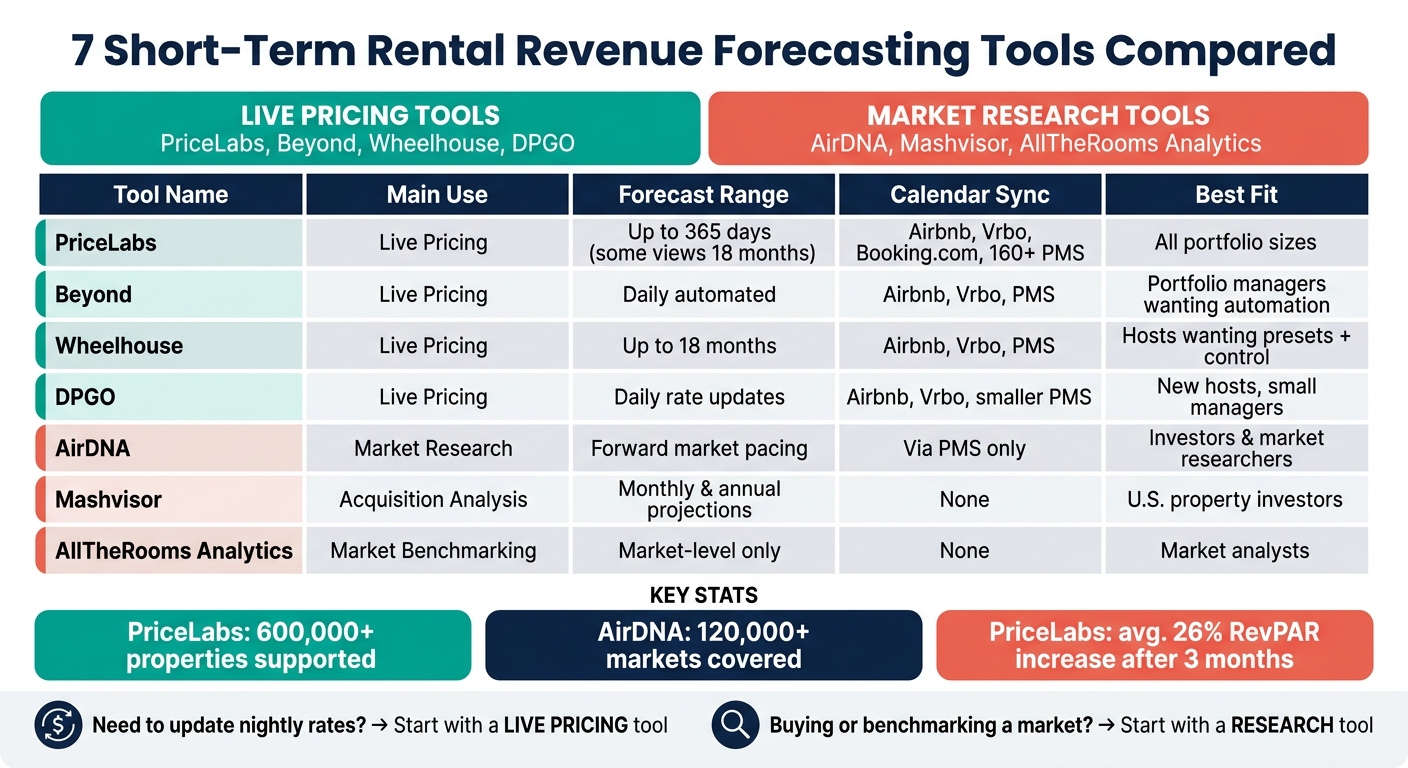
7 Short-Term Rental Revenue Forecasting Tools Compared
How to Analyze a Short Term Rental Market Using PriceLabs (Step-by-Step Walkthrough)
Quick Comparison
| Tool | Main Use | Forecast Range | Demand Inputs | Calendar/Rate Sync | Best Fit |
|---|---|---|---|---|---|
| AirDNA | Market research | Forward market pacing + pricing guidance | Airbnb/Vrbo market data, comp sets, lead times | Via PMS, not direct | Investors, market research |
| PriceLabs | Live pricing | Up to 365 days; some views to 18 months | Seasonality, local events, pickup pace, comps | Airbnb, Vrbo, Booking.com, 160+ PMS | Single hosts to large portfolios |
| Beyond | Live pricing | Daily automated pricing | Search demand, local events, pace, comp availability | Airbnb, Vrbo, PMS | Hosts who want more automation |
| Wheelhouse | Live pricing | Up to 18 months | Comp pricing, availability, events, seasonality | Airbnb, Vrbo, PMS | Hosts who want presets plus some control |
| DPGO | Live pricing | Daily rate updates | Competitor pricing, booking history, demand shifts | Airbnb, Vrbo, smaller PMS set | New hosts, small managers |
| Mashvisor | Acquisition analysis | Monthly and annual income projections | Airbnb data + MLS data | No live sync | U.S. property investors |
| AllTheRooms Analytics | Market benchmarking | Market-level only | Supply/demand and ADR trends | No live sync | Research and benchmarking |
My simple takeaway: if you need to change nightly rates every day, start with a pricing tool. If you’re studying where to buy or how a market is moving, start with a research tool. That split makes the choice much easier before you dig into features, fees, and reporting.
1. AirDNA
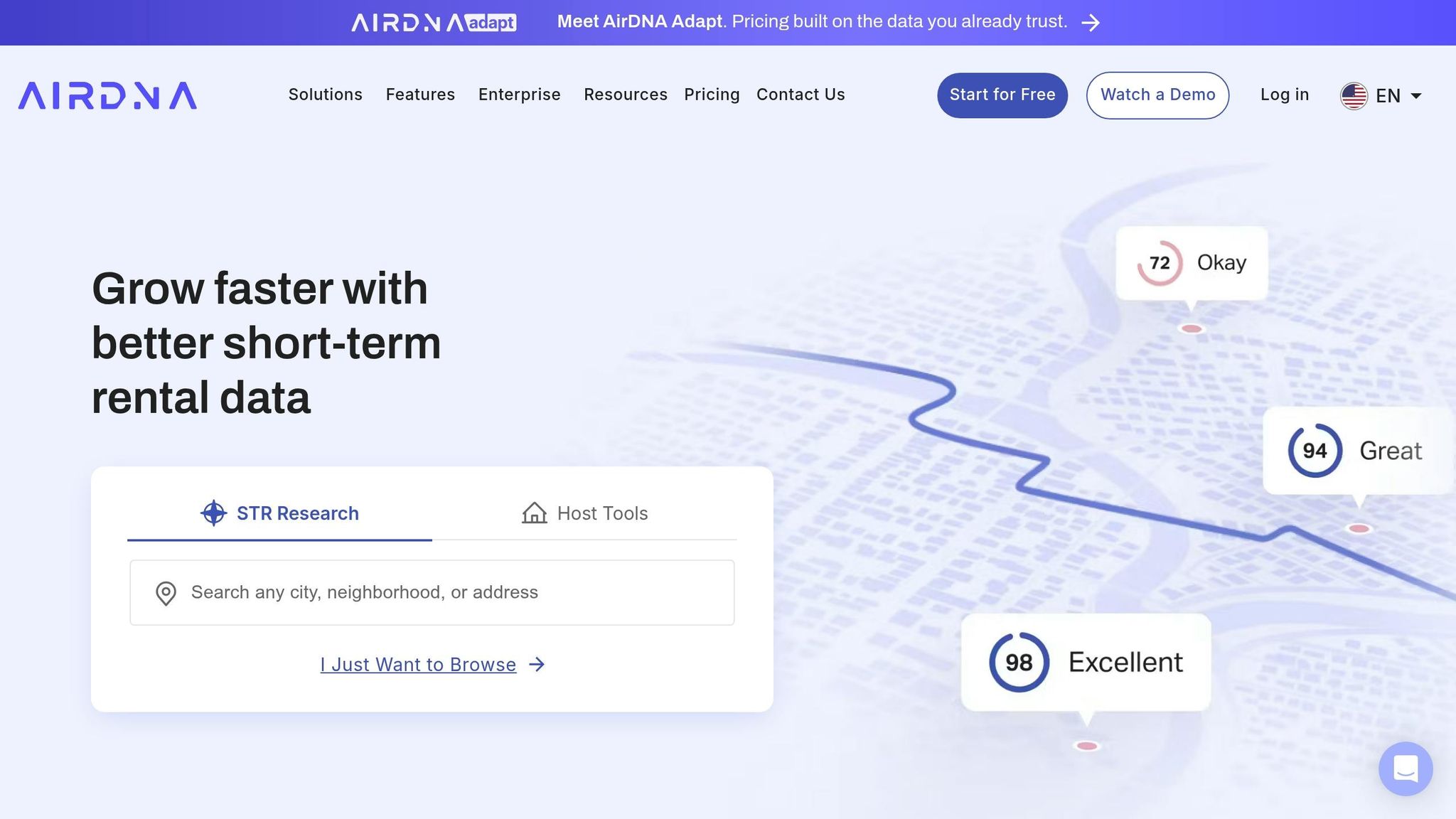
AirDNA gives short-term rental market data built from Airbnb and Vrbo listings in more than 120,000 markets around the world [6].
Forecast Depth
AirDNA tracks RevPAR, Average Daily Rate (ADR), and occupancy projections. Its Smart Rates feature creates day-by-day pricing suggestions based on seasonality, holidays, and live demand signals [1].
That said, AirDNA is more of a market data tool than a direct pricing engine. It tells you what to charge, but another integration has to handle the calendar update.
Demand Data
AirDNA’s forward-looking pacing view shows upcoming bookings and demand patterns, along with market-level booking lead times. That helps hosts make better timing calls when they change prices [1].
It also lets you build custom comp sets, so you can compare your property against specific nearby listings and their future availability [1].
That kind of market view is useful, but it matters most when it plugs into an active pricing workflow.
Calendar Integrations
AirDNA does not send rates straight to Airbnb or Vrbo. Instead, it passes SmartRates data into property management systems like Futurestay [6], which makes AirDNA the data layer in a larger pricing setup.
Reporting for Scale
Single-property hosts can use property-level pricing and local comp data. Portfolio investors can dig into trailing 12-month revenue analysis and forward-looking market demand when underwriting acquisitions [5][1].
AirDNA tends to fit best when market analysis comes first; the next tools get closer to live pricing execution.
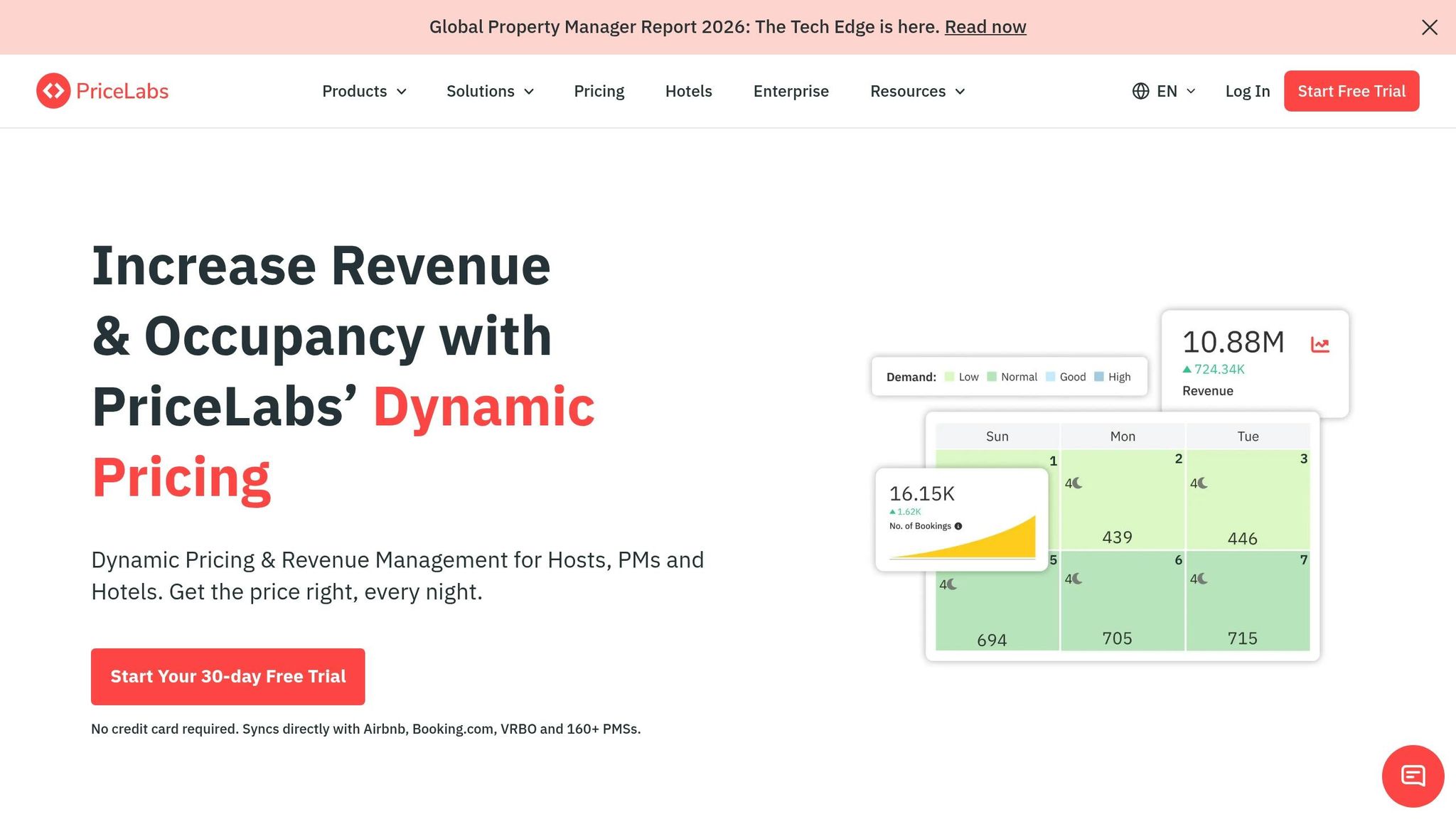
2. PriceLabs
PriceLabs updates rates and minimum stays every day across 600,000+ properties using its proprietary Hyper Local Pulse (HLP) algorithm. The focus is on neighborhood-level demand, not broad market averages [7].
Forecast Depth
PriceLabs is built for active rate management, not just reading forecasts. It looks ahead up to 365 days, and some Market Dashboard views extend to 18 months [4][1].
Revenue Estimator Pro uses market data to project revenue. Then, in April 2026, the Revenue Accelerator upgrade added AI-generated performance reports and Group-Level Preview Prices [7]. In plain English, this is a day-to-day pricing tool for hosts who need to make rate decisions all the time, not just check a yearly revenue estimate.
Demand Data
PriceLabs blends several demand signals to guide daily pricing decisions, including:
- seasonality
- day-of-week demand
- local events
- live pickup pace
All of those feed into its pricing logic [1][7]. The Market-Driven Base Price Helper sets a starting rate based on local comp performance, while gap-night rules discount single open nights [1][7]. On top of that, more than 30 controls shape how those signals affect pricing [7].
Calendar Integrations
PriceLabs syncs rates and minimum stays with Airbnb, Vrbo, Booking.com, and 160+ PMS platforms, including Guesty, Hostfully, and Lodgify [7].
Reporting for Scale
For single-property hosts, Base Price Helper cuts down setup guesswork, and the automation handles daily adjustments [1][7]. It works for one listing, but its edge shows up more clearly when you manage several.
For larger portfolios, bulk portfolio rules, Owner Analytics, and Group-Level Preview Prices make scale easier to manage [7]. That makes PriceLabs a strong benchmark for automation-heavy pricing. The next tools give up some control in exchange for different forecasting strengths.
Unlike market-only tools, PriceLabs turns those signals into daily pricing and stay-length rules.
3. Beyond
Beyond (formerly Beyond Pricing) takes a simpler, more automated path than PriceLabs. PriceLabs gives you deep rule control. Beyond leans more on automation and live demand signals.
Forecast Depth
Beyond adjusts daily rates automatically using a base price plus dynamic changes that balance occupancy and ADR [4]. Compared with PriceLabs, the tradeoff is pretty clear: less customization, more speed.
Demand Data
Beyond’s standout feature is real-time traveler search demand. Instead of leaning only on past booking patterns, it tracks how travelers search on OTAs to spot small shifts in demand before those shifts appear in bookings [1].
It also uses hyperlocal market signals, local events, booking pace, competitor availability, and seasonal demand curves to shape daily rate decisions [1][8].
Calendar Integrations
Beyond syncs with Airbnb and Vrbo. It also connects with property management system integrations for automatic rate and availability sync [1].
Reporting for Scale
For portfolio operators, bulk editing and portfolio-level analytics make it easier to manage many listings across multiple locations [1]. The workflow is simpler, which fits hosts who want automated portfolio management without heavy rule-building. That makes Beyond a better fit for operators who want less manual tuning and more automated portfolio control.
4. Wheelhouse
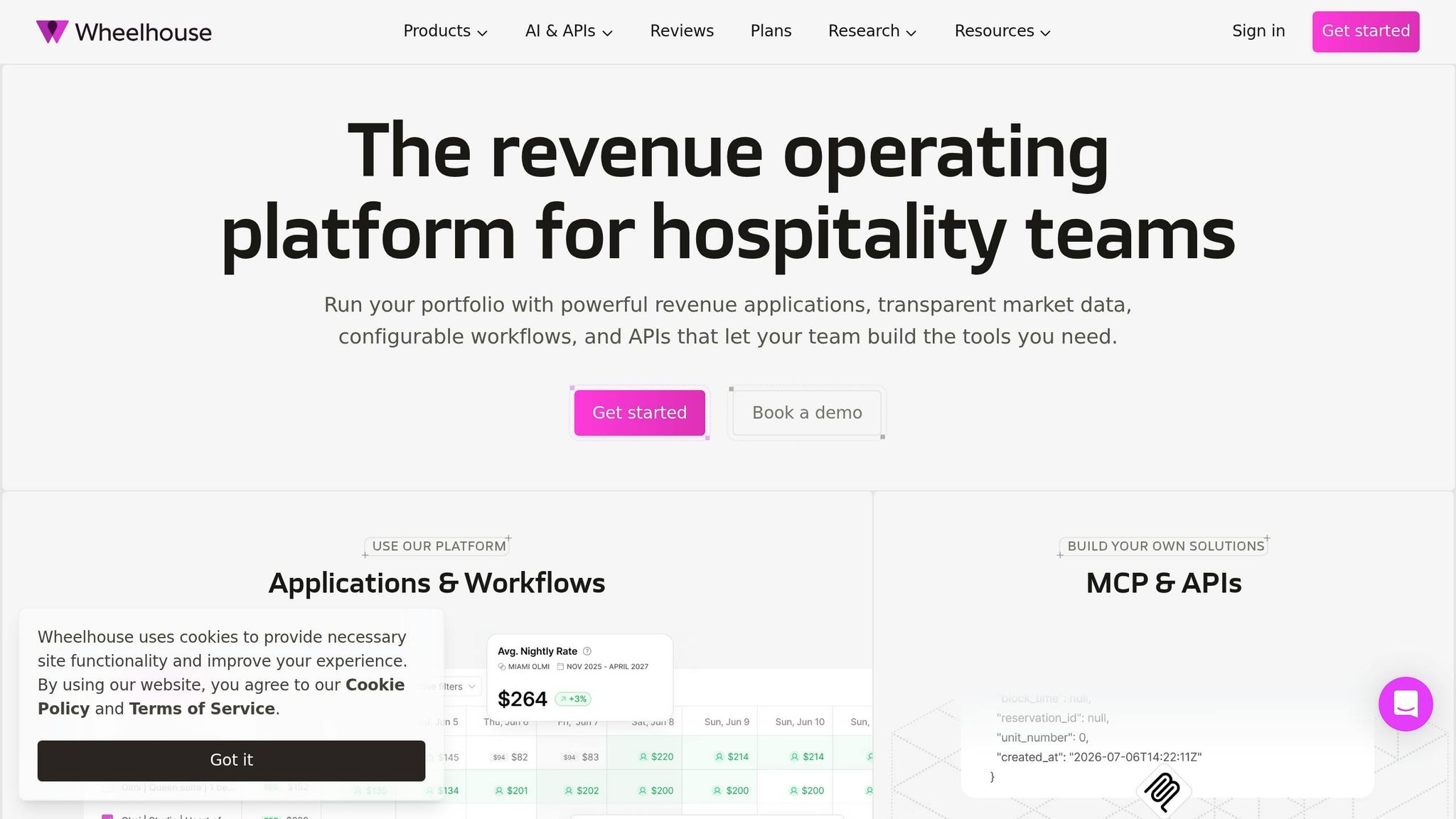
Wheelhouse sits in the sweet spot between set-it-and-forget-it automation and rule-heavy pricing setups. It works well for hosts who want preset strategy options without having to build every rule from scratch.
Forecast Depth
Wheelhouse offers forecasts up to 18 months out [1]. You can pick from conservative, balanced, and aggressive presets depending on whether you want to lean more toward occupancy or nightly rate [1]. It can also spot single-night gaps between bookings and lower minimum stay rules to help fill those openings [2][8].
Demand Data
Wheelhouse looks at comp set pricing, availability, event calendars, booking pace, and seasonality when setting daily rates [8][3]. That makes it a strong fit for markets where prices move a lot due to local events, seasonal swings, and shifts in booking pace. If you use it with Airbnb, turn off Airbnb Smart Pricing so the two systems don’t clash [1].
Calendar Integrations
It connects directly with Airbnb, Vrbo, and PMS platforms [1].
Reporting for Scale
Solo hosts can get up and running without much friction. Teams running larger portfolios tend to get more out of features like bulk adjustments and custom rules [1]. Wheelhouse can scale from one listing to more than 1,000 properties [1]. For operators with many units, deeper market data tends to matter more than it does for someone managing just one place [1]. Pricing starts at 1% of booking revenue or $19.99 per listing [1].
sbb-itb-103bddb
5. DPGO
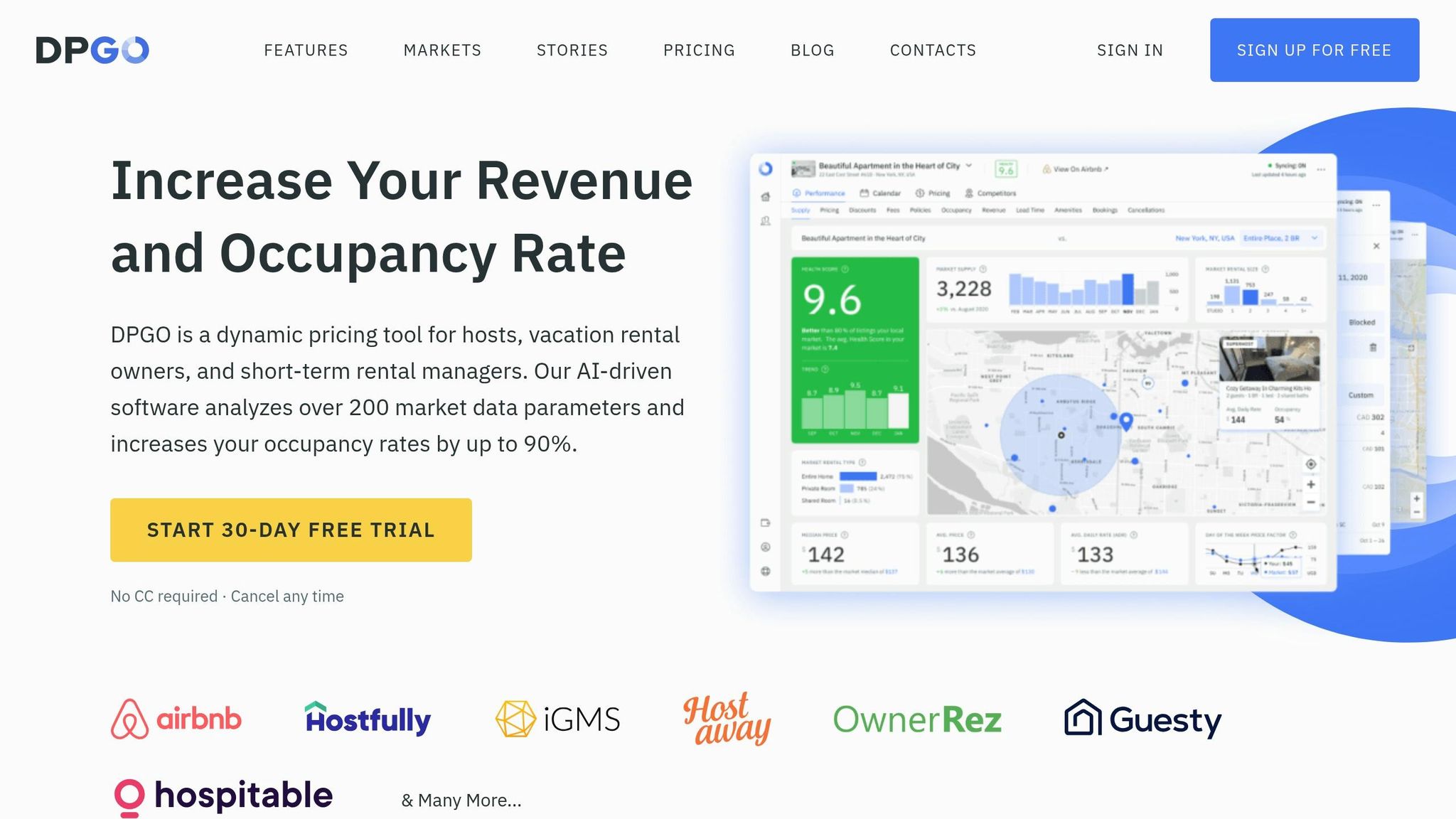
DPGO is a simple AI pricing tool built for new hosts and small property managers who want very little setup. In this group, it’s the most hands-off option.
Forecast Depth
DPGO updates nightly rates and minimum-stay rules every day based on local demand.
Demand Data
DPGO combines competitor pricing, demand changes, and booking history into three presets: Conservative, Balanced, and Aggressive[1].
Calendar Integrations
DPGO connects with Airbnb, Vrbo, and a smaller PMS network, though features can vary by system[1]. That smaller network matters more if you manage multiple listings across different platforms.
Reporting for Scale
DPGO fits individual hosts and small managers better than large portfolios. Its reporting is simple and geared toward an automated workflow. Pricing starts at $1 per listing per night or 0.5% of booking revenue, and it includes a 30-day free trial[1].
6. Mashvisor
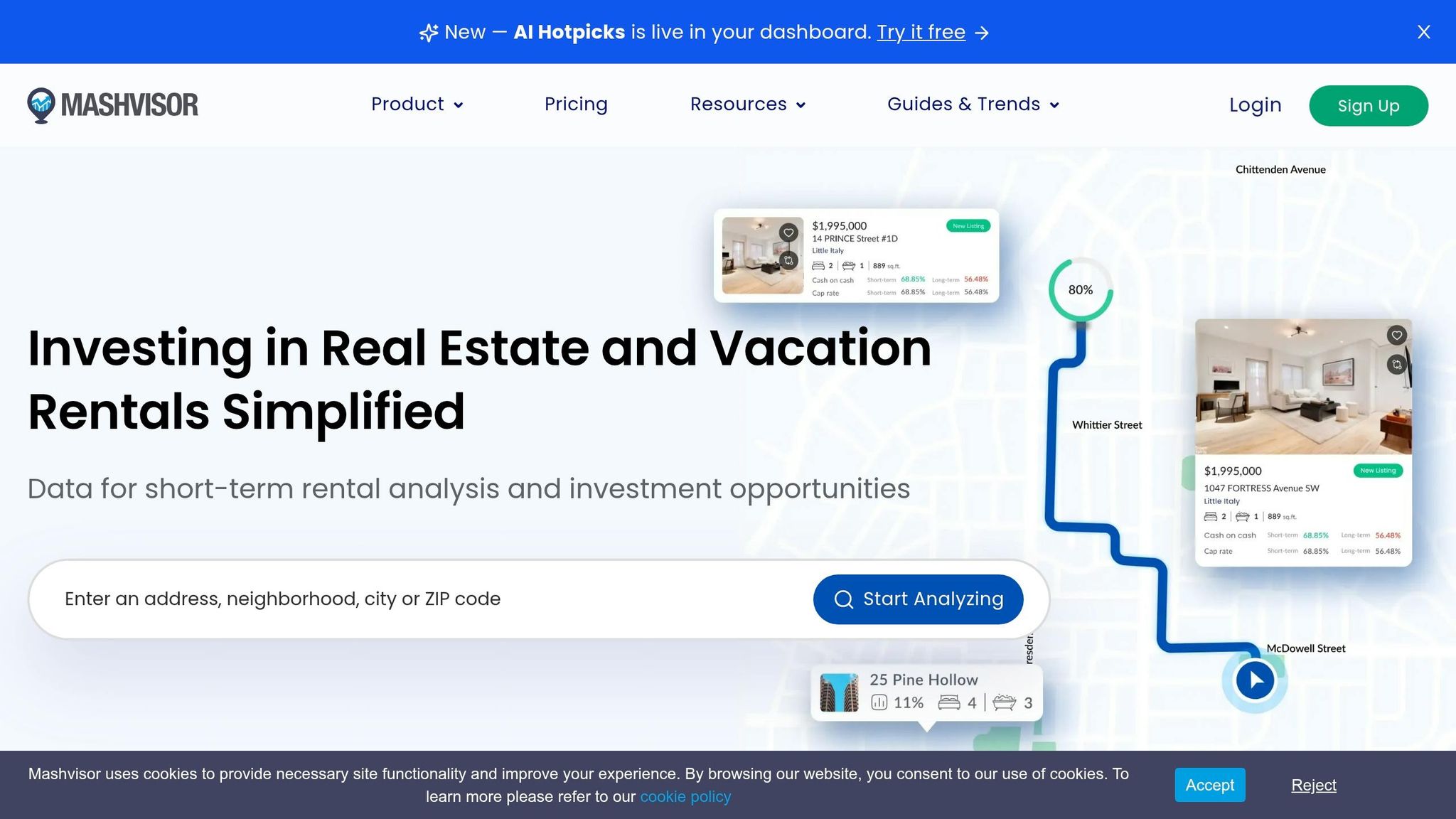
Mashvisor puts the spotlight on buying decisions, not live rate changes. It’s made for investors who want to size up a property before they put money into it.
Forecast Depth
Mashvisor projects monthly and annual rental income, cash flow, cap rate, and cash-on-cash return for U.S. residential properties [9]. Its AI and machine learning models can forecast performance even for properties with little or no rental history [9].
That matters when you’re underwriting in a new market. You can still get a read on a deal even if the property doesn’t have much past rental data. The downside is pretty simple: Mashvisor does not give you the day-by-day rate forecasts that active hosts use for live pricing.
Demand Data
Mashvisor pulls short-term rental data directly from Airbnb and combines it with MLS real estate data [9]. It brings together occupancy, ADR, listing price, expense data, and neighborhood ROI metrics in one place.
It also helps you see which property types and bedroom counts are producing the highest returns in a specific neighborhood [10]. If you’re comparing a two-bedroom condo to a three-bedroom house in the same area, that kind of detail can save a lot of guesswork.
Calendar Integrations
Mashvisor does not sync live rates to Airbnb or Vrbo. It is an investment-analysis tool, not a pricing engine.
Reporting for Scale
Its reporting works best when you’re comparing markets, neighborhoods, and single listings side by side.
| Reporting Level | Primary Tool | Best For |
|---|---|---|
| City | Top Locations rankings | Choosing a profitable market |
| Neighborhood | Real Estate Heatmap | Identifying high-performing areas [9] |
| Property | Investment Property Calculator | Analyzing a specific listing’s ROI |
Mashvisor is best for underwriting before purchase; it does not replace live pricing software. It fits pre-purchase analysis well, but not daily rate management.
7. AllTheRooms Analytics
AllTheRooms Analytics is a bit different from the pricing tools above. Instead of helping owners set nightly rates, it helps them size up a market. In plain English: it’s built for research first, not day-to-day pricing.
Forecast Depth
AllTheRooms Analytics is made for market benchmarking. It does not work as a daily revenue forecasting or pricing tool. So it fits on the market-research side of the short-term rental forecasting spectrum.
Demand Data
Its main strength is market visibility, not rate execution. It offers supply-and-demand data for the market, including neighborhood ADR distribution and broader market shifts.
Calendar Integrations
There’s no mention of calendar sync or pricing push.
Reporting for Scale
AllTheRooms Analytics works best as a research layer for market benchmarking. Use it to compare markets and study performance, not to run an active calendar. That makes it a useful reference point for the final comparison of forecast depth, data sources, integrations, and reporting scale.
Where the Tools Differ Most
The comparison boils down to four things: forecast depth, demand data, calendar integrations, and reporting scale.
Forecast Depth: Day-to-Day Revenue vs. Acquisition Analysis
The split here is pretty clear. Live pricing tools forecast nightly rates. AirDNA, Mashvisor, and AllTheRooms Analytics lean toward market analysis and buy-box decisions instead.
That means research tools help with underwriting and benchmarking, but they don’t handle live rate updates.
Once you know how far ahead a tool can forecast, the next step is simple: look at the data behind that forecast.
Demand Data: Market Comps, Booking Pace, Events, and Seasonality
This is where the inputs start to matter.
Beyond uses real-time search demand. PriceLabs and Wheelhouse mix comps, events, and booking pace. DPGO automates competitor and demand signals. AirDNA, Mashvisor, and AllTheRooms Analytics do a better job with market context than with live rate reaction.
In plain English: some tools help you react to what’s happening right now, while others help you understand the market before you make a move.
Calendar Integrations: Airbnb, Vrbo, and PMS Connections
PriceLabs has broad PMS and OTA coverage, which makes it the most flexible pick for hosts already working inside a property management system [1].
Beyond and Wheelhouse connect directly to major OTAs and PMS platforms, so rates can push out on their own. AirDNA, Mashvisor, and AllTheRooms Analytics are research platforms. They don’t offer meaningful calendar sync or rate-push functions, so you’ll need a separate pricing engine if automated pricing is the goal.
Reporting for Scale: Single Listings vs. Multi-Property Portfolios
The table below shows which tool tends to fit each owner type best:
| Tool | Single-Property Owner | Small Operator (3–10 units) | Portfolio Investor (10+ units) |
|---|---|---|---|
| PriceLabs | ✓ (granular control) | ✓✓ (bulk rules, gap-night fills) | ✓✓ (broad integrations, roll-up views) |
| Beyond | ✓ | ✓✓ | ✓✓ (bulk edits, portfolio-level analytics) |
| Wheelhouse | ✓ | ✓✓ | ✓✓ (scales from 1 to 1,000 units) |
| DPGO | ✓✓ (simple AI presets) | – | – |
| AirDNA | ✓ (market research) | ✓ (comp analysis) | ✓✓ (investment underwriting) |
| Mashvisor | ✓ (pre-purchase analysis) | ✓ (market benchmarking) | – |
| AllTheRooms Analytics | ✓ (market benchmarking) | ✓ (supply/demand research) | – |
A simple way to look at it:
- DPGO fits single hosts best
- Beyond and Wheelhouse fit larger portfolios
- PriceLabs works well for both smaller setups and bigger operations
Those trade-offs stand out even more in the pros and cons below.
Pros and Cons
Use these pros and cons to match each tool to the way you work, not just the features on the page.
| Tool | Main Pros | Main Cons | Best User Type |
|---|---|---|---|
| AirDNA | Strong market intelligence; 94.9% accuracy vs. Airbnb data [2]; useful for investment underwriting | Not a live pricing engine; may be pricey for casual hosts at $19.99–$39.99/month [2] | Investors and market researchers |
| PriceLabs | 150+ integrations; hyper-local demand algorithm; deep customization; average 26% RevPAR increase after three months [7] | Steeper learning curve for advanced features | All portfolio sizes; data-driven managers |
| Beyond | Real-time guest search data; 1% of booking revenue [1] | Percentage fee gets expensive on high-revenue properties | Portfolio managers |
| Wheelhouse | Risk-based presets; scales from 1 to 1,000+ units; flat fee starting at $19.99 per listing/month or 1% of revenue [1] | Requires disabling Airbnb Smart Pricing to prevent conflicts [1] | Hosts wanting simplicity with control |
| DPGO | Very affordable at $1/listing/night or 0.5% commission [1]; AI-driven presets [1] | Smaller integration network than major competitors | Cost-sensitive single-property hosts |
| Mashvisor | Strong pre-purchase analysis; granular competitor data for market research | Primarily a research tool, not a daily pricing engine | Real estate investors |
| AllTheRooms Analytics | Market-level benchmarking and supply/demand research | Less reliable in thin markets; relies on scraped data [2] | Market analysts |
The split here is pretty simple: some tools are built to help you set nightly rates, while others are built to help you study a market before you buy, launch, or expand.
Main Strengths by Tool
Live pricing tools – PriceLabs, Beyond, Wheelhouse, and DPGO – each lean toward a different balance of control and automation. Some give you deeper rule-setting. Others do more of the work for you.
Research-first tools – AirDNA, Mashvisor, and AllTheRooms Analytics – are strongest when you need help with underwriting, market checks, and benchmarking before making a move.
Main Trade-Offs by Tool
Research tools are strong at analysis, but they stop there. They won’t run day-to-day pricing for you.
Live pricing tools handle rate changes in the market as they happen, but there’s usually a trade-off. In most cases, the more automation you want, the less hands-on control you keep.
Conclusion
There’s no one-size-fits-all winner here. The main divide comes down to live pricing, market research, and portfolio reporting. The best pick depends on your goal: pricing tonight’s booking, sizing up a new market, or running a growing portfolio across several cities.
If you host a single property, DPGO is a smart place to start if you want very little setup. Wheelhouse makes sense if you want a bit more control without making things too complicated. If you want a broader view, compare their reporting depth and calendar sync next.
If you run several properties and lean hard on data, the choices get clearer. PriceLabs stands out for the deepest pricing control. Beyond fits operators who want simpler automation plus live demand signals. AirDNA is the go-to option for market underwriting. If you’re an investor comparing U.S. markets for acquisitions, start with AirDNA and treat its projections as directional estimates, especially in markets with fewer active listings. The table below lines each tool up with a common operating style.
| Your Situation | Best Starting Point |
|---|---|
| 1–2 properties, want easy automation | DPGO or Wheelhouse |
| Multiple properties, want pricing control | PriceLabs or Beyond |
| Researching a new U.S. market to buy into | AirDNA |
| Need portfolio-wide reporting and analytics | PriceLabs |
FAQs
Which tool is best for live pricing?
It comes down to two things: the size of your portfolio and how much control you want over pricing.
PriceLabs is often viewed as the go-to choice if you want deep customization and automated daily rate updates. Beyond works well if ease of use matters most and you want pricing that shifts with real-time demand. Wheelhouse sits in the middle, giving you a simpler setup without giving up too much control.
If you’d rather take a more hands-off route, Rank One Stays offers full-service management with expert dynamic pricing.
Do I need a pricing tool and a research tool?
Yes. Pricing tools manage day-to-day rate changes based on real-time market signals. Research tools help you spot seasonal trends, compare similar listings, and size up a property’s investment potential.
Put simply, pricing tools carry out your strategy. Research tools help you build it. If you want a turnkey option, Rank One Stays can handle dynamic pricing and listing optimization for you.
What should I choose for one rental property?
For a single rental property, professional management is often the best way to get more from your investment. Rank One Stays handles the day-to-day work for you, including listing optimization, dynamic pricing, 24/7 guest support, housekeeping, and damage claims.
Owners who partner with Rank One Stays earn 38% more revenue than the market average, with fees starting at 10%.