

The best vacation rental markets usually show one simple pattern: demand goes up while supply stays in check. If I were screening a market today, August 9, 2026, I’d focus on 12 to 24 months of data, check occupancy, ADR, RevPAR, and listing growth, and rule out any city where local STR laws break the deal.
Here’s the short version:
- I start with a buy box: budget, property type, distance, and whether I’d self-manage or hire help.
- I look for rising occupancy and ADR, not just one or the other.
- I compare demand growth vs. supply growth. If listings are piling up faster than bookings, I slow down.
- I want more than one travel driver, like parks, hospitals, sports, universities, or business travel.
- I check city, county, and HOA rules before I underwrite anything.
- I run the deal using base-case numbers, then test a lower-rent, lower-occupancy version.
- If I’m more than 2 hours away, I assume I’ll need local cleaners, vendors, and guest support lined up before I buy.
A market is not “emerging” just because people are talking about it. It needs to show year-over-year demand growth, room for rates to hold, and home prices that still work at today’s costs.
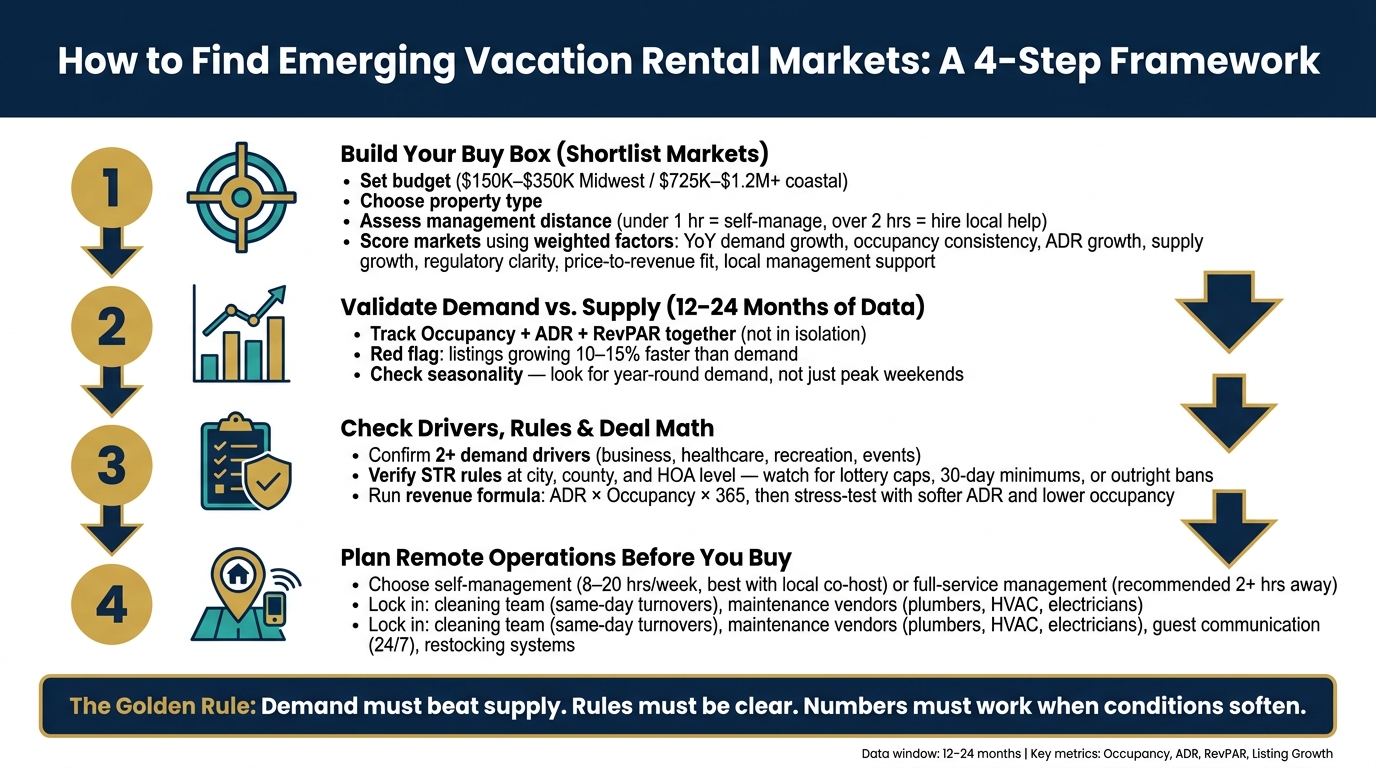
How to Find Emerging Vacation Rental Markets: 4-Step Framework
How to Find Emerging Airbnb Markets Before Everyone Else
sbb-itb-103bddb
Quick Comparison
| What I Check | What I Want to See | Red Flag |
|---|---|---|
| Occupancy | Steady or rising year over year | Flat nights with heavy discounting |
| ADR | Stable or up | Falling rates used to fill nights |
| RevPAR | Moving up | Flat or down even with solid occupancy |
| Supply growth | New listings growing slowly | Inventory growing 10% to 15% faster than demand |
| Demand drivers | 2+ sources of visitors | One season, one event, or one crowd |
| Rules | Clear permit path and usable STR setup | Ban, lottery cap, or long minimum stay |
| Deal math | Works with softer assumptions | Only works in peak-season numbers |
| Remote setup | Managing rentals across multiple locations with cleaners, maintenance, and guest support | No local team in place |
If I had to sum it up in one line: pick a tight buy box, verify demand is beating supply, confirm the rules, and make sure the home still works when the numbers soften.
Step 1: Build a Shortlist of Markets That Fit Your Buy Box
Before you open a single data dashboard, get clear on what you want to buy. A buy box keeps you focused on markets that match your budget, property type, and management approach. It tells you which markets make the cut. Use it first, then test occupancy, ADR, and supply growth.
Set Your Investment Criteria Before Looking at Data
Start with budget. Lower-entry Midwest markets may begin around $150,000 to $350,000, while premium coastal markets can cost $725,000 to $1.2 million+ [2][3].
Next, decide on the property type before you search. One smart rule: buy properties that still make sense as long-term rentals if short-term rules change.
Once you’ve set budget and property type, narrow the list based on how easy the asset will be to manage.
Use Travel Patterns and Access to Narrow the Field
Distance matters more than many buyers expect. Properties within an hour are usually easier to self-manage. Homes more than two hours away often need local help. That changes the math.
Access also shapes whether you can run the property at a profit from a distance. Look for markets with more than one demand driver. Beaches, major attractions, historic districts, and large events usually create broader demand than a market built around one seasonal pull. That can support steadier occupancy across the year [6][2].
Then compare the remaining markets with a simple scorecard.
Score Each Market With a Simple Weighted Model
Score three to five markets side by side. A simple weighted scorecard helps you stay honest and avoid chasing a market just because it sounds good.
| Factor | Why It Matters | Suggested Weight |
|---|---|---|
| YoY demand growth | Shows whether visitor interest is rising | High |
| Occupancy consistency | Flags seasonal vs. year-round markets | High |
| ADR growth | Confirms pricing power is improving | Medium |
| Supply growth | Reveals how crowded the market is getting | High |
| Regulatory clarity | Helps you avoid markets with bans or heavy restrictions | High |
| Price-to-revenue fit | Tests whether the deal actually pencils out | Medium |
| Local management support | Confirms local management support exists for remote owners | Medium |
Put the most weight on regulatory clarity. Minimum-stay rules and outright bans can make a market unusable [2]. If a market fails the scorecard, cut it before you spend more time digging in.
Move the top markets into the demand and supply check.
Step 2: Validate Demand, Occupancy, ADR, and Supply Growth
Use market data to check that demand is still beating supply. Pull 12 to 24 months of past numbers – not just the top month [4]. One strong August doesn’t tell you much. What matters is the trend across the full year. The next three checks help you tell the difference between steady growth and short-term hype.
Read Occupancy, ADR, and RevPAR Together
Start with performance, then stack it up against supply growth.
Don’t look at occupancy or ADR on their own. A market can post high occupancy while ADR slips because owners are cutting rates to fill nights. That’s a red flag. Use RevPAR to judge rate and occupancy together. It gives the clearest read on how the market is doing.
What do you want to see? Rising occupancy with stable or growing ADR. That usually means demand is being absorbed without owners having to give away rate. If RevPAR is moving up, the market has pricing power. If RevPAR is flat or down while occupancy still looks strong, dig a little deeper. Rate cuts are probably hiding weakness.
Compare Supply Growth Against Demand Growth
Demand growth by itself doesn’t make a market healthy. You also need to see how fast new listings are coming in. If listings grow faster than bookings, occupancy and ADR usually start to soften.
A good rule of thumb: if listings grow 10% to 15% faster than demand while occupancy stalls, the market is getting crowded [6][4]. Track active listing count year over year with tools like AirDNA. In a healthy emerging market, supply should grow at a steady pace – not outrun demand. Early-stage markets look good only while demand stays ahead of inventory.
Then take one more step: check whether that growth comes from steady demand or a one-off bump.
Map Seasonality and Event-Driven Demand
Now test whether the market works year-round or only during a few hot stretches.
Look for recurring events, holidays, and peak weekends that push rates and occupancy higher. Markets like Nashville show how event-driven demand can create strong peaks [1]. But an emerging market needs more than a handful of strong weekends. It needs a demand pattern that supports repeatable returns. Demand drivers from different sources – like medical tourism, corporate travel, and outdoor recreation – can help steady occupancy during slower periods [3].
At this stage, compare markets side by side and start cutting the weak ones.
Step 3: Check Travel Drivers, Local Rules, and Deal Economics
Once you’ve confirmed that demand is beating supply, the next step is simple: figure out why people are going there, and whether that demand has staying power. Strong data looks nice on a spreadsheet, but it only matters if the reason behind it lasts and the property can operate legally and make money.
Confirm the Demand Drivers Behind the Numbers
Look for markets with two or more steady demand drivers, such as business, healthcare, education, recreation, or repeat events. When a market pulls guests from more than one source, bookings tend to hold up better across the year.
Pay close attention to whether one event is doing most of the work. You want a mix of booking sources that keeps nights booked even during a slower month. If most demand comes from one event or one season, that’s a red flag. In that case, it’s usually smarter to move on.
Screen City and County Short-Term Rental Rules
If the demand story checks out, confirm that the exact address can legally operate as an STR. This is where many deals fall apart. Rules change a lot from one place to the next, and things like minimum-stay rules, license caps, and owner-occupancy rules can shut the model down fast.
Some cities limit whole-home STR licenses to a small share of total housing stock and issue them by lottery [7]. A 30-day minimum stay can, in practice, wipe out the short-term rental model [2].
Before you go any further, check:
- The exact address with the planning department
- HOA rules and restrictions
- TOT, permit fees, and renewal costs
Run a Basic Revenue and Risk Test Before Buying
If the property clears the legal screen, test the numbers against your full cost base. Start with gross revenue using this formula: ADR × occupancy × 365 [5]. Use the market averages you pulled in Step 2, not peak-season numbers that make the deal look better than it is.
Then stack that revenue against your full expense load: mortgage, taxes, insurance, utilities, cleaning, platform fees, and management [2][7].
After that, run a softer-case version of the deal with lower ADR and lower occupancy. This part matters. If the property only works when everything goes right, it’s probably too thin. A market worth entering should still produce acceptable returns when conditions cool off a bit.
Step 4: Plan for Remote Management Before You Enter a New Market
If the numbers work, operations will decide whether the deal still makes money. After a market passes your legal and financial checks, the next issue is simple: can you run it from a distance without letting performance slip? That matters even more in emerging markets, where local systems are often thinner and harder to lean on.
Self-Management vs. Full-Service Management: What to Expect
Running a vacation rental from afar usually comes down to two paths: manage it yourself or hand it off to a full-service team. In many cases, full-service management leads to stronger pricing results and fewer operating errors than DIY. But the right setup depends a lot on how far you are from the property.
| Management Approach | Time Commitment | Pricing & Revenue Management | Best Fit for Remote Owners |
|---|---|---|---|
| Self-Management (DIY) | High (8–20 hrs/week) [9][7] | Manual or basic tools; risk of pricing blind spots | Only with a strong local co-host already in place [8] |
| Full-Service Management | Minimal | Dynamic pricing; stronger rate capture [7][9] | Recommended for owners 2+ hours away [8] |
After you pick a management model, get local support lined up before you buy.
What Local Support Must Be in Place Before You Launch
Before launch, you need four things covered: cleaning, maintenance, guest communication, and restocking.
- Cleaning: Your team should be able to handle same-day turnovers, keep turnover standards steady, and send post-turnover photos to confirm the home is ready for the next guest.
- Maintenance: Set up local vendors ahead of time – plumbers, HVAC techs, electricians, and handymen – who can handle urgent issues and carry liability insurance.
- Guest communication: Slow replies can hurt search rankings and cost you bookings. Guests need prompt responses no matter what time zone you’re in.
- Restocking: Linens, toiletries, and other consumables need to be refilled between stays. Smart locks and noise monitoring can also make remote operations much easier to run.
If you want a more hands-off setup, a full-service manager can handle the day-to-day work. For remote investors, Rank One Stays offers full-service Airbnb and VRBO management in markets like Pittsburgh and Scottsdale, including listing optimization, dynamic pricing, 24/7 guest support, housekeeping, and damage claims.
Conclusion: Use a Repeatable Process to Find Markets Before They Peak
Finding an up-and-coming vacation rental market boils down to a process you can use again and again. Run the same filter each time: buy box, demand, supply, rules, and management. That simple framework helps you screen out weak markets before you put money on the line.
Use 12 to 24 months of trend data, not one hot season. A single spike can look great on paper and still lead you in the wrong direction. When the trend holds up over time, move on to legality and underwriting.
Then verify the exact address and stress-test the deal as a long-term rental. If the numbers still make sense, the next step is making sure you can run the property without chaos.
Strong operations protect the return you underwrote. If you want local help from day one, Rank One Stays offers professional vacation rental management in markets like Pittsburgh and Scottsdale. In emerging markets, execution often matters just as much as getting in at the right time.
FAQs
How do I know if demand growth is sustainable?
Don’t look at occupancy by itself. Steady growth usually shows up as RevPAR going up and a solid booking pace, like weekends selling out 3 to 4 weeks in advance.
If ADR climbs but occupancy drops, or booking velocity starts to slow, that can be a sign the market is cooling off.
Track RevPAR, ADR, and occupancy together. Then compare those numbers against market benchmarks, not just your own past results.
What data tools should I use to compare STR markets?
Use industry-standard platforms like AirDNA, Transparent, and Beyond Pricing to compare short-term rental markets. These tools show key metrics like historical occupancy, ADR, and revenue projections for similar properties.
For a fair comparison, build your competitive set with properties in a 1- to 2-mile radius that have similar bedroom counts, amenities, and guest capacity. Income calculators can also help you model local demand spikes, seasonal trends, and neighborhood-level data.
Can an emerging market still work if I live far away?
Yes, but it’s a lot harder to run by yourself.
Remote self-management usually means putting a dependable local team in place, setting up automated guest messages, and having a clear plan for emergencies. If even one of those pieces is weak, things can go sideways fast.
For many long-distance owners, hiring a professional manager is the simpler path. Rank One Stays offers a turnkey setup that covers listing optimization, dynamic pricing, guest support, and housekeeping, helping owners keep ratings strong and income steady.