
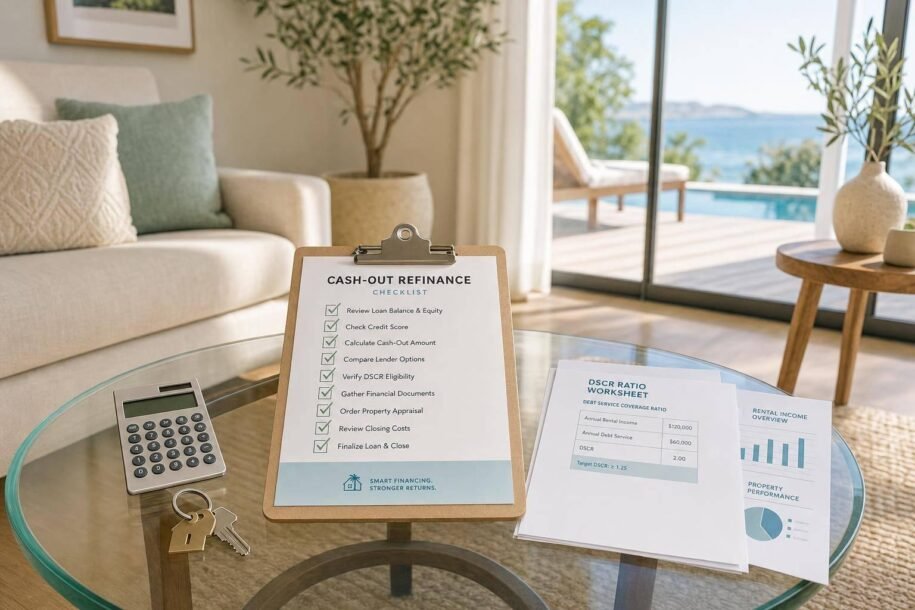
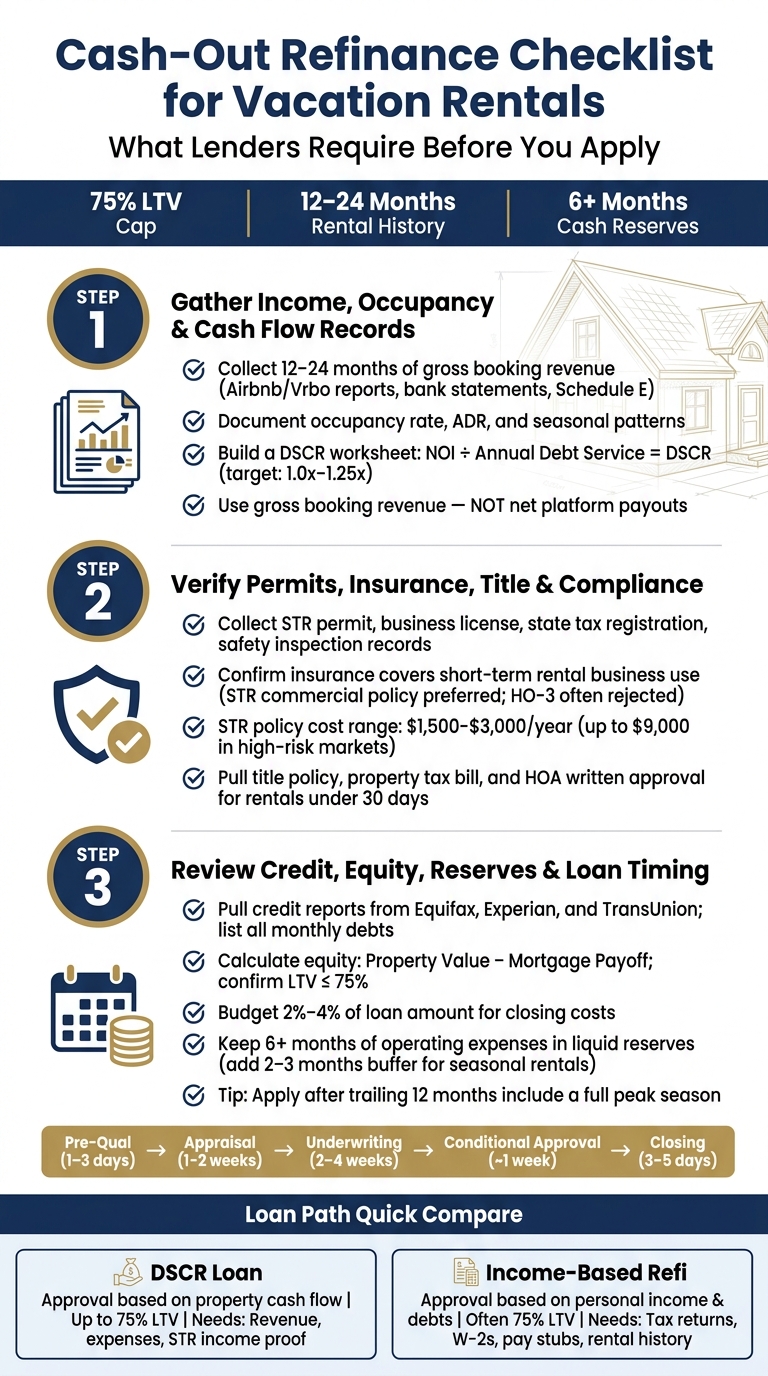
If I want to refinance a vacation rental, I need four things in place first: enough equity, clean income records, legal short-term rental paperwork, and cash reserves. Most lenders cap cash-out at 75% LTV, want 12–24 months of rental history for many loans, and often ask for at least six months of reserves.
Here’s the short version:
- I check whether the property fits the lender’s rules on equity, ownership time, and rental history
- I decide whether a DSCR loan or an income-based refinance fits my file
- I gather 12–24 months of revenue, occupancy, and expense records
- I confirm permits, insurance, title, taxes, and HOA rules
- I review my credit, debts, reserves, and closing costs
- I time the application so my numbers show a full high-season period when possible
If I’m short on paperwork, mixed personal and rental funds, or missing STR insurance, underwriting can stall. If I line up the documents before I apply, the process is usually simpler and easier to track.
| Loan path | Main approval focus | Common cash-out limit | Common document need |
|---|---|---|---|
| DSCR loan | Property cash flow | Up to 75% LTV | Revenue, expenses, lease or STR income proof |
| Income-based refinance | Personal income and debts | Often 75% LTV on investment property | Tax returns, W-2s, pay stubs, rental history |
Below, I break the checklist into the few items that matter most so I can see what to fix before I apply.
Cash-Out Refinance Checklist for Vacation Rentals: Step-by-Step Guide
Important Cash Out Refinance Rules For Investment Property Owners
sbb-itb-103bddb
Step 1: Gather Income, Occupancy, and Cash Flow Records
Start with income records. That’s what lenders use to judge cash flow.
Collect 12–24 Months of Vacation Rental Income Records
Don’t use net platform payouts as gross income. Use gross booking revenue instead, including nightly rates, cleaning fees, pet fees, and taxes [6].
Pull these records from the past 12–24 months:
- Airbnb and Vrbo host earnings reports or CSV exports that show gross booking revenue
- Monthly gross revenue summaries by platform
- Business bank statements from a dedicated property account
- Schedule E from your federal tax returns, or Schedule C if you provide substantial services
- A property-level profit and loss (P&L) statement
If your personal and rental income run through the same account, separate them now. Lenders want a clean audit trail, and mixed funds can slow underwriting [6].
After you’ve got those records in order, use them to show occupancy and seasonality.
Document Occupancy Rate, ADR, and Seasonal Patterns
Revenue alone doesn’t tell the whole story. Lenders also want to see whether the income holds up over time. That means showing your monthly occupancy rate, average daily rate (ADR), and revenue per available night for the last 12–24 months.
Seasonal swings are normal. The key is to explain them. Add short notes tied to local demand drivers like weather, major events, or peak tourism periods.
Rank One Stays‘ owner dashboards can keep occupancy, ADR, and revenue data in one place.
Then turn those records into a simple DSCR worksheet.
Build a Simple DSCR Worksheet
Once your income records are organized, make a one-page DSCR worksheet for your application file. The formula is simple: Net Operating Income (NOI) ÷ Annual Debt Service = DSCR [4]. Many lenders want to see a DSCR between 1.0x and 1.25x [2][3]. Build the worksheet using the same platform reports, bank statements, and P&L data you already pulled.
| Worksheet Line | What to Include | Where to Get the Data |
|---|---|---|
| Gross Revenue | Nightly rates, cleaning fees, pet fees, and taxes | Airbnb/Vrbo earnings reports or CSV exports |
| Operating Expenses | Management fees, utilities, and maintenance reserves | Bank statements / P&L |
| Fixed Costs | Property taxes, STR insurance, HOA dues | Tax bills / insurance policy |
| Net Operating Income | Gross revenue minus operating and fixed property costs | Calculated from P&L |
| Annual Debt Service | Proposed mortgage principal + interest | Loan estimate from lender |
Use actual expenses, not projected margins. Keep the worksheet to one page, and match it back to your Schedule E and platform reports.
With income verified, move next to permits, insurance, title, taxes, and HOA rules.
Step 2: Verify Permits, Insurance, Title, and Property Compliance
Next, check the legal and paperwork side of the property. That means permits, insurance, title, taxes, and HOA rules. Start with permits, then move to coverage and ownership records.
Collect STR Permits and License Records
Gather every permit and license connected to the property. That includes your STR permit, business license, state tax registration, and recent safety inspection sign-offs. Lenders compare these records against local zoning rules and HOA rules, so missing paperwork usually stands out fast [4][5].
Make a simple list of each expiration date in MM/DD/YYYY format. If any permit expires before closing, renew it now [4]. It also helps to check for pending local legislation or permit caps that could change the property’s legal status during underwriting [1].
Once legal operation is confirmed, move to insurance.
Review Insurance Coverage for Short-Term Rental Use
A standard homeowners policy often does not cover business use. That means a guest claim might get denied. You want to confirm that your policy clearly covers short-term rental activity. If the property is still insured under a plain homeowners policy, many lenders won’t move forward with an STR refinance.
Here’s a quick way to check the type of coverage you have:
| Insurance Type | Coverage Scope | Good for STR refi? |
|---|---|---|
| Standard Homeowners (HO-3) | Primary residence; excludes business use | Low; often rejected for dedicated STRs |
| Landlord/Dwelling Fire | Long-term rentals; may exclude short-term stays | Moderate; may require a specific STR rider |
| Short-term rental commercial policy | Full business use, liability, and lost income | High; preferred by most specialized lenders |
| Platform Protection (AirCover) | Supplemental damage and liability during bookings | Low; not accepted as primary insurance |
STR-specific policies often cost $1,500–$3,000 per year, though premiums can climb to $9,000 in high-risk markets like Florida or California [7]. Also look for gaps tied to vacancy periods. Some policies pause coverage after 30 or 60 straight days without guests, which can create trouble for seasonal rentals [1].
Before you apply, pull these documents:
- Insurance declaration page
- Proof of premium payment
- Any STR endorsements
After coverage is in place, check title, taxes, and HOA rules.
Confirm Title, Property Taxes, and HOA Rules
Lenders also look at title, taxes, and HOA approval. Pull your mortgage statement, property tax bill, and title policy so they’re ready for review [6].
If the property sits in an HOA, ask for the current HOA covenants and restrictions. You should also get a written statement from the board saying that rentals under 30 days are allowed [4][2]. HOA rental limits can stop underwriting cold, even when everything else checks out [2].
With that paperwork lined up, move on to credit, equity, reserves, and closing timing.
Step 3: Review Credit, Equity, Reserves, and Loan Timing
Once your property records are in order, turn to your own finances. This is where lenders take a hard look at your credit, equity, cash reserves, and closing timeline. If any of these pieces are off, underwriting can slow down or your loan terms can change.
Pull Credit Reports and List Current Debts
Before you apply, pull your credit reports from Equifax, Experian, and TransUnion. Look for errors, old accounts, or anything that doesn’t belong. Even a small mistake can cause extra back-and-forth later.
Then make a full list of your monthly debt payments. The lender will use that to calculate your DTI or review the property’s cash flow for underwriting.
After you review your debts, move on to your equity and cash-out goal.
Calculate Equity, Target Cash-Out Amount, and Reserve Funds
Start with a realistic estimate of the property’s current market value. Then subtract your mortgage payoff. What’s left is your equity.
Next, check the lender’s cash-out LTV limit. For investment property refinances, that cap is often 75%. Also set aside about 2% to 4% of the loan amount for closing costs [2].
On top of that, keep at least six months of operating expenses in liquid reserves. If your rental income swings with the season, add two to three more months as a buffer.
Map the Refinance Timeline From Application to Closing
A cash-out refinance on a vacation rental usually takes a few weeks from start to finish. The exact timing depends on how fast you can send documents and how involved the underwriting process gets.
| Refinance Stage | Typical Duration | What Must Be Ready |
|---|---|---|
| Pre-Qualification | 1–3 days | Credit reports, debt list, estimated property value |
| Appraisal | 1–2 weeks | Property accessible for inspection; permits and HOA approval confirmed |
| Underwriting | 2–4 weeks | 12–24 months of income records, DSCR worksheet, insurance declaration page |
| Conditional Approval | About 1 week | Any outstanding title, HOA, or insurance items cleared |
| Closing | 3–5 days | Reserve funds confirmed in a liquid account |
Try to apply only after your trailing 12 months include a full peak season [1][4]. If most of your income comes in between October and April, your numbers may look weaker on paper than they are in practice.
If that’s your situation, write a short seasonality note for the lender that explains when demand peaks and why the calendar matters [4].
Conclusion: A Pre-Application Checklist Owners Can Use Right Away
Before you apply, check the basics first: your credit, 12–24 months of rental history, DSCR, permits, insurance, HOA rules, and your closing timeline. After that, look at your cash reserves and equity.
You should keep at least six months of operating expenses in liquid reserves and have enough equity to meet the lender’s usual 20% to 25% requirement [1][2]. It also helps to line up your P&L with your income and occupancy records so underwriting goes more smoothly.
If you want help keeping rental operations organized, Rank One Stays can help owners keep rental operations organized.
FAQs
Can I refinance if I have less than 12 months of rental history?
Yes. You may still be able to refinance even if you have less than 12 months of rental history.
Many conventional lenders ask for 12 to 24 months of documented rental income. But a DSCR loan can work differently. Instead of focusing on your personal W-2 income, it looks at the property’s projected rental revenue.
That can make a big difference if your rental is newer and doesn’t yet have a long track record. Working with Rank One Stays can also help strengthen the performance data behind your refinance goals.
What if my vacation rental income is seasonal or inconsistent?
Seasonal income swings are part of the short-term rental business. That’s why it helps to keep at least six months of operating expenses in liquid reserves. When bookings slow down, that cash buffer can help cover the gap without putting pressure on day-to-day operations.
To smooth out income, use dynamic pricing tied to local events and seasonality. It also helps to adjust minimum-stay rules to support occupancy during holidays and shoulder seasons. If you want help with the day-to-day work, Rank One Stays can manage pricing, listing optimization, and guest support to help keep performance steady throughout the year.
How much cash should I keep on hand before applying?
As a rule of thumb, keep liquid cash reserves equal to at least 6 months of operating expenses for each property.
Why? Vacation rentals can be unpredictable. Income often swings with the seasons, and guest turnover tends to bring more day-to-day costs than many owners expect.
It also helps to plan for a 20% to 30% revenue dip in your first year while your listing picks up reviews and starts to gain traction.