

If guests can’t find your listing, they can’t book it. In plain terms, this guide says I should stop using vague phrases and start using the exact words travelers search on Airbnb, VRBO, and Google.
Here’s the short version:
- Start with a seed list built from my property type, location, top amenities, guest type, and trip purpose.
- Focus on search intent by separating planning phrases from booking phrases.
- Add local and seasonal terms like neighborhoods, landmarks, events, and time-of-year features.
- Check demand and competitors with autocomplete, Google tools, and top listings in my market.
- Pick one main keyword and a few support terms before I write.
- Place keywords where they matter most: title, first line, description, and photo captions.
- Update the listing often as seasons, events, and market trends shift.
A few numbers stand out: 68% of unbooked listings are tied to weak optimization , a problem often solved by professional vacation rental management, and high-intent, specific phrases can drive 40% higher conversion rates. That’s the core point of the article: better wording can lead to more visibility and more bookings.
I’d sum it up like this: use clear, specific search phrases that match how guests look for a stay, then place them in the parts of the listing people see first.
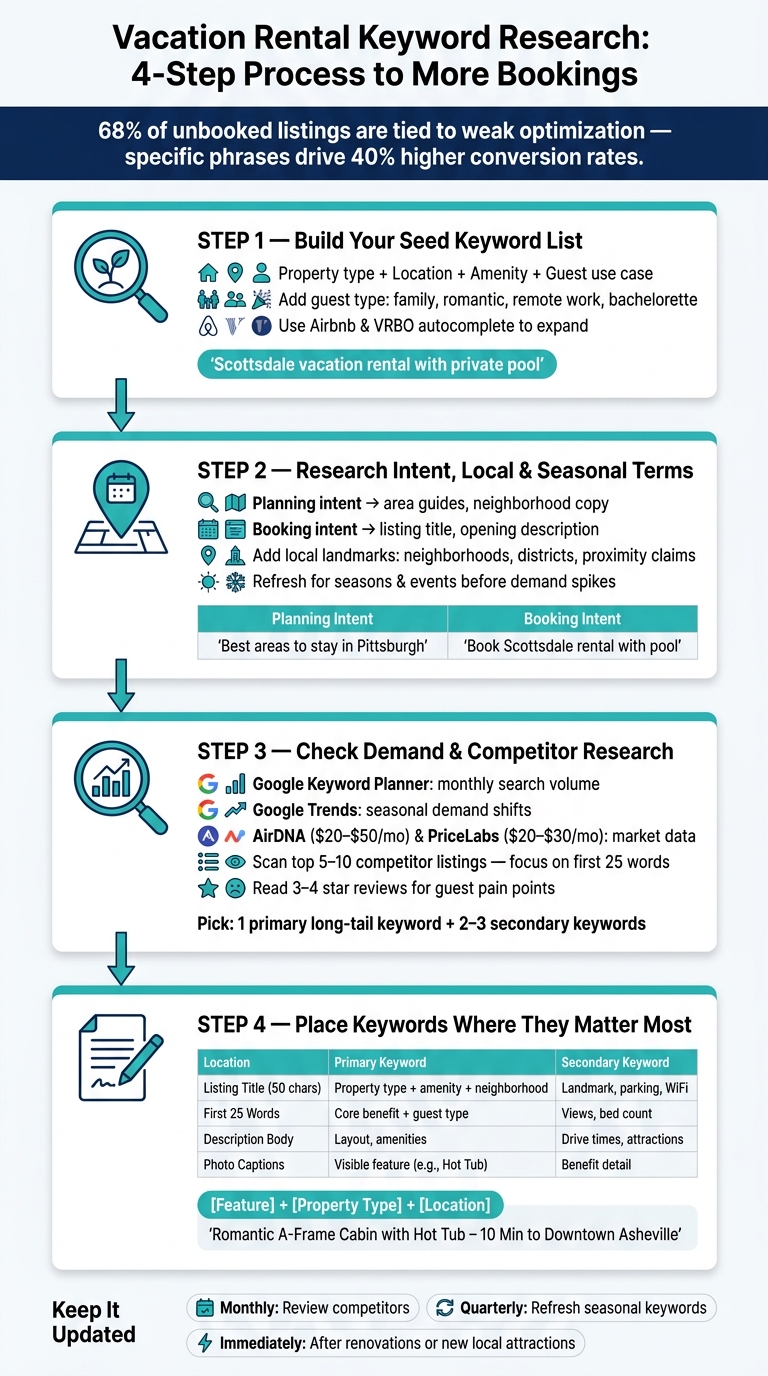
Vacation Rental Keyword Research: 4-Step Process to More Bookings
Step 1: Build a Seed Keyword List from Your Property and Market
Start with your property. Build a seed list of guest search terms, then use that list as the base for the next step.
Start with Property Type, Location, and Amenities
Begin with four inputs: property type, location, amenities, and nearby attractions. A simple formula ties them together:
[Property Type] + [Location] + [Standout Amenity] + [Guest Use Case]
In Scottsdale, that might mean phrases like "Scottsdale vacation rentals with a private pool" or "Scottsdale condos for a bachelorette party." In Pittsburgh, you might start with "Pittsburgh rental near downtown stadiums" or "Pittsburgh Airbnb with parking and fast Wi-Fi."
Focus first on amenities that send a clear signal to guests, such as:
- private pool
- hot tub
- EV charger
- workspace
- pet-friendly access
- fast Wi-Fi
Add Guest Type and Trip Purpose Terms
Next, add who is booking and why. Terms like family-friendly, romantic getaway, remote work stay, golf trip, bachelorette party, and group retreat can help you pull in guests who fit your property better.
For example, "Pittsburgh Airbnb near stadiums for a weekend trip" says much more than "Pittsburgh rental." The more specific phrase lines up better with booking intent.
Use Airbnb and VRBO Autocomplete to Expand Your List
Now type your seed phrases into the Airbnb or VRBO search bar and watch the suggestions that appear. Autocomplete gives you terms guests already search for, which is gold. Pull those ideas into a spreadsheet so you can compare them later.
A simple setup works well here. Track each phrase by location, amenity, guest type, and intent.
Skip filler terms like "cozy home" or "nice apartment." They sound fine, but they don’t say much. Go with specific long-tail phrases instead, and use this seed list as the starting point for guest intent and seasonal research in Step 2.
sbb-itb-103bddb
Step 2: Research Guest Intent, Local Terms, and Seasonal Phrases
Start by grouping phrases by search intent. Not every keyword matches the same point in the guest journey, so each one should go where it makes the most sense.
Separate Booking Intent from Planning Intent
Some guests are just looking around. Others are close to making a reservation. You can usually spot the difference in the words they use.
For example, "best areas to stay in Pittsburgh" fits the planning stage. It suggests the guest is still comparing options and learning the area. On the other hand, "book Scottsdale vacation rental with pool" shows booking intent. That search is much closer to a reservation. Properties that targeted high-intent, specific phrases saw 40% higher conversion rates than generic terms [1].
That’s why placement matters. Booking-intent phrases should show up in the title and the opening line. Planning-intent phrases work better in area guides, neighborhood details, and supporting copy.
Use booking-intent terms up front, then work broader phrases into the rest of the description.
| Intent Type | Example Phrase | Best Placement |
|---|---|---|
| Planning | "best areas to stay in Pittsburgh" | Area descriptions, local guides |
| Booking | "book Scottsdale vacation rental with pool" | Listing title, opening description |
Use Local Terms Guests Already Search
Guests don’t just search by city. They look for neighborhoods, districts, and nearby landmarks.
That means your copy should include terms like "Old Town Scottsdale," "North Scottsdale," "Downtown Pittsburgh," "Strip District," or "PNC Park." These place names help your listing line up with the way people search in practice.
Be specific with proximity claims too. Phrases like "5 minutes from PNC Park" or "walk to the Strip District" can help, but only if they’re accurate. If you can’t verify the distance, don’t guess. A sloppy claim can do more harm than good.
Add Seasonal and Event-Based Keywords
Search demand changes through the year, and your listing copy should change with it.
Refresh your wording by season to match what guests want at that moment. For instance, "ski-in/ski-out" fits winter demand, while "pool + shaded patio" fits summer [2].
It also helps to watch local events, conventions, and graduation dates. Update your copy before those demand spikes hit, not after [1].
These are the phrases to carry into Step 3, where you’ll check demand and compare competitor language.
Step 3: Check and Prioritize Keywords with Tools and Competitor Research
Take the local and seasonal phrases from Step 2 and figure out which ones are worth putting in your listing. The goal here isn’t to stuff in every phrase you found. It’s to see which terms have actual search demand and which ones show up again and again in competing listings.
Use Keyword Tools to Check Search Demand
Google Keyword Planner gives you estimated monthly search interest for a phrase, while Google Trends shows how that interest changes throughout the year. That matters because a phrase can look good at first glance but have little demand when people are ready to book. So don’t chase raw volume. Just make sure people are searching for the phrase in the first place.
If you want more market data, tools like AirDNA ($20–$50/month) and PriceLabs ($20–$30/month) can help you compare local competitors and track demand in your area [3].
Review Top Listings in Your Market for Repeated Language
Once you’ve checked your phrases with tools, look at how top listings in your market talk about the same features. Open the top 5–10 similar listings on Airbnb and VRBO and read the titles and first few lines of each description.
Pay extra attention to the first 25 words. That’s usually where hosts put the terms they care about most [2].
Look for wording that shows up across several listings. Phrases like "walkable," "mountain views," "heated pool," and "near downtown" tend to repeat for a reason: they line up with what guests search for.
Then check for what’s missing. Say most nearby listings talk about being close to restaurants, but none mention parking. If your place has a private garage, that’s worth calling out – but only if it’s a real feature of the property.
There’s another smart move here: read the 3- and 4-star reviews on competing listings. Those reviews often point straight to what guests care about most. Complaints about slow WiFi, missing kitchen supplies, or poor lighting can give you exact phrases to work into your own listing [3].
Pick Primary and Secondary Keywords Before You Write
Now narrow your list before you start writing. Long-tail phrases should be your main focus. These are phrases that combine a location, a property type, and a specific amenity.
For example, "pet-friendly Folly Beach rental with hot tub" will get far fewer searches than "Charleston vacation rentals." But here’s the tradeoff: the person searching that longer phrase is usually much closer to booking.
Keep it simple:
- Pick one primary long-tail phrase that matches your property’s location and best feature
- Choose two or three secondary phrases to back it up
- Put the primary phrase in the title and opening line
- Work the secondary terms into the description and captions
That gives your listing a clear focus instead of a scattered one.
Step 4: Place Keywords in Titles, Descriptions, and Photo Captions
Use the main phrase from Step 3 in your title first. Then work the supporting terms into the description and photo captions.
Write Titles with Location and Key Features First
Use this format: [standout feature] + [property type] + [location].
Think "Romantic A-Frame Cabin with Hot Tub – 10 Min to Downtown Asheville" or "Old Town Scottsdale Condo with Pool" instead of something vague like "Cozy Home Near Downtown."
Airbnb titles allow 50 characters [2][4]. That space goes fast. Put your main keyword at the front so it doesn’t get cut off on mobile, and remove filler words like "cozy," "beautiful," and "nice." They take up room, but they don’t add much search value [2][4].
After the title, mention the main term one more time in the opening line.
Place Secondary Keywords Throughout the Description
Work secondary keywords into the parts of the description that guests scan most:
- layout
- amenities
- nearby attractions
- local context
Start with the top selling point. Then add the supporting terms in the details that come next.
For local context, get specific. "2.5 miles from downtown" or "10-minute drive to downtown" gives guests a clear picture and also helps signal relevance to the algorithm [2][4]. Short bullet groups work well here because long paragraphs are easy to skip on mobile [2].
Then use photo captions to repeat those same features in a shorter, sharper way.
Use Photo Captions to Reinforce Amenities and Guest Benefits
Captions help both guests and search systems notice the features that matter. Name the feature, then say why it matters. "Private patio with string lights – perfect for evening dinners" says a lot more than "Patio."
That small shift matters. It turns a hidden feature into something guests can picture right away, and it gives search systems another clear clue about the listing.
The table below shows where each keyword type fits across your listing:
| Placement | Primary Keywords | Secondary Keywords |
|---|---|---|
| Listing Title | Property type, main amenity, neighborhood | Landmark proximity, free parking, fast WiFi |
| First 25 Words | Core benefit, guest type | Sunrise views, bed count |
| Description Body | Layout details, key amenities | Drive times, local attractions, house rules |
| Photo Captions | Visible feature, such as "Hot Tub" | Benefit detail, such as "Relax after a day on the slopes" |
Across all three areas, the job is simple: say exactly what guests are searching for, in the order they’re most likely to see it.
Conclusion: Keep Keyword Research Working Over Time
Once your listing is live, keyword research doesn’t stop. It just moves from setup to upkeep. As your market shifts, you need to keep updating your seed terms, guest intent, demand signals, and keyword placement.
When a listing sits untouched, keyword work starts to slip. A simple rhythm keeps things on track:
- Monthly: Review competitors’ pricing, photos, and recent reviews to spot changes in the market.
- Quarterly: Refresh your keyword list with seasonal terms or event-based phrases.
- Immediately: Update your copy after a renovation, a new local attraction, or a shift in demand.
If keyword updates and performance tracking start eating up too much time, a full-service manager can handle it for you. Rank One Stays can manage keyword updates, listing optimization, pricing, guest support, housekeeping, and staging for owners who want ongoing optimization.
FAQs
How do I choose my main keyword?
Pick a high-intent, long-tail keyword that fits your property and the kind of guest you want to bring in. Skip broad, crowded destination terms. Instead, focus on a specific detail, like a nearby attraction, pet-friendly setup, or a private pool.
Take a look at the top-performing listings in your market. Then choose the search term that describes your property as closely as possible.
What keywords work best for Airbnb and VRBO?
The best keywords are high-intent, long-tail phrases that match what guests are actually looking for, not broad terms tied only to a city. In plain English: go after search phrases with clear booking intent, like pet-friendly cabin with hot tub or downtown loft for remote work, instead of something vague like “Austin rental.”
A good keyword usually blends a few things together:
- Location
- Property type
- Standout amenity or use case
That mix helps you line up with more specific guest needs.
To find those phrases, look at competing listings, check the filters guests use during search, and pay attention to seasonal demand. Then work your keywords in naturally, especially in your title and within the first 25 words of your description.
How often should I update listing keywords?
Review and update your listing keywords at least quarterly so they match seasonal changes, market shifts, and platform algorithm updates.
You may need to revise them even sooner after renovations, new amenities, or changes to nearby attractions. Rank One Stays can take care of this as part of a steady listing optimization process that keeps your content fresh and easy to find.