
If I had to boil this down fast: Pittsburgh is the easiest buy for many investors, Athens is the lower-cost event play, Madison works best for live-in hosts, and Ann Arbor plus Boulder only make sense if you can handle high prices and tight rules.
If you want the short answer, here it is:
- Best lower-cost market: Pittsburgh
- Best for football-weekend upside: Athens
- Best for owner-occupied hosting: Madison
- Highest-cost, rules-heavy markets: Ann Arbor and Boulder
- Biggest risk across all five: local permit and zoning limits
The article compares Madison, Ann Arbor, Athens, Boulder, and Pittsburgh using the same filters:
- purchase price
- nightly rate
- occupancy
- annual revenue
- permit rules
- best owner type
A few numbers stand out right away:
- Pittsburgh has the lowest entry point at about $229,880 to $259,898
- Boulder has the highest entry point at about $1.1 million to $1.4 million
- Ann Arbor shows some of the highest reported revenue, but zoning cuts down where you can run a rental
- Madison and Boulder both lean hard toward primary-residence hosting
- Athens can see major game-weekend pricing jumps, with rates running 1.76x to 3.9x above normal on peak football weekends
If I were reading this to make a buy/no-buy call, I’d keep one idea front and center: high revenue means less if the city rules block your setup.
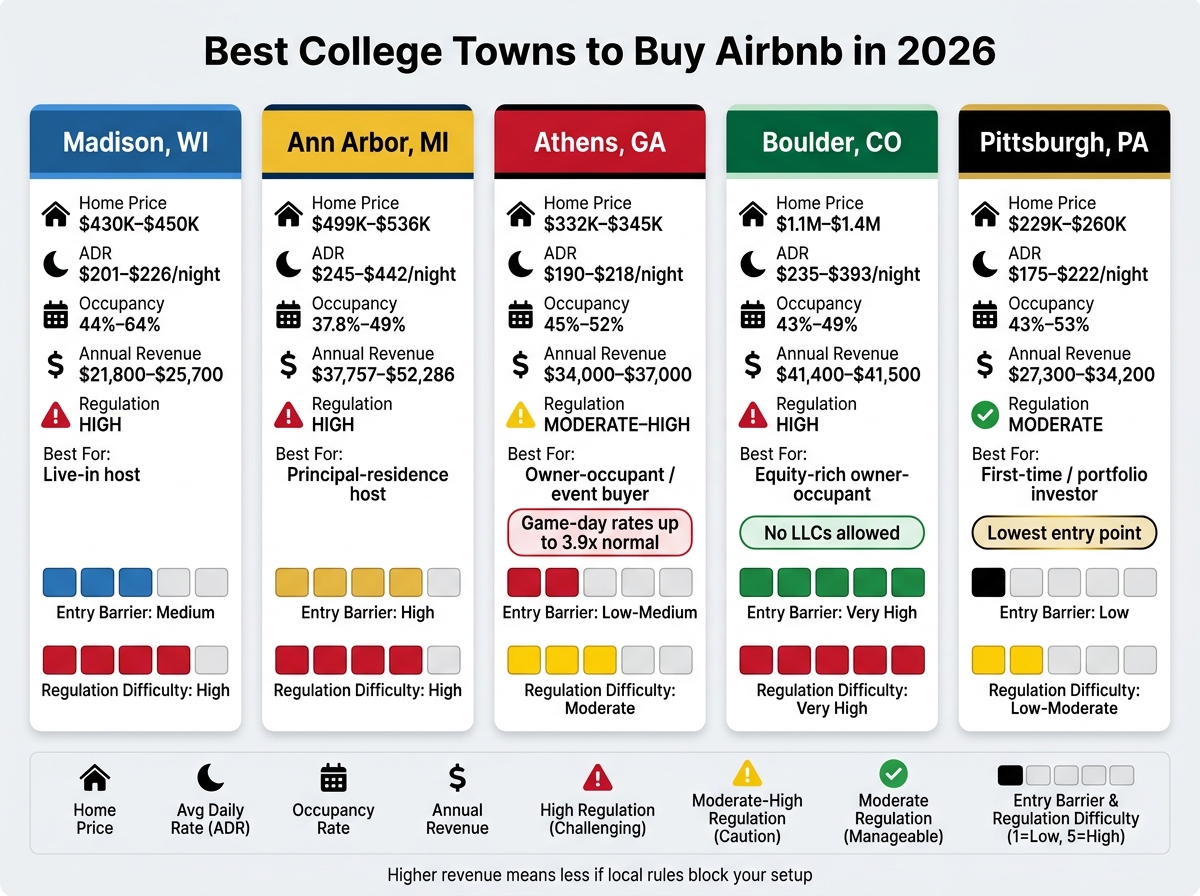
Best College Towns for Airbnb 2026: Market Comparison
Ep 167 – The Best Places to Invest in Short-Term Rentals in 2026
sbb-itb-103bddb
Quick Comparison
| Market | Home Price | ADR | Occupancy | Est. Annual Revenue | Rule Pressure | Best Fit |
|---|---|---|---|---|---|---|
| Madison, WI | $430,000–$450,000 | $201–$226 | 44%–64% | $21,800–$25,700 | High | Live-in host |
| Ann Arbor, MI | $499,750–$536,036 | $245–$442 | 37.8%–49% | $37,757–$52,286 | High | Principal-residence host or investor in allowed zones |
| Athens, GA | $332,000–$345,000 | $190–$218 | 45%–52% | $34,000–$37,000 | Moderate to high | Owner-occupant or event-focused buyer |
| Boulder, CO | $1.1M–$1.4M | $235–$393 | 43%–49% | $41,400–$41,500 | High | Equity-rich owner-occupant |
| Pittsburgh, PA | $229,880–$259,898 | $175–$222 | 43%–53% | $27,300–$34,200 | Moderate | First-time or portfolio investor |
Bottom line: if you want a simpler path, I’d look at Pittsburgh first and Athens second. If you plan to live in the home, Madison becomes more workable. If you want a pure non-owner-occupied Airbnb in Ann Arbor or Boulder, I’d check zoning and licensing before doing anything else.
1. Madison, Wisconsin
Among these five markets, Madison pairs strong guest demand with the toughest ownership and compliance limits.
Purchase Price
Madison has one of the highest barriers to entry in this group. The median sale price is about $430,000–$450,000, and homes near UW–Madison and downtown usually sell for more. [21][22][23][25]
That price point squeezes margin for first-time buyers and makes cash flow harder from the start. Inventory is also very tight. In May 2026, supply was just 1.11 months, and the median time on market was 7 days. [24]
ADR and Occupancy
For 2026, estimates put Madison at roughly $201–$226 ADR, 44%–64% occupancy, and $21,800–$25,700 in annual gross revenue per listing. [1][2]
A well-run property in a central location can land near the top of that range, often by utilizing professional vacation rental design to stand out. A poorly run one often falls short. And that matters here. At Madison’s purchase price, there isn’t much room for sloppy operations. The income potential is there, but it won’t cover weak pricing, poor guest service, or downtime. On top of that, operators also have to deal with strict rules.
Permit Rules
Before listing a property, hosts need a Zoning Tourist Rooming House Permit (ZTRHP), a Dane County Tourist Rooming House license, and a Transient Room Tax Permit. [3][11][16][17]
The property also has to be the host’s primary residence, which usually means living there at least 183 days per year. [20][16][3]
The big dividing line is simple:
- If the host is present during guest stays, there is no annual night cap.
- If the host is absent, stays are limited to 30 nights per licensing year. [3][16][18]
Madison also caps permits at about 0.75% of housing supply, or around 190 citywide, and licenses do not transfer. [12][15] So while permit fees are fairly low, the compliance risk is not. These rules shape who can operate in Madison and what kind of setup can work. [19][12]
Investor Fit
Madison works best for live-in hosts. Owner-occupants who stay on-site can avoid the 30-night cap and meet the primary-residence rule, which makes a duplex or flexible single-family home near campus the most workable entry point. [14]
For remote or portfolio investors, the picture gets tougher. The 30-night cap for absent hosts, the permit ceiling, and non-transferable licenses all make scaling hard. One workable approach is to blend mid-term stays with a handful of high-rate weekends. [13][10]
Hands-off owners will also need full-service management for pricing, guest messaging, cleaning, and permit compliance.
Madison is the most regulated setup in this group, which makes the next market a sharp contrast.
| Factor | Madison, WI |
|---|---|
| Median home price | ~$430,000–$450,000 |
| Average nightly rate | $201–$226 |
| Occupancy rate | 44%–64% |
| Est. annual revenue | $21,800–$25,700 |
| Regulatory burden | High |
| Best owner type | Primary-residence / host-present |
| Portfolio scalability | Limited |
2. Ann Arbor, Michigan
Ann Arbor is a college-town market with tight zoning rules. That’s the main pressure point here. In Madison, host-presence rules shape the market. In Ann Arbor, zoning does.
Purchase Price
Ann Arbor has the highest buy-in cost in this group. Typical home values sit around $500,000 to $536,000, which means a 20% down payment can top $100,000 before you even get to closing costs, furniture, and licensing.
For buyers trying to get in at a lower price, smaller condos or townhomes near campus or along commercial corridors tend to be the most practical starting point.
ADR and Occupancy
Demand here runs on the university calendar. Football weekends, graduation, and the Ann Arbor Art Fair drive most of the top booking periods.
Reported results vary quite a bit, from about $37,757 in annual revenue at $442 ADR and 37.8% occupancy to $52,286 at $245 ADR and 49% occupancy.[31][32]
That gap tells you a lot. This isn’t a market where you can just look at average demand and call it a day. Event spikes do much of the heavy lifting, and those peaks only matter if the property sits in a zone where short-term rentals are legal.
Permit Rules
Ann Arbor requires a city STR license for every legal listing, and operating without one is unlawful.[26][6] Legal listings fall into three types:
| STR Type | Where It’s Allowed | Key Requirements |
|---|---|---|
| Principal Residence Homestay | Any residential zone | Owner or 30+ day tenant is the permanent resident and stays onsite during guest stays; no Certificate of Compliance is generally required.[27] |
| Principal Residence Whole-House | Any residential zone | Permanent resident normally lives there but is absent during rental periods; standard licensing and housing code rules apply.[4][27] |
| Non-Principal Residence STR | Specific commercial and mixed-use zones only | Certificate of Compliance and periodic housing inspections are required before licensing.[26][27] |
The annual license fee is about $500 per unit.[26] ADUs can’t be used as STRs.[29] Hosts also have to show their license number and maximum occupancy in every listing.[26]
There’s also a proposed six-month license moratorium, which is a reminder that the rules here can still shift.[28][30]
That zoning divide shapes who can buy and operate in this market.
Investor Fit
For first-time hosts, the cleanest path is usually a principal-residence setup. Live near campus or the medical center, then rent a room or the full home during peak weekends.
For portfolio investors, the focus has to be on eligible commercial or mixed-use zones. Dedicated residential Airbnbs are usually off the table unless a property falls into a grandfathered case.
This market works best for owners who can price well during event surges and stay on top of compliance. You’re not underwriting steady year-round occupancy here. You’re underwriting around a handful of big weekends and the rules that sit around them.
| Factor | Ann Arbor, MI |
|---|---|
| Median home price | ~$499,750–$536,036 |
| Average nightly rate | ~$245–$442 reported |
| Occupancy rate | ~37.8%–49% reported |
| Est. annual revenue | ~$37,757–$52,286 |
| Regulatory burden | High |
| Best owner type | Principal-residence host; commercial-zone investor |
| Portfolio scalability | Limited to mixed-use/commercial zones |
3. Athens, Georgia
Athens works a bit differently from Ann Arbor. This is a football-first Airbnb market. The University of Georgia‘s Sanford Stadium holds 93,033 fans,[41] and Athens ranked #3 nationally in a 2026 analysis of college football Airbnb markets.[41] On fall Saturdays, rates can jump to 1.76x to 3.9x above normal levels.[41] So the big play here is simple: make the most of peak-event weekends.
Purchase Price
Home values in Athens sit in the low-to-mid $300,000s. Typical values are around $332,000–$345,000, and recent median sale prices have landed near $320,000–$355,000.[45][46][47]
Properties close to UGA often trade in the $275,000–$375,000 range.[37][40] If you’re looking at larger, updated homes that can handle game-day groups, prices can go past $400,000.[37][40]
ADR and Occupancy
Well-run 2- to 3-bedroom rentals usually earn about $190–$218 per night.[42][8][44] Across the market, occupancy tends to fall in the 45%–52% range, with average annual revenue around $34,000 to $37,000.[42][44]
Bigger homes near campus do better. Four-bedroom and larger properties average about $59,000 in annual revenue and post a 14% gross yield.[7][43] Most of the demand comes from football weekends, graduation, and parents’ weekends. Mid-summer and mid-week stretches are softer, which is pretty common in college-town markets.
Permit Rules
Athens has two main paths, and the split matters.
- Home Occupation STRs are the owner-occupied option. They’re allowed in most residential zones, require proof that the home is your primary residence, and come with an application fee of about $20.[39][5]
- Commercial STRs cover non-owner-occupied rentals. These are banned in single-family residential zones and only allowed in mixed-use, commercial, or employment districts. They also need a Special Use Permit, with fees in the $850–$1,350 range.[35][36][39][5]
All operators also need a Business Occupation Tax Certificate and must collect the 7% local hotel-motel excise tax, along with any state per-night fees that apply.[33][36][38]
Investor Fit
Athens is best for owner-occupant hosts. If you live in the home and rent it out during football season, graduation, and key campus weekends, the permit path is simple and low-cost. That’s a good match for house hackers and UGA-area professionals.
For portfolio investors, the door isn’t shut, but it is narrower. Non-owner-occupied rentals are limited to mixed-use and commercial zones. And if you don’t live nearby, you’ll likely need help with pricing, compliance, guest messages, and cleaning turnover.
| Factor | Athens, GA |
|---|---|
| Median home price | ~$332,000–$345,000 |
| Average nightly rate | ~$190–$218 |
| Occupancy rate | ~45%–52% |
| Est. annual revenue | ~$34,000–$37,000 (4+ bed: ~$59,000) |
| Regulatory burden | Moderate–High |
| Best owner type | Owner-occupant host; commercial-zone investor |
| Portfolio scalability | Limited to mixed-use/commercial zones |
4. Boulder, Colorado
Boulder is one of the toughest college-town markets for Airbnb buyers in 2026. Prices are high, the rules are tight, and scaling is hard. Unlike some of the earlier markets, Boulder gives investors very little room to run a non-owner-occupied Airbnb model.
Purchase Price
Recent reports put the median single-family home price at about $1.1 million to $1.4 million. Even properties that may work for Airbnb – like smaller homes, townhomes, or condos – often sell in the $800,000 to $1.2 million range. In prime areas, and for larger homes, prices can move past $1.5 million.[50][51][52][54]
That kind of pricing changes the math fast. You need more cash up front, and cash flow gets tighter. Boulder sits firmly in the low-yield, high-equity camp.
ADR and Occupancy
Boulder can still bring in decent nightly rates, but returns stay squeezed. Current estimates show:
- ADR: about $235 to $393[58][59]
- Occupancy: about 43% to 49%[58][59][60]
- Annual revenue: about $41,400 to $41,500[58][59][60]
So yes, the top-line revenue is respectable. But when you stack that against Boulder-level home prices, yield stays compressed.
Permit Rules
Boulder has some of the toughest STR rules in this group. A short-term rental means a stay of 29 days or fewer, and the property must be the owner’s principal residence. In plain English, the owner has to live there for more than half the year.[48][57]
Ownership rules are also narrow. Only individual owners, certain trusts, or nonprofits can qualify for an STR license. LLCs, corporations, and limited partnerships can’t hold one.[55][56][57]
There are more limits. Most new ADUs don’t qualify, and permanently affordable units can’t be used as STRs. The only small exception is a grandfathered carve-out for some pre-2019 ADUs.[49][9][57] Owners can hold only one license per property, and the license lasts four years. There’s also a $20 annual affidavit fee, and if the filing is missed, the license is revoked.[57]
Boulder did add a 2025 festival lodging license, but it’s narrow. It allows short-term rentals during named festival windows for up to 29 days per year, even if the owner doesn’t meet the standard STR rules.[53][57] That’s a small opening, not a broad path for investors.
Investor Fit
Boulder makes the most sense for owner-occupants and equity-rich long-term owners. If someone already lives in the home and wants to earn STR income during CU Boulder events, outdoor travel peaks, or festival periods, the setup can work.
It is a poor fit for:
- Passive buyers
- LLC-based purchases
- Portfolio investors
- Anyone counting on full-time Airbnb income
Boulder is a high-barrier owner-use market, not a broad investor play. The table below sums up the numbers and limits.
| Factor | Boulder, CO |
|---|---|
| Median home price | ~$1.1M–$1.4M[50][51][52][54] |
| Average nightly rate | ~$235–$393[58][59] |
| Occupancy rate | ~43%–49%[58][59][60] |
| Est. annual revenue | ~$41,400–$41,500[58][59][60] |
| Regulatory burden | High |
| Best owner type | Owner-occupant; existing equity holders |
| Portfolio scalability | Very limited; principal-residence use only, LLC ownership not allowed |
5. Pittsburgh, Pennsylvania
Pittsburgh is the value play in this group, with demand coming from Pitt, Carnegie Mellon, hospitals, and tech.[65][61] That gives the city a steadier, year-round demand base instead of a booking pattern tied only to the school calendar. In plain English, Pittsburgh can be a lower-cost, lower-regulation option than the tighter college-town markets listed above.
Purchase Price
Lower buy-in costs help both first-time buyers and investors picking up more than one unit. In 2025–2026, many investment properties trade in the low-to-mid $200,000s, while a broader 2026 market estimate puts the average home price at about $259,898.[69][70] Oakland and Shadyside tend to cost more, while Bloomfield and Lawrenceville can offer lower entry points.[63][65]
That price gap matters. Pittsburgh’s returns are solid, but they don’t sit at the top of the pack, so the purchase price has a big effect on whether a deal works.
ADR and Occupancy
Estimated ADR lands around $175–$222, occupancy runs about 43%–53%, and annual revenue comes in near $27,300–$34,200.[73][62] Occupancy peaks around 69% in August and drops into the low 40% range during winter.[63][64][65] Top listings can hit 68%–83% occupancy when they have strong reviews and pro management behind them.[65]
So yes, Pittsburgh brings in less revenue than pricier college towns. But the cost to get in is much easier to handle, which changes the math.
Permit Rules
Lower prices don’t mean no red tape. Pittsburgh has a clear set of rules, and that rulebook is getting heavier. Every STR needs a valid STR license, zoning approval, and a rental permit through the city’s Residential Housing Rental Permit Program.[71] Per-unit fees total about $35.50, including registration and inspection costs.[74]
The city also limits how many STRs can run inside multifamily buildings:
- No more than two units in buildings with 20 or fewer units
- No more than five units in larger buildings[72]
On top of that, operators must register for Allegheny County hotel/motel tax and Pennsylvania state sales tax.[67] The main risk here is tighter enforcement, including a proposed local-contact rule for someone located within about 25 miles of the property.[66][67][68]
Investor Fit
The best Pittsburgh operators do a few things well: they keep pricing in check, hold steady occupancy, and stay sharp on permits and tax rules. Pittsburgh works well for first-time buyers, portfolio investors, and remote owners who have management help. Many also invest in Airbnb design services to stand out in a competitive market. The lower entry price, no universal owner-occupancy rule, and broad demand base give investors room to work, but only if they stay on top of permits, guest records, building caps, and tax registration.
Remote owners can use Rank One Stays for local management, pricing, guest support, housekeeping, and damage claims.
| Factor | Pittsburgh, PA |
|---|---|
| Typical home price | ~$229,880–$259,898[69][70] |
| Average nightly rate | ~$175–$222[73][62] |
| Occupancy rate | ~43%–53%[73][62] |
| Est. annual revenue | ~$27,300–$34,200[73][62] |
| Regulatory burden | Moderate and growing |
| Best owner type | First-time buyers; portfolio investors; remote owners with management support |
| Portfolio scalability | Good; building caps apply |
Revenue, Regulation, and Risk: A Market-by-Market Breakdown
After the market profiles, this side-by-side view makes the trade-offs easier to see. Some markets win on price. Others win on revenue. And a few look good on paper until local rules get in the way. Put simply, each market balances three things: upfront capital, income ceiling, and regulatory friction.
Purchase Price and Entry Barrier
Athens and Pittsburgh are the lowest-cost ways in. Madison sits in the middle. Ann Arbor is pricey, and Boulder has the highest barrier to entry.
That matters for who can buy. Lower purchase prices make it easier for first-time hosts and portfolio buyers to get started. Higher prices shrink the pool to buyers with deep cash reserves or a lot of equity.
Revenue Potential: Nightly Rate and Occupancy
Boulder leads on revenue. Ann Arbor comes next. Athens and Pittsburgh land in the middle, while Madison trails on median revenue.
Madison’s 2026 median revenue is $36,177, with an 8.3% gross yield.
| Market | Typical ADR | Est. Occupancy | Est. Annual Revenue | Demand Type |
|---|---|---|---|---|
| Boulder, CO | $220–$300+ | 65%–75% | $80,000–$110,000+ | Year-round tourism plus university traffic |
| Ann Arbor, MI | $190–$250 | 60%–75% | $65,000–$90,000 | Football weekends and campus events |
| Madison, WI | $170–$220 | 60%–70% | $55,000–$75,000 | Football weekends and campus events |
| Athens, GA | $160–$210 | 55%–65% | $50,000–$70,000 | Football weekends and campus events |
| Pittsburgh, PA | $150–$200 | 60%–70% | $50,000–$70,000 | Year-round demand plus university traffic |
Event-driven markets can produce big spikes during peak weekends. Boulder and Pittsburgh, by contrast, lean more on demand across the calendar.
Still, higher revenue means less if the rules block the model you want to run.
Permit Rules and Compliance Risk
This is where the markets start to separate. In many cases, regulation matters more than gross revenue.
- Athens: New non-owner-occupied STRs in single-family zones are effectively blocked.[76][34][35]
- Boulder: Owner occupancy, single-license limits, and no LLC/corporate ownership make it the strictest investor market.[75]
- Madison: Primary-dwelling rules and host-presence limits keep the market tightly controlled.[17]
- Ann Arbor: Zoning separates principal-residence and non-principal-residence STRs.
- Pittsburgh: More permissive than the others, but rental permits, inspections, and insurance now add friction.[64]
Matching Each Market to the Right Owner Type
The owner model matters more than headline revenue.
Athens and Pittsburgh make the most sense for remote investors and portfolio builders who want non-owner-occupied properties without living nearby. Boulder and Ann Arbor fit local or semi-local hosts who can meet owner-occupancy rules and deal with tougher compliance demands. Madison is a better fit for hands-on local owners and cautious first-time hosts who can satisfy the primary-residence rule.
| Market | Best Owner Type | Regulatory Risk | Entry Barrier |
|---|---|---|---|
| Athens, GA | Local owner-occupant; local investor with compliance support | High (new STR restrictions) | Low–moderate |
| Pittsburgh, PA | Remote investor; portfolio builder | Moderate and growing | Low–moderate |
| Madison, WI | Local owner-occupant; first-time buyer | Moderate (primary residence required) | Moderate |
| Ann Arbor, MI | Local or semi-local owner-occupant | Elevated | High |
| Boulder, CO | Local owner-occupant; primary-residence host only | High (strict licensing) | Very high |
The next section turns these trade-offs into a simple pros-and-cons view for each college town.
Pros and Cons by College Town
After the detailed market profiles, this table lays out the trade-offs in a simple way. It gives a quick read on where each market stands and which type of buyer it tends to fit best.
| Market | Pros | Cons | Best Buyer Type |
|---|---|---|---|
| Madison, WI | Balanced year-round demand; moderate home prices; strong sports and event calendar; relatively stable occupancy | Regulation tightening; potential limits on non-owner-occupied STRs; neighborhood resistance in some areas | First-time host or local owner-occupier |
| Ann Arbor, MI | Higher-spending guests; premium nightly rates; anchor institutions drive resilient demand | Strict STR rules; non-primary residences tightly limited; higher compliance and licensing costs | Experienced portfolio investor or high-net-worth local buyer |
| Athens, GA | Affordable purchase prices; big revenue spikes during UGA football weekends; strong cash-on-cash yield potential with dynamic pricing | Pronounced off-season softness; medium regulatory risk; seasonality requires cash reserves | Yield-focused investor comfortable with event-driven seasonality |
| Boulder, CO | Premium nightly rates; strong long-term appreciation; diversified demand from tourism, tech, and university visitors | Very high entry price; strict primary-residence STR rules; limited license availability | Seasoned investor or owner-occupier |
| Pittsburgh, PA | Multiple universities and medical centers driving year-round demand; affordable entry; diversified urban visitor base; relatively lenient regulations | Rules vary by neighborhood and building type; performance varies widely by sub-market | Portfolio investor or data-driven first-time buyer |
A quick pattern stands out.
Pittsburgh and Athens have the lowest barriers to getting in, with fewer owner-occupancy limits than the other markets. That makes them the easiest starting point for portfolio investors and first-time buyers who want a simpler path.
Ann Arbor and Boulder sit at the other end. They come with tougher rules, tighter licensing, and higher barriers, but they also offer the strongest revenue upside. In plain English: more upside, more friction. Those markets tend to work better for owner-occupants or buyers who already know how to deal with strict local rules.
Madison lands in the middle on price, revenue, and regulation. It doesn’t swing as far in either direction, which can make it a steadier option for buyers who want balance instead of betting big on one factor.
The next section turns these trade-offs into the final buy/no-buy call by investor type.
Conclusion
There’s no one “best” college town for every Airbnb buyer in 2026. The right market comes down to your budget, risk tolerance, how involved you want to be day to day, and the local rules. That’s the simplest way to think about the trade-offs.
By buyer type, the markets break into pretty clear groups. Athens and Pittsburgh have the lowest entry costs. Madison sits in the middle as the more balanced option. Ann Arbor and Boulder can offer more upside, but the rules are much tighter.
If you want a more hands-off setup in Pittsburgh or Colorado, Rank One Stays can take care of pricing, guest support, housekeeping, and compliance.
Before you put in an offer on any property in these markets, check the current permit rules with the city itself, not just online summaries. Those summaries can fall behind when ordinances change. That’s the point that matters most in college-town investing. These markets can beat the national average on occupancy[77][78], but your return depends more on picking a market that fits your ownership model than on chasing the highest nightly rate.
FAQs
Which college town is best for first-time Airbnb investors?
For first-time Airbnb investors, emerging college towns like Columbia, South Carolina, and Tulsa, Oklahoma, can be a smart place to start. The big reason is simple: they often have a friendlier rent-to-revenue balance, which can make the numbers work more easily for new investors.
If you want to get better results without being glued to your phone all day, partnering with Rank One Stays can help. They handle key parts of the job, including listing optimization, dynamic pricing, and 24/7 guest support.
How much do local STR rules affect profitability?
Local short-term rental (STR) rules can make or break profitability. Things like permit caps, zoning limits, and minimum-stay rules can cut into occupancy, push down nightly rates, and shrink total revenue.
They also decide whether you can run the property legally in the first place. If you don’t follow the rules, you could face fines or even lose the right to operate. That’s why knowing the local laws isn’t optional – it’s part of the job.
Should I buy an owner-occupied or non-owner-occupied Airbnb?
It comes down to how much you want to earn and how involved you want to be day to day.
With owner-occupied properties, you get more personal use of the home. That’s a big plus if you want to stay there yourself. The trade-off is simple: when you block off nights, you leave fewer dates open for guests. That can cut into income and impact metrics like Revenue Per Available Night (RevPAN).
With non-owner-occupied properties, guests get the most booking availability. More open nights often means stronger occupancy and more room for revenue growth.
Either way, Rank One Stays can help you earn more. Professionally managed homes bring in 38% more revenue than the market average [1].