
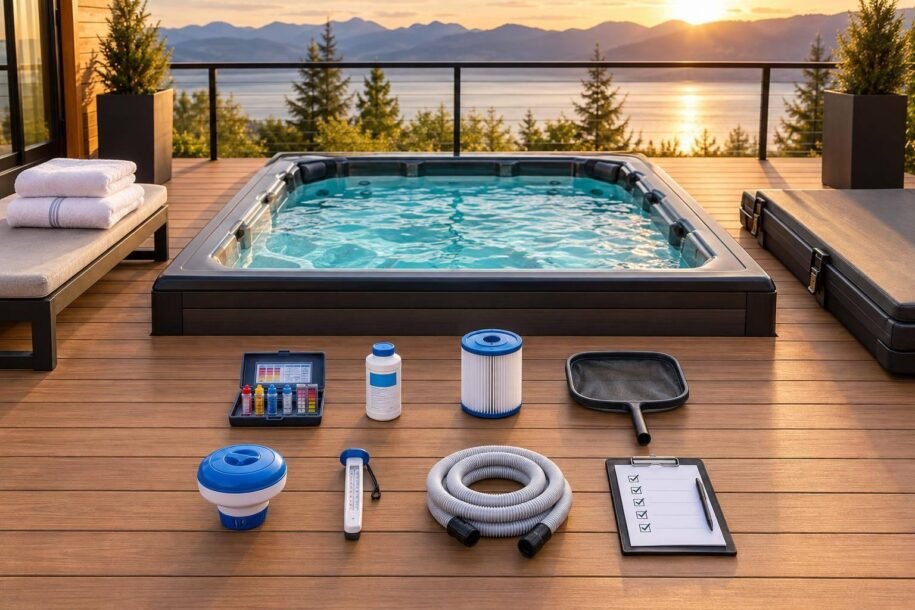
I keep the hot tub closed until water, equipment, and safety checks pass – not just until the water looks clear. My baseline: at least 3 ppm free chlorine or 4 ppm bromine, pH 7.0–7.8, and water no hotter than 104°F. I also follow chemical labels, the spa manual, and stricter local rules.
Here’s how I split the work:
- Every turnover: Inspect, clean, treat, retest, and record approval before guests enter.
- During guest stays: Keep testing. For public hot tubs, CDC guidance calls for checks at least twice daily, and as often as hourly during heavy use.
- Weekly: Check water balance, filters, surfaces, leaks, covers, and chemical storage.
- Monthly: Inspect equipment, test GFCI protection, and review repair logs. Plan draining and refilling around use and water condition – not a fixed monthly date.
Check-in time never changes the safety limits. If a check fails, I <u>keep the tub closed</u>, notify guests, assign repairs, and retest before reopening.
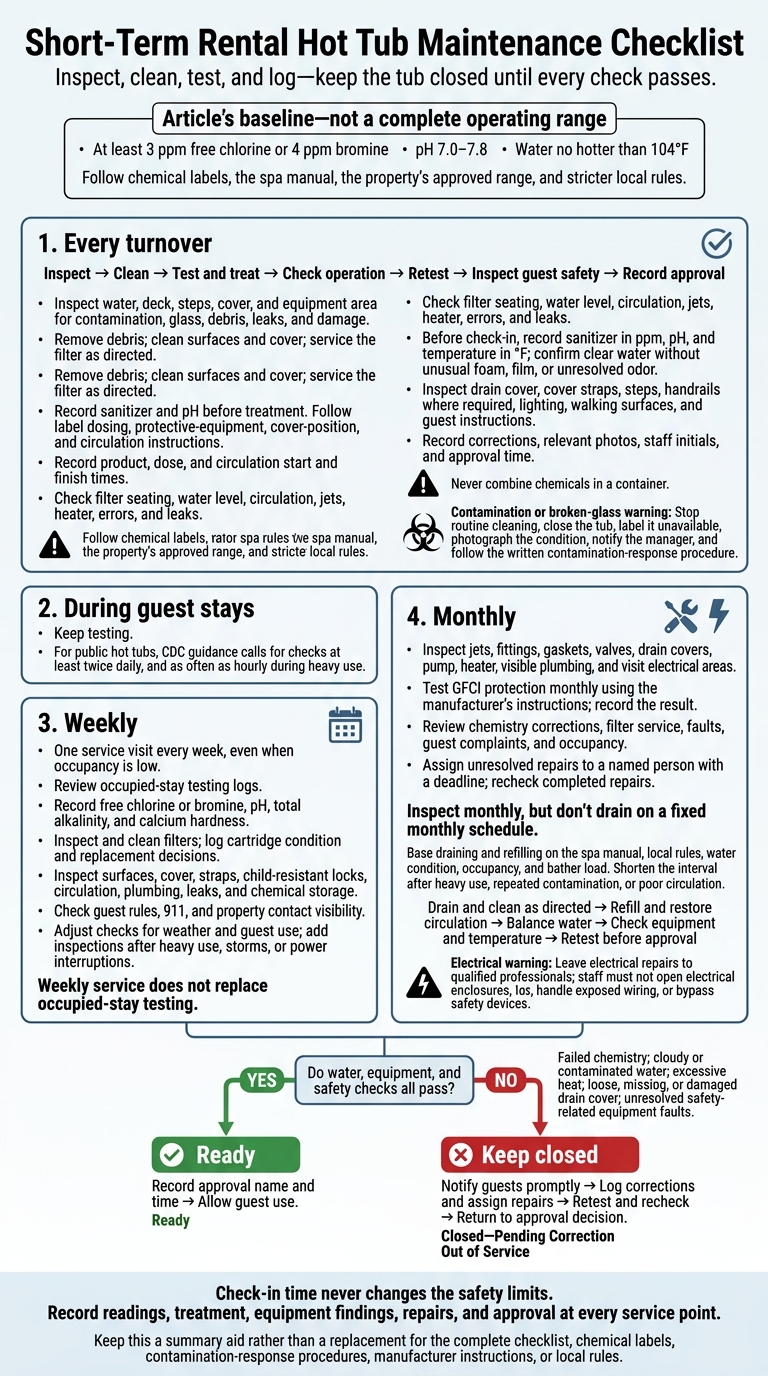
Short-Term Rental Hot Tub Maintenance Checklist
Turnover Checklist: After Check-Out and Before Check-In
After Check-Out: Inspect, Clean, and Treat
Treat turnover as a reset: inspect, clean, treat, and verify before the next guest arrives.
- ☐ Inspect first. Remove guest belongings. Check the water, deck, steps, cover, and equipment area for glass, food, bodily fluids, unusual odors, excessive debris, discoloration, leaks, and damage. If you find contamination or broken glass, stop routine cleaning. Close the tub, label it unavailable, photograph the condition, and notify your vacation rental management team. Follow the written contamination-response procedure.[6]
- ☐ Remove debris and clean surfaces. Skim the water and empty the skimmer basket. Use compatible, non-abrasive products on the waterline, headrests, controls, steps, and handrails. Clean and dry the cover, checking its underside for mildew, residue, tears, and water damage. Rinse the filter as directed by the manufacturer. Replace it if it’s damaged or excessively soiled.
- ☐ Test, then treat. Record sanitizer and pH before adding chemicals. Use only the chemical type and amount allowed by the product label and spa manufacturer. Wear the required protective equipment, and follow the label’s instructions for cover position and circulation time. Record the product, dose, and circulation start and finish times. Never combine chemicals in a container.[2][10]
- ☐ Check operation. Confirm that the filter is seated correctly, the water level is adequate, circulation and jet flow are normal, and the heater works. Check for control-panel errors and active leaks. Refer unresolved faults to a qualified technician.
Before Check-In: Retest and Approve Guest Use
- ☐ Check the turnover record to confirm cleaning and circulation are complete before taking final readings.
- ☐ Retest and record sanitizer in ppm, pH, and temperature in °F. Compare the readings with the property’s approved range and the chemical label. Confirm that the water is clear, with no unusual foam, film, or unresolved odor.
- ☐ Inspect guest safety points. Check the drain cover, cover straps, steps, handrails where required, lighting, and walking surfaces. Make sure readable guest instructions address no glass, child supervision, operating controls, and emergency contacts. A broken or missing drain cover means no guest use.[8]
- ☐ Document the decision. Record corrections, relevant photos, staff initials, and approval time. Keep the tub closed if chemistry fails, water is cloudy or contaminated, heat is excessive, drain covers are unsafe, or safety-related equipment faults remain unresolved. Approve guest use only when every check passes.
Schedule Service Around Cleaning and Guest Arrival
Start the inspection as soon as possible after departure. Check-in time is not a reason to shorten treatment. Link spa approval to the housekeeping record. If the tub remains unavailable, record that status separately and assign one person to notify the arriving guest promptly.
After turnover approval, continue weekly water and filter checks to keep the tub in service.
sbb-itb-103bddb
How to Clean Your Hot Tub Easily Between Guests | Guide for Airbnbs & Vacation Rentals
Weekly Checklist: Water, Filters, and Safety
After turnover approval, schedule one service visit every week, even when occupancy is low. Weekly service checks occupied-stay testing logs and adds cleaning, inspection, and repair checks. It does not replace occupied-stay testing.[4]
Use each visit to spot changes before guests notice them.
Test Water and Clean Filters
Record free chlorine or bromine, pH, total alkalinity, and calcium hardness. Follow the property’s approved range, guided by local rules, the product label, and the spa manual.[3][4][5] If logs show repeated sanitizer loss or pH swings, check dosing, bather load, circulation, and water balance. Check reagent expiration dates, calibrate digital testers as directed, and confirm questionable readings with a backup DPD test.[4]
Before removing cartridges, turn off the circulation system as directed. Check each cartridge for tears, crushed pleats, embedded debris, discoloration, and oil buildup. Rinse thoroughly. When needed, use only a filter cleaner that’s compatible with the cartridge, follow the manufacturer’s instructions, and rinse away all residue.
Replace cartridges that are damaged or remain clogged after cleaning, and follow the manufacturer’s replacement interval. Log the cleaning date, cartridge condition, and replacement decision.[5]
Next, check the shell, cover, plumbing, and storage area.
Check Surfaces, Circulation, and Chemical Storage
Check accessible surfaces for scale, biofilm, and cracks, and clean with approved products. Inspect the cover, straps, and child-resistant locks. Look for dampness or leaks around visible plumbing, and listen for grinding or unusual pump vibration.
Investigate falling water levels rather than repeatedly topping up. Restore the water level and retest the chemistry. Make sure guest rules, 911, and property contact details are still visible.
Keep chemicals in their original labeled containers, away from guests and moisture. Follow label directions for ventilation, mixing, spill response, and protective equipment.[11]
Adjust Checks for Weather and Guest Use
Adjust the same weekly checklist for local conditions:
In cold-climate rentals such as Pittsburgh, Pennsylvania, check snow, icy steps, drainage, circulation, and freeze protection. Arrange manufacturer-approved winterization before shutdown.[12][13] In hot, dry rentals such as Scottsdale, Arizona, monitor evaporation, dust, sun-damaged covers, and calcium hardness.
Add inspections after heavy use, storms, or power interruptions. Record any unresolved issue and assign a repair owner.
Monthly Checklist: Equipment and Water Replacement
Monthly service helps catch wear, leaks, and electrical faults that weekly checks may miss.
Inspect monthly, but don’t drain on a fixed monthly schedule. Base the drain-and-refill interval on the spa manual, local rules, water condition, occupancy, and bather load. Shorten it after heavy use, repeated contamination, or poor circulation.[2][5] Record any interval change before checking the equipment.
Inspect Fittings, Pumps, and Electrical Safety
Check jets, fittings, gaskets, valves, drain covers, the pump, heater, visible plumbing, and visible electrical areas. Look for loose or missing parts, scale, discoloration, corrosion, moisture, leaks, and repeated error codes. Verify normal circulation and working temperature controls. Make sure the drain cover is secure and undamaged. If it’s loose, missing, or damaged, keep the tub closed until the problem is corrected.[9][16]
Test GFCI protection monthly using the manufacturer’s instructions, and record the result.[15] Staff must not open electrical enclosures, handle exposed wiring, bypass safety devices, or attempt electrical repairs. Close the tub and assign a qualified electrician or spa technician if the GFCI won’t reset, trips repeatedly, a component overheats, or water enters electrical areas.[15]
Log any fault before draining or refilling.
Plan Deep Cleaning, Draining, and Refilling
Schedule draining and cleaning between reservations, leaving enough time to refill, heat, and approve the tub for use. Deep-clean or replace filters on the manufacturer’s schedule. If using a compatible plumbing-purge product, follow its label and the spa manual’s sequence before final drainage. Shut down and disconnect power as directed.[18]
Follow local wastewater and stormwater rules when draining. Clean the shell and accessible surfaces, rinse thoroughly, clean the filter housing as directed, and check for leaks before refilling.
After refilling, clean or reinstall the filters, restore circulation, balance the water, check temperature control and jet operation, and retest the chemistry. Keep the tub closed until the water is balanced and every equipment and safety check passes.[5][18]
Review Logs and Assign Repairs
Compare chemistry corrections, filter service, faults, and guest complaints against occupancy to decide whether to shorten service intervals. Photograph unresolved defects and assign each repair to a named person with a deadline. Keep the technician’s report, and recheck completed repairs before changing the tub’s status.[17]
Record findings right away so the next service date and the person responsible for each repair are clear.
| Log field | What to record |
|---|---|
| Property and usage | Property address, tub ID or serial number, date in MM/DD/YYYY format, time, staff name, occupancy, and recent guest-use level |
| Water readings | Water temperature in °F, clarity, sanitizer type and reading, pH, alkalinity, and calcium hardness |
| Equipment and safety | Filter condition and cleaning date; pump, heater, jet, fitting, drain-cover, and GFCI findings |
| Treatment and repairs | Chemical or purge product and amount added, drain/refill date, gallons drained or added, corrections, photos, work-order number, repair owner, and deadline |
| Status and approval | Ready, Closed – Pending Correction, or Out of Service; approval name and time, whether entry is prohibited, and whether the cover must stay secured |
Conclusion: Follow the Checklist and Record Approval
At every service point, inspect, clean, test, and log the results. Finish with a clear pass/fail decision.[7]
Keep the tub closed until every check passes. Record who approved guest use and when. If a check fails, notify guests immediately, log the repair, and retest before reopening.
Follow label instructions, store chemicals securely, and leave electrical and mechanical repairs to qualified technicians.[11][14][20][19]
FAQs
Is my rental’s hot tub considered a public spa?
No – unless the hot tub is open to the general public as a shared facility. Otherwise, your short-term rental’s hot tub is a private amenity for guests. Your checklist should follow property and guest safety and sanitation standards, not public spa rules. [1]
How can I arrange water testing during guest stays?
Schedule maintenance during mid-stay cleanings, or hire a professional management service to limit guest disruptions. Rank One Stays handles maintenance and day-to-day tasks, including routine water testing and chemical balancing. This keeps your hot tub safe, compliant, and working properly without your direct involvement.
How much time should I allow for hot tub turnover?
The provided search results don’t state how much time to allow for hot tub turnover.
Rank One Stays handles maintenance and cleaning, including hot tub sanitation and safety, to keep your property ready for guests. That takes day-to-day tasks off your hands while helping maintain your property’s standards and maximize revenue.