
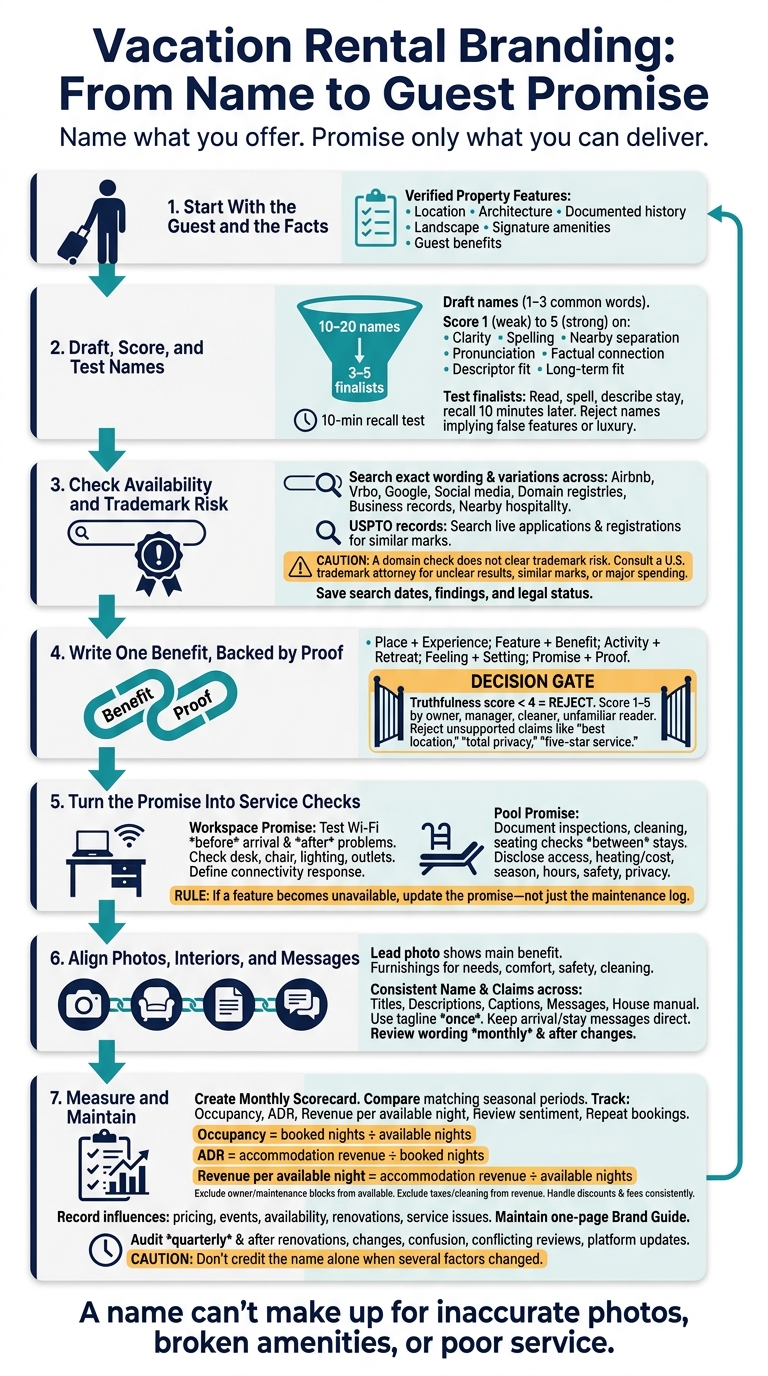
My rule for vacation rental branding: name what you offer, and promise only what you can deliver. Start with your target guest and verified property features. Draft 10–20 names, then test 3–5 finalists before checking name availability and trademark risks.
In this guide, I explain how to:
- Give your property name, listing title, and tagline separate jobs.
- Write a short tagline backed by a feature or service guests can count on.
- Match your photos, furnishings, listing copy, and guest messages to that promise.
- Track occupancy, nightly rates, reviews, and repeat bookings without crediting the name alone.
- Keep a one-page brand guide and review it quarterly or after property changes.
The goal is simple: <u>help guests know what they’re booking</u> – then deliver that stay. A name can’t make up for inaccurate photos, broken amenities, or poor service.
Vacation Rental Branding: From Name to Guest Promise
Choose a Memorable Property Name
Build a Name Shortlist From Property Features
Build your shortlist from the proof points in the worksheet above. Create a naming file with six headings: location, architecture, documented history, landscape, signature amenities, and guest benefits. Add supporting facts, then draft 10–20 names using one to three common words.
Base the names on your strongest verified feature: architecture, neighborhood, landscape, or a signature amenity. Cut generic superlatives, invented spellings, and references to furniture or seasonal features that may change.
Score and Test Your Name Shortlist
Keep names that match your guest promise. Score each from 1 (weak) to 5 (strong) using these criteria: clarity of meaning and spelling; separation from nearby rental names; ease of pronunciation; factual connection to the area; room for a useful descriptor in the listing title; and fit after property changes. A strong name should support the stay you already promised, not just sound attractive.
These hypothetical scores show the method, not market research or legal clearance.
Hypothetical name Clarity Distinctiveness Pronunciation Local relevance Listing-title usability Long-term flexibility Trademark review Sonoran Shade 5 4 5 5 5 5 Review Cactus View House 5 3 5 4 4 4 Review The Ultimate Scottsdale Luxury Oasis 2 2 4 3 2 2 Review SmartHome 4K Retreat 3 3 4 1 1 1 Review
Test 3–5 finalists with people who don’t know the property. Ask them to read each name aloud, spell it, describe the stay it suggests, and recall it 10 minutes later. Record mistakes without explaining what you meant.
Try each finalist in several guest touchpoints, too. Reject names that repeatedly suggest a view, pool, or level of luxury you don’t offer – even if they score well.
Check Name Availability and Platform Rules
Check availability before committing to a finalist. These checks help protect the identity behind your guest promise. Search exact wording, close variations, and sound-alikes across Airbnb, Vrbo, Google, social media, domain registries, state or local business records, and nearby hospitality businesses. Include the market and lodging category in each search.
Search USPTO records for identical and confusingly similar marks, including live applications and registrations.[6][7][12] A domain check does not clear trademark risk. Consult a U.S. trademark attorney if similar marks appear, the results are unclear, or you plan major spending or expansion.[8] Save search dates, findings, legal-review status, and approved spelling and capitalization in your naming file.
Airbnb recommends leading with key details, using fewer than 50 characters, sentence-style capitalization, and no emojis or distracting symbols.[2][11] Vrbo’s official listing guidance recommends 20–40 characters and one or two key features or amenities.[9][10] Check both platforms’ current rules before publishing, and record approved titles alongside the name.
Use the approved name as the anchor for the tagline.
sbb-itb-103bddb
Write a Tagline You Can Deliver
Use Tagline Formulas Based on the Property
Start with the approved property name, then describe a guest benefit the stay can deliver.
Choose one guest benefit – not another property name. Try place + experience, feature + benefit, activity + retreat, feeling + setting, or promise + proof:
Place + experience: “Scottsdale sunshine, poolside downtime.” Requires a usable pool and comfortable outdoor seating – not a weather promise.
Feature + benefit: “A dedicated desk for focused mornings.” Requires a dedicated desk, comfortable chair, lighting, outlets, and reliable internet.
Activity + retreat: “Explore Pittsburgh. Come home to unwind.” Requires verified attraction-access details and a comfortable living area.
Feeling + setting: “Calm nights in the heart of the city.” Requires a central location and evidence that nighttime noise stays low.
Promise + proof: “Work-ready stays with reliable Wi-Fi and a dedicated desk.” Requires reliable internet, an equipped workspace, and usable living space.
Back each tagline with one proof point.
Score Taglines for Clarity and Accuracy
Rate how well each line matches the property’s proof points, from 1 (weak) to 5 (strong). Ask the owner, manager, cleaner, and one unfamiliar reader to score each line independently. Reject any tagline with a truthfulness score below 4, regardless of its total.
These examples assume a Scottsdale pool home and a Pittsburgh workspace stay; they are illustrative only.
Tagline Clarity Emotional appeal Specificity Truthfulness Audience fit Memorability Use in listings and guest materials Decision Your place for poolside downtime. 5 4 4 5 5 4 5 Keep if the pool is usable and accurately disclosed Space to work. Room to unwind. 5 4 3 5 5 5 5 Keep if the workspace and living area meet the promise The best location in Scottsdale. 4 3 2 1 3 3 3 Reject unless objectively supportable Total privacy, five-star service. 3 5 2 1 3 4 3 Reject unless both claims can be verified Near Pittsburgh attractions. 3 3 2 3 3 2 4 Revise with specific distances or destinations A calm base for city exploring. 4 4 3 4 4 4 5 Keep if the setting and guest experience support it
Reject unsupported “best location,” “total privacy,” and “five-star service” claims. Emotional appeal can’t make inaccurate wording work. Airbnb advises hosts to give concrete details about what guests will see, hear, and experience. It also warns that exaggeration can lead to disappointment and negative reviews.[4]
Every tagline needs proof from how you run the property.
Set Service Standards for Each Promise
For a work-focused Pittsburgh vacation rental, test Wi-Fi before each guest arrives and after any reported connectivity problems. Check the desk, chair, lighting, and outlets, and keep the workspace clear. Show it in photos and define how you’ll respond to connectivity issues. Make sure descriptions, photos, and access details match the promise.[1]
For a pool-focused Scottsdale vacation rental, document pool inspections, cleaning, and seating checks between stays. Disclose whether access is private or shared; whether heating is available, required, seasonal, or costs extra; and the operating season, hours, safety rules, and privacy conditions. Airbnb specifically requires hosts to disclose limits on amenity access, including pools available only during certain hours or months.[1][3] If a feature becomes unavailable, update the promise – not just the maintenance log.
Next, carry the same promise into photos, design, and listing copy.
How to Write Airbnb Titles That Stand Out (With Examples & Formulas)
Match Photos, Design, and Copy to the Brand
Once you’ve set the name and tagline, make sure every photo, design choice, and message supports them.
Show the Features Behind Your Promise
Lead with a photo that shows the tagline’s main benefit. Follow it with the living area, kitchen, bedrooms, bathrooms, outdoor spaces, and signature amenities. Airbnb recommends landscape-oriented images. Its Help Center sets a minimum of 1,024 × 683 pixels, while more recent photography guidance recommends at least 1,200 × 800 pixels.[5][14] Use natural light and framing that shows the space accurately.
Include details guests need before booking: stairs, neighboring buildings, sleeping arrangements, and parking. Clearly label nearby attractions as off-property.
For accessibility features, use clear photos, descriptive captions, and measurements where useful. Photograph the arrival route every 10 feet, with the ground visible.[13] Explain which rooms or routes each feature serves rather than suggesting the entire property is accessible.
Design Interiors Around Guest Needs
The interior should deliver on your brand promise during everyday use – not just in photos.
Choose furnishings for the guest, not just the camera. Match durable upholstery, a family-size table, entry storage, and blackout shades to the guest type you defined. Use a restrained palette and local artwork throughout the home without forcing a theme. Before buying anything, weigh cleaning time, replacement cost, comfort, and safety.
Give arrival details the same care: visible house numbers, lit paths, readable signage, labeled switches, and bedside charging access. For turnkey vacation rental interior design and staging, Rank One Stays can help align the space with the brand. Aim for a home that looks accurate in photos and is efficient to clean and prepare between stays.
Keep Listings and Guest Messages Consistent
Check the approved name and claims across every guest-facing touchpoint, including titles, descriptions, captions, messages, and the house manual. Keep titles practical and concise, with the most important information first.[2] Skip filler, all caps, and excessive symbols.
Use the tagline once, and keep messages about arrival and the stay direct. Review the wording monthly and after any property change so guests don’t receive outdated instructions.
Measure Results and Maintain Your Brand
Consistent branding helps guests recognize a property and understand what they’re booking. It does not replace good pricing or dependable service. Track whether your promise attracts the right guests – and whether their reviews back it up.
Track Occupancy, Nightly Rates, and Repeat Bookings
Once your brand is live, check whether the name and tagline attract the guests you want. Create a monthly scorecard and compare matching seasonal periods. The figures below are hypothetical, not owner results. Use the same platform definitions for every comparison.
Metric Before: Jan. 1–Mar. 31, 2025 After: Jan. 1–Mar. 31, 2026 Available search impressions 18,000 22,500 Listing views 1,080 1,620 Booking conversion 4.6% 5.2% Available nights 82 84 Booked nights 49 61 Occupancy 59.8% 72.6% Average daily rate (ADR) $214.00 $229.00 Revenue per available night $128.00 $166.00 Cancellations 3 2 Positive review sentiment 78% 88% Repeat bookings 4 8
Occupancy = booked nights ÷ available nights. Leave owner and maintenance blocks out of available nights, but report them separately. Calculate ADR by dividing accommodation revenue by booked nights. For revenue per available night, divide that same revenue total by available nights. Exclude taxes and cleaning fees, handle discounts consistently, and state whether you deduct platform fees.
Count repeat bookings as reservations from previous guests. Divide that count by total reservations to get your repeat-booking rate. Together, review sentiment and repeat bookings help you check whether the name and tagline match the stay. Code reviews consistently across accuracy, cleanliness, arrival, and communication themes.
Also record local events, availability, minimum stays, pricing changes, renovations, housekeeping issues, maintenance incidents, and response times. If several factors changed, don’t credit the name alone. Treat the results as an improvement to the listing overall, not proof that naming drove the change.
Create a One-Page Brand Guide
Use the scorecard to choose what works, then record those choices in a one-page brand guide. Include the approved spelling, guest promise, and prohibited claims. Assign someone to handle updates and set a review date.
Audit the guide quarterly and after renovations, guest-profile changes, repeated guest confusion, reviews that conflict with your promise, or platform updates. Turn that promise into service checks: reliable arrivals, clean spaces, working amenities, and accurate local directions and recommendations. Keep the name unless your positioning changes. A service failure calls for a service fix – not a new brand after every complaint.
Conclusion: Connect the Name, Presentation, and Service
Hold your brand to measurable results and the guest promise. For coordinated help, Rank One Stays offers full-service vacation rental support, including design and staging, listing optimization, pricing, guest support, housekeeping, and damage claims. Assess that support through booking performance and whether guests receive the stay they were promised.
FAQs
Should I use one brand for multiple vacation rentals?
Your choice depends on your growth goals and how much day-to-day work you can handle. A single brand builds recognition and trust, encourages repeat bookings, and makes marketing across Airbnb and VRBO simpler. But keeping standards and guest experiences consistent takes time and expertise.
If you want to maximize revenue and protect your reputation without handling daily tasks, Rank One Stays offers professional management to help your properties perform at their best.
How can I rebrand without confusing returning guests?
Keep your guest promise and property quality consistent as you update your visual identity. Build on your existing listing with new photos and descriptions that match the standards returning guests expect.
Need help with the transition? Rank One Stays offers 24/7 support and expert listing optimization to help maintain high ratings and “Guest Favorite” status while protecting your revenue and reputation.
How long should I test a new name and tagline?
Test a new name and tagline for at least 30 days. New listings without reviews need time to gain visibility, so focus on filling your calendar rather than short-term revenue during this period.
Once you have enough early performance data, check whether the branding is helping your search placement, bookings, and the tone of guest reviews. Then adjust as needed. [1]