

I’d choose a payoff plan – and a backup – before closing a hard money Airbnb loan. These loans usually last 6–24 months, so I’d compare five exits against the payoff amount, rental income, property value, and time left before maturity.
Quick Comparison
| Exit plan | When I’d consider it | Main risk |
|---|---|---|
| DSCR refinance | Rental income supports a longer-term loan | Income or appraisal falls short |
| Cash-out refinance | Equity covers the payoff, costs, and extra cash | Loan limits leave little cash – or a payoff gap |
| Partner buyout | A remaining owner or new investor has funds to repay the debt | Funding or ownership approvals delay closing |
| Portfolio loan | Several rentals can support one loan | Every pledged property may be at risk |
| Property sale | Keeping the Airbnb no longer makes financial sense | Low net proceeds or a late closing |
I’d request a written payoff statement and screen lenders at least 90 days before maturity. For a sale, I’d allow 90–120 days. Some Airbnb lenders require about 12 months of rental history, so waiting can rule out a refinance.
My rule: use slow-season revenue, check permits and insurance, and budget for closing costs and reserves. <u>An expected approval is not money available to repay the loan.</u> If the numbers or timeline stop working, I’d switch to the backup before the balloon payment is due.
Exit Strategy for Hard Money Loans
sbb-itb-103bddb
Calculate Your Payoff and Set Your Timeline
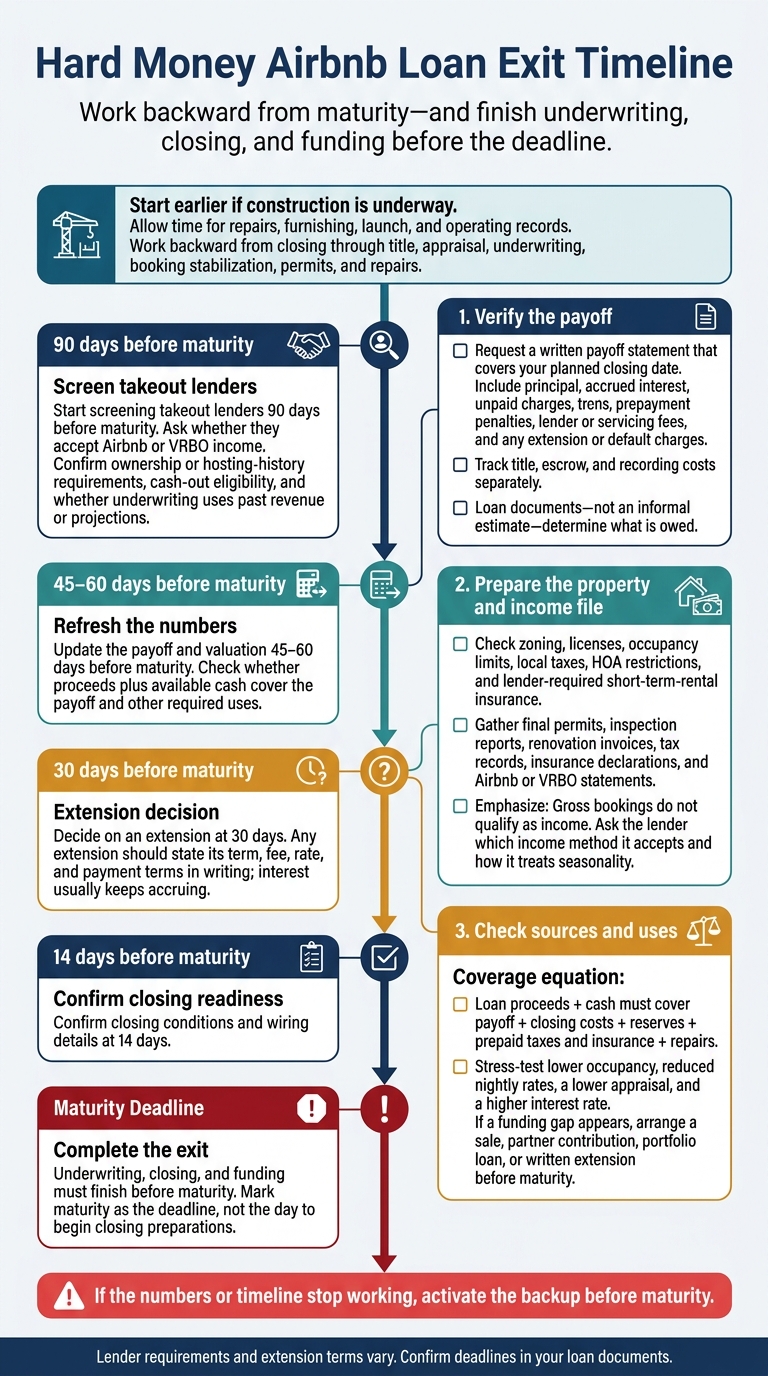
Hard Money Airbnb Loan Exit Timeline
Once you’ve chosen an exit plan, pin down the payoff amount and deadline. Request a written payoff statement that covers your planned closing date. It should list principal, accrued interest, unpaid charges, minimum-interest requirements, prepayment penalties, lender or servicing fees, and any extension or default charges. Track title, escrow, and recording costs separately. Your loan documents – not an informal estimate – determine what you owe.[5][8][9]
Your exit plan works only if underwriting, closing, and funding finish before maturity. Start screening takeout lenders 90 days before maturity. Ask whether they accept Airbnb or VRBO income, set ownership or hosting-history requirements, allow cash-out, and use past revenue or projections to underwrite the loan. Work backward from closing through title, appraisal, underwriting, booking stabilization, permits, and repairs. If construction is still underway, start earlier and allow time for furnishing, launch, and operating records. Update the payoff and valuation 45–60 days before maturity, decide on an extension at 30 days, and confirm closing conditions and wiring details at 14 days.[3][4][6]
Check that the property can legally operate as a short-term rental. Review zoning, licenses, occupancy limits, local taxes, and HOA restrictions. Ask your insurer to confirm that your short-term-rental coverage meets lender requirements. Gather final permits, inspection reports, renovation invoices, tax records, insurance declarations, and Airbnb or VRBO statements.[3][4]
Gross bookings do not qualify as income. Exclude refunds, platform fees, remitted taxes, cleaning fees, and other one-time items. Ask which income method the lender accepts and how it accounts for seasonality. Reported DSCR practices include income reductions of roughly 15%–20% for documented host history and 20%–25% for projections, but your lender’s method controls. Record both gross revenue and lender-eligible income in U.S. dollars.[4][7]
Build a sources-and-uses sheet. Loan proceeds plus cash must cover the payoff, closing costs, reserves, prepaid taxes and insurance, and repairs. Test whether the numbers still work with lower occupancy, reduced nightly rates, a lower appraisal, and a higher interest rate. If there’s a funding gap, arrange a sale, partner contribution, portfolio loan, or written extension before maturity. Any extension should state its term, fee, rate, and payment terms in writing; interest usually keeps accruing.[5][6][8] If the gap is too large, move to the next exit plan now.
1. DSCR Refinance
Best Fit
If rent alone can cover the new loan, DSCR is usually the first refinance option to test. A debt service coverage ratio (DSCR) refinance lets investors qualify mainly on their Airbnb’s rental income rather than personal employment income. It replaces hard money with longer-term debt.
Lenders typically calculate DSCR as qualifying rent ÷ PITIA (principal, interest, taxes, insurance, and dues). They may require a ratio of 1.00 or higher. Credit, liquidity, debt obligations, entity documents, and investor experience still matter.[11][13]
Requirements Before Maturity
Get the lender’s exact evidence requirements before the appraisal. Finish renovations, fully furnish the property, and make it guest-ready. Confirm that Airbnb or VRBO listings are live and insurance meets the lender’s requirements.
Ask whether the lender accepts hosting history, an appraiser’s rental analysis, or an approved market rent report. Get written rules for the required ownership period, maximum LTV, and reserves.[2][11][12][14]
Rank One Stays can help stabilize bookings, pricing, guest support, and records, which may help prepare the property for refinancing.
Advantages and Financial Risks
You keep the property and move into longer-term debt. But discounted rental income or a lower appraisal can leave a cash gap.
Review the quoted rate, points, closing costs, prepayment penalty, any personal guarantee, and the reserves you must keep after closing. DSCR isn’t automatically cheaper than conventional debt.[11][13][15]
Backup Plan
If the file stalls, ask the lender to identify the blocker right away: income, seasoning, appraisal, reserves, or documents. If short-term-rental income doesn’t qualify, test long-term rental underwriting, a smaller loan, or a written extension.
2. Cash-Out Refinance
Best Fit
A cash-out refinance releases equity. A payoff-only refinance replaces the debt without taking cash out. Cash-out can fit an improved Airbnb you plan to keep while paying off hard money before maturity. It can also preserve cash for reserves, repairs, vacation rental furnishings, or another investment. Some lenders offer DSCR underwriting for cash-out refinances.[17]
If refinancing works but you also need cash for reserves or the next deal, test this option.
Requirements Before Maturity
Use the payoff figure from the prior section to check whether the new loan covers the existing debt, closing costs, and cash you want to take out. Before paying for an appraisal, get a written payoff quote and confirm cash-out limits, ownership rules, and seasoning requirements.[16] Prepare records of completed improvements, an updated appraisal, and operating records.
Calculate net cash, not gross equity. From the approved loan amount, subtract the payoff, accrued interest, exit fees, closing costs, prepaids, and escrows. Then account for required post-closing reserves. Six months is a common benchmark, but requirements vary. Ask whether refinance proceeds can count toward those reserves.[18]
Advantages and Financial Risks
You keep ownership and gain cash, but borrowing more increases your debt obligations and may increase total interest. A lower appraisal or income-based loan limit can wipe out the cash-out – or leave you bringing cash to closing.
Check the full new payment against conservative slow-season net revenue after operating costs. Rank One Stays can help improve pricing, operations, and records, but it cannot guarantee qualification.
Backup Plan
If the quoted cash-out falls short, switch to a payoff-only refinance. If that smaller loan still leaves a gap, cover it with borrower equity before maturity.
3. Partner Buyout
Best Fit
A partner buyout works when one owner wants to leave and a remaining partner or new investor can fund the change. Unlike the refinance options above, it keeps the property in place but changes who owns it. This is an ownership transfer, not a refinance. The purchase agreement and closing instructions should put enough incoming cash toward the hard money debt before paying the departing owner. Start early so you can settle valuation, approvals, and funding before the balloon date.[1][21]
Requirements Before Maturity
Check the LLC operating agreement and any buy-sell agreement for transfer restrictions, rights of first refusal, voting thresholds, deadlock procedures, required approvals, and valuation rules. If there’s no valuation formula, use an independent appraisal and current Airbnb financials to set the value.[22][23]
Prepare a closing statement that accounts for the property, furnishings, operating cash, liabilities, unpaid distributions, and each partner’s capital account. Calculate the departing partner’s payout using capital accounts, unpaid distributions, profits, and liabilities. Pay the lender’s current payoff amount first, then settle the departing owner’s equity.[19][20][24]
Secure committed replacement funds and any required lender consent before closing. Selling an interest does not release a personal guarantee. Get a written guarantee release from each creditor.[25]
Advantages and Financial Risks
The Airbnb can keep operating during the ownership change, but new capital may dilute your share or shift control. Put voting rights and repayment priority in writing. Valuation disputes, funding gaps, taxes, and lender approval delays can stop the deal from closing. Have a CPA model the tax consequences before you finalize the price: partnership tax basis and each partner’s share of partnership liabilities can affect the transaction.[19][20][24]
Backup Plan
Set a deadline that leaves enough time to bring in another capital partner, close a refinance, or sell before the balloon date. If you miss that deadline, activate the backup plan and get any extension in writing before maturity.[10][1][21] If the buyout can’t close, move next to a portfolio loan or sale.
4. Portfolio Loan
Best Fit
When a single-property refinance or buyout won’t cover the payoff, a portfolio loan can combine several rentals into one takeout loan.
This option fits investors refinancing multiple rentals held by the same borrower or related entities. One lender can bundle the properties into a blanket loan, often with one payment and one maturity date.[33][34] Combined income may let stronger properties support weaker ones, though some lenders require each Airbnb to qualify separately.[28][31][32][34]
Requirements Before Maturity
Start 60–90 days before maturity and prepare a lender-ready file for each property. Include leases or booking statements, Airbnb and VRBO payout histories, trailing 12-month income and expenses, existing debt statements, title records, entity documents, and ownership charts.[32][34] Confirm that the lender accepts short-term-rental income and related-entity ownership. Check short-term-rental permits, zoning approval, HOA rules, and which properties will secure the loan.[27][29]
Arrange appraisals for every property, confirm eligible insurance, and budget for closing costs and required reserves. Typical leverage is 65%–75% of the portfolio’s combined appraised value, with portfolio DSCR often around 1.10x–1.30x. Some lenders also require each property to qualify separately.[26][27][34][35] Run the numbers for both the full portfolio and each rental to see which property falls short first.
Advantages and Financial Risks
Combining rentals can simplify payments, but one weak property can put the whole loan at risk. With cross-collateralization, each pledged property may secure the entire debt.[27][29] This exit works only if every pledged property passes underwriting and the loan funds before the balloon date.
Before signing, have an attorney review release prices, DSCR and LTV requirements for the remaining properties, prepayment penalties, lockouts, guarantees, and cash-management rules.[30] Stress-test the deal against a 20%–30% revenue drop before accepting the terms.[28][31]
Backup Plan
If the blanket loan stalls, pursue separate exits: individual DSCR loans for properties that qualify alone, a partial sale, or a full sale if financing cannot close in time.
After a blanket loan closes, get written release terms before committing to sell a property. Paying its allocated share of the debt may not be enough to release it from the loan. The lender may require a larger principal reduction or stronger coverage from the remaining properties.[36] Set a decision deadline that leaves enough time to close another exit before maturity.[36]
5. Property Sale
Best Fit
If refinancing falls through, selling is the cleanest way to cover the balloon payment. Use this option when refinancing or a partner buyout won’t cover the hard money payoff. The sale must close before maturity unless the lender grants a written extension. Review your loan documents now, since extension terms vary.[8][40]
Requirements Before Maturity
Plan the sale 90–120 days before maturity to allow time for construction closeout, permits, listing prep, marketing, buyer due diligence, and closing.
Finish renovations, address safety or habitability issues, close permits, and confirm any required occupancy, zoning, licensing, and inspection approvals. Gather invoices, permits, warranties, and inspection records. Prepare the listing with professional photos, accurate floor plans, honest copy, and a clean, staged property.
Set the price using nearby closed comparable sales, adjusted for condition, size, location, amenities, and rental use – not an optimistic after-repair value. Once the listing goes live, focus on price, buyer financing, and closing risk.
Advantages and Financial Risks
Selling avoids underwriting for a new loan and releases equity. But buyer financing, appraisal gaps, inspection issues, title defects, and price cuts can derail the closing.
Cash left = sale price minus payoff, fees, taxes, commissions, repairs, concessions, and carrying costs. Use the payoff statement to calculate net proceeds.[37][38][39] Have a CPA review adjusted basis, depreciation, and gain. Cash left is not profit.[41][42]
If buyer demand weakens, act promptly on pricing or extension terms.
Backup Plan
Set a deadline to revisit the price – for example, after 14 days without qualified offers – and review showings and buyer feedback. Keep refinancing as an option only if verified income and property value support it.
If closing slips, request a written extension before maturity. It should specify the fee, rate, payment terms, and new maturity date.[6][8][40]
Compare the 5 Exit Plans
Each exit depends on a different part of the deal: income, equity, ownership, or sale value. Match your plan to what the property can support. Rental income may cover debt service but still fall short of paying the balloon.[8][1]
DSCR refinancing depends on qualifying income. Cash-out refinancing requires usable equity and the ability to repay. Compare the options below to choose one primary exit and one backup before the balloon date.
| Exit plan | Best fit | Required before maturity | Main risk | Backup option |
|---|---|---|---|---|
| DSCR refinance | A rental you plan to hold, with income that supports the loan | Airbnb income history, payoff statement, appraisal, permits, insurance, and reserves | Too little qualifying income or too short an income history | Another DSCR lender, portfolio loan, or sale |
| Cash-out refinance | A property with enough equity to take cash out | Completed improvements, seasoning, appraisal, LTV, insurance, and reserve review | A low appraisal or LTV limit reduces cash proceeds or leaves a payoff gap | Payoff-only refinance, written extension, or borrower-funded paydown |
| Partner buyout | A change in ownership with funding in place | Buyout price, approvals, funding source, title changes, tax treatment, and lender consent | Partner funding misses the closing deadline | Remaining-owner refinance and written extension request |
| Portfolio loan | Several rentals with enough combined income and equity | Property schedules, payoff statement for each property, income records, insurance, tax documents, entity records, and STR compliance | Cross-collateralization can put every pledged property at risk | Refinance qualifying properties separately or sell the weakest asset |
| Property sale | A flip or an underperforming rental you hold | List price, repairs, payoff quote, marketing timeline, and closing buffer | Low net proceeds leave a payoff gap, or a delayed closing misses the balloon date | Lender-approved written extension or bridge refinance while listed |
Compare actual loan terms, not labels. Common investment-property cash-out limits are roughly 70%–75% LTV, but proceeds still depend on the appraisal, payoff, and closing costs.[44][45]
Lender requirements and local rental rules vary. Check city, county, state, and HOA restrictions; income from unlawful short-term rentals may not qualify.[43][3] Confirm the checklist for your chosen exit before the loan matures.
Conclusion: Checklist Before Loan Maturity
Use the exit-plan comparison above, then review this checklist before your loan matures.
Choose a primary exit and a funded, workable backup before borrowing. Whether you plan to refinance, arrange a buyout, use a portfolio loan, or sell, keep the property only if conservative revenue at lower seasonal occupancy covers the new debt payments, operating costs, and reserves. If the numbers don’t work, sell rather than extend expensive short-term debt.
Confirm the timeline and payoff. Verify the maturity date, request an updated payoff statement, and check extension terms and notice deadlines. Don’t assume an extension is automatic.
Review the refinance or sale math. Make sure refinance proceeds cover the payoff and closing costs, or that a sale leaves enough net proceeds to repay the loan. Get refinance terms in writing, including the rate, loan-to-value ratio (LTV), income test, reserves, and closing timeline. Preliminary terms are not a funding commitment.
Check income records and property readiness. Track monthly revenue and match platform payouts to bank deposits. Complete outstanding work, permits, and inspections. Verify that insurance and required licenses remain active.
Set aside cash and activate the backup early. Reserve cash for debt service, vacancy, repairs, and closing delays. Don’t count expected refinance proceeds or unfunded partner money as reserves. About six months of principal, interest, taxes, and insurance is a common lender benchmark, but requirements vary.[46][47] Assign responsibility for each backup task. Activate the backup immediately if valuation, income, permits, or approval falls behind expectations – and act no later than 60–90 days before maturity. If your chosen exit isn’t funded, approved, and ready, move to the backup now.
FAQs
Can I refinance before my Airbnb has a full rental season?
Yes, but you’ll need documentation of your property’s revenue potential. Lenders typically review revenue per available night (RevPAN) and past performance.
If your rental history is limited, Rank One Stays can help fill that gap with dynamic pricing and listing optimization. These services can support higher revenue and better property ratings, helping you document the financial results lenders need for a favorable refinance – even before your first full year.
What happens if my hard money loan matures before closing?
If your hard money loan comes due before you complete your exit plan, you could default. That can lead to foreclosure, steep late fees, and damage to your credit.
Professional management from Rank One Stays can help maintain occupancy and cash flow. Its property owners earn 38% more revenue than the market average, which may help you qualify for a conventional refinance or complete another exit strategy before the loan matures.
Can I refinance if my Airbnb loses its rental permit?
Refinancing gets much harder if your Airbnb loses its rental permit. Lenders require legal rental income, so a DSCR or cash-out refinance typically isn’t an option without a valid permit.
Protect your exit strategy by staying compliant and maintaining steady performance before your hard money loan matures. Professional management from Rank One Stays can help improve day-to-day operations and support the occupancy levels and operating standards lenders require.