

Airbnb DSCR loans have no universal minimum credit score. I’d use 620–680 as a rough range of advertised cutoffs – not a promise of approval – and ask each lender for its current requirements before applying.
Here’s what I’d check alongside your score:
- Cash needed: Plan for 20%–25% down, plus closing costs. Lenders may also require 6–12 months of housing-payment reserves, separate from your rental’s cash budget.
- Qualifying income: DSCR compares lender-accepted rent with monthly housing payments. A 1.00 ratio means those payments are covered – not that your Airbnb earns a profit.
- Property and records: Confirm short-term rentals are allowed, insurance meets lender rules, and booking records or rent estimates qualify.
- Loan costs and growth: Compare DSCR and conventional quotes, including rates, fees, personal guarantees, and prepayment penalties. Test whether each purchase or cash-out refinance leaves enough cash for weaker months.
My starting point: <u>check the lender’s credit cutoff, income formula, and cash requirements together</u>. A low score requirement alone doesn’t make a loan the right fit.
Think you need a 700+ credit score to get a DSCR loan? Think again
sbb-itb-103bddb
Credit Score Ranges and Approval Conditions
Treat these credit bands as underwriting guides, not approval guarantees. Before applying, ask for the lender’s current credit requirements in writing.[4][3] For Airbnb investors, your score affects more than eligibility – it can also shape how fast you grow your portfolio. Lenders use these ranges to balance credit risk with pricing, equity, and other loan requirements.
| Illustrative credit range | Typical access | Down payment expectations | Pricing considerations | What lenders review |
|---|---|---|---|---|
| 620–679 | Limited options; some programs exclude this range | More equity may be required | Higher rates or added fees may apply | Close review of DSCR, reserves, rental records, recent mortgage history, and the length and mix of credit history |
| 680–719 | More program options | Standard down payment requirements may be available | Rate and fee thresholds vary by program | Cash flow, reserves, and Airbnb income documentation |
| 720+ | Often the most program options | Lower down payments may be available | May qualify for better pricing | Credit events, rental rules, insurance, and valuation |
620–679: Fewer Options and Stricter Rules
Some lenders accept scores in this range; others don’t. Those that do may ask for more equity, stronger rental-income records, extra reserves, or a cleaner recent mortgage history. Other strengths won’t override a firm minimum score, so check the program’s cutoff before applying.[4][3] Lower scores usually slow portfolio growth because lenders require more equity and reserves to offset risk.
680–719 and 720+: More Loan Options
These tiers are the most useful for repeat purchases and refinances, but a score of 720+ doesn’t automatically get you the best offer. Compare written quotes for the same loan amount and structure. Look at the interest rate, points, lender fees, prepayment terms, and required reserves together. A lower advertised rate doesn’t necessarily mean a lower-cost loan.[4][3]
Credit Reports, Late Payments, and Major Credit Events
Underwriters check mortgage payment history separately from your score. Recent late payments may lead to stricter terms or a denial. Bankruptcies, foreclosures, short sales, and deeds-in-lieu may also come with lender-specific waiting periods. Disclose these events early, and ask which date starts the clock – for example, discharge or completion.[7][8]
Review all three credit reports and dispute genuine errors with supporting records. Pay down revolving balances where practical, but don’t count on a specific score increase. Ask which scoring model the lender uses, too: your qualifying mortgage score may differ from the number in your credit app.[4][6] These findings usually feed directly into your down payment, rate, and reserve requirements.
Down Payments, Rates, and Cash Reserves
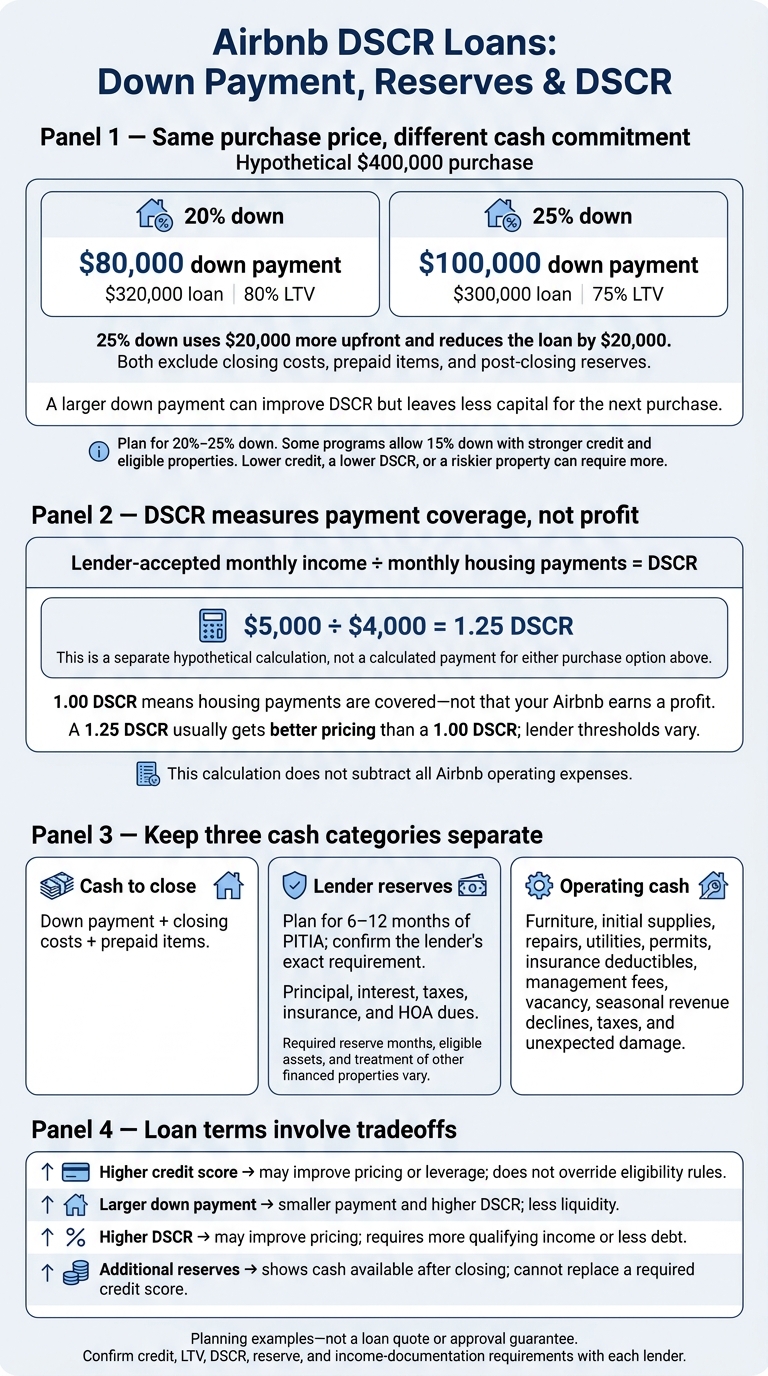
Airbnb DSCR Loans: Down Payment, Reserves & DSCR
Once your credit clears underwriting, your down payment, DSCR, and reserves help determine how much you can borrow – and what you’ll pay. Better credit can improve pricing, while lower scores or a lower DSCR can mean you need more cash.[12][15]
Planning for a 20%–25% Down Payment
Plan for 20%–25% down, the range many DSCR lenders use for pricing and approvals. That puts your loan-to-value ratio (LTV) at 75%–80%.[12][5] Some programs allow 15% down with stronger credit and eligible properties. Lower credit, a lower DSCR, or a riskier property can require a larger down payment.[13][9]
Ask lenders for separate LTV limits for purchases, rate-and-term refinances, and cash-out refinances. Also check refinance seasoning rules – the time you must wait before refinancing. The leverage available at purchase may not be available when you withdraw equity later.[12]
How Credit and DSCR Affect Loan Costs
Lenders price loans using credit, LTV, DSCR, and loan size together.[12][15] A 1.25 DSCR usually gets better pricing than a 1.00 DSCR.[12][14] Here’s how each factor can affect your terms and cash needs.
| Stronger factor | Possible effect on terms | Cash tradeoff |
|---|---|---|
| Higher credit score | Better pricing or leverage | May improve terms, but doesn’t override eligibility rules |
| Larger down payment | Smaller payment and higher DSCR | Uses more cash upfront and leaves less liquidity |
| Higher DSCR | Better pricing; lender thresholds vary | Requires more qualifying income or less debt |
| Additional reserves | Shows more cash on hand | Must remain available after closing; can’t replace a required credit score |
Compare written quotes on the same basis: loan amount, income assumptions, term, amortization, and points. Include lender fees and prepayment provisions, too. Loan structure – including interest-only options – can change both DSCR and long-term costs.[12][15]
Lender Reserves vs. Operating Cash
Reserves matter as much as pricing because lenders want to see cash available after closing. Plan for six to twelve months of PITIA reserves, then confirm the lender’s exact requirement.[11][12][14] Lenders usually count principal, interest, taxes, insurance, and HOA dues as PITIA. Required reserve months, eligible assets, and how lenders treat other financed properties vary.
Keep cash to close, lender reserves, and operating cash separate.[10] Your operating budget should cover Airbnb interior design, initial supplies, repairs, utilities, permits, insurance deductibles, management fees, vacancy, seasonal revenue declines, taxes, and unexpected damage.[10] More cash held in required reserves means less capital available for your next Airbnb purchase.
Example: Down Payment and DSCR Calculations
Hypothetical $400,000 purchase: A 20% down payment is $80,000, leaving a $320,000 loan. A 25% down payment is $100,000, leaving a $300,000 loan. Both exclude closing costs, prepaid items, and post-closing reserves. Separately, $5,000 in lender-accepted monthly income ÷ $4,000 in monthly housing payments = 1.25 DSCR. These figures aren’t a loan quote or net profit: the calculation doesn’t subtract all Airbnb operating expenses.[11][12]
A larger down payment can improve DSCR but leaves less capital for the next purchase.[12]
Before requesting quotes, prepare separate totals for cash to close, lender reserves, and operating cash. Ask each lender which assets qualify and how it calculates Airbnb income.[10][12] Check those totals against your available funds to see whether the deal works both on paper and in cash.
Airbnb Income Records and Property Eligibility
After reviewing credit and reserves, lenders check the property and income records. Strong credit won’t make up for an ineligible property or insufficient qualifying income. Confirm that your lender accepts the property type, short-term-rental use, and income documents. Keep bookings, qualifying rent, and actual cash flow separate for underwriting.
Document Rental History or Projected Income
Ask for the lender’s document list before applying. Gather booking statements, payout records, bank deposits, management reports, and insurance declarations. Include leases, operating agreements, and tax returns if requested.
Organize records by property and reporting period, then match payouts to bank deposits. This can speed up underwriting and help with repeat financing. Explain seasonal gaps, refunds, and owner stays. Even if personal income isn’t required, lenders still verify financial documents.
For a new rental, check which lender-approved rent estimate the lender accepts before ordering one. Some lenders discount projected income or use long-term market rent instead.
Check Rental Rules and Insurance
Income records aren’t enough if the property doesn’t meet local rules or insurance requirements. Rules differ by municipality, so check zoning, licensing, occupancy, and HOA limits for the specific property. Obtain insurance that confirms short-term-rental use and includes the coverage your lender requires.
Use Management Reports in Your Application
Clear reports can speed up underwriting when a lender needs proof of booking performance. Rank One Stays can organize lender-ready reports covering bookings, fees, occupancy, and deposited proceeds.
Ask whether its reporting format meets your lender’s requirements. Each report should identify the property and reporting period, with reported proceeds matched to bank deposits.
When DSCR Loans Fit Portfolio Growth
Once credit and reserves are in place, compare DSCR and conventional debt for your next purchase. Your credit score affects how fast you can expand by shaping available leverage, pricing, and repeat borrowing options.
DSCR vs. Conventional Investment Loans
DSCR loans can fit when property cash flow is strong, but your income, DTI, or tax returns make conventional approval harder. Compare both options before applying. Conventional financing may offer better terms if you meet its underwriting requirements. Match the loan structure to your income profile and how long you plan to hold the property.
| Feature | DSCR loan | Conventional investment loan |
|---|---|---|
| Income records | Primarily property rental income; proof of Airbnb revenue may be required | Borrower income, tax returns, assets, debts, and eligible rental-income documentation |
| Borrower DTI | Often less central; lenders may still review personal credit and liabilities | A central qualification factor |
| Pricing | Often higher than conventional for comparable borrowers | Potentially lower for qualified borrowers |
| Prepayment penalties | Common in many DSCR programs; compare the penalty period with your expected hold.[17] | Conventional loans usually have fewer DSCR-style restrictions |
| Entity ownership | Eligible LLCs may borrow; personal guarantees are common.[17] | Generally made to individuals |
| Portfolio limits | Lender-specific caps on balances, property counts, and market concentration.[17] | Agency and lender financed-property and reserve limits apply |
An LLC does not remove personal guarantee exposure. Ask which owners must guarantee repayment, whether the guarantee is full or limited, and which obligations it covers. Before planning another purchase, get written limits on total borrowing, property count, geographic concentration, and short-term-rental exposure.[17]
Buying Properties and Refinancing for Cash
DSCR loans can fund purchases or cash-out refinances. For portfolio growth, the key test is whether the property still produces positive cash flow after refinancing. Check ownership-seasoning requirements, then calculate usable proceeds after paying off the existing mortgage, closing costs, and any prepayment charge.[16][17]
Cash-out refinancing adds debt, not income. It supports expansion only when both the refinanced property and the next purchase maintain the required DSCR. Higher rates, points, penalties, and a restarted amortization schedule can outweigh the benefit of funding another down payment.
Look beyond a single-property projection: the full portfolio needs to withstand weaker months.
Stress-Test Each Additional Airbnb
Run base, downside, and severe cases across the full portfolio. Test changes in occupancy, rates, insurance, repairs, taxes, and management fees while keeping debt payments unchanged. If you outsource property management, include Rank One Stays in the model.
Calculate usable liquidity after closing and required reserves, leaving room for deductibles, replacements, and personal obligations. Delay borrowing if conservative cash-flow estimates turn negative, rental rules remain uncertain, or properties rely on the same peak season. Use portfolio cash flow to judge whether you can support the next DSCR loan through weaker months. Approval for one Airbnb does not prove the portfolio can absorb a downturn.
Conclusion: Check Credit, Cash Flow, and Reserves
A low minimum credit score isn’t enough reason to choose a DSCR loan for your next Airbnb purchase. Lender cutoffs vary, and stronger credit can improve pricing, leverage, and reserve flexibility.
Before requesting quotes, use this checklist to compare loans your property can support – and keep capital available for your next acquisition.
Before You Apply: Checklist
- Credit: Confirm the minimum score for your loan-to-value tier, late-payment rules, and bankruptcy or foreclosure seasoning requirements. Check all three credit reports for errors.
- Cash flow: Get the lender’s DSCR formula and accepted income sources in writing. Confirm that the qualifying income covers PITIA.
- Funds: Budget for a 20%–25% down payment, closing costs, prepaid items, and required reserves. Verify which reserve accounts qualify and the balances required after closing, while keeping capital available for future deals.
- Property: Check zoning, permits, HOA restrictions, and insurance coverage for short-term rentals.
- Records: Gather the booking, payout, and tax records your lender requests.
- Written quotes: Compare two to three written quotes using the same loan amount and term. Review rates, points, fees, personal guarantee terms, and prepayment penalties.[18][19] Calculate whether paying points will break even before your planned sale or refinance.
FAQs
Should I improve my credit before applying for an Airbnb DSCR loan?
Yes. DSCR loans focus on the property’s income potential rather than your personal income. But a higher credit score can help you get a better interest rate and down payment terms. Better terms can make debt payments easier to cover, protect your reserves, and support long-term profits.
After you buy, Rank One Stays can help maximize rental revenue through professional management, helping you cover debt payments and maintain reserves.
Can reserves from one Airbnb count toward another DSCR loan?
No. DSCR lenders typically require liquid cash reserves in a dedicated account for each property. These funds cover loan payments and operating expenses during seasonal slowdowns or repairs. The same reserves can’t count toward multiple loans [1].
Rank One Stays oversees reserve requirements, works to improve revenue, and manages maintenance to help keep cash flow steady and reserves funded [1].
How do lenders handle seasonal Airbnb income when calculating DSCR?
Lenders typically calculate DSCR using annual Airbnb income, rather than month-to-month results, to account for seasonal swings [1]. That includes peak periods like Scottsdale’s November–April snowbird season [1][2].
Rank One Stays uses dynamic pricing and listing optimization to maximize revenue during both peak and off-peak periods. This helps investors maintain cash flow and a stable debt-coverage ratio year-round [1][2].