
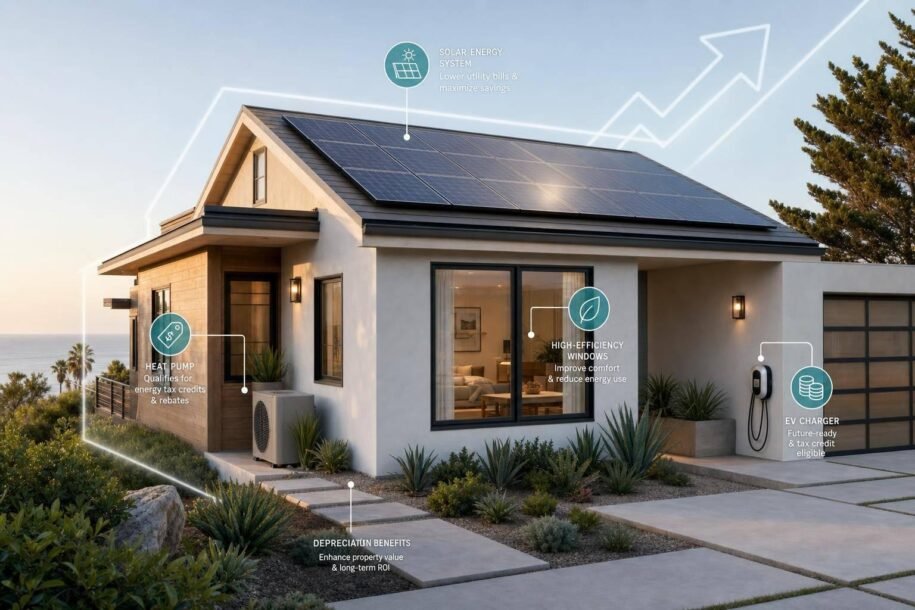
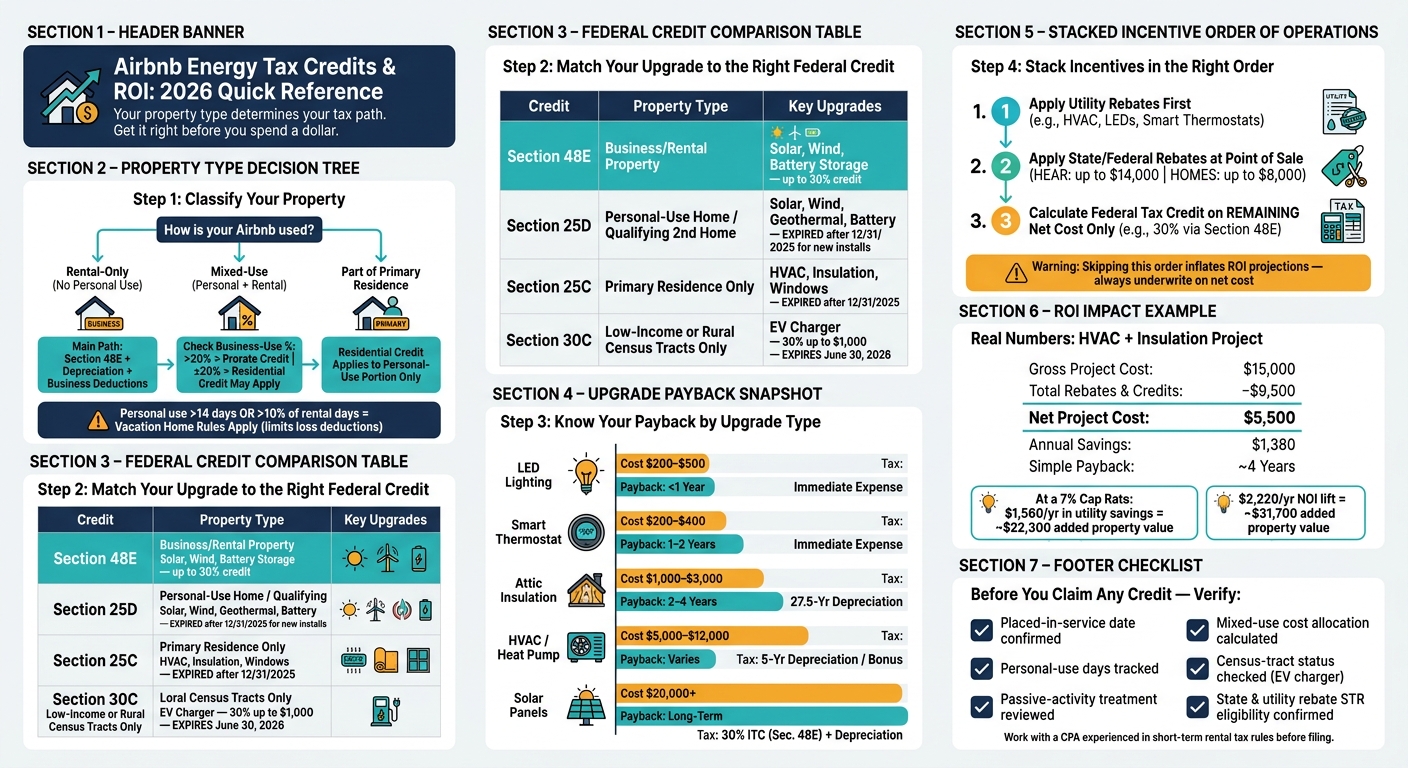
If your Airbnb is a rental business, most homeowner energy credits do not apply. In 2026, the main federal tax path for many short-term rentals is Section 48E for solar and batteries, plus depreciation and business deductions for many other upgrades.
Here’s the short version:
- Rental-only Airbnb: usually looks to Section 48E, depreciation, and business write-offs
- Mixed-use property: tax treatment can change based on business-use percentage and personal-use days
- Homeowner credits: generally do not fit full-time rentals, and 25C/25D expired for property placed in service after 12/31/2025
- Section 30C for EV chargers: may still apply in some low-income or rural census tracts, but it expires June 30, 2026
- Order matters: apply rebates first, then calculate any federal credit on the remaining cost
- ROI is more than tax savings: lower utility bills can lift NOI, and at a 7% cap rate, $1,560 in annual savings can add about $22,300 in value
A few numbers stand out fast. Smart thermostats can often pay back in 1–2 years. Attic insulation may pay back in 2–4 years. And a project with a $15,000 gross cost, $9,500 in stacked rebates and credits, and $1,380 in annual savings can land near a 4-year simple payback.
Before I count any tax break in the math, I’d check:
- Placed-in-service date
- Personal-use days
- Passive-activity treatment
- Mixed-use cost allocation
- Census-tract status for EV charger credits
- State and utility rebate rules for short-term rentals
A fast side-by-side view:
| Item | Full-Time Rental | Mixed-Use Airbnb | Primary Home Portion |
|---|---|---|---|
| Main federal credit path | Section 48E | Depends on business-use split | Older residential rules may apply if placed in service before 01/01/2026 |
| Solar / battery | Credit + depreciation may apply | Split may apply | Older 25D treatment may apply |
| HVAC / windows / insulation | Usually depreciation | Split by use | Homeowner path generally not for rental share |
| EV charger | 30C if tract qualifies and placed in service by 06/30/2026 | Same test | Same test |
| Key risk | Wrong property classification | Wrong allocation | Mixing home and rental costs |
This guide boils the article down to one point: the best project is the one that improves after-tax cash flow, not just the one with the biggest sticker-credit number. I’d use tax rules, net cost, annual savings, and guest impact together before spending a dollar.
Airbnb Energy Upgrade ROI: Tax Credit Decision Flow & Payback Guide
Vacation Homes & Rentals: Are They Eligible for the Solar Tax Credit?
sbb-itb-103bddb
Energy Tax Credit Rules for Airbnb Properties
If a project doesn’t meet the homeowner-credit test, the next move is to classify the property the right way. That IRS label shapes the tax route you can use. And it affects when the tax savings show up – now in cash flow, or later over time. Get it wrong, and you may claim the wrong credit, face recapture, or miss deductions you expected.
Business Use, Mixed Use, and Rental-Only Property Treatment
The IRS usually places Airbnb properties into one of three buckets: full-time rentals, mixed-use vacation homes, or part of a primary residence. When preparing these properties, professional vacation rental design can help maximize the ROI of your upgrades.
A full-time rental – meaning you don’t use it personally – is usually treated as business property. In that case, the main federal options are depreciation and the Section 48E business credit for renewable systems [1].
Mixed-use property works a bit differently. Here, the key line is 20% business use. If business use is 20% or less, the residential credit may still apply in full. If business use goes above 20%, you generally prorate the credit based on the nonbusiness share [1][7]. If the Airbnb is part of your primary residence, the residential credit applies only to the personal-use part of the costs.
Personal-use days also matter. If personal use goes over 14 days – or 10% of total rental days, whichever is greater – the property falls under vacation-home rules under IRS guidelines. That can limit loss deductions and force you to split expenses proportionally [3]. So yes, this is one of those places where good recordkeeping can save a lot of pain later.
Tax Credits vs. Deductions, Nonrefundable Limits, and Basis Reduction
A deduction cuts taxable income. A credit cuts tax owed.
That sounds like a small difference, but it changes the math in a big way.
Most energy credits reduce tax owed but do not create a refund [7]. Carryforward rules depend on the credit. Also, credits tied to rentals are generally passive, which means they usually offset passive income unless you qualify as a real estate professional [1].
Section 48E has another rule that often gets missed: it reduces depreciable basis by 50% of the credit. And if you sell the asset or switch it to another use within five years, recapture may apply [1].
Which Upgrades Typically Qualify Under Federal Energy Rules
For full-time rentals, the main federal routes in 2026 are Section 48E and depreciation. Section 48E can apply to solar panels, wind turbines, and battery storage used in a trade or business. The credit can reach 30% for projects under 1 megawatt or for projects that meet prevailing wage rules [1]. Standalone battery storage may also qualify for first-year bonus depreciation if acquired after January 19, 2025 [1][9].
For nonrenewable upgrades, the tax break usually comes through depreciation instead of a direct credit. That affects both after-tax cost and payback. Windows and insulation are generally recovered over 27.5 years. Heat pumps may sometimes fall into a shorter recovery period, while larger HVAC systems are usually 27.5-year property unless cost segregation changes the result [1][9].
EV charging equipment may also qualify for a credit. But Section 30C expires June 30, 2026, and it only applies to properties in IRS-designated low-income or rural census tracts [5][8].
Typical treatment looks like this [1][5][8][9]:
| Upgrade | Tax Treatment | Recovery Period | 2026 Bonus Eligible |
|---|---|---|---|
| Solar panels / wind | Section 48E credit (can reach 30%) + depreciation | 5-year MACRS | Yes |
| Standalone battery storage | Section 48E credit + depreciation | 5-year MACRS | Yes |
| Heat pump | Depreciation | 5-year MACRS | Potentially |
| HVAC systems | Depreciation only | 27.5 years | No |
| Windows / insulation | Depreciation only | 27.5 years | No |
| EV charger (qualifying tract only) | Section 30C credit (30%, capped at $1,000 for eligible installations); expires June 30, 2026 | Varies | Verify with CPA |
Confirm eligibility before you buy, and keep all manufacturer documentation with your tax records [7].
With the property type set, the next step is matching each upgrade to the right federal credit or depreciation path.
Main Federal Energy Tax Credits U.S. Hosts Should Know
For Airbnb investors, the big federal tax-credit question in 2026 comes down to one thing: is the property treated as personal-use or as rental business property?
That split drives everything.
Section 48E is the main federal credit for rental energy projects. Sections 25D and 25C applied only to personal-use homes, or to systems placed in service before Jan. 1, 2026. Pick the right credit path, and you can cut the net cost of the project and improve payback for short-term rentals. Professional vacation rental management can further optimize these returns through expert tax positioning and dynamic pricing.
Use the chart below to line up each upgrade with the credit path that fits your property type.
| Credit | Eligible Property Type | Common Qualifying Upgrades | Key Takeaway |
|---|---|---|---|
| Section 25D – Residential Clean Energy | Personal-use home or qualifying second home | Solar, wind, geothermal, battery storage | Mixed-use properties may qualify only under the 20% business-use rule [10][11][7] |
| Section 48E – Clean Electricity Investment Credit | Business/rental property | Renewable energy upgrades | Main federal credit for rental-only properties [1] |
Section 25C (Energy Efficient Home Improvement Credit) applied to a primary residence only, not rental properties, and expired for installations placed in service after Dec. 31, 2025 [1].
For hosts dealing with mixed-use property or systems installed before 2026, the next step is figuring out whether any residential-credit treatment still applies.
Residential Clean Energy Credit for Solar, Batteries, and Related Systems
Section 25D offered a 30% credit for solar, wind, geothermal, and battery storage on a personal-use home or qualifying second home [10][11].
But there was a catch: it did not apply to full-time Airbnb rentals. Mixed-use properties could qualify only under the 20% business-use rule, and credits from systems installed before Jan. 1, 2026 may still carry forward [1][11].
What Still Matters for Rentals
For rental-only properties, Section 48E is the federal credit to watch. If the property is mixed-use, some residential-credit treatment may still be on the table under the 20% business-use rule [7][11].
State Incentives and ROI Calculations for Energy Upgrades
Federal credits are only part of the picture. State, utility, and local programs can trim your out-of-pocket cost, but there’s a catch: you need to check the rules before you spend a dollar. Once you know which rebates fit your property, it gets much easier to figure out your actual project cost and payback.
How to Find State, Utility, and Local Rebates That Apply to STRs
A good place to start is DSIRE (Database of State Incentives for Renewables & Efficiency), which lists state, local, and utility programs by ZIP code [8]. After that, go straight to your utility company’s rebate page. Big providers like PG&E, Xcel Energy, and ConEd all have pages for upgrades such as HVAC, insulation, and smart thermostats [12].
It also helps to check your state energy office first. HOMES can cover up to $8,000 for whole-home upgrades, and HEAR can cover up to $14,000 for items like heat pumps, panels, and water heaters. That said, don’t assume a short-term rental qualifies. Verify that point before you build the rebate into your budget.
Before you include any rebate in underwriting, confirm that the program allows short-term rentals, second homes, or rental-only properties. Rules change from one program to another, and some come with income caps, audit rules, or efficiency-tier standards [12][13].
Use the table below to separate upfront discounts from tax benefits.
| Incentive Type | Provider | Upgrade Category | Net Cost Effect |
|---|---|---|---|
| HEAR Rebate | Federal (via State) | Heat pumps, panels, water heaters | Instant rebate at purchase up to $14,000 per household [12] |
| HOMES Rebate | Federal (via State) | Whole-home upgrades | Post-install rebate up to $8,000 per household [12] |
| Federal tax credit used after rebates | IRS (Business) | Solar, battery storage | 30% credit applied to the remaining net cost [1][4] |
| Utility Rebates | Local Utility | HVAC, LEDs, smart thermostats | Upfront rebate or ongoing bill credit [12] |
How to Calculate Net Project Cost and Simple Payback
The order matters here. Apply utility rebates first, then state rebates at the point of sale, and only after that calculate the federal tax credit on the remaining out-of-pocket amount [13]. If you skip that sequence, it’s easy to double-count savings and make ROI look better than it is.
Here’s a realistic example of an HVAC and insulation project once incentives are stacked the right way [2]:
| Metric | Before Upgrades | After Upgrades |
|---|---|---|
| Gross Project Cost | – | $15,000 |
| Total Rebates & Credits | – | ($9,500) |
| Net Project Cost | – | $5,500 |
| Annual Savings | – | $1,380 |
| Simple Payback Period | – | ~4 years |
Attic insulation by itself can pay back in as little as 2–4 years [2]. For many Airbnb properties, that makes it one of the best-return projects on the list. And the NOI effect doesn’t stop at the utility bill. At a 7% cap rate, a $1,560 yearly drop in utility costs can add about $22,300 to property value [2].
How Energy Upgrades Can Affect ADR, Occupancy, and Resale Value
The math above covers direct utility savings only. In practice, guests notice comfort. They notice when the place stays cool in July, warm in January, and doesn’t feel drafty or awkward to use.
That means visible upgrades can do more than cut bills. They can support higher ADR, better occupancy, and a stronger resale story. EV charging is a good example. The Section 30C credit covers 30% of installation cost up to $1,000, but the property must be placed in service by June 30, 2026.
How to Build and Execute an Energy-Efficient Airbnb Plan
Prioritize Upgrades by Payback, Credit Limits, and Guest Impact
Once rebates and credits are clear, rank each project by net cost, payback, and how much it could affect guests.
A simple way to think about it: start with the low-cost wins first. Then move into building-shell work and bigger equipment jobs.
Start with LED lighting ($200–$500) and a smart thermostat ($200–$400). These projects often pay back fast, and both can often be expensed right away under a valid de minimis policy.
After that, move to air sealing and attic insulation ($1,000–$3,000). Seal the building first, then size HVAC. If you install a heat pump in a leaky building, you may end up oversizing the system, which can cut into its efficiency [2].
Solar and battery storage usually make more sense after those lower-cost efficiency fixes are done. Solar tax benefits step down after 2026, so timing matters.
| Upgrade | Estimated Cost | Tax Treatment (Rental) |
|---|---|---|
| LED Lighting | $200–$500 | Immediate expense under a valid de minimis policy |
| Smart Thermostat | $200–$400 | Immediate expense under a valid de minimis policy |
| Attic Insulation | $1,000–$3,000 | 27.5-Year Depreciation |
| HVAC / Heat Pump | $5,000–$12,000 | 5-Year Depreciation / Bonus Depreciation |
| Solar Panels | $20,000+ | 30% ITC (Sec. 48E) + Depreciation |
Document Every Project and Work With a STR-Savvy CPA
Before work starts, get the paper trail in place.
At a minimum, keep itemized invoices that separate labor from materials, proof of payment, and records showing the exact date each item was placed in service [14][4]. You’ll also want manufacturer certification statements, equipment specs, permits, and inspection reports [14][2][8]. If a project needs third-party certification, line up the rater while the work is still in progress.
This is where a CPA who knows short-term rentals can save you a headache. Energy incentives and STR tax treatment overlap in ways that can affect passive activity rules and whether your setup keeps material participation in place for the STR loophole [1][6].
Use Professional Management to Protect ROI During and After Upgrades
Energy upgrades only help ROI if they don’t throw off bookings or hurt the guest stay.
A full-service vacation rental management company can help keep things on track by scheduling work during low-occupancy stretches or between bookings, coordinating with contractors, and keeping the guest experience steady during the project. Once the work is done, a good manager can feature smart climate control, EV charging, and other green upgrades in the listing to help support higher ADR and appeal to eco-conscious guests.
Rank One Stays can coordinate upgrades around bookings, protect guest experience, and keep the property positioned for stronger post-upgrade revenue.
Before you sign a management agreement, ask your CPA if the structure changes material participation under STR tax rules.
Conclusion: The Best Energy Tax Credit Plan Is the One That Improves Net ROI
Start with the first thing that matters: property classification.
If the Airbnb is rental-only, it will usually lean on Section 48E, depreciation, and business deductions instead of residential credits. That step matters because the tax path changes fast once the property is treated as a rental business rather than a personal residence.
After that, the main question is pretty simple: does the project improve after-tax cash flow? If it doesn’t, the tax angle alone shouldn’t carry the deal.
There’s also a smart order of operations here. Apply rebates first, then credit the remaining balance. That keeps your eye on the net cost, not the sticker price. And that’s the number that should drive the math.
For many rental owners, business deductions lead to more usable tax savings than residential credits. That can make a bigger difference than people expect, especially when the goal is better property income, not just a one-time tax break.
The upside isn’t limited to lower utility bills, either. A $2,220 annual NOI lift can add about $31,700 in property value at a 7% cap rate. That’s why the strongest projects tend to do two jobs at once: cut operating costs and make the stay better for guests.
The right plan comes down to correct tax treatment, after-tax underwriting, and smooth project execution. Rank One Stays can coordinate upgrades around bookings while keeping revenue on track.
FAQs
Does my Airbnb count as business or personal-use property?
The IRS looks at how you use your Airbnb.
If you use it only as a rental, the property is treated as a business asset, not a personal residence. That means it doesn’t qualify for residential energy tax credits.
But there’s a middle ground. If you use the property for personal stays for more than 14 days or more than 10% of the days it was rented, whichever is greater, you may be able to claim part of those credits based on your personal use.
That’s why good recordkeeping matters. Keep detailed occupancy records so you can show rental days vs. personal-use days if the IRS ever asks.
Can I still claim energy credits if I use the property myself?
It depends on how you use the property.
In most cases, residential energy credits apply only to a home that you use as your own residence. If a property is used only for business, it doesn’t qualify.
If the home is used for both personal and business purposes, you may still claim the part tied to nonbusiness use. But there’s a limit: business use can’t be more than 80% of total use.
If the property is used mostly as a rental, residential credits usually aren’t the right fit. In that case, look into depreciation and business energy credits instead.
Which upgrades give the best ROI for a short-term rental?
For a short-term rental, the fastest-ROI upgrades are:
- LED lighting
- Low-flow showerheads
- Smart thermostats
These cut utility costs right away and don’t cost much to install. One catch: residential energy tax credits don’t apply to rental properties.
That said, these upgrades may still count as depreciable business expenses, which can help at tax time over the long run.