
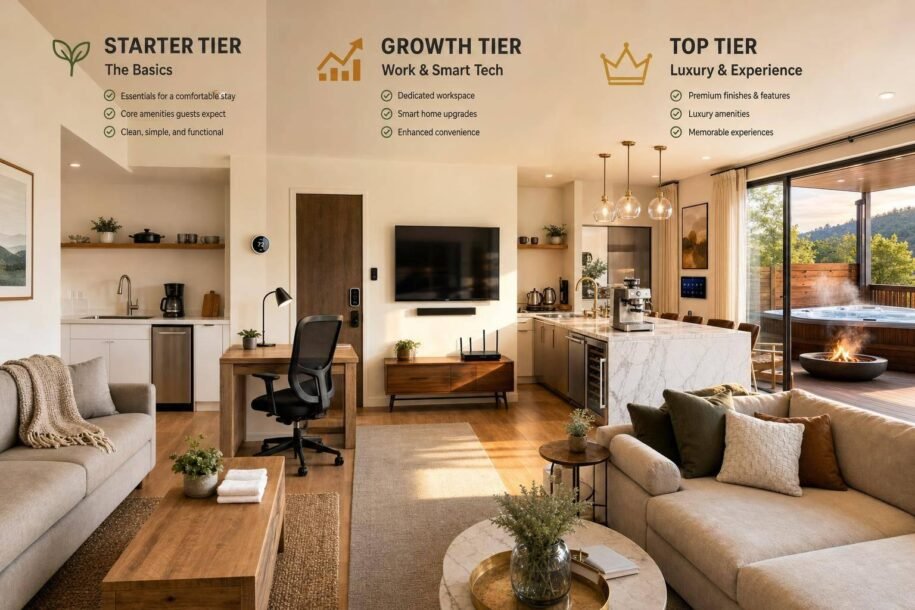
The short answer: your amenity plan should match your revenue level. A listing under $15,000/year needs the basics done right. A listing over $100,000/year needs features that help sell the stay itself.
I’d sum the article up like this:
- Every listing needs the floor items first: Wi-Fi, heating and A/C, hot water, clean linens, toiletries, a working kitchen, and self check-in.
- Low-tier listings win by avoiding friction, not by adding flashy extras.
- Mid-tier listings grow by matching the trip type: work, family, pets, and outdoor use.
- Upper-midscale listings justify higher rates with smart-home tools, better sleep setup, stronger design, and better entertainment.
- Luxury listings sell an experience, often through pools, hot tubs, wellness features, privacy, and hotel-like service.
- Amenity count can help occupancy, and some features show strong links to revenue:
- workspace listings: about 14% higher host earnings
- pet-friendly listings: about 24% more RevPAN
- EV charging in the right markets: about 19% more income
- smart-home features: 60% of guests say they would pay more
What matters most is simple: don’t spend like a luxury host on a budget property. Fix weak photos, cleaning, pricing, and guest issues first. Then add the features your market will pay for.
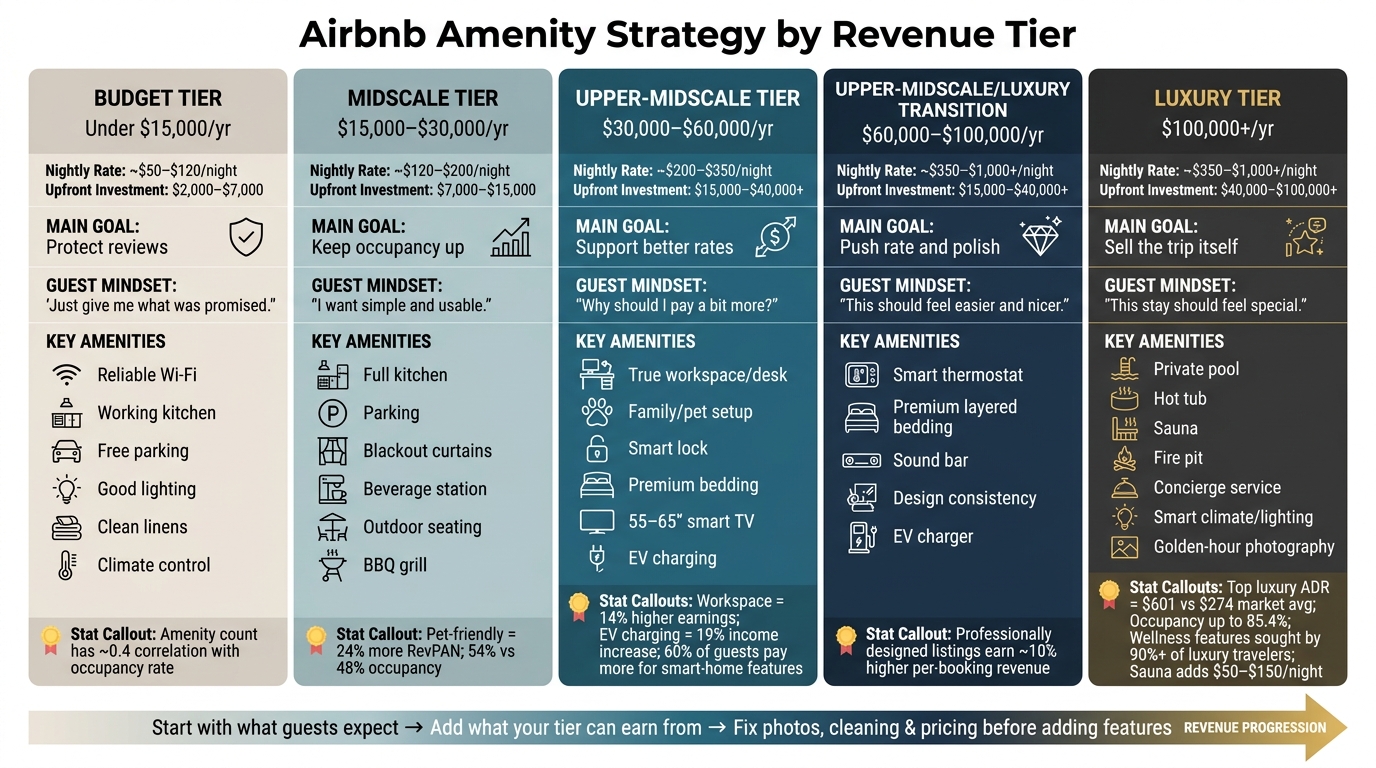
Airbnb Revenue Tier Amenity Guide: What to Offer at Every Level
Top Airbnb Amenities That Boost Revenue (Backed by Real Data!)
sbb-itb-103bddb
Quick Comparison
| Revenue Tier | Main Goal | What Matters Most | Guest Mindset |
|---|---|---|---|
| Under $15,000 | Protect reviews | Basics work every time | “Just give me what was promised.” |
| $15,000–$30,000 | Keep occupancy up | Kitchen, parking, lighting, low-cost function | “I want simple and usable.” |
| $30,000–$60,000 | Support better rates | Workspace, family/pet setup, outdoor seating | “Why should I pay a bit more?” |
| $60,000–$100,000 | Push rate and polish | Smart locks, better bedding, TV setup, design | “This should feel easier and nicer.” |
| $100,000+ | Sell the trip itself | Pool, hot tub, sauna, privacy, service | “This stay should feel special.” |
If I had to boil the whole piece down to one line, it would be this: start with what guests expect, then add what helps your tier earn more without adding the wrong cost.
1. Essential Basics
Essential basics are the floor, not the ceiling. If a listing says it offers them and then comes up short, that can lead to penalties, including removal. At the lowest revenue tiers, these basics matter most because they protect reviews and help hosts avoid price cuts.
Revenue Role
Essentials protect ratings and help keep pricing power in place. Listings that stay near the top of the rating range tend to show up more in search and do better than lower-rated properties. Research also shows that amenity count has one of the strongest positive links with occupancy rate, at about 0.4.[4]
Core Amenities
Essentials fit into four groups: sleep, bathroom, safety, and connectivity.
For sleep, guests expect a comfortable mattress, clean linens, at least one pillow per guest, extra blankets, and blackout curtains or shades. For the bathroom, the baseline is simple: toilet paper, hand soap, body soap or shower gel, and clean towels for each guest, with backup supplies easy to find.
Safety covers the non-negotiables: working smoke and carbon monoxide detectors, a fire extinguisher, and secure locks. Connectivity means fast, dependable Wi-Fi with the network name and password posted clearly. It also includes steady hot water and climate control.
A simple coffee setup helps. So do basic kitchen tools. In full kitchens, cookware, dishes, and cleaning supplies round out the baseline.
Wi-Fi and temperature control need extra attention. In states like Arizona and Florida, guests see A/C as non-negotiable. In Colorado and Pennsylvania, steady heat matters just as much. These are not nice-to-have extras. They are basic expectations, and the exact need shifts with climate.
Guest Expectations
Guest expectations are shaped less by revenue tier and more by why they booked the trip. U.S. guests already know what should be there. Reliable Wi-Fi, climate control, basic toiletries, comfortable bedding, and a place to sit and work all fall into the standard bucket. When one of those is missing, guests usually treat it as a failure, not a fair trade-off.
Business travelers and remote workers are even less flexible here. They expect fast Wi-Fi, a comfortable chair, a flat surface, quiet surroundings, and enough outlets to stay productive. A dedicated workspace may sit in a higher tier, but if there is no workable spot at all, reviews can still take a hit, even for a budget listing.
Once these basics are in place, the next tier shifts to low-cost upgrades that improve comfort and make the listing more appealing. Professional Airbnb design services can help bridge this gap by optimizing your layout for both aesthetics and guest utility.
2. Budget Tier
Revenue Role
Budget listings usually sit near the low end of local pricing. They win on occupancy, not nightly rate. At this level, small upgrades only matter if they make day-to-day use easier. Each amenity should cut friction and help protect reviews. These are high-occupancy listings that keep cash moving during slower seasons.
Core Budget-Tier Amenities
At this tier, the most important amenities are the ones guests use every single day. A usable kitchen sits at the top of the list. It is one of the first amenities guests check across guest types and markets.[3] That means a working stove or cooktop, refrigerator, microwave, basic cookware, utensils, dishes, and a coffee maker. Budget guests don’t need a fancy kitchen. They need one that works.
Parking matters just as much outside dense urban areas. Free, clearly explained parking – whether that’s a driveway, assigned spot, or street parking without permit confusion – is treated as a high-priority amenity in most U.S. markets.[2][3] A plain parking description and a photo can stop a lot of arrival complaints before they start.
Lighting is one of those details that seems small until it isn’t. Poor lighting is easy to miss as a host and hard to forgive as a guest. People notice whether there’s enough light to read, outlets near the bed, bedrooms that can be darkened, and switches that are easy to use.[5][6][7][8] Bright, even lighting makes a place feel more livable without adding much cost.
Rate Impact and Guest Expectations
Budget guests will accept fewer extras. They won’t accept broken basics. A lot of low-star reviews at this tier come from expectation gaps: a kitchen missing basic cookware, parking directions that don’t match what guests find, or Wi-Fi that drops out. Good execution helps protect reviews and gives hosts room to move rates up little by little. Strong reviews also help budget listings inch rates up without hurting occupancy.
Once these low-cost basics are handled, the next tier starts adding comfort features that support a higher rate.
3. Midscale Tier
Revenue Role
Once you remove the friction that drags down budget stays, midscale amenities start doing a different job: they sell convenience for a specific kind of trip.
At this level, listings do more than cover the basics. Guests slow down and compare. They look more closely at photos, read amenity lists, and ask a simple question: Why should I pay more for this place? That means your amenities need to support a higher nightly rate in a clear way.
So the revenue focus changes. It’s no longer just about filling the calendar. It becomes a mix of better nightly rates and steady bookings. The best midscale amenities cut down guest hesitation. When a listing clearly fits a need – remote work, family travel, or pet-friendly stays – it becomes much easier to turn views into bookings at a better rate.
Core Midscale-Tier Amenities
Midscale features should fix a clear guest problem, not just pile on more stuff.
One of the best upgrades at this tier is a true workspace. That means a real desk, an ergonomic chair, a task lamp, and outlets close by. Listings with laptop-friendly workspaces are tied to roughly 14% higher host earnings.[1][3] That tracks with guest behavior too. Remote workers and business travelers often stay longer and worry less about small price differences, which helps support a higher average daily rate.
Blackout curtains are another strong add-on that doesn’t cost much. Sleep issues show up all the time in midscale reviews, especially from families with young kids and travelers dealing with jet lag. Blackout curtains send a simple message: the host thought about the stay, not just the staging. They work even better with a stronger beverage setup, like:
- a drip coffee maker
- a pod machine
- a kettle
- quality mugs
For family and pet travelers, the data is hard to brush off. Pet-friendly listings earn 24% more revenue per available night and post occupancy rates of 54% versus 48% for non-pet-friendly listings.[10] A pet bed, food and water bowls, waste bags, and easy-clean rugs are cheap additions that open the door to a big, loyal guest group. For families, a Pack ‘n Play, high chair, outlet covers, and a few board games can make parents feel like the home was set up with them in mind.
Rate Impact and Guest Expectations
Grill access and outdoor seating help round out the midscale offer. A BBQ grill ranks among the top amenities guests search for most on Airbnb.[9] You don’t need anything fancy here. A clean propane grill with a spare tank, basic tools, and clear instructions is usually enough. Add weather-resistant chairs and a table, and the place starts to feel like a full stay, not just somewhere to crash. It also helps the listing photos do more work.
Guests in this tier also notice décor choices. They’re not looking for high-end finishes, but they do want the space to feel pulled together. Coordinated linens, warm lighting, and clean surfaces go a long way. A polished-looking listing tends to earn more saves and more bookings. The aim is simple: make the place feel shaped around the guest’s trip, not just filled with furniture.
At the next tier, guests start paying for bigger-ticket amenities such as hot tubs, pools, and smart-home features.
4. Upper-Midscale Tier
Revenue Role
Upper-midscale listings make more money by pairing comfort, convenience, and polish. It’s not about tossing in random extras. At this level, amenities aren’t there to fix gaps anymore. They help explain why this place costs more.
That only works if the basics are already in good shape. Pricing has to make sense. Photos have to sell the space. Operations have to run smoothly.
Core Upper-Midscale Amenities
Smart home features are one of the clearest signs that a listing has moved into this tier. A smart lock with one-time guest codes makes check-in easier. A smart thermostat gives guests more control while letting hosts keep an eye on things. A 2023 smart-home study found that 60% of guests would pay more for a vacation rental with smart home features, and 90% of business travelers are more likely to book when smart tech is present.[11]
Premium bedding is also expected here. That usually means:
- A quality mattress with a protector
- High-quality sheets
- Pillow options with different firmness levels
- Layered bedding that works across seasons
When reviews keep mentioning how well people slept, that tends to help ratings and conversion at higher price points.
Upgraded entertainment finishes the core package. A 55- to 65-inch smart TV, streaming apps, and a sound bar can make the main living area feel more polished. A monitor or docking station can also help with remote-work demand. Paired with strong Wi-Fi, these features can support higher nightly rates.[10]
Once those core upgrades are done, the next money lever is design and day-to-day usefulness.
Rate Impact and Guest Expectations
Design consistency is where a lot of hosts miss out. Listings that are professionally decorated or designed with a clear, matching look earn about 10% higher per-booking revenue than similar self-decorated properties.[12] That doesn’t mean going over the top. It means keeping the space consistent: a tight color palette, furniture that works together, and one or two focal pieces that stand out.
The point is simple. The listing should look intentional in photos. That matters because photo-friendly listings tend to do better in search and can support a higher rate.
EV charging is also becoming more important in urban and suburban U.S. markets. In the right places, a Level 2 charger can be tied to roughly a 19% income increase.[13]
Put these upgrades together – smart entry, better sleep, stronger entertainment, clean design, and EV charging – and the lift can add up fast. A property making $55,000 at the midscale level can reasonably aim for $70,000–$75,000 per year after a solid upper-midscale move, with a typical payback period of 12–24 months on an investment that usually lands between $4,000 and $10,000.
The next tier moves beyond polished execution and into destination appeal.
5. Luxury Tier
Revenue Role
At the luxury tier, amenities don’t just add comfort. They sell the whole experience. The property itself becomes the reason for the trip.
This is the point where amenities stop helping justify the price and start shaping the stay from start to finish. Top luxury listings can reach a $601 ADR, compared with a $274 market average. Occupancy can climb to 85.4% [16]. Numbers like that usually come from a very specific mix: standout outdoor features, hotel-level presentation, and design that feels deliberate in every frame.
Core Luxury Amenities
For luxury listings, the outdoor setup does a lot of the heavy lifting. A private pool, hot tub, fire pit, and sauna form the base.
That makes sense when you look at guest behavior. More than 90% of luxury travelers look for wellness features when choosing accommodations [14]. And in the $500–$1,000 per night range, wellness additions like saunas can add $50–$150 per night [14].
A sauna can change the feel of the stay. It moves the property from “place to sleep” to “wellness retreat,” which helps support a higher nightly rate. Add a cold plunge or an outdoor shower, and it becomes a full ritual instead of a single extra feature [14]. Luxury guests notice that difference.
Design and Staging Expectations
Once the outdoor experience feels high-end, the interior has to keep up.
Platforms like Plum Guide accept only the top 3% of homes through a scientific vetting process that looks at aesthetics, layout flow, and overall quality [17]. That’s the bar many luxury guests bring with them.
At this level, the home should show clear visual consistency across every room, full-property styling without mismatched pieces, and indoor-outdoor continuity that looks photo-ready from every angle [14][17]. If one room feels off, it can pull down the whole impression. The staging has to support the rate in every detail and every image.
Golden-hour photography matters here, especially for pools, outdoor lounges, and architectural details [14][15]. In luxury listings, photos aren’t just marketing. They set the promise.
Rate Impact and Guest Expectations
Of course, premium features alone aren’t enough. The service has to feel just as polished.
Luxury guests expect keyless entry, smart climate and lighting, pre-arrival grocery stocking, and concierge support [17]. The tech should work smoothly, without making guests stop and figure things out. Keyless access, preset climate, and lighting scenes need to feel easy, not fussy.
Privacy also carries a lot of weight. Entire-home rentals with no shared spaces, often in gated communities or with private beach or waterfront access, line up with luxury expectations [15][17].
At this income level, professional management often becomes part of the product. It helps keep the guest experience in line with the rate through listing optimization, dynamic pricing, 24/7 guest support, housekeeping, and staging.
Pros and Cons by Revenue Tier
As amenities stack up, the choice stops being just about comfort. It becomes a trade-off between more revenue, more cost, and more day-to-day work. The table below lays out how that trade-off changes by tier.
| Revenue Tier | Typical Nightly Rate | Annual Revenue | Upfront Investment | Pricing Power | Occupancy Support | Operating Load | Expectation Pressure |
|---|---|---|---|---|---|---|---|
| Budget | ~$50–$120/night | Under $30,000 | Low ($2,000–$7,000) | Weak – competes mainly on price and cleanliness | Weak – relies on discounts in slower periods | Simple – easy to self-manage | Low – cleanliness and basics are enough |
| Midscale | ~$120–$200/night | $30,000–$60,000 | Moderate ($7,000–$15,000) | Solid – workspace and better design lift rates noticeably | Stable – remote workers and longer stays help fill weekdays | Manageable – better housekeeping standards are needed | Moderate – guests expect consistent quality |
| Upper-Midscale | ~$200–$350/night | $60,000–$100,000 | High ($15,000–$40,000+) | Strong – hot tubs, outdoor living, and smart-home touches add meaningful premium | Strong – heavily searched amenities improve visibility and booking demand | Elevated – hot tubs, smart locks, and outdoor spaces need regular upkeep | High – premium features must work reliably every stay |
| Luxury | ~$350–$1,000+/night | $100,000+ | Very high ($40,000–$100,000+) | Very high – pools, design, and concierge-level service justify top rates | Volatile – strong in peak periods, more sensitive to pricing in slower seasons | Complex – resembles boutique hotel operations | Very high – any failure feels unacceptable at this price point |
For most owners, Midscale and Upper-Midscale tend to hit the best return-to-effort balance. That’s usually where amenity bundles move beyond the basics and start adding work-friendly features, family-friendly touches, smart-home tools, and outdoor upgrades. You can push rates higher without sliding all the way into the heavy operating burden that luxury brings.
Budget listings stay easy to run, which is a big plus. But there’s a catch: when more competitors show up, price-led listings can get squeezed fast. On the other end, premium properties can push the revenue ceiling much higher, but they also demand tighter execution. At that level, guests don’t just hope things work. They expect it, every single stay.
As amenity load grows, management matters more. Hot tubs need service. Smart locks need monitoring. Outdoor spaces need upkeep. Pricing also gets trickier. That’s where Rank One Stays helps owners make the most of that upside with pricing, operations, and guest support.
That trade-off is what decides which tier fits a property best.
Conclusion
Amenities should scale with your revenue tier. Across all five tiers, an amenity adds value ONLY when it lines up with guest demand and what your pricing can support. Start with the basics, then layer in upgrades when the revenue tier makes sense. If weak photos, uneven cleaning, or poor pricing are still holding the property back, fix those first. In many cases, those issues limit revenue more than one missing feature ever will.
After that, the key question is simple: what will this market pay for? Amenity ROI depends on demand in that area. Hot tubs can pay off in leisure markets. In business-heavy or remote-work-driven areas, workspaces and smart-home features often do better.
For owners who want amenity strategy, design, pricing, and operations handled in one place, Rank One Stays offers full-service Airbnb and VRBO management with fees starting at 10%. Rank One Stays starts at 10% fees and helps owners earn 38% more revenue than the market average.
The best amenity strategy isn’t more features. It’s the right features for the right tier.
FAQs
How do I know which revenue tier my listing fits?
Calculate your property’s RevPAN (revenue per available night) and compare it with benchmarks for your location, property size, and market type.
For example, national averages often range from $115.97 to $172.69 per day, while luxury estates may reach $600+. Rank One Stays can help fine-tune pricing and positioning so your property has a shot at landing in the highest tier.
Which amenities usually deliver the best ROI first?
Professional photography is often the first upgrade with the best payoff, and it can lift earnings by up to 40%.
But photos alone won’t do all the work. Strong listing optimization and a 5.0-star rating are just as important if you want to drive more revenue. Rank One Stays can help push returns further with dynamic pricing, staging, and guest support.
When should I upgrade from basics to luxury features?
Consider upgrading when your property is ready to move into a higher RevPAN bracket or when you need to stand out from standard competition so you can lift your average daily rate.
The basics can support entry-level profit. But if you want to charge more, guests need to feel the difference. Things like professional interior design, dedicated workspace setups, and experience-driven amenities can help support premium pricing.