
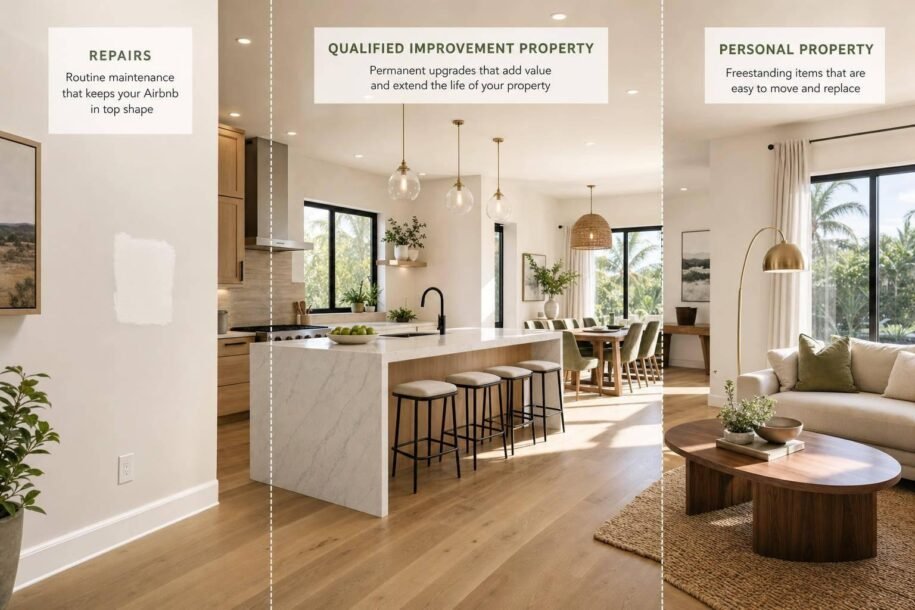
Most Airbnb renovation costs are not a same-year write-off. If I spend on a remodel, the tax result depends on whether the cost is a repair, a capital improvement, or a short-life asset like furniture or appliances.
Here’s the short version:
- Repairs like paint touch-ups or drywall patches are often deductible now.
- Improvements like a new roof, deck, or full kitchen redo usually must be depreciated.
- Many short-term rentals with average stays of 30 days or less may fall under 39-year building depreciation instead of 27.5 years.
- Some items inside a renovation, such as furniture, appliances, landscaping, patios, and certain interior upgrades, may use 5-year or 15-year lives.
- Property with a recovery period of 20 years or less may qualify for 100% bonus depreciation, which can shift more of the tax write-off into year one.
- Depreciation starts only when the asset is placed in service – meaning it is ready and available to rent.
The main tax move is simple: split each renovation cost into the right bucket instead of rolling everything into the building.
A few common mistakes can cost a host years of delayed deductions:
- treating all work as one lump sum
- using the wrong building class
- missing shorter-life assets in contractor invoices
- failing to track the in-service date before 12/31
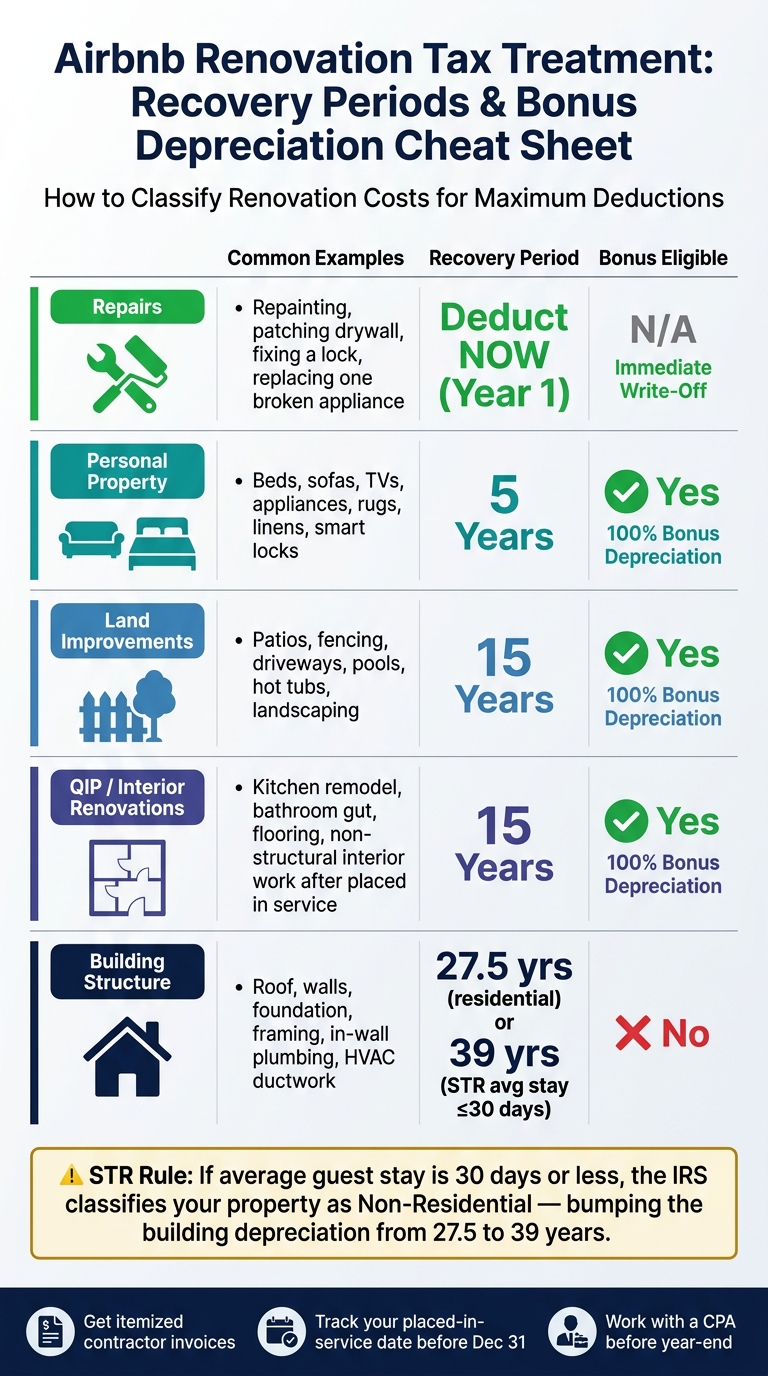
Airbnb Renovation Tax Treatment: Recovery Periods & Bonus Depreciation Cheat Sheet
How to Use Depreciation to Pay Less Tax on Your Airbnb
sbb-itb-103bddb
Quick comparison
| Cost Type | Common Examples | Tax Treatment | Typical Recovery Period | Bonus Depreciation |
|---|---|---|---|---|
| Repair | Repainting, patching drywall, fixing a lock | Deduct now | N/A | N/A |
| Personal property | Beds, sofas, TVs, appliances, rugs | Depreciate | 5 years | Yes |
| Land improvement | Fences, driveways, patios, pools, hot tubs | Depreciate | 15 years | Yes |
| QIP | Certain interior, non-structural work after placed in service | Depreciate | 15 years | Yes |
| Building structure | Roof, walls, foundation, framing | Depreciate | 27.5 or 39 years | No |
Bottom line: if I classify costs well, keep itemized invoices, and work with my CPA before year-end, I may pull more of the deduction into the current tax year and cut taxable income within IRS rules.
Common Tax Mistakes Hosts Make With Renovations
Hosts miss tax savings all the time when renovation costs are reported the wrong way. The IRS has strict rules here, and small filing mistakes can push deductions out for years or leave faster write-offs on the table.
Repairs vs. capital improvements
The IRS draws a clear line between repairs and improvements. Repairs are costs that keep the property in working order, like replacing a broken lock or patching drywall. Those are usually deductible now.
Capital improvements are different. A new roof or a bathroom remodel adds to the property or extends its life, so those costs must be depreciated over time [1]. You don’t get to deduct a capital improvement in year one. Instead, you recover the cost through depreciation. That timing difference can change your tax outcome in a big way.
Using the wrong property classification
A lot of Airbnb hosts assume their rental counts as residential property, which uses a 27.5-year depreciation period. But that isn’t always how the IRS sees it.
If your average guest stay is 30 days or less, the IRS treats the property as nonresidential real property, which uses a 39-year depreciation schedule [4]. That’s an 11.5-year gap in recovery time.
That longer timeline affects which renovation costs may get faster write-offs, so classification isn’t a small detail. It shapes how every improvement is treated. And this rule doesn’t stop with the building. It can affect each item inside the renovation budget too.
Missing shorter-life assets inside a renovation budget
This is where many hosts slip up. They lump every renovation cost into the building basis, and once that happens, everything gets depreciated over 39 years – even items that may fit into 5-year, 7-year, or 15-year recovery periods and may also qualify for bonus depreciation [5][8].
Some common examples:
- Furniture, appliances, electronics, and area rugs are 5-year personal property.
- Fences, driveways, pools, and landscaping are 15-year land improvements.
- Interior renovations made to a nonresidential short-term rental after the building is placed in service often qualify as Qualified Improvement Property (QIP) at 15 years [1][4][8].
Think of it like sorting laundry. If you throw everything into one load, some items get treated the wrong way. Tax treatment works much the same way.
That’s why itemized contractor invoices matter. They help assign each cost to the right recovery period instead of dumping the full project into the building basis. Once those costs are split the right way, the next job is putting each item on its proper depreciation schedule.
How Depreciation Works for Airbnb Renovations
Once you sort renovation costs into the right buckets, the next step is figuring out how the IRS lets you write them off. The system is called MACRS. Under MACRS, each asset gets a set recovery period and a depreciation method [9][3].
What gets depreciated and what does not
Land is never depreciable. The IRS treats land as having an indefinite useful life, so you leave its value out of the depreciable basis.
The building itself can be depreciated. So can qualifying improvements. Your depreciable basis usually starts with the building value, then you subtract land, add eligible closing costs, and increase that amount for capital improvements [9][3]. That matters because each renovation that counts as a capital improvement adds to the amount you can depreciate over time.
After basis is set, the recovery period decides how fast you get those renovation costs back on your tax return.
Recovery periods for common Airbnb renovation categories
Not every line item in a renovation budget moves at the same speed. The IRS gives different recovery periods based on the type of asset and how it’s used. For Airbnb properties, common renovation items often fall into these MACRS buckets [3][4][9]:
| Asset Category | Recovery Period | Common Examples | Bonus Eligible |
|---|---|---|---|
| Personal Property | 5 Years | Beds, sofas, appliances, smart TVs, rugs, linens | Yes (100%) |
| Specialty Equipment | 7 Years | Decorative lighting, specialty fixtures, office equipment | Yes (100%) |
| Land Improvements | 15 Years | Patios, fencing, landscaping, driveways, pools, hot tubs | Yes (100%) |
| QIP (STR Interior) | 15 Years | Interior, non-structural renovations made after the building is placed in service | Yes (100%) |
| Residential Structure | 27.5 Years | Walls, roof, foundation (long-term rentals) | No |
| Non-Residential STR | 39 Years | Building structure for STRs with average stays under 30 days | No |
One small but common mistake: cabinets and sinks are usually structural items, not 5-year personal property [4].
When depreciation starts
The recovery period matters, but timing matters too. Depreciation starts when the asset is placed in service. That means it’s ready and available for rent, even if no guest has booked it yet [9][3][6]. Put simply, what counts is the date the space is ready for guests.
If you finish a renovation and place the asset in service before December 31, you may take the first-year deduction on that year’s return. If the in-service date slips to January, the deduction moves to the next tax year [8]. That’s why dated records matter. Keep things like contractor completion certificates and listing screenshots that show when the unit was updated and ready to rent [8][7].
Ways to Increase Tax Savings on Renovation Costs
Once you know the recovery periods, the next step is simple: push as many costs forward as the IRS allows. In most cases, that comes down to three legal moves: straight-line depreciation for structural work, bonus depreciation for shorter-life assets, and cost segregation for renovation-heavy properties. Before you file, have a qualified U.S. tax professional confirm what fits your case.
Straight-line depreciation for structural improvements
When a renovation affects the building itself – a new roof, HVAC replacement, bathroom gut, or kitchen remodel – those costs get added to your depreciable basis and recovered over the building’s normal depreciation schedule. The write-off is usually slow, but it’s steady.
For walls, foundations, in-wall plumbing, and HVAC ductwork, straight-line depreciation is generally the only option. Those parts do not qualify for faster treatment. So yes, structural work can help revenue, but it usually won’t give you fast tax relief.
The bigger tax win often comes from separating that structural work from shorter-life assets.
Bonus depreciation and qualifying shorter-life assets
This is where the year-one tax move starts to matter. Under current law, qualifying property with a recovery period of 20 years or less may be eligible for 100% bonus depreciation in the first year [5][2].
Bonus depreciation works best for short-life items buried inside a renovation budget, like:
- Furniture
- Appliances
- Fixtures
- Exterior improvements
For example, a furnishing package where all items qualify as shorter-life property could be fully deducted in year one instead of being spread over several years [10]. That kind of front-loaded deduction can improve year-one cash flow, especially if you’re putting money back into the property.
This split matters even more for renovation-heavy properties, where those hidden short-life assets often produce the biggest first-year deduction.
Cost segregation for renovation-heavy vacation rentals
Cost segregation shifts costs out of long-life building categories and into shorter-life buckets that may qualify for bonus depreciation. In plain English, it helps you sort the bill the way the tax code sees it.
An engineering-based study reviews the property or renovation and breaks out components by MACRS class. These studies often reclassify 20% to 35% of a property’s depreciable basis into 5-, 7-, or 15-year property [5][6]. For larger remodels, that can lead to a much bigger year-one deduction.
There is a cost, of course. Engineering-based studies generally run $1,000 to $8,000, depending on property size and complexity [6].
If your renovation spend is material – say, a full kitchen and bath remodel plus a furnishing package – it’s worth asking your CPA if a cost segregation study makes sense. For larger remodels, getting the study done before year-end can change how much depreciation you claim this tax year.
The next step is choosing renovation projects that improve both bookings and tax treatment.
Choosing Renovations With Both Revenue and Depreciation in Mind
Pick renovations that lift bookings and speed up depreciation. The best projects do both.
That’s why renovation planning should start with tax class, not design taste.
Common renovation types by recovery period and first-year tax impact
Use this table to sort projects by tax speed and revenue impact.
| Renovation Category | Likely Tax Treatment | Recovery Period | Bonus Eligible (100%) | ROI Impact |
|---|---|---|---|---|
| Structural work (walls, roof framing) | Capital Improvement | 39 Years | No | Increases long-term asset value; slow tax recovery |
| Interior improvements (QIP) (kitchen, bath, flooring) | Qualified Improvement Property | 15 Years | Yes | High; potential year-one deduction |
| Furnishings and decor (sofas, beds, art) | Personal Property | 5 Years | Yes | Immediate deduction; drives higher nightly rates |
| Appliances and tech (smart locks, TVs, range) | Personal Property | 5 Years | Yes | Immediate deduction; improves guest reviews |
| Outdoor improvements (deck, fire pit, hot tub) | Land Improvement | 15 Years | Yes | Big lift to occupancy and average daily rate |
The next move is simple: decide which projects deserve priority based on rent growth and tax recovery.
Rank One Stays‘ design and staging support can help you package furnishings and appliances cleanly for 5-year treatment and stronger year-one deductions.
Repairs vs. improvements for common Airbnb projects
Before you approve work orders, split true repairs from depreciable improvements.
Classify each project before you spend.
| Project | Classification | Tax Treatment | Recovery Period |
|---|---|---|---|
| Repainting a room | Repair | Currently Deductible | N/A |
| Replacing one broken microwave | Repair | Currently Deductible | N/A |
| Patching drywall damage | Repair | Currently Deductible | N/A |
| Full kitchen upgrade | Capital Improvement (QIP) | Depreciated | 15 Years |
| New deck addition | Capital Improvement | Depreciated | 15 Years |
| Full roof replacement | Capital Improvement | Depreciated | 39 Years |
Treat cabinets as 5-year property only when records show they were removed and reused.
Once you’ve picked the project mix, document each cost before year-end so your CPA can place it in the right bucket. After the scope is set, lock in invoices, asset lists, and in-service dates before year-end.
How to Put a Tax-Efficient Renovation Plan Into Action
Once you know the scope of the renovation, the next part is execution. That’s what decides how much tax value you can get from the project.
Document costs clearly and coordinate with your CPA before year-end
Good records make your depreciation schedule easier to defend. Ask every contractor for itemized invoices that break out:
- structural work
- personal property, such as furniture and appliances
- land improvements, such as decks and landscaping
If you get one lump-sum invoice, asset classification gets harder. And when classification gets messy, support for cleaner asset buckets and the right recovery periods can get shaky.
The single most important detail is the placed-in-service date. If the renovation finishes in November but the property isn’t ready and available to rent until January, you could lose current-year deductions. That’s why it helps to line up timing with your CPA before December 31.
"The tax code does not reward hosts who work hard. It rewards hosts who document, classify, and file correctly." – Sean Rakidzich, 155-property operator [5]
It also helps to use a dedicated card and bank account for renovation spending. That keeps records clean when your CPA builds the depreciation schedule or works through a cost segregation study.
Use design and management support to protect ROI after the renovation
Once the tax side is in order, the next issue is simple: will the renovated property earn back the money you put into it?
Rank One Stays can manage design, staging, pricing, guest support, and housekeeping so the property performs after the tax benefit begins.
Key depreciation takeaways for Airbnb investors
Most major renovations are capital improvements, which means they must be depreciated over time. Recovery periods and bonus treatment depend on how each asset is classified. Your CPA handles classification and documentation. Your management partner handles pricing, occupancy, and guest experience.
FAQs
How do I tell a repair from an improvement?
The IRS uses the BAR test. If the work is a betterment, an adaptation, or a restoration, the IRS treats it as a capitalized improvement. If it doesn’t meet one of those tests, it’s usually a deductible repair.
There’s one catch: if a repair happens as part of a larger renovation project, you may still need to capitalize it.
Does my Airbnb use 27.5-year or 39-year depreciation?
Most Airbnb properties are treated as 27.5-year residential rental property. By contrast, 39-year depreciation usually applies to commercial property.
If you don’t do a cost segregation study, the IRS will generally place the property on the 27.5-year residential schedule. A cost segregation study can move certain parts of the property into 5-year, 7-year, or 15-year categories, which lets you claim deductions sooner.
What renovation items qualify for bonus depreciation?
Bonus depreciation usually applies to property with a MACRS recovery period of 20 years or less. That often includes interior renovations and personal property found through a cost segregation study.
Common qualifying items include:
- Appliances
- Carpeting
- Window treatments
- Decorative fixtures
- Furniture
- Cabinetry
- Specialty lighting
- Land improvements, such as driveways, fencing, landscaping, patios, and outdoor lighting