
If you host on Airbnb, AirCover alone is not enough. Most home insurance policies may deny short-term rental claims, and 47% of AirCover claims over $10,000 get reduced or denied on first submission.
Here’s the short version:
- I’d treat AirCover as a backup for guest-caused damage
- I’d use specialized vacation rental insurance for full-time hosting or high-value homes
- I’d look at an STR endorsement if I rent my primary home now and then
- I’d add a guest damage plan for per-stay protection
- I’d use security deposits or direct recovery for small losses and extra cleaning
Costs usually break down like this:
- STR endorsement: about $15 to $50 per month
- Standalone STR policy: about $800 to $2,500 per year
- Per-booking damage plan: about $5 to $15 per booking
Bottom line: if you rent often, want building coverage, or need lender-accepted insurance, I’d start with a real short-term rental policy first. Then I’d add Airbnb and guest-paid protection on top.
Short-Term Rental Insurance Explained: What Every Airbnb & Vrbo Host Needs to Know
sbb-itb-103bddb
Quick Comparison
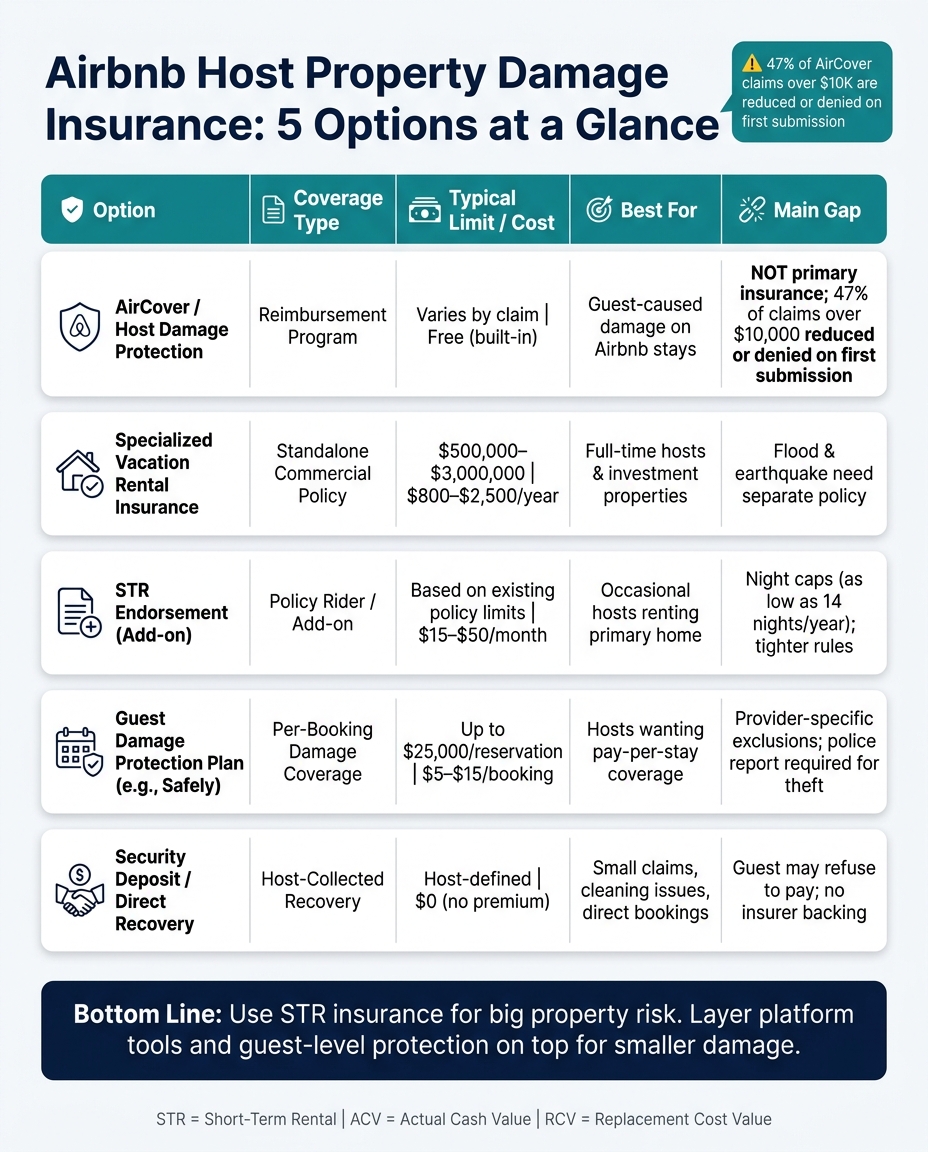
Airbnb Host Insurance Options Compared: Coverage, Cost & Best Fit
| Option | What it is | Typical limit | Best for | Main gap |
|---|---|---|---|---|
| AirCover / Host Damage Protection | Airbnb reimbursement program | Varies by claim | Guest-caused damage on Airbnb stays | Not primary insurance |
| Specialized vacation rental insurance | Standalone STR policy | Often $500,000 to $3,000,000 | Full-time hosts and investment properties | Separate flood or quake policy may be needed |
| STR endorsement | Add-on to home or property policy | Based on policy limits | Occasional hosts | Night caps and tighter rules |
| Guest damage protection plan | Per-booking damage coverage | Varies by provider | Hosts who want pay-per-stay coverage | Provider-specific exclusions |
| Security deposit / direct recovery | Host-collected recovery method | Host-set | Small claims and cleaning issues | Guest may refuse to pay |
If I had to simplify the whole topic into one sentence, it would be this: use insurance for big property risk, and use platform or guest-level tools for smaller guest damage.
Quick Comparison of Property Damage Coverage Options
There’s no one-size-fits-all answer here. The best option depends on how often you rent, whether the place is your main home or a pure investment property, and how much risk you’re willing to keep on your own books.
This table gives you a side-by-side look at the main coverage paths so you can match your setup with the right layer of protection.
| Option | Protection Type | Payout Limit | Typical Protection | Typical Gaps | Best-Fit Host |
|---|---|---|---|---|---|
| Airbnb Host Damage Protection (AirCover) | Reimbursement program | Varies by claim | Guest-caused property damage | 47% of claims over $10,000 are reduced or denied on first submission [5] | Hosts who want Airbnb’s built-in reimbursement layer |
| Specialized Vacation Rental Insurance (e.g., Proper Insurance) | Commercial policy | Varies by policy | Rental income loss during repairs [4] | Varies by insurer; some high-risk amenities like trampolines may need to be disclosed [5] | Full-time hosts and investment property owners |
| Commercial Property Insurance with a Short-Term Rental Endorsement | Policy rider / add-on | Aligned with the underlying homeowners policy limits [9][10] | Personal property and limited liability [9][10] | May require a separate homeowners policy; some guest theft or vandalism claims may be denied [10] | Occasional hosts with a primary home |
| Guest Damage Protection Plan (e.g., Safely, Truvi) | Per-booking or subscription | Varies by provider | Damage protection for a single booking | Varies by provider | Hosts who prefer per-stay coverage |
| Security Deposit / Direct Recovery | Host-collected recovery | Host-defined | Minor damages and extra cleaning [8] | Guest refusal to pay; platform limitations [8] | Hosts using third-party management tools [8] |
Two points matter most.
- Most homeowners policies exclude short-term rental use [3][10][11].
- Hosts often need either an endorsement or a separate policy [3][10][11].
On cost, a short-term rental endorsement usually runs $15 to $50 per month, a standalone policy often costs $800 to $2,500 per year, and per-booking plans tend to fall around $5 to $15 per booking [6][11].
The sections below show which option makes sense for each host type and why. Next, we’ll walk through each one based on control, cost, and how claims are handled.
1. Airbnb Host Damage Protection
AirCover for Hosts is Airbnb’s built-in reimbursement layer for guest-caused damage on eligible stays. That sounds useful, and it can be. But here’s the key point: AirCover is not primary property insurance. It helps after guest-related damage. It does not step in like a full short-term rental policy.
Coverage scope
AirCover covers guest-caused damage to your property and contents, but it does not cover structural damage that should be handled by a primary short-term rental policy [13][14]. Put simply, its main use is guest-caused loss, not broad property risk.
That distinction matters more than many hosts expect. If a guest breaks a lamp or ruins a couch, AirCover may help. If the issue involves the building itself, you’re in a different lane.
A survey found that 47% of AirCover claims over $10,000 are reduced or denied on the first submission [5]. So documentation isn’t optional. Use dated photos and videos before each check-in. Airbnb rejects altered or AI-generated evidence [7].
Short-term rental eligibility
Not every host or booking qualifies. Eligibility excludes:
- Hosts in Japan, who use Japan Host Insurance [15][12]
- Hotels [15][12]
- Stays booked through Airbnb Travel, LLC [15][12]
Major exclusions
This is where many hosts get tripped up. AirCover does not handle a lot of the damage people assume it does.
Common exclusions include structural perils such as fire, flood, wind, and earthquakes [5][17][7]. It also excludes damage caused by non-guests, like neighbors, cleaners, or contractors [5][16]. High-value items such as cash, securities, jewelry, and collectibles are excluded too [5][18][7].
Then there’s the stuff that falls into the “part of owning property” bucket: normal wear and tear, gradual deterioration, and bed bug infestations [17][7]. As of April 2026, toiletries, coffee, and cleaning supplies are also formally excluded [7].
Best for minor guest-caused damage
AirCover works best for smaller guest-caused issues: a broken lamp, a stained couch, or specialized cleaning costs [13][14]. It is not built for structural or catastrophic loss.
That’s also why mortgage lenders don’t treat AirCover as valid primary insurance. It doesn’t name them as a mortgagee, and it doesn’t cover structural perils [14]. If you need broader protection backed by an actual policy, the next step is to compare AirCover with specialized vacation rental insurance.
2. Specialized Vacation Rental Insurance
Specialized vacation rental insurance is a standalone commercial policy built for short-term rentals. In plain English, it’s the first option here that works as a true primary policy after AirCover.
That matters because standard homeowners insurance usually excludes short-term rentals. Once an insurer sees guest stays as business activity, the usual home policy often stops being enough. So if you rent year-round or want coverage that’s built for this kind of use, this is where things start to look more solid.
Property damage limit
The biggest draw is simple: higher limits and broader protection for losses.
Specialized policies often offer $500,000 to $3,000,000 in property damage coverage. Some providers also offer no sub-limit on guest-caused damage, up to the full dwelling and contents limits [1][4][20]. That’s a big step up from standard policies, which often cap guest-caused damage at $25,000 or $50,000 [2].
And that cap can disappear fast. A bad fire, major water damage, or a guest incident that wrecks high-end finishes can burn through $25,000 before you’ve even finished the first round of repairs.
Annual premiums usually fall between $1,500 and $3,400, depending on the provider and the property’s value [22].
Short-term rental eligibility
This type of policy works well for year-round rentals. Unlike endorsement-based coverage, it usually doesn’t come with the 30- to 90-night rental caps that many hosts run into [19][2].
There’s also an ownership detail that’s easy to miss. If the property sits inside an LLC, the LLC should be listed as the Primary Named Insured [22]. If that name doesn’t match up the right way, claim issues can get messy.
Major exclusions
Even with a commercial policy, some gaps still show up.
Common exclusions include:
- Flood
- Earthquake
- Gradual wear and tear
- Intentional damage by the host
- Theft of cash or securities
Flood and earthquake often need separate coverage [19][21]. In some markets, wind and hail may also need a separate policy [4].
One more thing to check: whether the policy pays replacement cost value instead of actual cash value [21]. That difference can hit hard. Replacement cost helps pay to replace what was lost. Actual cash value factors in depreciation, which can mean a much smaller payout.
Best for
This option makes the most sense for professional hosts, homes with pools or hot tubs, and high-value properties that need broader primary coverage [2][4][6][19].
If you don’t need a separate commercial policy, the next option is an endorsement-based approach.
3. Commercial Property Insurance with a Short-Term Rental Endorsement
If a full vacation rental policy feels too broad, a short-term rental endorsement can extend an existing policy at a lower cost.
A short-term rental endorsement adds limited business-use coverage to a homeowners or commercial property policy. It doesn’t go as far as a standalone vacation rental policy, but it can patch some of the biggest holes in your main policy. For hosts with frequent bookings, though, endorsement-only coverage often stops being enough.
Coverage limits
A short-term rental endorsement usually extends the dwelling and contents limits already built into the main policy. That said, it still won’t match the range of coverage you get with a standalone STR policy. If the property sits in an LLC, make sure the LLC is listed as the primary named insured.
Short-term rental eligibility
This option works best for hosts with some rental activity, but not full commercial occupancy. Some endorsements limit rentals to 14 nights per year. That’s the tradeoff: lower cost, but tighter rules. So it’s worth reading the exclusions line by line.
Major exclusions
Vacancy rules may still pause coverage after 30 empty days. Pools, hot tubs, bikes, and gym equipment can need riders. Some carriers also require no-firearms and no-events riders for coverage to stay in place.
Coverage also has to line up with local permit rules.
Local requirements
Check local permit rules, since some cities require $500,000 to $1 million in liability coverage for STR permits [19].
If you need protection for single bookings instead of ongoing coverage, the next option is a guest damage protection plan.
4. Guest Damage Protection Plan
A guest damage protection plan pays back guest-caused damage on a per-booking basis.
Coverage and pricing
For example, Safely covers up to $25,000 per reservation for accidental damage, intentional damage, and theft [23]. Safely charges $10 per occupied night, and that fee is usually added to the guest’s bill [23].
That makes it a solid option for hosts who want protection tied to each stay without changing their main policy.
Major exclusions
Safely requires a police report for theft claims [23].
Best-fit host scenario
This works well as extra protection, especially if you’d rather use per-stay coverage than rely on a larger security deposit. Many hosts find that professional property management helps streamline these protection layers.
If you handle smaller claims yourself and those claims sit outside insured coverage, security deposits and direct recovery can give you one more layer of control.
5. Security Deposit and Direct Recovery Process
When insurance or platform protection doesn’t cover enough, security deposits and direct recovery give hosts one more way to deal with damage.
A security deposit isn’t the same as insurance. What it does offer is direct control over smaller damage claims. On Airbnb, direct recovery runs through the Resolution Center. With direct bookings, the process depends on how you collect the deposit and how well you can prove the damage. There’s no insurer-set cap here. What you recover depends on the guest, your evidence, and how much you’re able to collect.
The tradeoff is pretty clear: this route usually costs less than insurance, but it puts more pressure on you. You need to file fast, document everything, and show clear proof. If insurance is a safety net, a deposit is more like keeping a paper trail and being ready to use it.
Short-term rental eligibility
This option fits hosts who take direct bookings or want a deposit-based backup when platform coverage is limited, often as part of professional vacation rental management.
Major exclusions
Deposits usually don’t cover wear and tear or missing consumables. Claims also tend to fail if you don’t have dated photos and receipts. Recovery is unavailable for damage that happens while the property is vacant [24][25][7].
Use:
- Dated photos
- Repair invoices
- Original receipts
Those records can make the difference between a paid claim and a dead end.
Best-fit host scenario
This works best for hosts who document every turnover and want a fast way to recover small, guest-caused losses.
The right recovery process works best when it sits on top of the coverage choices above. This is especially true when managing rentals across multiple locations where consistency in documentation is key.
How to Choose the Right Coverage for Your Property
There’s no one-size-fits-all policy for hosts. The right setup depends on how often you rent, how much your furniture and belongings are worth, and whether you own one place or several. Professional vacation rental management services can also help navigate these insurance requirements. Think of the five coverage types above as building blocks. Then pick the mix that matches how you operate.
The simplest way to narrow it down is to line up coverage with two things: how often you host and how much you could lose.
Match coverage to your rental setup
If you host once in a while, an STR endorsement is usually the starting point. If you rent full time, you’ll likely need a standalone STR policy. And if you own several rentals, commercial coverage can lower your total cost.
Here’s the rough pricing range:
- STR endorsements usually cost $15–$50 per month, but many come with annual night caps.
- Standalone STR policies usually run $800–$2,500 per year.
- Portfolio commercial policies can lower costs by 15%–25% compared with insuring each unit on its own [7].
One more thing: replacement cost coverage usually beats actual cash value. If something gets damaged, depreciation can eat into your payout fast.
Start with your hosting frequency, then dig into exclusions and liability gaps.
Check for short-term rental exclusions
This is one of the easiest mistakes to miss – and one of the most expensive. About 60% of standard homeowners policies stop covering the property once the owner begins short-term renting [11]. A business-use exclusion can wipe out the whole claim, not just the guest-damage part [19].
Get written confirmation from your insurer that STR activity is covered before you accept the first booking [19].
Look beyond property damage
Property damage coverage is only the first layer. Standard homeowners and landlord policies usually don’t pay for lost rental income when repairs shut down the property after fire, water damage, or guest damage.
You’ll also want to review liability limits for things like pools, hot tubs, gym equipment, and any local permit minimums. If your property is in an area with wind, hail, or wildfire risk, check that those perils haven’t been carved out of the policy [4].
Use the table below as a quick filter.
| Hosting Scenario | Recommended Coverage | Typical Annual Cost |
|---|---|---|
| Occasional (<50 nights) | AirCover + Safely (pay-per-stay) | $250–$750 [7] |
| Full-time (1–2 units) | Standalone STR policy | $800–$1,500 per unit [7] |
| Professional (3+ units) | Portfolio commercial policy | $2,000–$5,000 total [7] |
| Leased short-term rentals | Commercial GL + business renters | $960–$2,400 [7] |
Once your coverage matches the property, the next step is figuring out who handles claims and what paperwork you’ll need.
How Full-Service Management Can Help With Damage Claims
Coverage is only half the job. How fast you handle the claim often decides whether you get paid back for the loss.
Even with the right policy or platform protection in place, claims still take work. Someone has to document the damage, report it, gather proof, and file everything before the deadline runs out.
What managers handle during a damage claim
Property managers usually take care of the busywork that slows hosts down. They do pre- and post-stay walkthroughs with timestamped photos and video, which creates a clear before-and-after record showing when the damage happened [7].
They also gather repair quotes from vendors and handle guest follow-up before a claim is filed. That matters because Airbnb requires hosts to first try to resolve the cost with the guest before submitting a claim. Managers also keep an eye on filing deadlines, including Airbnb’s 14-day reimbursement submission window [3][7].
| Task | Self-Managed | Professional Management |
|---|---|---|
| Pre/post-stay inspections | Often skipped | Standardized every stay |
| Photo documentation | May lack timestamps | Timestamped photo and video [7] |
| Repair estimates | Host finds vendors | Existing vendor network |
| Claim filing | Higher deadline risk | Dedicated tracking [7] |
| Guest communication | Can be delayed | Neutral, resolution-focused |
For hosts who can’t inspect the property, document damage, and file claims fast, professional management fills that gap.
When full-service management makes sense
Full-service management tends to fit remote owners best. If you live out of state, it’s tough to stay on top of same-day inspections, photo proof, repair scheduling, and claim deadlines on your own.
That’s where local support can make a big difference. Rank One Stays provides full-service vacation rental management, including damage claims, guest support, housekeeping, and property oversight in Scottsdale, Denver, Pittsburgh, and Lighthouse Point, with fees starting at 10%. They also offer Airbnb interior design and staging services to help hosts maximize their property’s earning potential from day one.
Conclusion
AirCover is a backup layer, not your main short-term rental insurance. So if you host on Airbnb, you still need an actual policy, not just platform repayment after something goes wrong.
For most hosts, the best starting point is a dedicated vacation rental insurance policy or a commercial policy that includes a short-term rental endorsement. Then, on top of that base, you can add guest-level protection through damage plans or security deposits to help cut down on losses that might not be covered.
Start with primary STR insurance first. Then layer in platform and guest-level protection.
Coverage only helps if claims are documented well and filed the right way. The best setup pairs real STR insurance with disciplined claims handling. For hosts who want help with that side of the job, Rank One Stays handles damage claims along with guest support and property oversight.
FAQs
Do I need insurance if I already have AirCover?
Yes. AirCover is a reimbursement program, not a regulated insurance policy. It’s meant to supplement primary coverage, not replace it.
It also comes with some big exclusions. That includes natural disasters, vandalism, vacancy-related damage, and anything that happens outside Airbnb bookings.
A standalone short-term rental insurance policy helps cover liability and major losses that AirCover may not pay for. Rank One Stays can also help streamline damage claims.
What coverage is best for occasional hosting?
For occasional hosting, the best pick usually comes down to cost vs. protection. If you rent out your place only a few weekends a year, a short-term rental endorsement added to your current homeowners insurance is often a smart fit.
Another good option is pay-per-booking coverage. This type of coverage applies only when a guest checks in, which makes it a solid match for part-time hosts.
Both options can help cover liability and property damage without the higher cost of a full commercial policy.
What is usually not covered by Airbnb damage protection?
Airbnb’s AirCover is a reimbursement program, not an insurance policy. That distinction matters, because it comes with some clear limits.
In most cases, it does not cover:
- normal wear and tear
- natural disasters like earthquakes or hurricanes
- cash loss, theft, pet damage, or high-value items
- intentional guest damage
There are timing limits too. AirCover only applies during an active Airbnb booking. If the property is vacant or you’re using it yourself, it doesn’t apply.
It also doesn’t cover guest injuries or damage to a guest’s property. So while AirCover can help in some cases, it leaves a few pretty big holes.