

Denver’s short-term rental (STR) regulations are designed to ensure compliance, protect housing availability, and address neighborhood concerns. If you rent out a property for fewer than 30 days in Denver, here’s what you need to know:
- Primary Residence Rule: STRs are only allowed in your primary residence, where you live for at least 185 days per year. Proof like a Colorado ID or voter registration is required.
- Licensing: A Denver Short-Term Rental Business License is mandatory, costing $150 initially ($50 application fee + $100 annual fee) and $100 for annual renewals. Late renewals incur a $50 penalty.
- Taxes: Hosts must collect and remit a 10.75% Lodger’s Tax. Even if platforms like Airbnb handle this, you must file tax returns with the city.
- Penalties: Non-compliance can lead to fines up to $999 per violation, removal of listings, or permanent hosting bans.
To simplify compliance, professional management services like Rank One Stays handle licensing, taxes, and inspections, reducing risks and saving time. Denver’s rules are strict, but following them ensures a smooth and profitable rental experience.
Denver Airbnb Rules [Colorado Short Term Rental Laws]
Licensing Requirements for Short-Term Rentals in Denver
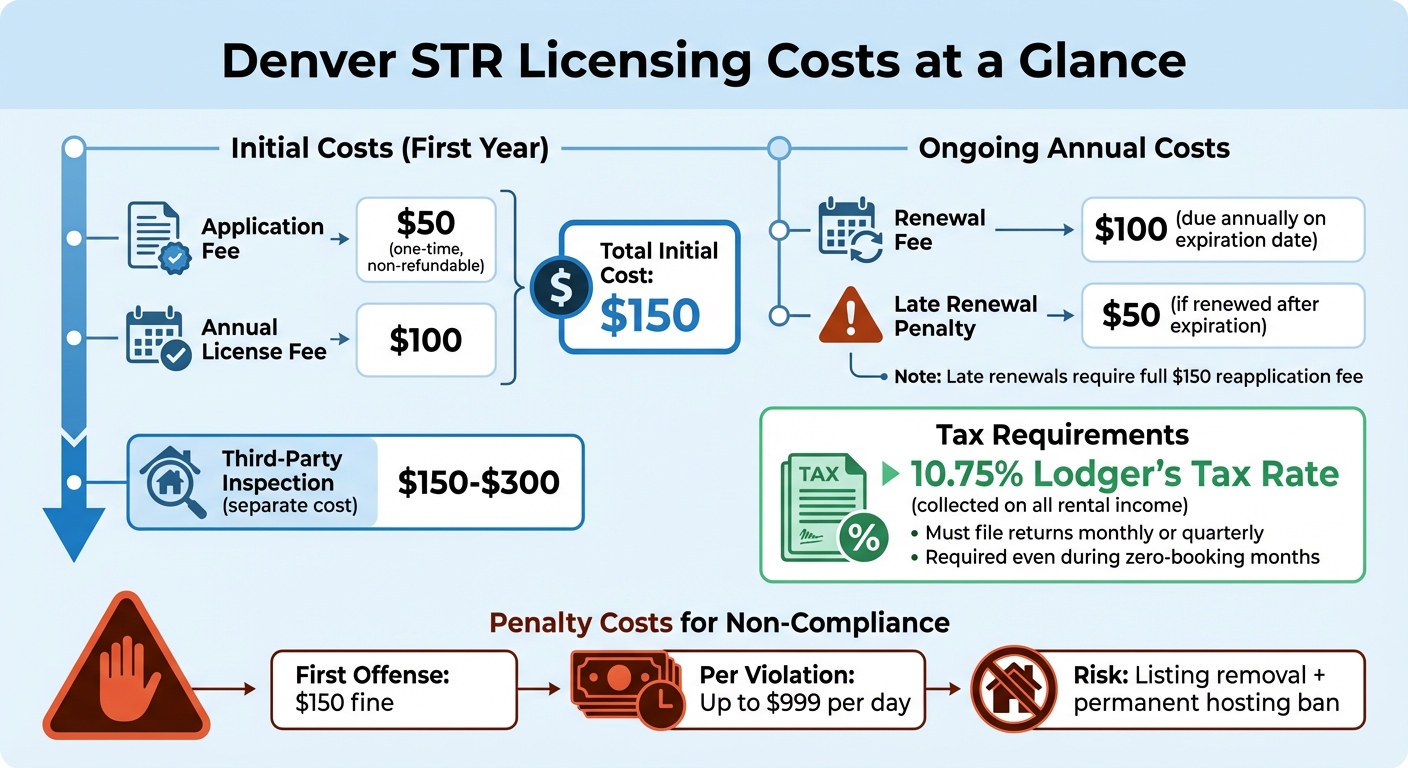
Denver Short-Term Rental Costs and Fees Breakdown
If you’re planning to rent out your primary residence in Denver for less than 30 consecutive days, you’ll need a Denver Short-Term Rental Business License. The application process is relatively straightforward but requires specific steps and documentation. Applications must be submitted online through the Denver Permitting and Licensing Center. Let’s break down the process to help you get started.
How to Get a Short-Term Rental License
The first step is to obtain a seven-digit Lodger’s Tax ID from the Denver Treasury Division. This ID is necessary for collecting and remitting the Lodger’s Tax.
Next, gather the following documents:
- A Colorado-issued ID with an address that matches your rental property.
- At least two additional documents proving the property is your primary residence. Examples include voter registration, motor vehicle registration, federal or state tax returns, or recent utility bills.
- Proof of ownership or legal occupancy, such as a deed or lease.
During the application process, you’ll need to complete an Affidavit of Primary Residence, confirming that the property is your permanent home where you live for at least 185 days each year. Before applying, check your property’s zoning status to ensure short-term rentals are allowed in your area. Be aware that your property may need to pass inspections to confirm compliance with safety and building codes.
The initial cost for the license is $150, which includes a $50 non-refundable application fee and a $100 annual license fee. Once approved, you must display your license number on platforms like Airbnb, VRBO, or similar sites. If you’re working with a Denver vacation rental management company, they can assist with preparing and submitting the necessary documentation.
License Renewal Process and Fees
Your license is valid for one year from the date of issuance and must be renewed annually to stay compliant. The renewal fee is $100, and it’s a good idea to start the renewal process at least 30 days before the license expires to avoid disruptions. Additionally, your Lodger’s Tax account must be in good standing for the renewal to be approved.
If you miss the renewal deadline, a late renewal penalty of $50 applies. Licenses that lapse entirely require a new application, which means you’ll need to pay the full $150 fee again.
| Fee Type | Amount | When Due |
|---|---|---|
| Application Fee | $50 | One-time (new applications) |
| Annual License Fee | $100 | At issuance and each renewal |
| Total Initial Cost | $150 | First year |
| Renewal Fee | $100 | Annually on expiration date |
| Late Renewal Penalty | $50 | If renewed after expiration |
Primary Residence Rule and Zoning Restrictions
What the Primary Residence Requirement Means
Denver’s short-term rental (STR) law revolves around a key principle: you can only operate an STR in your primary residence. This is defined as the place where you live for more than half the year. To prove it, your address must match what’s listed on your Colorado driver’s license, voter registration, and tax returns.
"A short-term rental is only allowed in your primary residence." – Denver Department of Excise and Licenses [1]
What does this mean in practice? Properties like second homes or investment properties are off-limits for short-term rentals under 30 days. Each host is permitted just one STR license, and Denver enforces this rule through automated audits [1]. Breaking these rules can lead to hefty fines – up to $999 per day [1].
There are some exceptions to this rule. For instance:
- If you own a duplex, you can rent out one unit as long as you live in the other, and both units share the same tax parcel [2].
- STRs are allowed in accessory dwelling units (ADUs), like basement apartments or carriage houses, as long as you reside in the main house [2].
- Even if your property is owned under an LLC or trust, you might still qualify – but only if you can prove it’s your actual primary residence [1].
Getting a handle on these residency requirements is crucial before diving into local zoning and neighborhood-specific restrictions.
Zoning Rules and Neighborhood Restrictions
Denver generally permits STRs in most residential, business, and mixed-use zoning areas [1]. But here’s the catch: just because your property is in a residential zone doesn’t mean you’re automatically in the clear. Homeowners Associations (HOAs) and landlords can enforce stricter rules through private covenants or lease agreements, which override city approval [2].
Before you apply for an STR license, it’s a good idea to double-check your HOA bylaws or lease terms to make sure there aren’t any restrictions. If navigating these requirements feels overwhelming, working with a Denver vacation rental management company like Rank One Stays can simplify the process. They can help ensure your property meets both city regulations and any private rules.
sbb-itb-103bddb
Tax Obligations for Short-Term Rentals
Which Taxes Apply to Short-Term Rentals
If you’re operating a short-term rental (STR) in Denver, you’re required to collect and remit a 10.75% Lodger’s Tax on rental income for stays under 30 consecutive days [2]. This tax is specific to the income generated from rental transactions.
To comply, you’ll need to secure a Denver Sales, Use, and Lodger’s Tax License in addition to your STR business license. This license is issued by the Denver Treasury Division and is separate from your standard property taxes. Even if platforms like Airbnb or VRBO collect the Lodger’s Tax on your behalf, you’re still obligated to file regular tax returns with the city. This includes filing "zero-dollar returns" during months when you have no bookings.
"Short-term rental hosts are required to have a Denver sales and use tax license and a lodger’s tax ID." – Denver Department of Excise and Licenses [2]
Let’s explore how to manage these tax responsibilities effectively.
How to Collect and Pay Taxes
Once you’ve obtained your STR license, apply for your Lodger’s Tax File Number through the Denver Treasury Division. Double-check whether your rental platform automatically collects the 10.75% Lodger’s Tax. If not, you’ll need to add this tax manually to your rental charges.
File your tax returns through Denver’s e-Biz Tax portal either monthly or quarterly. Be mindful of deadlines, as late filings can result in fines of up to $999 per violation [1]. Keep detailed records of all bookings, receipts, and taxes for at least three years in case of an audit.
If managing these tax requirements feels like too much to handle, consider partnering with a Denver vacation rental management company. They can handle compliance and save you time and stress.
DIY vs Professional Management with Rank One Stays

Common Problems with DIY Compliance
Managing short-term rental compliance on your own can be a real headache, especially in Denver. The process involves juggling multiple licenses, including one that requires a third-party inspection costing between $150 and $300. On top of that, you’ll need to handle intricate tax filings to stay within the law [1].
Primary residence verification is another tricky hurdle for DIY owners. Your Colorado driver’s license, voter registration, and motor vehicle registration must all match your rental property’s address perfectly. Any discrepancies could lead to your application being denied. And then there’s the 10.75% Lodger’s Tax, which you’ll need to calculate and remit yourself through Denver’s e-Biz Tax portal.
The risks of non-compliance are steep. Fines can go up to $999 per violation [1], and Denver actively removes listings on platforms like Airbnb and VRBO that lack valid license numbers. The city also operates a 24/7 hotline for neighbors to report issues and conducts audits of primary residence claims using tax returns and utility bills [1][2]. With so much at stake, it’s no wonder many property owners turn to professional management for help.
How Rank One Stays Handles Compliance for You
Rank One Stays takes the stress out of compliance with a hands-on approach. Their team handles the entire licensing process, including applications and renewals. They also arrange all required safety inspections, ensuring your property is equipped with smoke detectors, carbon monoxide detectors, and fire extinguishers.
When it comes to taxes, Rank One Stays makes life easier by automating the process. Instead of manually calculating and filing the 10.75% Lodger’s Tax, their system collects and remits payments directly to the city, avoiding missed deadlines and penalties. With their Denver vacation rental management services, you stay compliant while they monitor any changes to local laws and handle documentation for city audits.
Comparison Table: DIY vs Rank One Stays
| Feature | DIY Management | Rank One Stays |
|---|---|---|
| Licensing | Research and apply for two separate city licenses; manage renewals manually | Professional handling of STR and Residential Rental licenses with renewal tracking |
| Tax Handling | Manual calculation and remittance of 10.75% Lodger’s Tax | Automated tax collection and remittance |
| Inspections | Find, vet, and schedule a third-party inspector ($150–$300) | Coordinates all mandatory safety inspections |
| Compliance Risk | High risk of fines for administrative errors | Compliance monitoring prevents fines and listing removal |
| Time Commitment | Significant time managing regulations, inspections, and filings | Minimal; professional team handles regulatory updates |
| Revenue Performance | Dependent on the owner’s marketing and pricing skills | 38% more revenue than the market average with optimized pricing |
Conclusion
Key Takeaways for Denver Property Owners
Navigating Denver’s short-term rental regulations requires careful attention to detail. To legally operate, your property must serve as your primary residence, meaning you must live there for at least 185 days each year. You’ll also need to secure a license, prominently display the license number, and collect and remit the 10.75% Lodger’s Tax. In addition, your property must meet specific safety standards, and your documentation – like your driver’s license, voter registration, and tax returns – must confirm the property’s address.
Denver takes enforcement seriously, using audits, neighbor complaints, and rental platform monitoring to ensure compliance. Penalties for violations range from $150 for a first offense to $999 per incident. Repeated non-compliance can even lead to a permanent loss of hosting privileges.
The Case for Professional Management
Given the complexity of Denver’s regulations, managing compliance on your own can be overwhelming. Staying updated on rule changes, calculating taxes manually, and ensuring all requirements are met leaves plenty of room for error – and costly mistakes. This is where professional management can make a big difference.
Partnering with experts like Rank One Stays not only simplifies compliance but also increases your rental income. On average, property owners working with them earn 38% more than the market average, with management fees starting at just 10% of rental income. They handle everything from automated tax collection and safety inspections to staying ahead of ordinance updates – like the 2025 noise limits of 55 dBA during the day and 50 dBA at night.
FAQs
What happens if I don’t follow Denver’s short-term rental laws?
Failing to follow Denver’s short-term rental laws can result in hefty penalties. Property owners risk fines reaching $5,000 per violation for issues like operating without a license, disregarding safety or zoning rules, or neglecting tax responsibilities.
These fines aren’t just for show – they’re meant to ensure rental properties meet health and safety standards. To steer clear of expensive fines and legal headaches, make sure you’re adhering to all licensing, zoning, and tax regulations. Staying on top of these requirements safeguards your property and keeps your rental business running without interruptions.
What documents do I need to prove my property is my primary residence for a short-term rental license in Denver?
To show that your property is your primary residence for a short-term rental license in Denver, you’ll need to submit official documents proving you live there full-time. Accepted documents typically include your driver’s license, state ID, or utility bills with your name and the property’s address. In some cases, you might also need to provide a signed declaration or affidavit stating that the property is your primary residence.
It’s important that all submitted documents clearly demonstrate that you live at the property permanently. Denver’s short-term rental laws require hosts to reside full-time at the property they’re renting out. Providing accurate and thorough documentation not only ensures compliance but also helps you avoid any legal complications during the licensing process.
What are the advantages of hiring a professional management service for short-term rentals in Denver?
Hiring a professional management service for your short-term rental in Denver comes with plenty of perks. For starters, these experts ensure your property meets all local regulations – like licensing, zoning, and tax requirements, including collecting and remitting the lodger’s tax. By taking care of these legal complexities, they help you steer clear of fines and other potential legal headaches.
On top of that, professional managers handle marketing your property, communicating with guests, and maintaining top-notch safety and cleanliness standards. This attention to detail often leads to glowing reviews, higher occupancy rates, and more rental income. Partnering with a service like Rank One Stays simplifies everything, letting you enjoy peace of mind and more free time – all while boosting your rental’s profitability.