
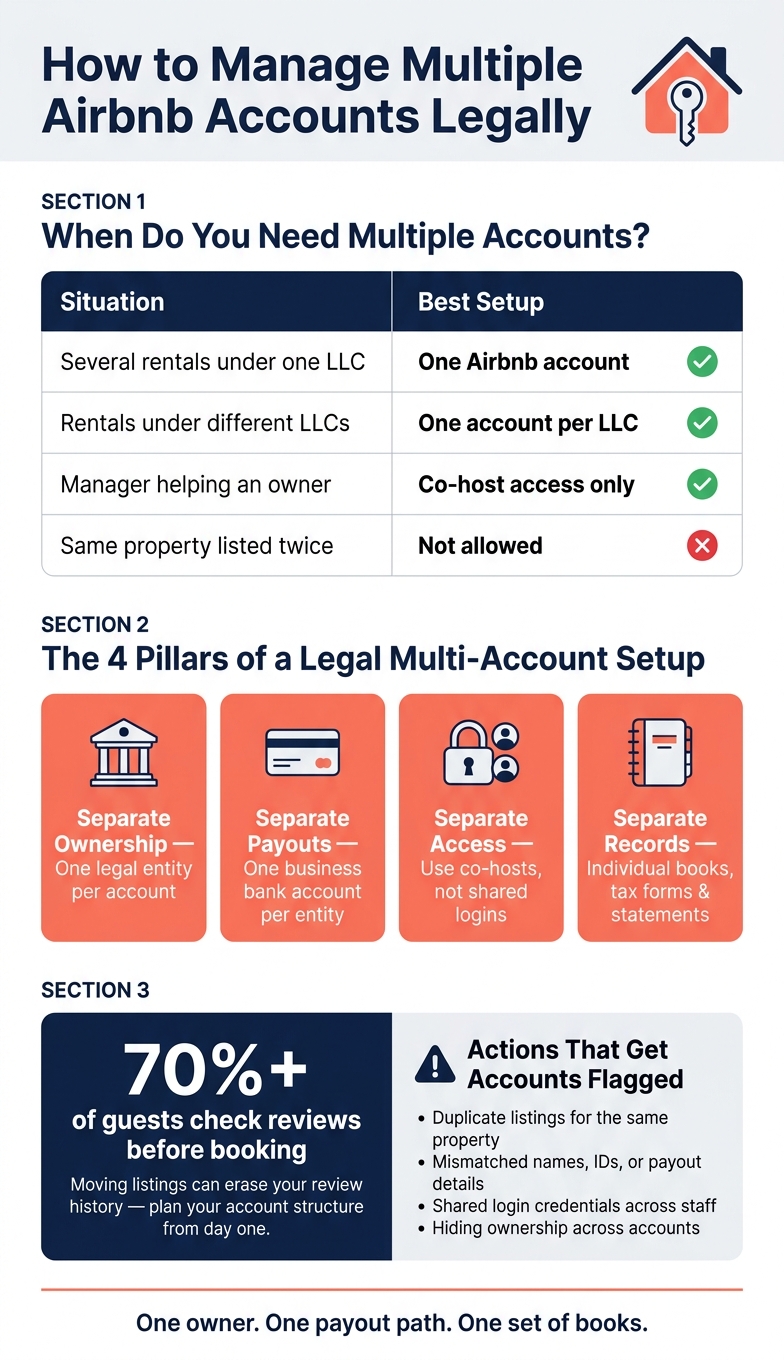
Yes, I can run more than one Airbnb account without breaking the rules – but only when each account belongs to a different person, LLC, or brand. That is the whole issue in one line.
If I want to keep things clean, I need to make sure each account has:
- its own legal owner
- matching ID and tax details
- its own bank account for payouts
- separate access for staff or co-hosts
- separate records for income, fees, and statements
If I use a second account to repost the same property, hide ownership, or get around platform rules, that can get the account flagged or removed. And if I move listings after reviews start coming in, I may lose that review history – which matters when more than 70% of guests look at reviews before booking.
Here’s the short version:
- One entity, many properties: one account is often enough
- Different LLCs or owners: separate accounts may make sense
- Staff help only: use co-host access, not extra logins
- Mixed payouts and mixed books: that is where problems start
| Situation | Best setup |
|---|---|
| Several rentals under one LLC | One Airbnb account |
| Rentals under different LLCs | One account per LLC |
| Manager helping an owner | Co-host access |
| Same property listed twice | Not allowed |
I’d treat each account like its own business file: one owner, one payout path, one login structure, and one set of books. That keeps reporting clear, tax prep easier, and account reviews less likely to turn into a mess.
Multiple Airbnb Accounts: Legal Structures at a Glance
Understand Airbnb‘s Rules Before Creating a Second Account
Before you open a second Airbnb account, set it up under the actual owner, LLC, or brand. If someone else just needs help with daily tasks, use co-host permissions instead [4]. That setup should line up with your ID and payout details from the start.
This matters more than it may seem. Reviews and guest history stay with the listing, so moving a listing later can wipe out that history [1]. In plain terms: if you build first and fix the setup later, you could lose the track record you worked hard to build.
Actions That Can Get Multiple Accounts Flagged or Removed
The biggest risk is posting duplicate or misleading listings. If the same property appears under more than one account without a valid reason, Airbnb can see that as conflicting information. And if titles, photos, or amenity details don’t match, the account can get flagged as deceptive [3].
Once you’ve picked the right account structure, keep everything tied to it the same way:
- verification details
- payout setup
- account access
Why Account Planning Matters Before Your Portfolio Grows
Pick the structure early, before listings, reviews, and team access start stacking up. It keeps ownership records clean and makes account management much less messy as your portfolio grows [2].
sbb-itb-103bddb
Choose the Right Account Structure for Your Properties and Entities
Once the legal owner is clear, your Airbnb account setup should match that same structure across banking, taxes, and user access. In plain English: build each account around the legal owner, not around how many listings you have.
When One Account Is Enough and When Separate Accounts Make Sense
If you own several properties under the same legal entity, one Airbnb account is usually enough. Co-hosts can still handle day-to-day work, and you won’t need to split up reviews or guest history.
Separate accounts make sense only when ownership is separate, such as:
- Different LLCs
- Different investment partners
- Different brands that need separate books and tax reporting [2]
Once you’ve picked the right setup, make sure each account’s verification and payout details match that same entity.
Match Each Airbnb Account to a Real Legal and Banking Structure
Each Airbnb account should connect directly to a real owner or business entity. Use the entity’s legal name, EIN, and a dedicated business checking account. That keeps tax records clean and makes a later transfer or sale much easier [2].
From day one, line up the verification details, payout method, and tax information with that same entity. When all of those details point to the same owner or LLC, income, expenses, and owner statements are much easier to track.
Consider Professional Management Instead of Running Multiple Accounts Yourself
If you can’t avoid using multiple accounts, centralize the work so compliance doesn’t turn into an admin headache. Managing more than one account adds paperwork and coordination, and that load can grow fast as your portfolio gets larger [5].
For owners who want to scale without piling on extra admin, Rank One Stays can manage listings, guest support, housekeeping, and reporting while keeping each account tied to the correct entity.
Set Up Verification, Payouts, and Daily Access Correctly
Once your account setup lines up with your legal entities, the next step is making sure the day-to-day setup can stand up to review. That same alignment needs to carry through verification, payouts, and account access. In many multi-account setups, this is where things start to go sideways.
Complete Identity Verification with Matching Personal or Business Details
Match each account to the exact legal name, ID, date of birth, and address shown on the owner’s or entity’s records. If a property is owned by an LLC, Airbnb may also ask for a government ID plus business documents that match the entity’s legal name.
Even small mismatches in names, addresses, or entity details can cause verification issues. If you’re setting up accounts for different partners or separate LLCs, submit each one under the correct owner or entity and keep those details the same across the full setup.
Once the identity details line up, keep payout routing and user access tied to that same owner or entity.
Separate Payout Methods and Bank Accounts by Entity or Owner
Send each account’s payouts to a separate business bank account tied to that entity. Use a separate business bank account and expense card for each one. This makes reconciliation cleaner and gives you a clearer audit trail.
It may feel like extra admin work at first, but it saves a lot of headaches later. When money from multiple entities lands in one place, things get messy fast.
Use Co-Hosts, Team Permissions, and Secure Devices Instead of Shared Logins
Don’t pass around login credentials to staff. Instead, add cleaners, virtual assistants, and property managers as co-hosts directly on each listing with agreed-upon permissions.
Co-hosts can manage guest messages and scheduling without using the main account credentials, while the owner keeps control of the account and listings. You can also use a PMS to assign role-based permissions and keep messages in one place without shared passwords.
For daily access, stick to a simple approach:
- Use co-hosts for task-based access
- Sign into each account only on secured devices
- Turn on two-factor authentication
That separation also makes each account’s activity much easier to track later.
Keep each account’s access, payouts, and records lined up so reporting stays clean later.
Keep Records Clean and Scale Without Compliance Problems
Track Income, Fees, Tax Forms, and Owner Statements by Account
Once ownership, payouts, and access are split up, your records need to back that up. The goal is simple: each account should stand on its own on paper, not just in Airbnb.
Treat every account and entity like its own ledger. That means keeping payout reports, reservation exports, tax forms, fees, receipts, and owner statements for each account separately. If you manage properties for other owners, keep monthly owner statements and per-property reports too.
A clean month-end process matters here. Close the books every month by:
- reconciling bank feeds
- clearing exceptions
- updating per-property P&Ls
That’s what shows each account is still clean if questions come up later.
Use Professional Reporting for Multi-Market Growth Without Extra Admin
As your portfolio grows, reporting often becomes the choke point. More accounts can mean more markets, more owners, more payouts, and more moving parts. If the reporting side gets messy, everything else tends to follow.
Professional management helps centralize reporting, guest support, and housekeeping across accounts without adding a separate admin layer for every market. Rank One Stays gives owners a transparent portal with real-time visibility into revenue, occupancy, and performance across accounts, while keeping each one tied to the correct entity [6].
Growth only stays legal when every new account keeps its own books, bank flow, and reporting trail.
Conclusion: Legal Multi-Account Management Requires Clear Ownership, Clean Payouts, Secure Access, and Strong Records
Running multiple Airbnb accounts legally comes down to four things: separate ownership, separate money, separate access, and separate books. And those pieces need to be in place from day one.
Professional management can help keep reporting organized as you expand.
FAQs
Can I transfer a listing to another Airbnb account without losing reviews?
No, in most cases, you can’t move a listing to a new account and keep the reviews.
Here’s the simple reason: reviews are usually tied to the listing profile itself, but control of that profile often stays with the account that created or manages it.
So if your property is listed under a management company’s account, the reviews will often remain with that account when the partnership ends.
The safest move is to set up the property under your own owner account from the start. That way, you keep control of the listing and the reviews attached to it.
What happens if Airbnb sees duplicate listings for the same property?
If Airbnb spots duplicate listings for the same property, you can run into account and day-to-day operating issues fast. The biggest problem is double booking when calendars aren’t synced. That can lead to bad guest reviews, platform penalties, and even account suspension.
To lower that risk, owners who manage multiple properties or accounts should use a channel manager. If you want a more hands-off setup, Rank One Stays offers full-service management to help keep listings optimized and operations on track.
Do I need separate tax and bank details for each Airbnb account?
Generally, no. But you should keep business and personal finances separate to make your books more accurate and tax time a lot less messy.
Use a dedicated business bank account and credit card. Track income and deductible expenses by property or account, and keep clear records. If you run the business through an LLC, check with your tax professional to make sure your reporting lines up with your setup.