

Pricing your vacation rental effectively is the key to increasing revenue and staying competitive. Here are the main takeaways:
- Dynamic Pricing is Essential: Static pricing no longer works. Adjust rates frequently based on seasonality, local events, and booking trends.
- Last-Minute Bookings Dominate: 62% of bookings happen within 21 days of the stay. Use discounts to fill gaps closer to check-in dates.
- Avoid Overpricing and Underpricing: Overpricing leads to empty nights, while underpricing leaves money on the table. Data-driven adjustments help balance occupancy and revenue.
- Leverage Tools: Dynamic pricing tools like PriceLabs or Beyond Pricing optimize rates using real-time data but require manual oversight for local events and unique property features.
- Longer Stays and Discounts: Offer discounts for extended stays to reduce turnover costs and attract longer bookings.
- Factor in Local Events: Major events can justify rate increases by 50–200%. Monitor event calendars and competitor pricing to capitalize on demand spikes.
- Track Performance Regularly: Monitor occupancy, average daily rate (ADR), and revenue per available room (RevPAR) weekly to fine-tune rates.
- Avoid Common Mistakes: Don’t rely on static pricing, ignore expenses, or overuse discounts during high-demand periods.
Quick Tips:
- Set Pricing Boundaries: Calculate minimum rates to cover costs and maximum rates based on competitors and amenities.
- Adjust for Micro-Seasons: Use multipliers to reflect demand during holidays, festivals, or weekends.
- Optimize with Data: Regularly review booking trends and adjust rates accordingly.
By combining dynamic pricing tools with regular oversight, you can ensure your property stays competitive and profitable.
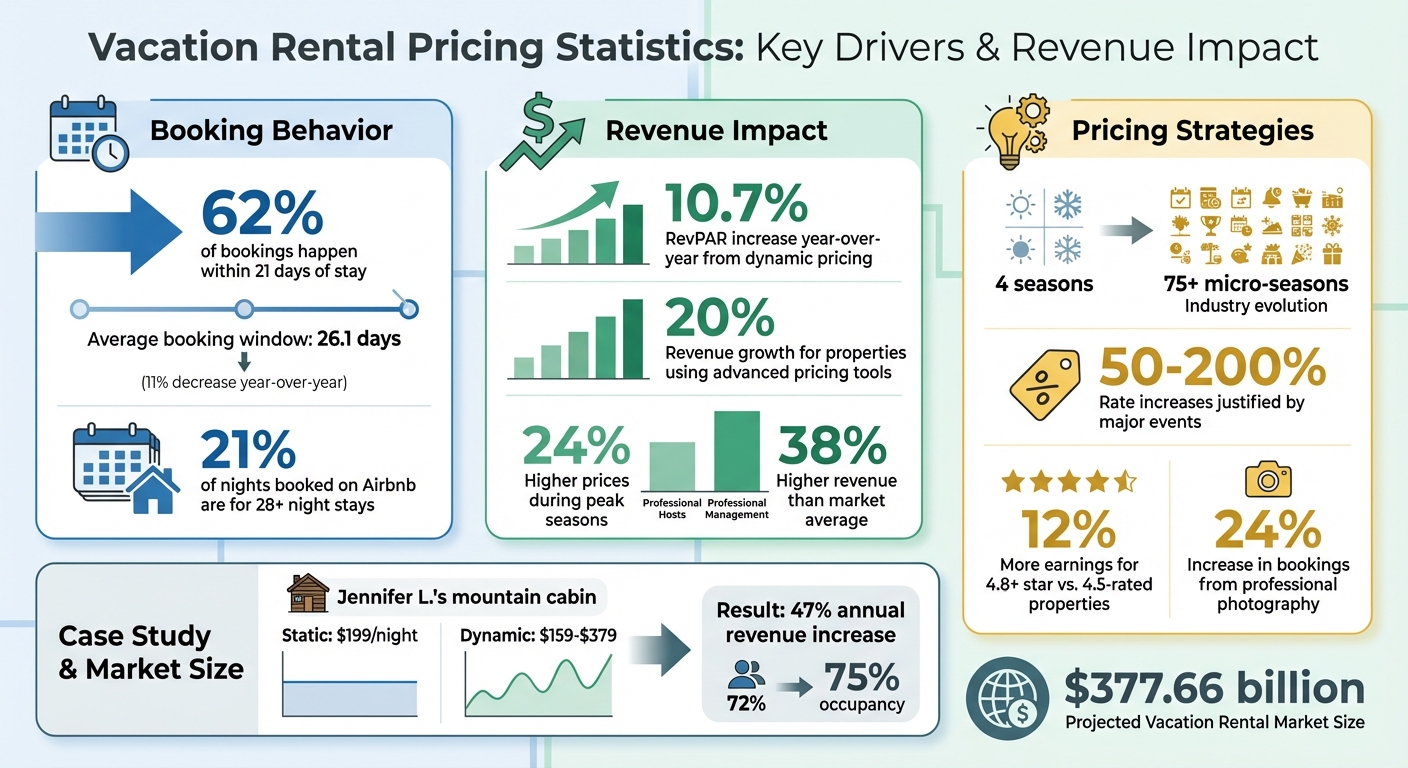
Vacation Rental Pricing Statistics: Revenue Impact and Booking Trends
The Ultimate Short Term Rental Pricing Masterclass (Step-by-Step) for 2025
Why Fixed Pricing Doesn’t Work Anymore
A few years ago, setting a single nightly rate and revising it every few months worked just fine. But today, that static approach falls short. The industry has evolved from four broad seasons to 75+ micro-seasons, each influenced by local events, holidays, conferences, and unpredictable demand patterns [4]. A fixed $200 nightly rate might miss the chance to capitalize on a local festival’s surge in demand, while also failing to compete on slower weekdays. To keep up, pricing needs to be adjusted constantly to seize every revenue opportunity.
Modern platforms now reward frequent price updates with better visibility. Sticking to rates set in January could actually hurt your listing’s performance [6]. As Beyond Pricing aptly states:
Static playbooks have expired. Agility is now the advantage [7].
The data backs this up. Properties using dynamic pricing models see an average 10.7% increase in Revenue Per Available Room (RevPAR) year-over-year compared to those with fixed rates [4]. With most bookings happening within 21 days of the stay, guests are making decisions based on current market conditions – not outdated prices [1]. Fixed pricing simply can’t keep up in today’s fast-moving environment.
Lost Revenue from Setting Prices Too Low
Locking in a single rate for the year is essentially a gamble on your property’s value in every possible scenario. More often than not, that gamble leads to underpricing during high-demand periods. Take Jennifer L., for example. She managed a 3-bedroom mountain cabin priced at a static $199 per night in 2024. After switching to a dynamic pricing strategy in 2025 – ranging from $159 during the off-season to $379 during peak holidays – her annual revenue jumped by 47%, and her occupancy rate rose from 72% to 75% [8].
The math is clear. If your market could support $350 per night during a major event but you’re charging $200, you’re leaving $150 on the table for every booked night. Over a three-day weekend, that adds up to $450 in missed revenue. And with so many micro-seasons throughout the year, these missed opportunities can add up fast [4]. AI-powered tools excel at identifying these peak periods and adjusting rates accordingly [4]. Fixed pricing, on the other hand, simply can’t capture these gains. While underpricing leaves money on the table, overpricing can push potential guests away.
Empty Units from Setting Prices Too High
Overpricing can be equally harmful. If you’re charging $200 per night in February while competitors drop to $140, guests are likely to skip your listing. STR Profit Map puts it succinctly:
Price too high, and occupancy will drop significantly. Underprice, and you may book out but miss significant revenue [8].
The solution lies in data-driven adjustments. For instance, if your booking pace is below 40% with only 14 days to go, a 5–10% price cut can help fill those empty nights [1]. After all, an occupied unit – even at a slightly lower rate – is far more valuable than an empty one. AvantStay, which manages over 2,300 properties, saw a 10.7% boost in RevPAR by shifting from quarterly pricing to micro-seasonal adjustments [4]. This highlights the importance of aligning your rates with real-time market conditions to maintain profitability consistently.
Core Elements of Effective Vacation Rental Pricing
Adjusting your pricing strategy in real-time is one of the most effective ways to maximize revenue for vacation rentals. As Staystra puts it:
"Pricing is the most powerful lever you control as a host, and it can make the difference between a thriving listing and a frustrating side project." [1]
At the heart of this approach is value-based pricing – setting rates based on what your property offers to guests. For instance, a beachfront condo in South Florida can justify higher rates due to its prime location and amenities. Data backs this up: properties with 4.8+ star ratings earn about 12% more than those rated 4.5 [8]. Additionally, professional photography can increase bookings by 24% [8], making it easier to charge higher rates while offering an enhanced guest experience.
Adjusting for Booking Windows
Since most reservations are made on short notice [1], your pricing strategy needs to be flexible. For example, if your occupancy is below 40% and there are only 10–14 days left until arrival, offering a discount can help fill those nights. Even at reduced rates, an occupied unit generates revenue that would otherwise be lost.
Incentives for Longer Stays
Offering discounts for extended stays is another way to optimize pricing. A 10–20% discount for guests staying 7 or more days can attract long-term travelers, such as digital nomads or vacationers looking for an extended getaway. This also reduces turnover costs like cleaning, restocking, and guest communication [1][3].
Accounting for Platform Fees
With platforms increasingly adopting single host service fees, recalibrating your base rates is critical to maintain your margins [1]. Professional management services can help fine-tune these adjustments, ensuring your pricing stays competitive and profitable.
Here’s a quick overview of these key pricing adjustments:
| Pricing Factor | Impact on Strategy | Recommended Action |
|---|---|---|
| Last-Minute Gaps | Risk of zero revenue | Apply 5–15% discounts within 10–14 days of arrival [1] |
| Longer Stays | Lower turnover costs | Offer 10–20% discounts for 7+ day bookings [1][3] |
Market Research and Competitor Pricing
Keeping an eye on your local competitors’ rates is a smart way to set prices that attract guests without leaving money on the table. Start by identifying 5–10 nearby properties that match your location, size, and amenities – this group will be your competitive set [10][2].
You can manually research competitors using Airbnb‘s search tools. Narrow down listings within a half-mile radius using filters and map view [10]. To get a clearer picture, select specific check-in and checkout dates during peak seasons to see how other hosts adjust their pricing. For a more streamlined approach, use pricing tools that compare your rates with up to 10 competitors, helping you spot pricing gaps quickly [10]. This research lays the groundwork for understanding how external factors, like special events, can impact pricing strategies.
Key metrics like ADR (Average Daily Rate), occupancy rate, and RevPAR (Revenue per Available Room) are essential for evaluating market trends and profitability [10]. Major events can create huge demand spikes. For instance, during the 2024 Paris Olympics, Saint Denis experienced a 7-fold increase in occupancy and a 2.6x rise in ADR [11]. Similarly, the Las Vegas Super Bowl caused ADR to climb by 2.3x [11]. These patterns show how events can justify 50–200% price increases during festivals, conferences, or sports events [8].
Local events and holidays also create "micro-seasons" that require ongoing adjustments to your rates [4]. Regularly researching competitors and staying aware of these shifts ensures you’re not missing out on extra revenue opportunities that static pricing might overlook.
Adjusting Prices for Seasons and Events
To align your pricing with demand, divide your calendar into three key periods: peak, shoulder, and slow seasons. For example, a beach rental might see its peak season in summer, with rates climbing by 30–80% above the base rate. Meanwhile, a ski property near Denver would experience its busiest months in winter. Shoulder seasons, like spring and fall, often warrant a smaller increase of 10–30%, while slow periods may require discounts of 10–25% to keep bookings steady. By breaking the year into these segments, you can fine-tune your base rate using targeted multipliers.
How do multipliers work? Let’s say your Scottsdale vacation rental has a base rate of $200 per night. During a busy summer weekend, you might use a 1.5x multiplier, raising the nightly rate to $300. For major festivals, multipliers can jump to 2.0x or even 3.0x. High-demand sporting events might justify rates 1.5x to 2.5x higher, while conferences could lead to increases of 1.25x to 1.75x. These adjustments ensure your pricing reflects the demand spikes created by local events.
Local event calendars are invaluable for spotting these demand surges. For nights near major events, charge full rates, but consider lowering multipliers on surrounding days to attract early arrivals or late departures. This strategy helps you capture spillover demand and maximize occupancy.
Daily demand patterns also play a big role in pricing. Weekends, especially Fridays and Saturdays, can command premiums of 20–40% over weekday rates. On the flip side, offering a 10–20% discount on Sundays can encourage guests to extend their stays. This approach works particularly well in markets driven by leisure travel, complementing your overall dynamic pricing strategy to optimize revenue.
Modern pricing strategies go beyond traditional seasons. Today, properties adjust rates for over 75 micro-seasons – short periods tied to school breaks, local festivals, or specific holidays. Properties that use this method often see a 10.7% increase in RevPAR year-over-year [4]. Staying on top of these micro-seasons in real time is key to capturing last-minute bookings and maximizing your earnings.
Pricing Based on Booking Length
Dynamic pricing isn’t just about adjusting nightly rates – it’s also about tailoring discounts based on how long guests stay. Offering discounts for longer stays can cut down on turnover expenses while ensuring extended bookings. Think about it: every time a guest checks out, you’re covering the costs of cleaning, laundry, restocking supplies, and managing check-ins and check-outs. Hosting someone for 28 nights eliminates multiple turnovers, saving you time and money while guaranteeing 100% occupancy for the entire month.
A great way to reflect these savings is by using a tiered discount system. For instance:
- Charge full price for 1–2 nights.
- Offer 5–10% off for stays of 3–5 nights.
- Discount 10–20% for guests staying 7+ nights.
- Provide 20–30% off for stays of 28+ nights [13].
Oliver, a seasoned host in New York City, suggests a practical method for setting these discounts:
"It’s a good idea to add up what you earn in a month with guests paying your nightly price. Then you can adjust your monthly discount to match that total, which helps to keep your income more reliable" [15].
This approach ensures stable earnings while keeping your pricing competitive. Plus, longer stays can help your listing stand out. Properties offering weekly or monthly discounts often rank higher in search results [15]. In fact, 21% of nights booked on Airbnb in 2022 were for stays of 28 nights or more [15]. If your property is in a location like Denver, where remote workers or seasonal visitors favor extended stays, offering these discounts can keep your calendar consistently booked.
However, during peak seasons or major events, it’s smart to limit or even remove length-of-stay discounts. When demand is high, guests are willing to pay full price no matter how long they stay [13][14]. Robert Beames of Truvi advises:
"Don’t offer discounts during high-demand periods, and be aware that constant discounting can look suspicious to guests who might wonder why you’re having trouble booking your property" [17].
Instead, consider setting a minimum stay requirement – like three nights during peak weekends – to capture high-value bookings without cutting into your revenue.
Another opportunity lies in filling those awkward gaps between bookings, often called “orphan nights.” These 1–2 night gaps can be filled by applying a 5–15% discount [12][14]. Fabio Castiblanco, Head of Revenue and Analytics at Sosuite, highlights the value of extending stays:
"If you can get the guest who is already booked to extend their stay by one night, that is always going to be an easier and more profitable booking than trying to attract a brand new one-night stay from the market" [12].
This strategy helps maximize occupancy without undercutting your pricing for longer stays. By weaving these tactics into your pricing plan, you can balance revenue growth with competitive occupancy rates.
How to Use Dynamic Pricing Tools
Dynamic pricing tools simplify rate adjustments by using live market data to automate pricing changes. However, these tools work best when paired with hands-on oversight. Let the software handle daily pricing fluctuations, but step in with manual adjustments for key factors like major events, unique property features, or sudden changes in the local market [1,29]. This blend leverages the tool’s data-driven insights while incorporating your market knowledge.
Before fully trusting the tool’s recommendations, allow it to gather data for at least 30 days [28,29]. During this learning phase, the software analyzes your property’s booking trends, guest behavior, and competitive positioning. Once the system is calibrated, review your booking pace weekly and tweak rates as needed to stay aligned with short-term occupancy trends [1].
When selecting a dynamic pricing tool, evaluate its cost structure and customization features. Look for options that suit your portfolio size and market needs. Pricing models vary, from flat monthly fees to revenue-based percentages. For example, Airbnb’s Smart Pricing may not be ideal, as it often undervalues properties and lacks the detailed market analytics required to optimize revenue [29,30].
Keep in mind that automation isn’t a set-it-and-forget-it solution. Schedule regular maintenance, including monthly base price reviews and quarterly performance evaluations [8,29]. As sanchjohn aptly points out:
The tool is only as good as the user, and knowing what customizations to set is important [19].
Don’t forget to update your rates when you make upgrades to your property. New amenities or renovations can justify higher premiums [8]. For competitive markets, like Denver, these manual adjustments ensure your pricing reflects both market demand and your property’s unique features. By integrating automated insights with thoughtful refinements, you can keep your rates aligned with both market trends and the value your property offers.
Choosing a Dynamic Pricing Tool
Picking the right dynamic pricing tool means weighing factors like cost, data reliability, and customization options. Pricing models vary: subscription plans typically cost between $10 and $30 per property per month, while revenue-based models charge about 1% of total booking revenue, often with a $10–$30 monthly minimum [19]. The best choice depends on your portfolio size and how much control you want over pricing decisions.
Why Data Quality Matters
Forget about flashy features – data quality is what really drives results. Some tools rely on scraped data, which only reflects publicly posted prices from listing sites. The problem? These prices don’t always match what guests actually pay [5]. Instead, tools that pull source data directly from reservation systems offer a clearer picture. They provide insights into booking rates, occupancy levels, and lead times. When evaluating tools, ask whether they use confirmed booking data or just visible prices. This distinction is critical for accurately predicting market trends and setting competitive rates.
Flexibility Over Automation
The best tools don’t force automatic rate changes on you. Instead, they provide data-driven suggestions that you can review and adjust. Anurag Verma, co-founder of PriceLabs, explains:
We know about your market, you know a lot about your property, and together this combination is going to automate your pricing… we come up with suggestions for you. We don’t want to force them on you [20].
This balance lets you combine your property expertise with the tool’s market insights, giving you more control over your pricing strategy.
Test Before You Commit
Before rolling out a tool across your entire portfolio, test it on a single property for a few weeks [19]. Use this trial period to experiment with different base prices and rule settings. This is especially important in competitive markets like Denver, where local demand patterns can heavily influence automated pricing. Testing helps you understand how the tool interacts with your unique market conditions.
Integration and Customization
Specialized tools like PriceLabs, Wheelhouse, and Beyond Pricing offer advanced customization options and multi-channel synchronization [19]. If you’re managing multiple properties, check whether the tool integrates seamlessly with your property management system. For larger portfolios, consider professional management services to handle setup, optimization, and ongoing adjustments. This ensures you’re getting the most out of your dynamic pricing strategy.
sbb-itb-103bddb
Setting Minimum and Maximum Price Limits
Your floor price is the absolute minimum you should charge to cover all your operating costs. These include utilities, internet, supplies, HOA dues, insurance, cleaning, platform fees, taxes, and, if applicable, property management fees ranging from 15–25% [21]. Without this baseline, you risk losing money on every booking.
Once you’ve determined your floor price, calculate your target gross rate by accounting for taxes and fees. For example, if local lodging taxes are 12%, divide your desired net rate by 0.88. This calculation ensures that taxes and platform fees don’t eat into your profits [1].
On the other end, your ceiling price should match what comparable high-performing listings in your area are charging [1][3]. To gauge this, create an Airbnb Wishlist with 20–30 similar properties and monitor their pricing in real time [22]. If your property includes standout features, like luxury amenities or professional design from a vacation rental design service, you can justify setting a higher maximum price. This strategy keeps your pricing competitive while reflecting the market’s demands.
To maintain control, use guardrails in your dynamic pricing tool – typically set at +/- 25%. These limits prevent your prices from dropping below your cost floor or exceeding what the market will bear. This way, you avoid underreacting to spikes in local demand or overreacting to short-term market changes. As Sean Rakidzich from Airbnb Automated highlights:
The guest decides what you are worth [22].
Your pricing boundaries should balance your costs with what guests are willing to pay. These guardrails not only safeguard your profit margins but also prepare your pricing for real-time adjustments in a fluctuating market.
| Profit Margin | What It Means |
|---|---|
| Under 10% | Barely breaking even; at risk if unexpected repairs arise [21] |
| 10%–25% | A solid position in competitive markets [21] |
| Above 25% | Highly profitable; likely due to premium location or amenities [21] |
Tracking Performance and Adjusting Rates
Once you’ve established clear pricing boundaries, the next step is keeping a close eye on performance to fine-tune your strategy. Regularly reviewing key metrics like occupancy rate (OR), average daily rate (ADR), and revenue per available room (RevPAR) – ideally on a weekly basis – can help you make smarter adjustments [23].
Start by analyzing your booking pace, which measures how quickly reservations are coming in compared to past trends [24]. For example, if your occupancy rate 30 days out is below 40% with only two weeks to go, it might be time to lower your ADR by 8% to 12% to attract more bookings. On the flip side, if occupancy surpasses 70% in the same timeframe, increasing rates by 5% to 10% can help you maximize revenue per booking [1]. This balanced approach ensures you’re responding to shifts in demand without making hasty decisions based on short-term changes.
Data shows that 62% of short-term rental bookings now happen within 21 days of arrival [1], and in the U.S., the average booking window has dropped to just 26.1 days – an 11% decrease compared to the previous year [5]. As Julie Brinkman, CEO of Beyond, puts it:
The idea of a ‘historically normal’ year is out the window [5].
While dynamic pricing tools can handle many of these adjustments, manually staying aware of local events can help you seize opportunities that algorithms might miss. For instance, if a last-minute music festival is announced in a city like Denver, you might justify a rate increase that your software hasn’t accounted for yet. Hosts who actively manage their pricing – using advanced tools alongside manual oversight – report an average 20% revenue growth compared to those who rely solely on automation [2].
Beyond tracking booking trends, it’s essential to evaluate overall profitability. Keep an eye on your net operating income (NOI), which is your total revenue minus operating expenses like cleaning fees, taxes, and management costs [23]. This metric helps you determine whether a high occupancy rate with lower ADR is more lucrative than fewer bookings at premium prices. Additionally, if your listing is getting plenty of views but few conversions, the issue may lie elsewhere – think outdated photos, poor calendar settings, or a lack of appealing property upgrades [1].
Common Pricing Mistakes to Avoid
Even seasoned property owners can stumble into pricing pitfalls that chip away at profits. One of the biggest missteps is relying on static pricing. Keeping the same rate throughout the year overlooks key factors like seasonal demand and day-of-the-week variations – weekends, for instance, often attract higher rates than weekdays[25][26].
Another frequent error is overlooking local events. When a major festival, concert, or conference rolls into town, failing to adjust your rates can mean selling out too early at prices far below what guests would willingly pay[25][26]. This results in lost revenue opportunities. Similarly, pricing based on personal bias – valuing your property based on your own attachment rather than objective market data – can lead to overpricing, which discourages potential bookings[25].
A common blind spot for many owners is underestimating actual expenses. Rates that seem profitable at first glance can fall short once you factor in hidden costs like cleaning fees, platform commissions (Airbnb, for example, charges hosts a 3% service fee[28]), maintenance, and local taxes[25]. To avoid this, calculate your floor price by summing up all monthly operating costs and dividing them by your expected booked nights. This number represents the bare minimum you need to charge to cover your expenses[28].
Timing mistakes can also hurt your bottom line. New hosts often set rates too high, making their property less competitive[26]. On the flip side, even experienced hosts can undervalue their property if they’re fully booked months in advance – this typically signals that they could have charged more. Professional hosts, for example, often price their properties up to 24% higher during peak seasons compared to casual hosts[27]. They focus on Revenue Per Available Night (RevPAR) as a more accurate measure of profitability, rather than just looking at occupancy rates.
Lastly, inconsistent channel management can create major problems. If your pricing isn’t synced across platforms, you risk double bookings or rate discrepancies that can damage your reputation[26]. Partnering with professional vacation rental management can help keep your pricing consistent, data-driven, and responsive to market trends – saving you from the headache of constant manual updates. By steering clear of these common mistakes, you can build a pricing strategy that maximizes profitability while staying competitive.
Lowering Prices to Beat Competitors
While adjusting prices dynamically can be a smart move, relying solely on lower rates to outdo competitors can backfire. Sure, dropping prices might fill your calendar quickly, but it comes at a cost. It shrinks your profit margins, diminishes the perceived value of your property, and risks branding your rental as a budget option – even if it offers high-end features.
Instead, focus on what makes your property special. Highlight your Unique Selling Proposition (USP) – whether it’s a breathtaking location, top-notch service, or a unique niche appeal. For instance, professional photos can make a world of difference. They’ve been shown to boost bookings by 24% and increase click-through rates by 40%[9]. Even small details, like showcasing a hot tub in your photos, can increase click-through rates by 15%[9].
Rather than slashing prices, elevate your property’s value with premium amenities. Features like high-speed Wi-Fi (a filter used by 72% of guests)[9], home office setups for remote workers, or even offering bikes or kayaks for local adventures can justify higher rates[16][3]. You can also enhance the guest experience by bundling extras like premium coffee, self-check-in options, or discounts at local businesses. These small touches add value and appeal without cutting into your base price[1][3].
Not Reviewing Rates Regularly
Sticking to static pricing can drain your revenue. The market is always shifting – local events pop up, competitors tweak their rates, and demand fluctuates. If you’re not reviewing your rates regularly, you risk losing out during high-demand periods or facing empty nights when demand dips.
This ties directly to the importance of data-driven strategies. Did you know about 62% of vacation rental reservations are booked within 21 days of the stay[1]? That means real-time adjustments aren’t just helpful – they’re essential. For example, if you set your rates in January and don’t revisit them until March, you could miss the chance to charge premium prices during peak demand or use discounts strategically to fill vacancies.
The numbers speak for themselves. If your 30-day occupancy is under 40%, your prices might be too high. On the other hand, if it’s over 70%, you’re likely undercharging and should raise rates to protect your margins[1]. Take the case of Jennifer L., a mountain property owner. In 2025, she switched from flat rates to dynamic pricing and saw significant improvements in both revenue and occupancy[8].
To stay competitive, review your 7-, 30-, and 60-day pacing weekly[1]. Set aside just 15 minutes a week to analyze your short- and mid-term trends. If occupancy is low (below 65%), consider applying gradual discounts starting 14 days before the stay[8]. For those managing properties in active markets like Denver vacation rentals or Pittsburgh short-term rentals, regular monitoring becomes even more critical since local events and seasonal changes can quickly shift demand.
Even with automation tools, it’s smart to conduct a full strategy review every quarter[18]. This ensures your pricing stays aligned with your long-term revenue goals. Regular adjustments not only help you capitalize on immediate opportunities but also protect your margins as operational costs – like utilities, cleaning, and maintenance – rise with inflation. In the end, consistent rate reviews are key to staying competitive and profitable.
Using Discounts at the Wrong Times
When it comes to dynamic pricing, timing is everything – especially with discounts. Offering discounts during peak periods can drain your revenue faster than you think. During high-demand times like holidays, festivals, or major local events, travelers are typically willing to pay premium prices. In fact, guests often book even when rates are 50% to 200% higher than usual[8].
"Don’t offer discounts during high-demand periods, and be aware that constant discounting can look suspicious to guests who might wonder why you’re having trouble booking your property" [17].
Overusing discounts not only eats into your profits but can also harm your property’s reputation. It may even attract guests who are less likely to respect your space. This is especially risky in competitive markets like Denver vacation rentals or Scottsdale vacation rental management, where maintaining pricing power during peak seasons is critical.
Instead, focus on strategic timing. Hold your rates steady until about 10–14 days before check-in. If your occupancy is still lower than expected, consider offering a carefully calculated discount. For peak periods, tighten your minimum stay requirements and stick to stricter cancellation policies[8].
Save discounts for moments when they make the most sense, like:
- Last-minute gaps: Within 48 hours of check-in.
- Orphan nights: Single nights between longer bookings.
- Midweek slowdowns: When demand naturally dips.
During off-peak or shoulder seasons, discounts of 10–20% can help fill vacancies without damaging your pricing strategy for high-demand periods[1]. The trick is to treat discounts as a targeted tool, not a default approach.
To ensure profitability, set a minimum price floor at 25–30% below your average base rate. This way, you’ll cover operating costs while still leaving room for a margin[14].
Conclusion
Pricing vacation rentals is more than just setting a fixed rate – it’s about staying adaptable. With 62% of reservations happening within 21 days, rigid pricing can either leave you undercharging during high demand or overpricing during slower times, costing you bookings and revenue[1].
To stay competitive, focus on strategies like dynamic pricing, adjusting for seasons, analyzing competitors, and offering targeted discounts. Start by setting minimum and maximum prices that align with your costs and market position. Then, track occupancy weekly. For instance, if occupancy is below 40% two weeks before a date, consider lowering prices by 8–12%. On the flip side, if occupancy surpasses 70%, increase rates by 5–10%[1]. Using advanced pricing tools can also make a big difference, potentially increasing your revenue by 20%[2].
Success in this field also means keeping an eye on local events, fine-tuning for micro-seasons, and responding to booking trends with a clear head. In competitive markets like Denver or Pittsburgh, these adjustments can translate into thousands of extra dollars each year.
If you feel overwhelmed, partnering with Rank One Stays can make all the difference. From dynamic pricing to guest communication and property upkeep, they handle it all. Plus, property owners working with them see 38% higher revenue than the market average, with management fees starting at just 10%.
Now’s the time to refine your pricing strategy and claim your share of the projected $377.66 billion market[1].
FAQs
What’s the best way to use dynamic pricing tools to boost revenue for my vacation rental?
Dynamic pricing tools are a smart way to maximize revenue by automatically adjusting your rental rates based on real-time factors. These include market demand, seasonality, and competitor pricing. By using algorithms to analyze data, these tools help you determine the best pricing strategies to attract bookings while staying competitive.
To get started, pick a reliable dynamic pricing platform. Set clear boundaries, like minimum and maximum rates, to ensure your prices remain reasonable and competitive. It’s also important to regularly review and tweak your settings to match your revenue targets. Keep an eye on seasonal trends or local events that might spike demand and adjust your rates accordingly to make the most of those opportunities.
The key to success is consistency. Regularly monitor how your pricing strategy is performing and fine-tune it as needed. This approach helps you stay competitive and ensures you’re optimizing your earnings effectively.
Why should I offer discounts for longer stays at my vacation rental?
Offering discounts for extended stays can be a smart move for vacation rental owners. It not only helps increase occupancy rates but also cuts down on the hassle and costs of frequent turnovers. With fewer guests coming and going, you’ll spend less time and money on cleaning and maintenance between bookings, making operations smoother.
On top of that, platforms like Airbnb often give hosts a boost in search rankings if they provide discounts for longer stays. This can help you stand out to travelers seeking month-long or multi-week accommodations. It’s an especially useful approach during slower seasons or in areas where there’s a demand for temporary housing, such as from business professionals or families in the process of relocating.
How can I adjust my pricing to take advantage of local events and short-term demand spikes?
To boost revenue during local events or short-term demand surges, adjust your pricing to match the increased demand from festivals, concerts, sporting events, or holidays. Dynamic pricing tools can be a game-changer here. These tools analyze market trends in real time and automatically adjust your rates, helping you capitalize on high-traffic periods without missing potential earnings.
For micro-seasons – brief windows of heightened demand, like holiday weekends or regional events – keeping an eye on local event calendars is crucial. By proactively adjusting your rates and using data-driven tools, you can stay competitive while protecting your profit margins. The secret lies in understanding local demand patterns and using automation to fine-tune your pricing strategy effectively.