

If I own a rental in a college market, I don’t plan around the calendar year. I plan around the school year. That one shift can affect vacancy, rent, nightly rates, and turnover costs. In many college towns, demand spikes around late August move-in, football weekends, and May graduation, while June and July can be the weakest months.
Here’s the short version:
- Leasing starts early: many students sign for fall housing from January to April
- Move-in season is the peak: August and September often bring the strongest demand
- Event weekends can move rates fast: some stays can reach 2x to 4x normal pricing
- Summer is the trouble spot: 9- or 10-month leases can leave a 2–3 month income gap
- Turnover is expensive: a student rental turn can cost about $3,000 to $5,000 for a 3- to 4-bedroom home
- Timing matters: many owners aim to have units leased by June 1 for fall move-ins
I’d treat this kind of market in five simple phases: pre-lease season, move-in peak, mid-semester, finals/graduation, and summer gap. Each phase calls for a different plan for pricing, lease length, guest type, and maintenance timing.
A few numbers make the point clear. The U.S. has about 19.5 million college students, and student housing occupancy for the 2025–2026 school year reached 95.1%. In Ann Arbor, September 2025 ADR hit $374, which was 54% above the annual average ahead of a major football weekend. So demand is often not the problem. Timing is.
If I ignore the college calendar, I risk three common problems:
- empty units after the spring leasing window closes
- missed high-rate weekends
- August turnover pileups with crews, cleaning, and repairs
The fix is simple: match the rental plan to the campus schedule. That means setting lease dates around the academic year, pricing early for event weekends, using short or mid-term stays to cover slow months, and booking vendors months before the late-summer rush.
Below is a quick snapshot of how I’d think about each part of the year.
| Phase | What usually happens | What I’d do |
|---|---|---|
| Jan–Apr | Students look for fall housing | Market units early and lock leases |
| Aug–Sep | Move-ins and peak demand | Push top rates and tighten turnover timing |
| Oct–Nov / Feb–Mar | Steadier demand | Fill gaps with mid-term renters |
| May / Dec | Graduation and visitor travel | Use short stays and event pricing |
| Jun–Jul | Lower demand | Offer flexible summer rentals |
If I want steadier income in a college market, I use the academic calendar as the plan – not just background information.
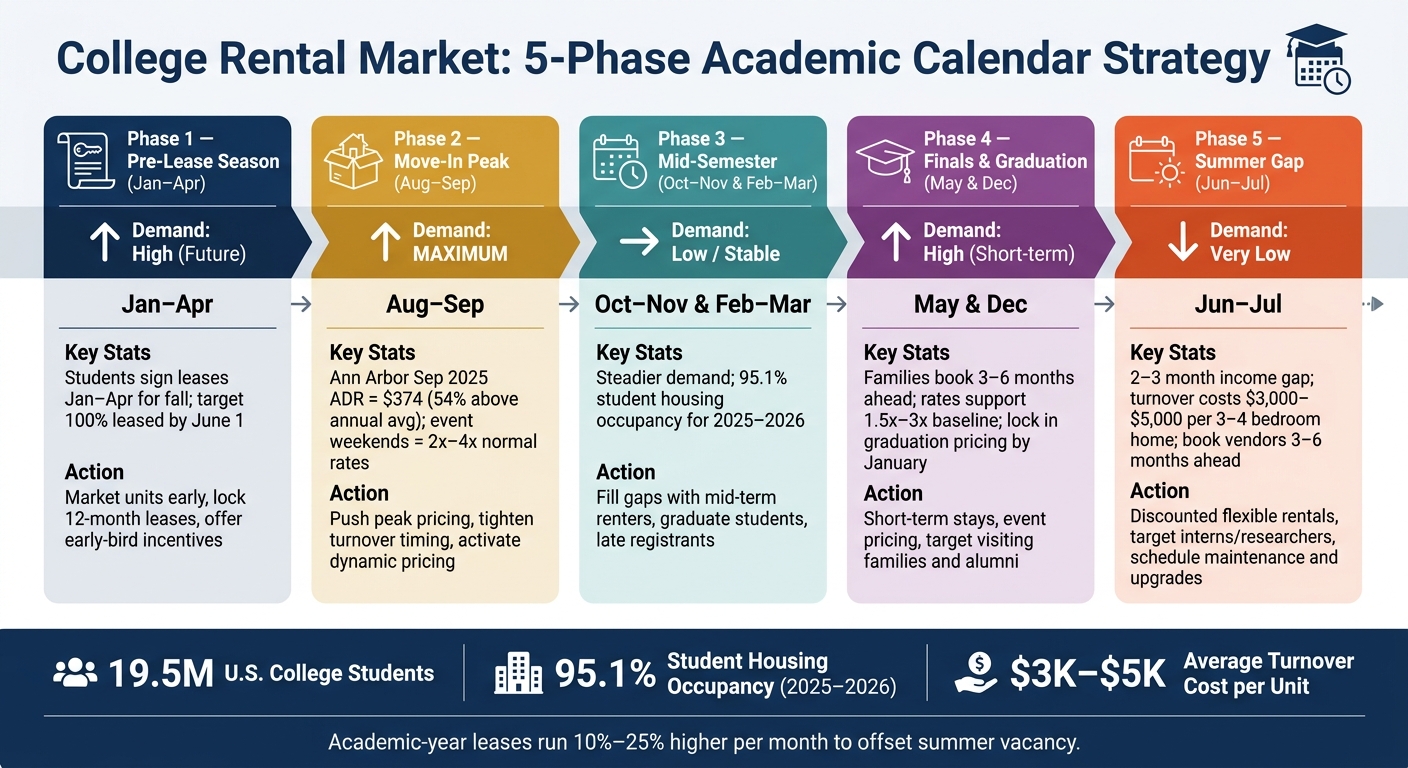
College Rental Market: 5-Phase Academic Calendar Strategy
Should you Invest in College Towns? Real Estate Investing for Beginners
sbb-itb-103bddb
How Academic Calendars Shape Rental Demand Year-Round
Most U.S. colleges follow a semester system. That usually means the fall term begins in late August and the spring term starts in mid-January. Some schools use a quarter system instead, with extra transition points in late September, early January, and late March [1].
That one detail changes a lot for owners. A quarter-system campus creates one more turnover window, which also means one more chance for vacancy if timing slips. The goal is simple: line up each campus date with the right rental move, whether that means a student move-in, a family visit, or a busy event weekend.
The Dates That Move Demand Most
A small set of dates drives most rental demand in college towns. Late August move-in sets off the busiest stretch of the year [1][9]. But the work starts well before that. The pre-leasing window usually runs from January through April, when students lock in housing for the fall [2].
Demand doesn’t just move with the start of classes. Homecoming weekends, admitted-student days, and graduation can all bring short-term spikes, often from parents and alumni [5][9]. December through January creates another turnover point as campuses move from the fall term into the spring term [5][9].
Demand Phases Owners Should Plan Around
Owners should think in five phases.
The pre-lease season, from January through May, is the time to secure tenants. The move-in peak, usually August and September, is when pricing can hit its high point. Mid-semester, which covers October to November and February to March, tends to be a steadier, lower-turnover stretch. That’s often when late registrants or graduate students can fill open units [2][9].
Then the pattern shifts again. Finals and graduation push demand away from long-term tenants and toward short-stay visitors. After that, summer brings the weakest demand of the year, which means owners often need short stays to fill the gap [2][7].
Turn those dates into a simple operating plan.
Academic Phase vs. Rental Strategy: A Side-by-Side Comparison
| Academic Phase | Demand Level | Ideal Pricing Posture | Target Guest/Tenant | Best Move |
|---|---|---|---|---|
| Pre-Lease (Jan–Apr) | High (Future) | Premium / Competitive | Proactive students, upperclassmen | 12-month lease |
| Move-In Peak (Aug/Sep) | Maximum | Peak | Incoming students, transfers | Peak pricing |
| Mid-Semester (Oct–Nov, Feb–Mar) | Low / Stable | Market rate | Late registrants, graduate students | Mid-term stay |
| Finals / Graduation (May, Dec) | High (Short-term) | Premium | Visitors | Short-term stay |
| Summer (Jun–Jul) | Very Low | Discounted / Flexible | Interns, researchers, summer students | Discounted flexible stay |
Academic-year leases often run 10% to 25% higher per month to make up for summer vacancy [7]. The smart move is to match each phase with the right lease terms, pricing, and turnover plan before demand changes.
Problems Owners Face When They Ignore the College Calendar
Lease Timing and Vacancy Gaps
When owners miss the academic cycle, the pain shows up fast in leasing, pricing, and turnover. Miss the spring leasing window, and a unit can sit empty for months [2].
Here’s the issue: if a lease ends after the student leasing cycle wraps up, the property hits the market when most student renters have already signed somewhere else. At that point, you’re not just late. You’re fishing in a much smaller pool.
Standard 9-month leases create another drag on income: the 3-month summer gap from June through August. Owners who don’t use 12-month leases or allow summer subletting give up a meaningful share of yearly revenue [2][6]. That’s why lease end dates need to match the school year, not the calendar year.
Pricing Mistakes During Peaks and Breaks
College calendars don’t just shape demand. They shape pricing, too.
Campus events can push nightly rates to 2x to 4x above normal [3]. Owners who miss those windows leave a lot of money behind. On the flip side, pushing rates too high during slower periods, like mid-November through January, can leave units sitting empty when they could have been filled with discounted flexible stays.
That’s the trap: underpricing when demand spikes, then overpricing when demand drops. The result is revenue management that’s out of step in both directions.
Turnover Bottlenecks and Uneven Cash Flow
In college towns, August is a traffic jam.
Move-outs and move-ins hit all at once, which puts pressure on cleaners, painters, and repair crews. For a 3- to 4-bedroom house, turnover costs can run $3,000 to $5,000 [1][2][8]. Owners who don’t line up vendors months ahead often end up paying emergency premiums or settling for rushed work from last-minute crews [8].
And rushed repairs have a nasty habit of coming back around. They don’t just cost more upfront. They can trigger more maintenance requests later, plus added labor to fix the same problem the right way.
The result is uneven cash flow. Costs spike right when revenue should be strongest.
These losses are avoidable, but only if the operating plan follows the academic calendar. The fix is simple: line up lease terms, pricing, and vendor schedules with the school year.
Calendar-Based Strategies to Stabilize Occupancy and Revenue
Once you spot the points in the college calendar that cause vacancies, pricing swings, and turnover stress, you can build your plan around those dates instead of reacting at the last minute.
Align Lease Terms, Pricing, and Minimum Stays With the School Year
Use August-to-May or August-to-June lease terms to keep vacancy windows tight and deal with the timing gaps that can leave units sitting empty between terms. Many operators push to have 100% of units leased by June 1 for August/September move-ins [2]. Miss that window, and you’re often left marketing after the main student renter pool has already made its choice.
For short-term rentals, tie pricing to campus events. The biggest demand spikes, like rivalry football games and graduation, can support rates at 2x–3x your baseline [4]. Mid-tier events, such as homecoming and parents’ weekend, often support 1.5x–2x [4]. Graduation is its own beast. Families tend to book 3–6 months ahead, so rates and minimum stays should be locked in by January for May ceremonies [4]. During slower stretches, like the summer gap or mid-semester slowdowns, lower rates and shorter minimum stays can help pull in bookings.
Once lease terms and event pricing are in place, the next move is to line up each part of the year with the guest type most likely to book.
Target Different Guest Types in Different Seasons
No single renter group will carry the property all year. The smart play is to shift your audience as the school year changes.
| Season | Target Guest | Approach |
|---|---|---|
| Early Spring (Jan–Feb) | Returning students, transfer students | Early-bird incentives, flexible lease terms |
| Late Spring (Mar–May) | Student groups, incoming freshmen | Co-signed group leases |
| Summer (Jun–Aug) | Summer interns, visiting researchers, faculty | Furnished mid-term rentals, corporate outreach |
| Fall/Winter (Sept–Dec) | Alumni, fans, visiting parents | Event-specific STR listings, dynamic pricing |
Furnished mid-term rentals for summer interns and visiting researchers can help cover the summer gap [2][3]. And before you switch over to short-term guests, make sure local occupancy and noise rules allow it.
With the seasonal audience mapped out, you can schedule labor and upkeep around the weeks when turnover hits hardest.
Plan Staffing and Maintenance Before Peak Turnover Weeks
Book cleaners, painters, and repair crews 3–6 months ahead so you don’t get stuck in the August turnover crunch, when costs jump and move-ins get delayed [1][10]. Summer is also the best time to handle preventive maintenance and unit upgrades.
Inside the unit, focus on features renters care about right away:
- High-speed Wi-Fi
- Individual bedroom locks
- Study-friendly layouts with desks, good lighting, and durable furniture
These details can sway leasing decisions for both students and visiting researchers [5][10].
For budgeting, set maintenance reserves at 12%–15% of gross rent for student housing [6].
How Professional Management Helps Owners Act on the Calendar
Once the calendar is mapped, the edge comes from acting on it at the right time. Professional management takes a predictable academic schedule and turns it into pricing, leasing, and turnover that actually get done.
What a Professional Manager Can Put on Autopilot
Professional management matters because it turns seasonal timing into repeatable action. A professional manager handles the jobs that need constant attention: adjusting nightly rates as demand changes, keeping listings tuned up across platforms, and replying to owners, tenants, and guests 24/7. On the operations side, they line up cleaners, painters, locksmiths, and maintenance crews months before the August turnover rush hits. That helps owners avoid emergency pricing and move-in delays.
| Feature | Self-Management | Professional Management |
|---|---|---|
| Pricing Sophistication | Reactive; often misses 2x–4x event spikes [3] | Dynamic, based on demand and the academic calendar [3][5] |
| Turnover Readiness | Scrambling for vendors during peak weeks | Process-driven; vendors scheduled months in advance [8] |
| Guest & Tenant Support | Limited; struggles with multi-tenant and parent coordination | 24/7 support managing owners, tenants, and guests [8] |
Where Rank One Stays Fits for College-Influenced Markets
That’s where a specialized manager can make the biggest difference. Rank One Stays is a full-service vacation rental management company that uses dynamic pricing, professional housekeeping, 24/7 guest support, and damage claims handling to keep properties performing through each phase of the academic year. The company currently operates in Pittsburgh, Denver, Scottsdale, and Lighthouse Point – markets where college-influenced demand creates the same timing pressure covered in this article.
Conclusion: Use the Academic Year as Your Operating Calendar
The academic calendar repeats every year. Owners who act on it with consistency are the ones most likely to turn that predictability into stable revenue.
FAQs
How do I find my college town’s key demand dates?
Start with the university’s official academic calendar. That’s the easiest way to spot move-in and move-out windows, graduation, and semester start dates.
Then keep an eye on major events like football home games, basketball tournaments, orientations, and family weekends. If you offer long-term rentals, watch campus housing deadlines and student registration periods too.
That timing matters. It helps you adjust your listing before demand spikes, not after. Rank One Stays can help with listing optimization and dynamic pricing.
Should I use 12-month or academic-year leases?
It comes down to how you want to deal with summer vacancies.
Academic-year leases – usually 9 to 10 months – line up with the student calendar. That makes them easy for renters to understand. The trade-off is simple: your units may sit empty during the summer.
A lot of owners prefer 12-month leases because they provide steadier income across the full year. If you take that path, adding subletting terms can give students more room to work around summer plans while helping protect your rent stream.
Some owners also use summer break to test short-term rentals.
How can I reduce summer vacancy in a college market?
Use 12-month leases to keep revenue coming in all year. Or allow subletting, so tenants can cover empty periods when they’re away.
You can also go after summer demand from interns, visiting researchers, conference attendees, and summer school students with flexible, furnished rentals. If handling these shifts takes too much time, Rank One Stays can help with dynamic pricing and listing optimization.