

Guest complaints can make or break your vacation rental business. Here’s the bottom line: how you handle issues directly impacts your reviews, revenue, and repeat bookings. DIY hosts often struggle with slow responses and inconsistent communication, leading to negative reviews and lost income. In contrast, professional managers use 24/7 support, structured processes, and quick resolutions to turn complaints into opportunities for better ratings and higher earnings.
Key Takeaways:
- DIY Hosts: Limited time, slower responses, and emotional reactions often lead to poor guest experiences and lower revenue.
- Professional Managers: Fast responses, empathetic communication, and efficient systems result in happier guests, better reviews, and up to 38% more revenue.
| Criteria | DIY Hosts | Professional Managers |
|---|---|---|
| Response Time | Delayed due to personal schedules | 24/7 support ensures fast issue resolution |
| Communication | Reactive, inconsistent, and emotional | Structured, empathetic, and SOP-driven |
| Complaint Resolution | Slow repairs and limited resources | Same-day fixes with vetted vendor networks |
| Impact on Revenue | Negative reviews hurt bookings and income | Higher ratings boost revenue by 20–38% |
Bottom Line: Professional management is a game-changer for guest satisfaction and financial success.
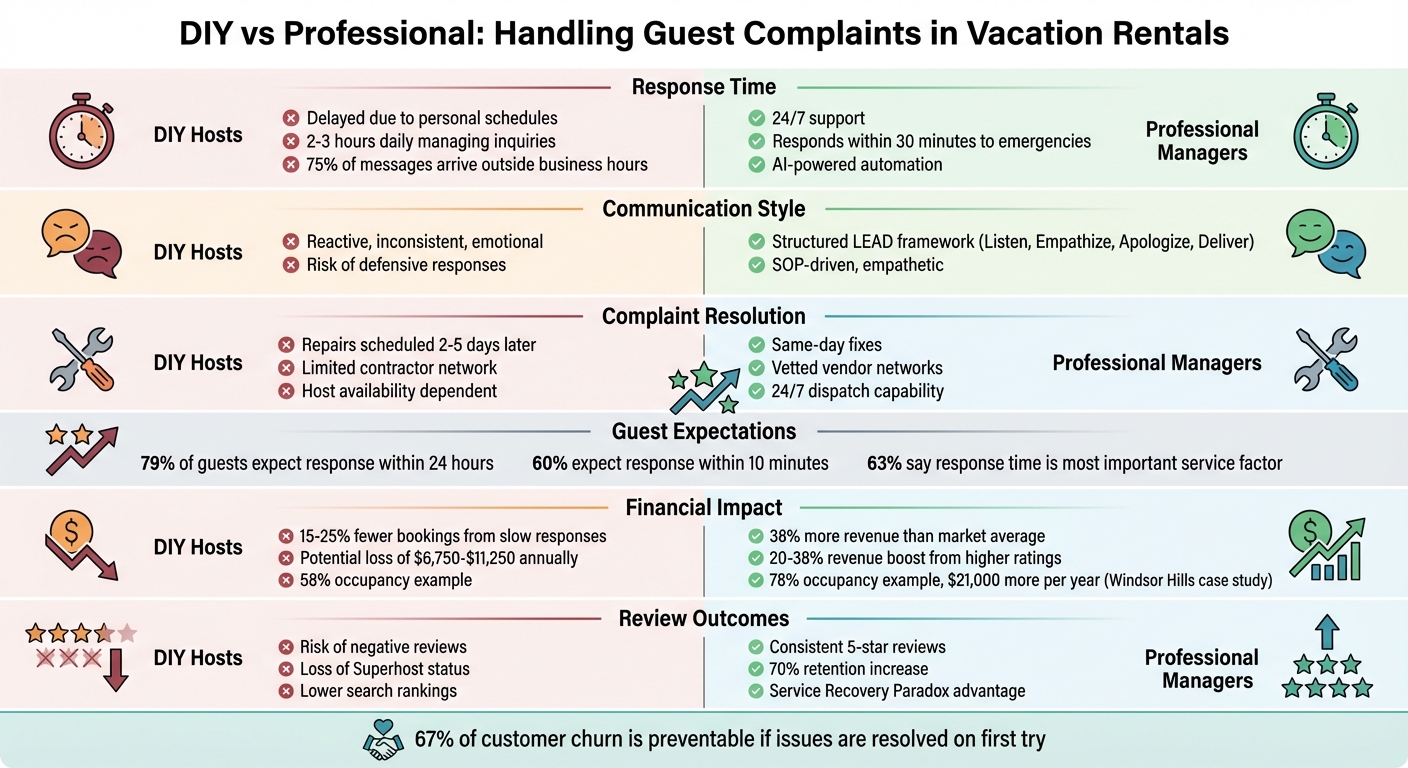
DIY vs Professional Vacation Rental Management: Response Times, Revenue & Guest Satisfaction Comparison
How to Handle Guest Complaints on Airbnb
sbb-itb-103bddb
How DIY Hosts Handle Guest Complaints
DIY hosts juggle rental management alongside their full-time jobs, which means guest issues often compete with work and personal responsibilities. This balancing act makes it tough to provide round-the-clock support. As Elliott Caldwell from Home Team Luxury Rentals points out:
"Individual hosts (or even small teams) can’t realistically be awake and online all the time. These availability issues can result in slower replies late at night or during your off-hours" [8].
While 79% of guests expect a response within 24 hours, experts recommend acknowledging inquiries within just 30 minutes to avoid negative reviews or lost bookings [7] [2]. Delayed responses can drive guests to seek alternatives, leave poor reviews, or escalate minor problems into major disputes. These challenges highlight the difficulties DIY hosts face, especially when it comes to timely communication.
Response Times: Why DIY Hosts Respond Slowly
On average, DIY hosts dedicate 2–3 hours daily to guest inquiries [8]. Without a unified inbox to manage messages across platforms, important complaints can slip through the cracks. The problem becomes even more pronounced during off-hours. For example, if an air conditioner breaks down at 11 PM or the Wi-Fi fails on a weekend morning, DIY hosts are often unavailable. An industry report emphasizes:
"If you don’t respond quickly, guests may book elsewhere, and if problems aren’t resolved efficiently, it can lead to negative reviews and fewer future bookings" [3].
Slow responses are only part of the issue; inconsistent communication further complicates guest relations.
Communication Methods: Inconsistent and Reactive
Since guest reviews directly impact revenue, clear and effective communication is vital. However, many DIY hosts operate reactively, addressing problems only after they escalate [6]. Without clear Standard Operating Procedures (SOPs), responses can feel improvised – sometimes emotional or even defensive. Hospitality author George Spassos advises:
"An online dispute – no matter how ‘right’ we are – will only damage our brand’s image and diminish trust" [9].
Additionally, relying on a single, lengthy email to share check-in details and Wi-Fi codes often leads to guests missing important information. This results in repeated questions and unnecessary frustration.
Professional services, such as Rank One Stays, address these challenges with structured, empathetic, and consistent communication protocols.
| Challenge | DIY Host Impact | Professional Alternative |
|---|---|---|
| Response Time | Delays due to personal schedules and sleep [8] | 24/7 support teams or AI chatbots [2] [3] |
| Message Volume | 2–3 hours of manual work daily [8] | Automated messaging and unified inboxes [8] |
| Communication Tone | Risk of reactive or defensive responses [9] | Empathetic, SOP-driven communication [2] |
How Professional Managers Handle Guest Complaints
Professional managers approach guest complaints with a mix of dedicated resources and technology, turning potential negative experiences into opportunities for better reviews and increased revenue. Unlike DIY hosts, who may struggle to juggle issues alongside other responsibilities, professional teams treat guest concerns as top priorities. They rely on structured systems and specialized teams to ensure quick and effective resolutions, which translate into higher guest satisfaction and improved business performance.
Fast Response Times with 24/7 Support
One of the key advantages professional managers offer is their ability to respond quickly, thanks to 24/7 support teams and automated systems. Whether it’s a late-night air conditioning failure or a weekend Wi-Fi issue, these teams aim to address emergencies within 30 minutes. This kind of responsiveness is crucial, as studies show that 46% of customers expect a reply within four hours, and 63% consider response time the most critical part of their service experience [1].
To streamline this process, professional managers use automated systems that route complaints directly to the right department. For example, housekeeping issues go straight to the cleaning team, while maintenance problems prompt the immediate dispatch of qualified technicians [2]. A great example of this in action comes from Vello, a management company that handled a midnight AC failure in September 2025. Their 24/7 team quickly engaged with the guest, dispatched a local HVAC specialist, and provided updates throughout the process, preserving the property’s impressive 4.9+ rating [6].
Empowering staff is another way professional managers ensure quick resolutions. Many frontline teams are given discretionary budgets – typically up to $50 – to handle minor issues without waiting for managerial approval [1]. For example, if a coffee maker breaks, the team can order a same-day replacement. Similarly, technicians arrive equipped to fix common problems like Wi-Fi routers on the spot. Companies like Rank One Stays maintain networks of vetted vendors in key locations such as Scottsdale, Denver, Pittsburgh, and Lighthouse Point, ensuring repairs happen within hours rather than days.
While speed is essential, the way complaints are communicated can make or break the guest experience.
Consistent and Empathetic Communication
Professional managers prioritize structured, empathetic communication to address guest concerns effectively while protecting the property’s reputation. Instead of reacting emotionally, teams follow clear protocols that validate the guest’s feelings and demonstrate a commitment to resolving the issue.
A widely used approach is the LEAD framework – Listen, Empathize, Apologize, Deliver – which ensures every interaction feels thoughtful and professional [6]. Listening helps de-escalate tension, while empathizing acknowledges the guest’s frustration without making excuses. Apologizing resets the tone, and delivering involves taking action with clear timelines. Ian Ferrell from Global Vacation Rentals explains:
"The goal of your first response isn’t to solve the problem instantly. It’s to make the guest feel heard and understood. The solution is step two; validation is always step one" [1].
Standard Operating Procedures (SOPs) further guarantee consistency across teams. These documented workflows guide staff in addressing common complaints, such as noise issues, broken amenities, or cleanliness concerns, in a professional and uniform manner [2]. This structured approach avoids the defensive or inconsistent responses often seen with DIY hosts.
The results speak for themselves: 70% of dissatisfied customers are willing to return if their problems are resolved, and 85% feel more positive about a brand when their concerns are genuinely acknowledged [1][4]. By combining empathy with effective solutions, professional managers turn challenging situations into opportunities to build loyalty and trust.
DIY vs Professional: Side-by-Side Comparison
Picture this: a guest reports a broken air conditioner at 2:00 AM or complains about a malfunctioning coffee maker on a Saturday morning. These moments highlight the stark contrast between handling issues as a DIY host versus relying on professional management. It’s not just about speed – it’s about having the right tools, systems, and people to turn potential disasters into glowing reviews and repeat bookings.
DIY hosts often manage guest communications solo. With 75% of guest messages arriving outside traditional business hours [11], it’s easy to miss critical opportunities to respond. Many hosts spend 20–40 hours per week juggling tasks like coordinating repairs, answering questions, and managing bookings [10]. This means complaints can go unanswered for hours – or even days – if they arrive at inconvenient times, like during dinner or while the host is asleep.
On the other hand, professional managers have systems in place to handle issues seamlessly. Using Follow-the-Sun staffing and AI-powered automation, they ensure fast, targeted responses [11]. Teams working across time zones, supported by unified inbox systems, can quickly direct guest concerns to the right department – whether it’s dispatching housekeeping or sending a technician for urgent maintenance. Properties with response times under one hour enjoy 25% more conversions on Airbnb, and improving response rates from 89% to 100% can lead to 116% more bookings [11].
The difference doesn’t stop at response times. Resolution outcomes are worlds apart. DIY hosts may struggle with contractor delays, leaving guests frustrated. A 2024 case study tells the story of a London property owner who faced a 10-hour time difference, leading to communication gaps and dissatisfied guests. After switching to professional management, the property achieved a 4.7 Trustpilot rating and won a 2024 Booking.com Traveller Review Award. On average, professionally managed rentals earn 39% more monthly revenue and command 43% higher daily rates than self-managed properties [10].
Common Guest Complaints: Maintenance, Amenities, and Service Issues
Guest complaints generally fall into three categories: maintenance problems (like broken appliances), issues with amenities (such as Wi-Fi outages), and service-related concerns (like unclear check-in instructions or unresponsive hosts).
| Complaint Type | DIY Host Approach | Professional Manager Approach | Typical Outcome |
|---|---|---|---|
| Broken AC or Appliance | Locates a contractor; repair often scheduled 2–5 days later | 24/7 team dispatches a vetted technician within hours while keeping the guest informed | DIY: Negative review due to discomfort. Professional: Guest appreciates the quick fix. |
| Wi-Fi or Amenity Failure | Troubleshoots remotely via messaging, sometimes requiring an in-person visit | Uses an AI chatbot for instant troubleshooting, with tech support dispatched the same day | DIY: Escalating guest frustration. Professional: Issue resolved before it disrupts the stay. |
| Cleanliness Issue | Apologizes and offers a discount; re-clean scheduled as available | Provides an immediate re-clean (typically within 2 hours) and a small compensation (e.g., a $15 gift card) | DIY: Guest feels unheard. Professional: 70% of unhappy guests are willing to return if resolved [1]. |
| Noise Complaint | Contacts the guest directly, with results depending on guest cooperation | Follows a documented protocol, including relocating the guest or involving a local contact to resolve the issue | DIY: Risk of platform penalties. Professional: A structured approach protects the property’s reputation. |
These differences in handling complaints have a direct impact on guest satisfaction, reviews, and even revenue. Professional managers don’t just react – they take proactive steps to prevent issues. For example, digital guidebooks and mid-stay check-ins help address potential problems before they escalate [9][14]. Companies like Rank One Stays leverage strong vendor networks in places like Scottsdale, Denver, Pittsburgh, and Lighthouse Point to ensure same-day repairs, eliminating delays caused by host availability.
The numbers speak volumes: 60% of consumers expect an "immediate" response within 10 minutes, and 90% consider quick responses essential for service inquiries [12][13]. For part-time DIY hosts, meeting these expectations is nearly impossible. As Enso Connect puts it:
"In 2025, response time isn’t just a metric, it’s a core competency that directly impacts revenue, reputation, and guest loyalty" [11].
This comparison highlights how professional management doesn’t just solve problems – it turns them into opportunities for higher revenue and better guest experiences.
How Complaint Handling Affects Reviews and Revenue
Slow responses and inconsistent communication can seriously harm guest satisfaction – and that directly affects your bottom line. Poor complaint handling doesn’t just upset guests; it sets off a chain reaction. Negative reviews drag down your search rankings, reduce bookings, and chip away at revenue. In extreme cases, platforms have removed over 400,000 listings for unresolved complaints[2].
The financial impact is hard to ignore. Properties with sluggish response times experience 15–25% fewer bookings. For a rental earning around $45,000 annually, that’s a loss of $6,750–$11,250[19]. And with 81% of travelers reading reviews before booking, unresolved issues can scare off potential guests[7].
DIY Risks: Negative Reviews and Lost Bookings
For DIY hosts, the risks are even higher. Here’s why: 91% of unhappy customers don’t bother to complain – they just leave and never come back[17]. This “silent churn” can blindside you when the first sign of trouble is a scathing 1-star review. To make matters worse, 79% of guests expect a response within 24 hours[7]. Without round-the-clock support, slower replies hurt satisfaction and tank your search rankings. Booking platforms monitor response times closely, and delays can cost you Superhost status[6]. Even a single unresolved issue, like a cleanliness complaint, can bury your listing’s visibility for months[19]. Lower occupancy, forced price cuts, and a downward financial spiral often follow – making it tough to recover without professional help[6].
Professional Results: Better Reviews and Higher Revenue
This is where professional management shines. The Service Recovery Paradox suggests that resolving a complaint well can actually boost guest loyalty more than if the issue had never happened[16][18]. Imagine a guest reporting a broken appliance late at night. A swift response – like dispatching a local technician immediately – can turn their frustration into a glowing review. This kind of proactive handling doesn’t just salvage the situation; it can improve revenue outcomes significantly.
Professional managers implement strategies like 24/7 support and proactive maintenance, which can increase retention by up to 70% and boost bookings by 20%[4]. Companies such as Rank One Stays use structured frameworks like the LEAD model (Listen, Empathize, Apologize, Deliver) to ensure prompt and effective responses – something DIY hosts often struggle to achieve[6].
Consider this example: a professionally managed Windsor Hills 4-bedroom villa brought in $55,770 annually with 78% occupancy. In contrast, the same property earned just $34,770 at 58% occupancy when self-managed – a difference of $21,000 per year[19]. Property owners partnering with Rank One Stays in locations like Denver, Scottsdale, Pittsburgh, and Lighthouse Point consistently earn 38% more than the market average. Faster complaint resolution, better reviews, and optimized pricing strategies are key drivers of this success.
"A well-handled complaint can be the difference between a negative review and a returning guest." – RentAlready[5]
How you handle complaints often matters more than the issue itself[15]. A genuine apology resolves issues for 45% of customers, compared to just 23% when compensation is offered without empathy[17]. This makes clear, empathetic communication a cornerstone of maintaining 5-star reviews and securing repeat bookings.
Why Professional Management Works Better for Guest Complaints
When it comes to handling guest complaints, the difference between doing it yourself (DIY) and hiring professional management boils down to three key factors: systems, speed, and scale. Imagine it’s 11:00 PM, and a guest has an urgent issue. A DIY host might not even be available, but a professional management team? They’re ready 24/7, dispatching a vetted technician immediately. That kind of quick response is crucial – 63% of guests say response time is the most important part of their service experience[1].
Another advantage of professional management is their ability to handle complaints without emotional bias. DIY hosts often take complaints personally, which can lead to defensive or even confrontational responses. Professionals, however, rely on proven methods like the LEAD framework (Listen, Empathize, Apologize, Deliver) to stay calm and focused on solutions[6]. This approach pays off – 67% of customer churn is preventable if the issue is resolved on the first try[1].
But it’s not just about reacting to problems – it’s about preventing them in the first place. Professional managers conduct routine inspections, follow hotel-grade cleaning checklists, and handle proactive maintenance to address potential issues before guests even arrive. DIY hosts, on the other hand, often wait until a guest reports a problem to take action. This proactive strategy gives professional management a clear operational edge.
The financial benefits are just as compelling. Properties managed by professionals consistently achieve higher ratings, better search rankings, and even Superhost status – all of which attract more bookings. Take Rank One Stays as an example. They manage properties in Scottsdale, Denver, Pittsburgh, and Lighthouse Point, offering round-the-clock support and a vetted vendor network with fees as low as 10%. Their clients see 38% more revenue than the market average, avoid the hassle of late-night emergencies, and maintain consistent 5-star reviews.
FAQs
What should I do first when a guest complains?
When a guest raises a complaint, it’s important to act quickly and acknowledge their concern. Begin by listening attentively, demonstrating genuine empathy, and taking swift action to address the issue. Your immediate response not only sets the stage for resolving the problem but also plays a key role in preserving their satisfaction.
When does hiring a professional manager pay off?
Hiring a professional manager can make a big difference when it comes to addressing guest complaints effectively and on time. These managers are equipped to respond quickly – often within minutes – using tried-and-true methods to protect your property’s reputation, encourage glowing reviews, and keep your occupancy rates high. Beyond that, they take care of guest communication, coordinate maintenance, and ensure everything stays within legal boundaries, taking a huge load off the property owner’s shoulders. On the other hand, DIY hosts often find themselves overwhelmed by the time-consuming nature of these tasks, especially during emergencies, which makes professional management a smart choice for delivering a consistently great guest experience.
How can I prevent complaints before guests arrive?
To avoid guest complaints, focus on maintaining transparency and setting clear expectations. Start with accurate, detailed descriptions of your property and include high-quality photos that showcase its features. This helps guests know exactly what to expect.
Proactive communication is another key step. Reach out to guests before their stay to answer any questions or clarify details. This not only builds trust but also helps address potential concerns early.
Finally, make regular property inspections a priority. Ensure the space is clean, everything works as it should, and safety measures are in place. By staying on top of these tasks, you can create a smoother, more enjoyable experience for your guests while minimizing potential issues.