
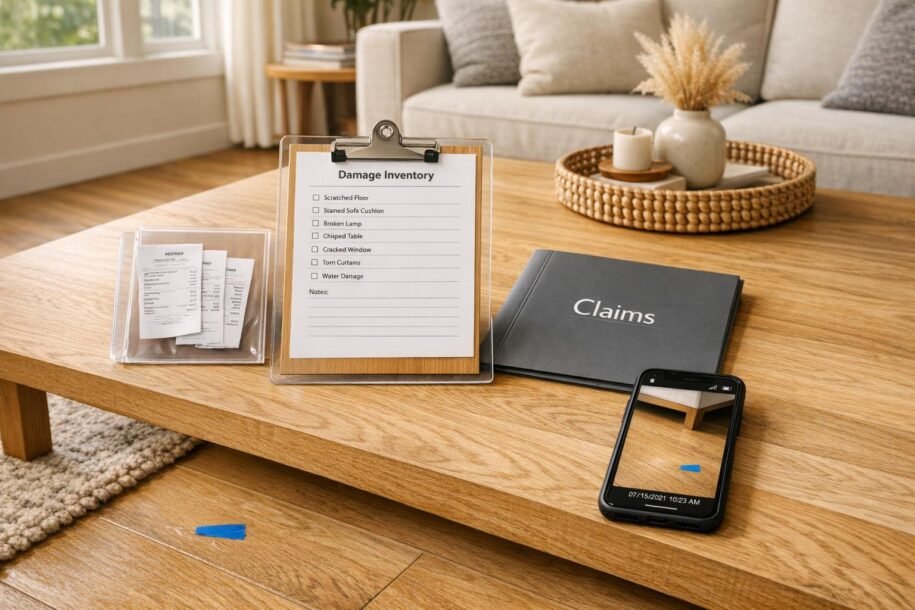
When property damage occurs, documenting it effectively can save you time and help you secure insurance or rental platform payouts faster. Poor documentation is a common reason claims are delayed or denied. Here’s a quick guide to streamline the process:
- Act Fast: Assess the damage safely, report it to your insurer or platform within required deadlines (e.g., Airbnb and Vrbo often require filing within 14 days).
- Take Photos and Videos: Capture wide-angle, medium, and close-up shots with timestamps. Use consistent methods like the Four-Corner Method for thorough coverage.
- Write Detailed Descriptions: Be specific about the damage, including measurements, locations, and affected items.
- Organize Supporting Documents: Gather receipts, repair estimates, and communication logs for a strong claim package.
- File Claims On Time: Submit complete evidence promptly to meet strict deadlines.
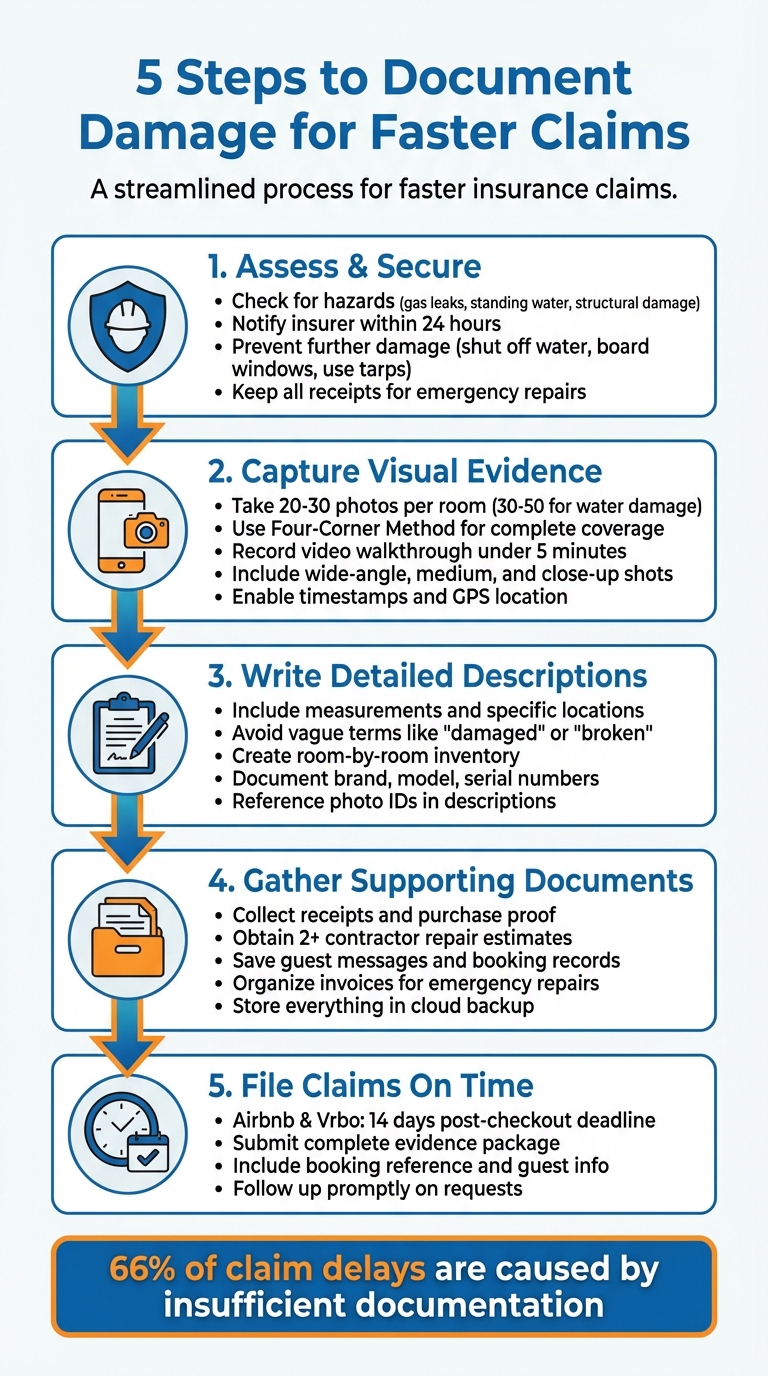
5-Step Property Damage Documentation Process for Insurance Claims
How to Document Your Possessions for Insurance Claims: Expert Tips from Ken Aaron
sbb-itb-103bddb
Step 1: Assess and Secure the Damage Right Away
When damage occurs at your rental property, acting quickly is crucial. Your immediate steps not only protect your property but also ensure a smoother claims process through proactive maintenance and repairs. However, safety comes first. Before documenting anything, determine if it’s safe to enter and take precautions to prevent further harm.
Initial Inspection and Safety Steps
Don’t rush into a damaged property without first checking for hazards. Be on the lookout for sagging ceilings, standing water, exposed electrical wires, or the smell of gas[2][3]. If you notice any of these, stay out and call the appropriate professionals. If it’s safe to enter, wear protective gear like sturdy boots, gloves, and a mask to guard against contaminated water and airborne particles[2][3].
| Safety Hazard | Immediate Action Required |
|---|---|
| Gas Leak Suspected | Do not enter; contact professionals or utility company[2][3] |
| Standing Water | Avoid contact; ensure electrical safety first[2][3] |
| Structural Damage | Contact your insurance company; avoid entering if ceilings are sagging[2] |
| Downed Power Lines | Stay away and call the local utility provider[2] |
Notify your insurance company within 24 hours and get a claim number to begin the process[2][3]. Start a claim journal immediately, noting the exact date and time you discovered the damage[2]. Use your phone’s default camera to take photos – this ensures time-stamped metadata is preserved, which can serve as a "digital fingerprint" for your claim[6]. If the damage involves sewage, structural concerns, or water that has been sitting for more than 48 hours, call a professional right away[2].
Once safety concerns are addressed, focus on preventing further damage.
How to Prevent Further Damage
Your insurance policy requires you to take reasonable steps to minimize additional losses. For example, shut off the main water valve if there’s a leak, or turn off electricity if needed[9][10]. Secure your property by boarding up broken windows or doors to keep out weather and trespassers[9][11]. Use tarps to cover holes in roofs or walls to prevent rain from causing more harm[9][7].
"Policyholders have certain contractual responsibilities in the event a natural disaster damages their insured property. First, prevent any possible injury and second, protect the property from further damage." – AI/MBC[8]
Keep every receipt for emergency repairs, such as tarping or boarding up windows, as these costs are often reimbursable[7]. Document each action you take, whether it’s shutting off utilities or using a wet vacuum to remove standing water[9]. To stay organized, sketch a simple floor plan of the damaged areas and number each room. This system is especially helpful if you manage multiple properties, whether it’s a single unit or a larger portfolio like a Pittsburgh vacation rental management operation. Staying organized simplifies the process when handling damage across several locations.
Step 2: Take Photos and Videos of the Damage
Once the property is secure, the next step is to create a detailed visual record of the damage. This is crucial for substantiating your insurance claim. Insurers often expect around 20–30 photos per room, with 30–50 photos being common for water damage claims. More extensive or complex damage might require over 100 photos to fully document the situation [2][12].
How to Take Effective Photos
Start by capturing wide-angle shots from doorways to provide an overview of the damage. Then, move on to medium-range photos of the affected areas, and finish with close-ups of specific issues. For a natural perspective, take photos at eye level. To ensure you cover the entire room, try the Four-Corner Method: stand in one corner, photograph toward the opposite corner, and repeat this for all four corners [15].
"A close-up of water damage means nothing without a wide shot showing which room it’s in and how far it extends." – CompanyCam Blog [12]
Different types of damage require different approaches. For example, water damage or buckled flooring is best captured by taking overhead shots to show the full pattern. For textured issues like mold or fire damage, use a 45-degree angle with side lighting to highlight the severity. Clean your camera lens before shooting to avoid blurry images, and even in daylight, use your phone’s flash to remove shadows that could obscure important details.
| Photo Type | Technique | When to Use |
|---|---|---|
| Overview | Wide-angle from doorways; Four-Corner Method | To show the full extent of the damage |
| Detail/Close-up | Zoom in with a scale indicator (e.g., ruler) | To document specific damage and severity |
| Textured Damage | 45-degree angle with side lighting | For mold, charring, or surface irregularities |
| Floor/Foundation | Overhead (straight down) | To capture water patterns or buckled flooring |
For close-ups, always include a scale indicator like a ruler, coin, or dollar bill to provide context for the size of the damage. Moving systematically in a clockwise direction around each room ensures no area is overlooked.
Recording Video Walkthroughs
Videos provide a thorough overview of the damage, helping adjusters better understand its scope and source. In fact, 66% of restorers report that missing field documentation is a leading cause of delays or disputes in insurance estimates [13]. Begin your video at the property entrance, stating your name, the date, and the time to authenticate the recording [2]. Use landscape mode, walk slowly, and narrate as you go. Open cabinets, closets, and drawers to reveal hidden damage. If there’s active damage, like running water or shifting debris, make sure to capture it to emphasize the urgency. Keep video segments under five minutes for easier sharing.
"At the click of a button, you’ve got a document on a quarter-million dry out that just screams wow." – Brent Werner, President, Werner Restoration Services Inc. [13]
Before recording, enable high-resolution settings, timestamps, and GPS location on your device. These details add credibility by verifying when and where the footage was taken. Once recorded, back up your files immediately to secure cloud storage to prevent accidental loss [14].
Adding Context to Your Visual Evidence
Adding context transforms your visuals from simple snapshots into compelling evidence. Always keep the original files, as they contain metadata – a digital record of when and where the photos or videos were taken [4][15][16].
"Photography forms the backbone of any insurance claim. However, not all photos are created equal. The difference between amateur snapshots and professional documentation can mean thousands of dollars in your settlement." – Global Patriot Adjusters [15]
If you have pre-damage photos of the property, include them in your claim to show the extent of the loss. If not, photograph similar undamaged areas to create a baseline for comparison. For example, if one bedroom is water-damaged, photos of an identical, undamaged bedroom can highlight the change.
In tight spaces like closets, take one photo with the doors closed and another with them open to document internal conditions. If an area is unsafe to enter, photograph it from a safe distance, including caution tape or barriers to indicate the danger. For property owners using services like Scottsdale vacation rental management, professional documentation can ensure no detail is missed during the claims process.
With your visual evidence complete, the next step is to pair it with detailed written descriptions to create a strong claim package.
Step 3: Write Detailed Damage Descriptions
Pair your photos and videos with clear, detailed written descriptions to strengthen your insurance claim. While visual evidence captures the damage, written details add context, quantify losses, and establish timelines. This combination proves the damage is new and helps avoid relying on memory during lengthy claims processes [6][16].
"Knowing how to document property damage for insurance is the difference between getting paid quickly and fighting for months." – American Response Team [3]
Specificity is key. Vague descriptions like "wall damage" can lead to claim denials, while precise accounts such as "3-inch diameter hole in east bedroom wall, 4 feet from floor, drywall punctured through" give adjusters the clarity they need [17]. Keep in mind that most policies require damage notification within 30 to 60 days, with some demanding formal proof of loss within 60 days [2][3].
What to Include in a Damage Description
When describing damage, address these key questions: what happened, where it occurred, how severe it is, what caused it, and which items are affected. For structural damage, specify the room, wall, and height from the floor. Use tools like rulers or measuring tapes to provide exact measurements. Reference corresponding photo IDs in your description (e.g., "see photo MI-BATH-04") to create a well-organized evidence package [17].
Avoid generic terms like "damaged" or "broken." Instead, use precise phrases such as "fabric torn", "cushions waterlogged", or "foundation cracks." This level of detail ensures adjusters understand the extent of the damage [5].
"Bad documentation is the #1 reason landlords lose security deposit disputes. Tenants claim the damage was pre-existing. You can’t prove otherwise. The judge sides with the tenant." – Zac Maurais, Utility Profit [17]
If possible, reference pre-damage conditions using older photos or inspection reports to confirm the damage is new and not pre-existing [4][5].
Creating an Inventory of Damaged Items
A room-by-room inventory helps ensure no damaged items are overlooked. Focus on one room at a time, completing the list before moving on [3][1]. For each item, document key details such as the brand name, model number, and serial number – especially for electronics and appliances. These details are essential for proving ownership and securing replacement coverage [2][3].
| Inventory Detail | What to Include |
|---|---|
| Item | Brand, model, color, size, and unique features [5][4] |
| Serial/Model Number | Required for electronics and appliances; photograph the label [2][3] |
| Purchase Information | Approximate date and store of purchase [2][5] |
| Financial Data | Original price and estimated replacement cost [2][5] |
| Damage Specifics | Detailed description of damage (e.g., "screen cracked", "motor burned out") [5] |
| Location | Room and specific area within the room [17][16] |
To estimate replacement costs, check online retailers for similar items [3]. For high-value items, include the approximate age and any receipts or warranty documents you might have. If receipts are missing, note whether you still have the original packaging, an owner’s manual, or if the item appears in older photos [5].
For smaller items like kitchen utensils or linens, grouping them together saves time. For example, instead of listing every fork and spoon, you can write "approximately 30 pieces of stainless steel cutlery" [2]. However, high-value items should always be listed individually with full details.
If you’re working with professional services like Denver vacation rental management, pre-existing inventory records can make this process quicker and more accurate. Once you’ve completed your detailed descriptions and inventory, you’re ready to gather supporting documents to back up your claim.
Step 4: Collect Supporting Documents and Records
After documenting the damage visually and in writing, the next step is gathering financial and communication records to back up your claim. These supporting documents are essential for proving the extent of your losses and avoiding potential delays, denials, or underpayments.
"Most claim delays, denials, and underpayments can be traced back to one issue: insufficient documentation." – Jorge Cardenas, Restore-It
Start by searching your email for "order confirmation" or "receipt" to retrieve purchase dates and costs for damaged items. If physical receipts are lost, credit card statements and bank records can help confirm ownership and value. Collect written estimates from licensed contractors and save all invoices for emergency repairs like tarping, water removal, or debris cleanup – expenses that are often reimbursable. Organizing these documents alongside your photos and written descriptions will strengthen your claim.
Receipts, Repair Quotes, and Invoices
While photos and written records show the damage, financial documents establish the cost of the loss. Receipts demonstrate ownership and original value, while repair quotes justify the settlement amount. For high-value items like electronics or appliances, take photos of serial numbers and model tags to ensure replacements are calculated accurately. If you’ve misplaced receipts, check your email or contact the retailer for duplicates.
Secure at least two written estimates from licensed contractors to confirm you’re pursuing fair market rates. Store these records in a cloud folder for easy access and sharing.
| Document Category | Specific Examples to Collect | Purpose for the Claim |
|---|---|---|
| Purchase Proof | Receipts, warranties, credit card statements, appraisals | Confirms ownership and value |
| Repair Evidence | Contractor quotes, repair invoices, supply bills | Supports the requested settlement amount |
| Communication Logs | Guest messages, emails, call logs, platform alerts | Establishes a timeline and liability |
| Property Records | Move-in checklists, maintenance logs, tax schedules | Distinguishes pre-existing conditions from new damage |
Guest Messages and Booking Information
In cases involving vacation rental damage, guest communication and booking records are crucial. Platforms like Airbnb require hosts to attempt resolution with guests through their messaging system before filing a formal claim. These conversations often include admissions about how the damage occurred and show your effort to resolve the issue professionally.
"The way you respond can make a huge difference in whether you get reimbursed, avoid bad reviews, and protect your future bookings." – Tyler Collins, JaxBNB
Always keep communication on the platform to ensure it’s verifiable by support teams. Screenshot guest messages and booking confirmations. If you discuss the issue by phone, follow up with an email summarizing the conversation to create a written record. Property managers, like those at Scottsdale vacation rental management, often maintain detailed logs of guest interactions, which can streamline claims and minimize disputes. Remember, Airbnb damage claims must be filed within 14 days of checkout or before the next guest checks in.
Step 5: File Claims on Time and Meet Deadlines
Once you’ve gathered all your evidence, the next step is to file your claim within the required timeframe. Missing a deadline means losing your chance to recover damages. Both Airbnb and Vrbo have strict timelines, and failing to act in time renders even the most thorough documentation useless.
Platform Deadlines You Should Know
For Airbnb, claims must be initiated within 14 days of the guest’s checkout or before the next guest checks in, whichever happens first [18][19]. This means if a new guest arrives within the 14-day period, your window to file is shortened. Airbnb’s AirCover offers up to $3 million in host damage protection [22], but only if you meet the deadline. Once escalated, claims are generally resolved within 1–2 weeks [22].
Vrbo also has a 14-day post-checkout window for filing damage claims [20][21]. The platform processes damage deposit claims quickly, with payouts typically completed within 3–7 business days [20]. Vrbo guarantees coverage up to the full damage deposit amount, even if there are issues with the guest’s payment method [20]. Both platforms require hosts to first try resolving the issue directly with the guest through their secure messaging systems before escalating the matter to support [19][20].
| Platform | Filing Deadline | Max Coverage | Typical Resolution Time |
|---|---|---|---|
| Airbnb (AirCover) | 14 days post-checkout OR before next check-in [18][19] | Up to $3 million [22] | 1–2 weeks [22] |
| Vrbo | 14 days post-checkout [20][21] | Up to deposit amount [20] | 3–7 business days [20] |
Before submitting your claim, make sure all required evidence is organized and ready to go.
Checklist for Filing a Complete Claim
Claims are often denied due to incomplete documentation. To avoid this, ensure you have the following:
- Photos showing both the overall scene and close-up details of the damage.
- A narrated video walkthrough recorded immediately after the guest’s departure.
- A detailed inventory list of damaged items, including descriptions and estimated costs for replacement.
- Two written repair estimates from licensed contractors [23].
- Screenshots of guest communications from the platform’s messaging system, especially any messages where the guest admits responsibility.
For high-value items, include photos of serial numbers or model tags to verify ownership and replacement costs. If the damage involves theft or vandalism, attach a police report [23]. Professional property managers, like those from Denver vacation rental management, often keep pre-organized evidence files for each guest stay, making it easier to submit complete claims promptly.
"The more detail you provide, the faster we can process your claim." – Truvi [23]
Be sure to include the booking reference number, guest count, and a link to your property listing in your claim [23]. Filing a thorough and timely claim not only increases your chances of approval but also allows professional services – like Rank One Stays – to manage the process efficiently on your behalf.
How Professional Management Handles Claims for You
Dealing with damage claims on your own can quickly drain your time and energy. While proper documentation is essential, it’s just one part of the process that professional managers handle with ease. These experts oversee every step, from assessing damages to filing claims within tight platform deadlines. Their teams are trained to gather evidence, manage documentation, and navigate the claims process efficiently [51, 44].
How Rank One Stays Manages Damage Claims

Rank One Stays has a system in place to address damage claims effectively. They work closely with cleaning teams to collect "before and after" photos and videos during each turnover. This ensures they have clear, high-quality evidence ready to go [51, 43]. Their documentation process is standardized with date and time stamps, as well as scale references, and all communication is conducted through official Airbnb and Vrbo channels [24].
When repairs are needed, Rank One Stays takes the lead by coordinating with trusted local contractors. This eliminates the hassle of negotiating with guests or obtaining repair quotes on your own [42, 51]. Although damage claims are rare – occurring in just 0.43% of Vrbo bookings and 0.71% of Airbnb stays – professional managers achieve approval rates of 56.75% on Airbnb and 68.29% on Vrbo [24]. Beyond just handling claims, their involvement also boosts your property’s overall performance.
Increase Revenue with Professional Management
Rank One Stays doesn’t just simplify claims – they help you earn more. By partnering with Rank One Stays, property owners see an average revenue increase of 38%. This is achieved through optimized listings, dynamic pricing strategies, and round-the-clock guest support. Whether your property is in Scottsdale, Denver, Pittsburgh, or Lighthouse Point, professional management not only simplifies damage claims but also helps you maximize your income.
Transparent Services with Flexible Contracts
Rank One Stays offers a straightforward 10% month-to-month management fee. This flexible approach means you get the benefits of professional management without being tied to a long-term contract. Plus, you’ll have access to a real-time owner portal for full transparency. Their services cover everything from housekeeping and maintenance to claims handling, giving you peace of mind while they take care of the details.
Conclusion
To effectively document damage, focus on these key steps: assess the scene, capture detailed visual evidence, write clear descriptions, gather supporting documents, and submit claims promptly. Following this process strengthens your evidence and simplifies the claim process, helping to avoid disputes and speed up resolution.
Attention to detail is crucial. Solid documentation can significantly boost your settlement amount. By organizing your evidence efficiently, you reduce delays and increase the likelihood of receiving the reimbursement you deserve.
"Most claim delays, denials, and underpayments can be traced back to one issue: insufficient documentation." – Jorge Cardenas, Restore-It[6]
Companies like Rank One Stays make the process easier by handling both documentation and repairs. Their approach not only ensures full compensation but also helps property owners earn 38% more with optimized listings and dynamic pricing.
Whether you manage claims on your own or work with professionals, acting quickly and thoroughly is essential. Detailed, timely evidence can make the difference between receiving full compensation and getting stuck in a drawn-out dispute.
FAQs
What should I do before taking photos of the damage?
Before snapping any photos, make sure the area is safe to access. Gather the essentials: a smartphone or camera, measuring tape, flashlight, notebook, and pen. Good lighting is crucial for clear images, so adjust as needed. Don’t forget to jot down the date and time for each photo to keep your records organized. Take steady, deliberate shots to ensure sharp, detailed documentation – rushing can lead to blurry or incomplete images.
How can I prove the damage is new and not pre-existing?
To show that the damage is recent, take clear photos and videos of the affected areas as soon as possible. Pair these visuals with detailed written descriptions, noting when you first noticed the damage and how it differs from any previous conditions, if you’re aware of them. Acting promptly and maintaining well-organized, timestamped records can strengthen your insurance claim by clearly demonstrating the damage is new.
What’s the best way to organize my files so my claim gets approved faster?
To get your claim approved faster, make sure to document the damage thoroughly. Start by taking clear, well-lit photos and videos from different angles, and ensure they are date-stamped. Along with visual evidence, maintain a written record that includes detailed descriptions, dates, and any repair actions taken.
Organize everything digitally in a dedicated folder – using cloud storage can be a smart choice. Be sure to include receipts, repair logs, and any correspondence related to the claim. Having all this information neatly organized can make it much easier for adjusters to process your claim quickly.