

I’d start with 3–6 months of fixed costs, then add cash for repairs, refunds, and payout delays. If your unavoidable bills total $2,500 a month, that means a $7,500–$15,000 starting reserve – before those extra allowances.
Here’s how I’d set the final target:
- Check the bills: Use 12 months of records to find costs you must pay even without guests, including any minimum management fees.
- Test weak months: Model consecutive booking shortfalls, plus a repair and delayed reimbursement. Count each expense only once.
- Check local risks: Test winter gaps and frozen pipes in Pittsburgh; summer gaps, cooling bills, and AC failures in Scottsdale.
- Keep funds separate: Use different accounts or categories for routine spending, emergencies, and planned replacements.
- Refill and review: Replace withdrawals before taking discretionary owner draws, check the balance quarterly, and recalculate annually.
My rule: <u>size the fund around bills you may need to pay – not income you hope to earn.</u> New listings, older properties, and steep seasonal swings may call for more than six months of fixed costs.
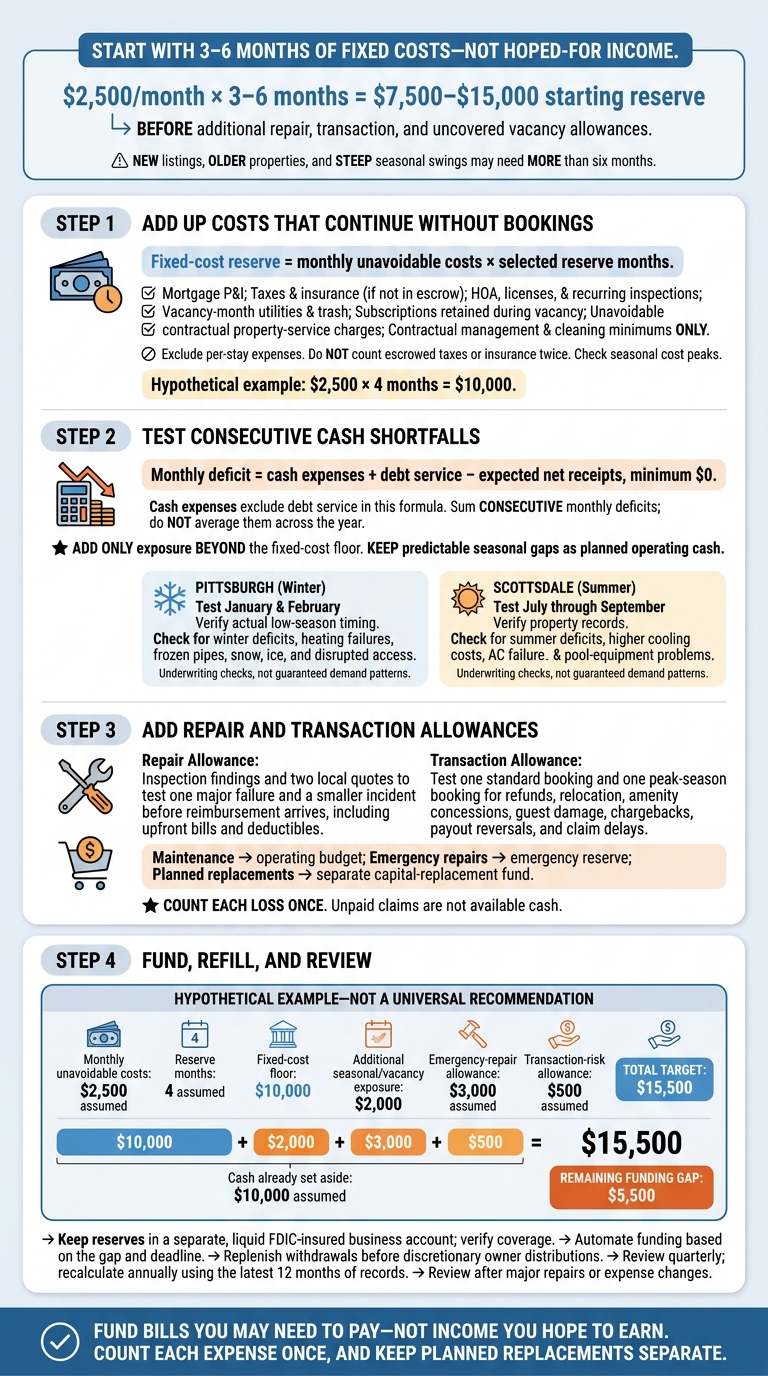
Airbnb Emergency Fund: Calculate Your Reserve in 4 Steps
The Real Costs of Running an Airbnb (Full Expense Breakdown)
sbb-itb-103bddb
Step 1: Add Up Costs That Continue Without Bookings
Gather the past 12 months of statements and reconcile them with your bank transactions. If renewal quotes are higher than current costs, use those quotes. This gives you a reserve floor before you account for vacancy and repair risk.
Separate Fixed Costs From Booking-Based Expenses
Identify recurring costs in those statements, then remove one-time repairs and reimbursed items. Check your mortgage escrow statement before adding property taxes and insurance separately – you don’t want to count either twice.
| Expense category | Monthly amount to record | Include in fixed-cost reserve? |
|---|---|---|
| Mortgage or debt service | Full monthly principal and interest payment | Yes |
| Property taxes and insurance | Annual bill ÷ 12, unless included in escrow | Yes |
| HOA, licenses, and recurring inspections | Annual recurring total ÷ 12 | Yes |
| Utilities and trash | Average vacancy-month usage from 12 months of bills | Yes; check seasonal peaks |
| Internet, software, and security | Monthly subscription or annual charge ÷ 12 | If kept during vacancy |
| Landscaping, pest, pool, and snow services | Annual unavoidable contractual cost ÷ 12 | Unavoidable contractual charges only |
| Management fees | Contractual monthly minimum, if any | Minimum only |
| Cleaning, laundry, and supplies | Contractual monthly minimum, if any | Minimum only; exclude per-stay costs |
For a new rental, use lender documents, insurance quotes, tax records, and vendor bids – not projected peak-season revenue. In Pittsburgh, check heating and snow-service costs. In Scottsdale, check summer electricity, pool care, and water costs. Mark uncertain amounts as assumptions and replace them with actual bills as they arrive.
Multiply Monthly Fixed Costs by Reserve Months
Fixed-cost reserve = monthly unavoidable costs × selected reserve months. Before choosing the monthly amount, compare your average with the highest-cost stretch of consecutive months. A low utility bill from a mild month won’t give you a reliable vacancy baseline.
Hypothetical calculation: $2,500 in monthly unavoidable costs × 4 months = $10,000. This is the fixed-cost floor before repair and transaction allowances – not the complete emergency-fund target.
Then add seasonal vacancy and repair allowances. Next, test how seasonal dips and back-to-back weak months increase that floor.
Step 2: Estimate Seasonal and Vacancy Shortfalls
Once you’ve set the fixed-cost floor, model the months when bookings won’t cover expenses. Use at least 12 consecutive months of property records. If you have several years of data, use them to check when the low season occurs.
Track available nights, booked nights, occupancy, ADR, refunds, cancellations, owner-blocked dates, platform deductions, cleaning costs, utilities, management fees, maintenance, and debt service. Calculate occupancy as booked nights ÷ available nights. Keep owner-blocked dates separate from actual vacancies.[6]
Calculate Cash Deficits Across Consecutive Months
Monthly deficit = cash expenses + debt service − expected net receipts, with a minimum of $0. Cash expenses exclude debt service because you add it separately.
Estimate receipts using booked nights at a reduced ADR, minus refunds, cancellations, and platform deductions. Handle lodging taxes consistently on both sides of the model. And don’t subtract cleaning costs twice if platform payouts already account for them.
Build three scenarios: a base case using recent performance, the weakest seasonal stretch in your records, and an extended vacancy case with several consecutive months of low or zero bookings. Add each stretch’s monthly deficits instead of averaging them across the year.
Set aside cash for predictable seasonal gaps as planned operating cash. Treat unexpected vacancy as emergency exposure. Add only the shortfall beyond the Step 1 floor – you don’t need to fund the same dollars twice.
Then stress-test those numbers against local demand patterns.
Use Local Assumptions for Pittsburgh and Scottsdale
Use this table to check local underwriting assumptions, but base the model on the property’s own records.
| Underwriting factor | Pittsburgh | Scottsdale |
|---|---|---|
| Demand pattern | Check neighborhood demand from hospitals, universities, sports, and events. | Check cool-season demand from snowbirds, golf, spring training, and major events. |
| Low-season exposure | Test January and February, but check property records for the actual low point. Local data differ on its exact timing.[2][5] | Test the hot-season stretch, especially July through September, using lower occupancy and ADR.[4] |
| Weather risks | Heating failures, frozen pipes, snow, ice, and disrupted access. | Air-conditioning failure, extreme heat, and pool-equipment problems. |
| Records to verify | Event dates, winter cancellations, heating bills, snow-removal invoices, and owner-blocked dates. | Event premiums, summer cancellations, cooling bills, HVAC service records, and pool costs. |
| Reserve test | Consecutive winter deficits plus a weather-related disruption. | Consecutive summer deficits plus an HVAC or pool outage. Keep repair allowances separate from operating deficits. |
Check upcoming event dates against current local information before assuming last year’s event-driven booking spikes will repeat. Base the vacancy allowance on consecutive cash deficits. Next, add repair allowances and payout-delivery risk.
Step 3: Add Repair and Transaction Allowances
Separate Emergency Repairs From Maintenance and Replacements
Vacancy isn’t the only source of a cash gap. Repairs and payout delays can also leave you short. Once you’ve covered vacancy shortfalls, add allowances for both. Sort expenses by urgency and predictability so planned purchases don’t eat into emergency cash.
| Category | Examples | Funding source | Timing | Review frequency |
|---|---|---|---|---|
| Maintenance | HVAC servicing, pest control, plumbing inspections, filter changes | Operating budget | Scheduled | Monthly or quarterly |
| Emergency repairs | Burst pipe, failed water heater, HVAC breakdown, electrical outage, broken lock, refrigerator failure | Emergency reserve | Immediate | After every incident and annually |
| Replacements | Roof, flooring, furniture, mattresses, appliances, exterior paint | Separate capital-replacement fund | Planned | Annually |
Base your repair allowance on inspection findings, equipment age, turnover, amenities, and two local contractor quotes. Ask contractors to price after-hours labor, parts, mitigation, and cleanup. Use current local quotes for each property in Pittsburgh and Scottsdale.
Test whether your reserve could cover one major failure and a smaller incident before reimbursement arrives. Set aside cash for upfront bills and deductibles. Count reimbursement only after you receive it.
Keep planned replacements on a separate capital schedule that lists the replacement year, estimated cost, and monthly contribution. If an appliance or system fails sooner than expected, use the emergency reserve first, then update the capital schedule.
Budget for Refunds, Chargebacks, and Claim Delays
Build a separate transaction allowance from actual booking values and incident history. Include refunds for unusable nights, relocation, amenity concessions, guest damage, chargebacks, and payout reversals.
Test one standard booking and one peak-season booking against your payout and claim timelines. Record each cost once: put physical repairs in the repair allowance and related refunds here. Include revenue lost while the unit is out of service, but don’t count vacancy shortfalls you’ve already covered.
Don’t assume you’ll recover every expense. Airbnb says Host Damage Protection can cover up to $3 million for eligible guest damage, subject to conditions and exclusions. That coverage is not immediate cash.[8][9]
Keep dated photographs, inventories, invoices, maintenance records, and guest messages together in one incident file. Airbnb’s published materials call for supporting documentation within 14 days of checkout, damage, or loss.[7][8]
Check insurance deductibles, short-term-rental coverage, exclusions, and claim requirements. Keep enough cash on hand to cover costs if reimbursement is delayed or denied. In the next step, add these allowances to your reserve target and funding plan.
Step 4: Fund and Maintain Your Reserve
Complete the Reserve Worksheet and Stress Test
Combine Steps 1–3 into one reserve target. Start with the $10,000 fixed-cost floor, then add only exposure that isn’t already covered.
Hypothetical reserve worksheet
Worksheet field Calculation or assumed amount Monthly unavoidable costs $2,500 assumed Reserve months 4 assumed Fixed-cost reserve $2,500 × 4 = $10,000 Additional seasonal/vacancy exposure $2,000 Emergency-repair allowance $3,000 assumed Transaction-risk allowance $500 assumed Total target $15,500 Cash already set aside $10,000 assumed Remaining gap $5,500
Count each loss once. If the fixed-cost cushion already covers a vacancy shortfall, don’t add it again. Keep planned capital replacements outside this worksheet.
Once you’ve set the target, fund it in a separate account and replace any money you withdraw.
Set Funding, Replenishment, and Review Rules
Keep the reserve in a separate, liquid FDIC-insured business account. Check coverage with the FDIC estimator.[11] Credit, future bookings, and unpaid claims aren’t cash.
Set automatic transfers based on your funding gap and deadline. Use cash left after operating costs. Limit withdrawals to disruptions covered by the worksheet, and record each withdrawal’s date, reason, invoice, amount, and remaining balance.
Replenish withdrawals before increasing discretionary owner distributions. Review the reserve before and after high season, after major repairs or expense changes, when occupancy drops, and at least once a year.
Account for Management Fees and Support
If you use professional management, track its fees separately from your reserve calculation. Rank One Stays can handle pricing, guest support, housekeeping, and damage claims.[10][12]
Ask for monthly reports that break out revenue, fees, repairs, distributions, and reserve transfers. Include revenue-based fees in cash-flow forecasts and unavoidable minimum fees in fixed costs.
Conclusion: Fund Your Target and Review It Regularly
Set your reserve at 3–6 months of fixed costs. Add funds for uncovered seasonal vacancy and emergency repairs, plus a separate allowance for refunds, chargebacks, and claim delays.[3]
Use the same formula for each location, but test it against local risks. In Pittsburgh, account for winter vacancy and freeze risk. In Scottsdale, account for summer vacancy, higher cooling costs, and HVAC failure.
If you use Rank One Stays, include its fees in your calculations and keep a separate reserve for remaining property costs.
Your reserve must cover the bills you need to pay in the stress scenario. Fund any gap between your target and available reserve cash. Review the reserve quarterly, and recalculate it annually using the latest 12 months of actual expenses and net cash flow.
FAQs
When should I save more than six months of costs?
If your market is highly seasonal – or you self-manage without professional dynamic pricing and occupancy optimization tools – consider saving more than six months of costs [1]. DIY management often leaves 30% to 50% of potential revenue untapped, making cash flow harder to predict [1].
Rank One Stays helps steady income by maximizing revenue and occupancy, which may reduce the need for an oversized emergency fund [1].
Can I share one reserve across multiple rentals?
You can, but it’s generally discouraged. Each rental has its own fixed costs, seasonal vacancy risks, and maintenance needs, especially in different markets like Pittsburgh and Scottsdale. Pooling reserves makes it harder to track each property’s profitability and whether it has enough cash for emergencies.
Rank One Stays makes this easier by handling damage claims and day-to-day expenses, keeping each property cash-flow positive without leaving you to manage complicated shared reserve accounts.
How do I estimate vacancy risk for a new listing?
With few reviews and limited visibility in search results, focus on occupancy over revenue for the first 30 days. Set your price 10%–20% below the market average to help secure 5–10 reviews. If you get no inquiries within two weeks, your price is likely too high.
Rank One Stays helps reduce vacancy risk through professional listing optimization and daily dynamic pricing, keeping properties competitive and visible in Pittsburgh and Scottsdale.