

Refinancing cannot make a prohibited Airbnb rental legal. I’d first confirm what Pittsburgh or Scottsdale allows at your address, then choose whether to move in, rent for longer stays, or sell.
Here’s how I’d narrow the options:
- FHA: Usually tied to a primary residence; a streamline refinance requires an existing FHA loan.
- VA: Available to eligible borrowers, with occupancy rules that differ between IRRRL and cash-out loans.
- USDA: Generally limited to existing USDA loans and primary residences.
- Conventional: May fit a legal rental property if you won’t live there.
Before applying, I’d verify the legal unit count, document rental income, and map out booking changes. In Scottsdale, stays of fewer than 30 days require a city vacation-rental license; longer stays can still face other restrictions.
My bottom line: <u>choose the legal use first, then compare financing</u>. Count closing costs, insurance, lost bookings, and rental expenses – not just the new monthly payment. Keeping the current loan or selling may cost less.
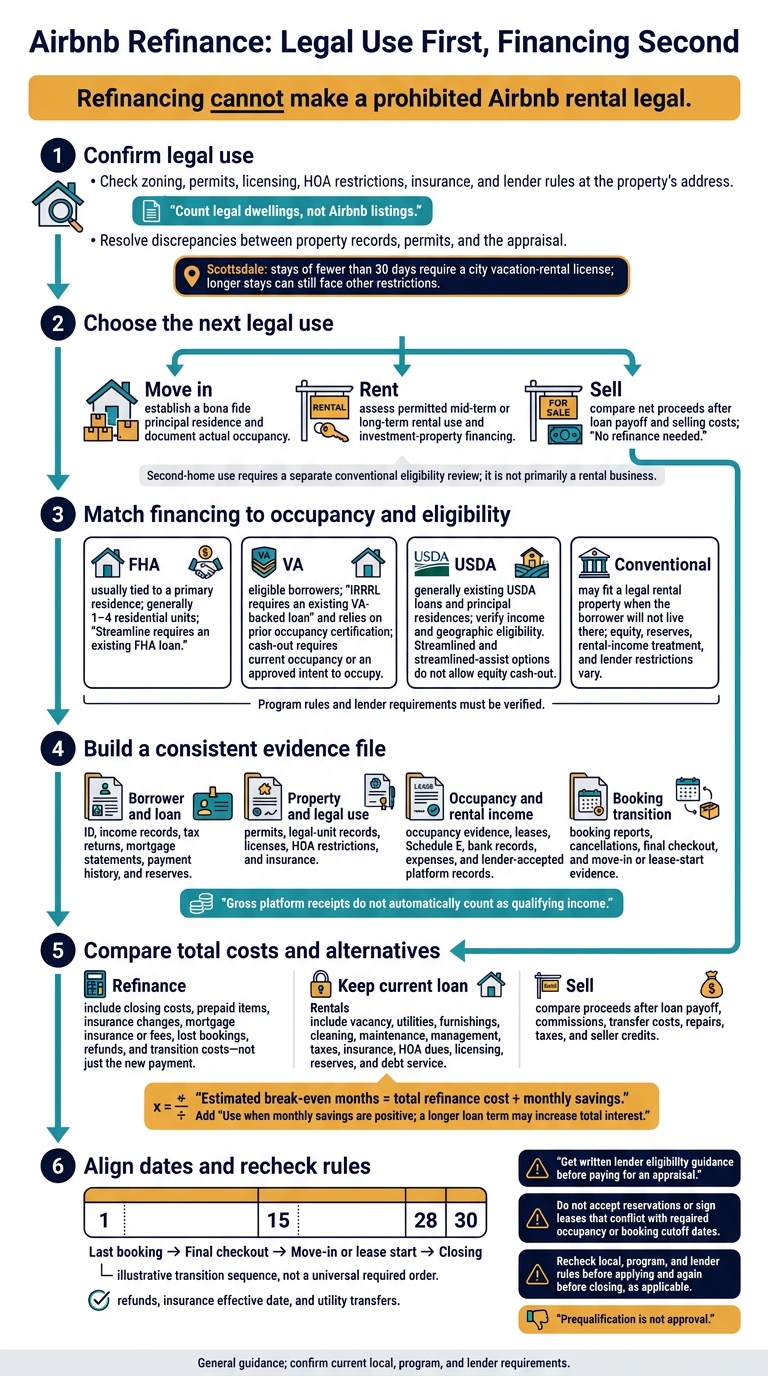
Airbnb Refinance: Legal Use First, Financing Second
Refinancing Your FHA Loan Will Save You $$
sbb-itb-103bddb
Compare Government-Backed Refinance Programs
Once the property’s current use is legal, match the refinance to your next step: move in, switch to a mid-term or long-term rental, or sell. The property’s next legal use matters more than its Airbnb history.
Use the table to compare eligibility, occupancy, and paperwork. Before applying, confirm the program’s rules for occupancy, unit count, and rental income.
| Program | Borrower or existing-loan eligibility | Property use and units | Key restrictions | Documents to expect |
|---|---|---|---|---|
| FHA | Qualified borrowers; streamline requires an existing FHA-insured loan | Generally 1–4 residential units[4] | Equity, seasoning, and transient-use rules apply | Mortgage history, occupancy evidence, and financial and property records |
| VA | Eligible borrower; IRRRL requires an existing VA-backed loan | Qualifying residential property, generally up to 4 units[9] | Benefit, seasoning, and payment-history requirements vary | Certificate of Eligibility and existing loan records |
| USDA | Existing USDA-financed or USDA-guaranteed loan; income limits apply[2][3] | Geographic eligibility must be verified[2][3] | Separate refinance paths and payment-history requirements | USDA loan, income, and property records |
| Conventional | Borrowers meeting lender and applicable Fannie Mae or Freddie Mac requirements | Eligible 1–4-unit investment properties | Equity, reserves, seasoning, and rental-use restrictions vary | Income, rental, insurance, and appraisal records |
FHA Rate-and-Term, Cash-Out, and Streamline Refinancing
FHA refinance options usually require you to live in the property and certify it as your principal residence. Cash-out refinancing adds a separate review of ownership, occupancy, payment history, equity, and the appraisal. Changing occupancy does not override zoning, licensing, or HOA limits.
A streamline refinance requires an existing FHA loan and a qualifying borrower benefit. It cannot turn a conventional or investment-property loan into FHA financing.
Ask the lender how hotel or transient-use rules apply, especially if you market units separately or will not live on-site. Three- and four-unit properties also require a self-sufficiency analysis, Form HUD-92561, and reserves covering three months of PITI – principal, interest, taxes, and insurance.[4]
VA and USDA Refinance Options
VA IRRRLs rely on prior occupancy certification. VA cash-out refinancing requires current occupancy or an approved intent to occupy.[5][6][8] USDA refinance options are generally limited to existing USDA loans and principal residences.[2][3]
VA cash-out also requires an appraisal, income verification, and credit qualification.[8] For an IRRRL, allowable costs generally must be recouped within 36 months, excluding certain items.[7]
USDA refinancing is not a general route for ordinary rural Airbnb investments. Before applying, verify the existing loan, household income, and geographic eligibility. Streamlined and streamlined-assist options do not allow equity cash-out. Streamlined-assist guidance generally calls for a fixed 30-year term and a new rate no higher than the existing rate.[3] Section 502 Direct loans follow separate rules.
Conventional Refinancing for Rental Properties
If you will not live in the property, conventional investment-property refinancing may fit better. Fannie Mae and Freddie Mac programs can work for a legal mid-term or long-term rental. But rates, equity requirements, and reserves may be higher than for a primary residence.
Ask how the lender calculates rental income. Gross platform receipts do not automatically count as qualifying income. Expect requests for leases, Schedule E, operating records, and possibly a market-rent appraisal.
Before applying, confirm current agency rules, lender overlays, and local short-term-rental laws. If the loan depends on rental income, document how the lender will count it.
Verify Occupancy, Unit Count, and Rental Income
Once you choose a refinance path, document how you use the property. The loan must match the home’s current and planned use, not just what’s on the application.
Identify the Property’s Intended Use
| Classification | Intended use and actual occupancy | Possible financing | Supporting records |
|---|---|---|---|
| Primary residence | You live there as your main home; in an eligible 2–4-unit property, you may occupy one unit | Owner-occupied refinance options | Occupancy affidavit, utility bills, driver’s license or voter registration, insurance declarations, move-in evidence, and platform shutdown or booking-transition records |
| Second home | You use it personally for part of the year; it is not primarily a rental business | Conventional second-home refinancing | Evidence of another primary residence, personal-use calendar, insurance, reserves, and records showing limited rental activity |
| Investment property | You hold it mainly for rental income rather than as your principal home | Investment-property refinancing | Leases, tax returns, Schedule E, property-management statements, bank records, insurance, and rent-roll documentation |
Write down your move-in date, the unit you’ll occupy, and which bookings will end or change. Give the lender records that back up your plan. For a second home, review conventional rules separately with the lender. All occupancy documents should reflect actual use.
Confirm the Legal Number of Units
Count legal dwellings, not Airbnb listings. Check that zoning, permits, certificates of occupancy where applicable, property records, and the appraisal agree. Ask the lender and appraiser to resolve any differences involving basement apartments, accessory dwelling units, kitchens, or separate addresses.
Document Qualifying Rental Income
Match rental income to tax returns, schedules, leases, expenses, deposits, and lender-accepted platform records. Explain any differences caused by refunds, fees, or other items. Gross bookings aren’t net income.
If you’re switching to monthly or annual leases, provide records showing permitted residential use, an accepted lease, market-rent support, and a timeline for the booking transition. For conventional loans, use lender-accepted income tools where applicable.
Prepare Your Refinance Documents
Once you’ve settled the property’s use, gather the records that document it. Ask your lender for the program checklist before uploading anything. Your file must reflect the property’s current use. Some streamlined FHA refinances may require fewer documents and no appraisal, but you’ll still need payoff details and closing papers.[11]
The lender uses these records to confirm who occupies the property, how many legal units it has, and when the rental model changed.
Gather Borrower, Mortgage, and Income Records
Borrower and financial file: Gather a government-issued ID, signed authorization forms, recent pay stubs, W-2s, employment details, bank and investment statements, gift-fund records if used, and proof of reserves. Send Social Security information ONLY through the lender’s secure portal.
Prepare your last two years of signed federal tax returns, including any applicable rental schedules. Self-employed hosts should also collect business tax returns, a year-to-date profit-and-loss statement, and a balance sheet. Check with your lender about the required tax years and statement periods.
Mortgage and payment records: Include your current mortgage statement, loan number, payoff authorization, payment history if requested, and statements for any second mortgage or home-equity line. Add property-tax bills, homeowners-insurance declarations, flood-insurance information if applicable, and HOA statements.
Have existing FHA or USDA loan details – or VA Certificate of Eligibility information – ready, as applicable. Review Form 1003 with your loan officer. It records intended occupancy, other properties, mortgage obligations, and rental income. For a refinance, list the subject property first in the real-estate section.[10]
Gather Property and Rental Transition Records
Property and legal-use records: Gather and submit the deed, ownership documents, trust or LLC records when applicable, recorded liens, legal-unit documentation, permits, occupancy certificates, zoning confirmations, HOA covenants or rental restrictions, licenses, and relevant inspection or enforcement correspondence.
The lender orders the appraisal, title search, credit report, flood determination, and any required survey.
Rental transition records: Sort booking reports, payout statements, expenses, lodging-tax filings, and management statements by month. Include current residential leases, addenda, deposit records, and rent ledgers.
Add a one-page timeline showing when new bookings stopped, the final guest checkout, remaining reservations, and the planned move-in or lease start date. Attach cancellation records and license-closure confirmations where applicable. These documents should show exactly when short-term bookings ended and the new use began.
If Rank One Stays manages the property, include its owner statements and management agreement as supporting records only. They don’t replace tax returns, bank statements, leases, or lender forms. Make sure your application, tax returns, leases, and operating records agree on past use, current occupancy, and the rental transition date.
An organized file also helps you compare the cost of moving in, leasing long term, or selling.
Choose Whether to Move In, Rent, or Sell
With occupancy, unit count, and rental income documented, choose a path that fits the property’s legal use and costs. Choose the next legal use first, then match the refinance to it. Owner-occupied pricing applies only if the borrower qualifies and actually moves in.
| Path | Decision | Cash flow after costs | Financing |
|---|---|---|---|
| Move in | Establish a bona fide principal residence backed by your occupancy records | Give up rental income; compare that loss with the rent, mortgage, and utilities you would otherwise pay | Owner-occupied refinancing if eligible |
| Mid-term rental | Keep the property furnished with shorter tenant commitments | Account for vacancy, utilities, furnishings, and turnover | Conventional investment financing may fit, but projected rent may not fully qualify |
| Long-term rental | Take on longer tenant commitments for more predictable rent | Account for vacancy, repairs, operating costs, management, and reserves | The lender may require leases, tax returns, and Form 1007 or Form 1025.[13] |
| Sell | Exit the property after closing | Compare the costs of selling and net proceeds | No refinance needed |
Use the table to narrow your legal options, then compare the dollars behind each one.
Compare Move-In, Rental, and Sale Costs
For a refinance, compare payment changes, closing costs, prepaid items, mortgage insurance or fees, and any prepayment penalty. Divide the total refinance cost by monthly savings to estimate your break-even point. A longer loan term can lower payments but increase total interest.
Ask the lender whether changing the property’s use requires notice, consent, or a new loan. You may be able to keep your current mortgage. Keep it if the permitted use remains affordable and you won’t recover refinancing costs before selling. Refinance only if the new loan lowers total cost or better fits the property’s legal use.
For rentals, compare furnished and unfurnished rents after vacancy, utilities, cleaning, maintenance, management, taxes, insurance, HOA dues, licensing, reserves, and debt service. Review income taxes separately with your tax professional. Mid-term rental demand needs to justify paying for utilities and furnishings between tenants.
Sell if rent won’t cover costs or compliance is too expensive. Compare sale proceeds after the loan payoff, commissions, transfer costs, repairs, taxes, and seller credits.
Use Management Support Within Rental Rules
If you keep the property as a rental, check whether management can help with the transition while following local and lender rules. Rank One Stays offers listing optimization, pricing, guest support, housekeeping, and staging in Pittsburgh and Scottsdale.[12][14]
Ask whether it can also handle lease administration, tenant screening, utilities, and maintenance for the new rental term. Management cannot override zoning, HOA, insurance, or lender rules.
Final Refinance Checklist
Before you apply, give your legal and financial checklist one last review.
Record the date of your compliance check. Confirm any deadlines tied to your planned next use of the property, and document the exact local rule that applies.
Confirm the final occupancy requirements and documents for your move-in, lease, or sale plan. Gather tax returns, payouts, bank statements, leases, permits, mortgage statements, payment history, and violation-resolution records. Get written lender eligibility guidance before paying for an appraisal. That guidance should cover income treatment and booking cutoff rules.
Compare total costs against your chosen exit path – not just the interest rate. Include cash-to-close, insurance changes, lost bookings, refunds, and transition costs.
Put all transition dates on one calendar: the last booking date, final checkouts, refunds, lease start, insurance effective date, utility transfers, and closing. Don’t accept reservations or sign leases that conflict with required occupancy or booking cutoff dates.
Recheck current local, HUD, VA, USDA, and lender rules before applying and again before closing, as applicable. Submit your application only after the checklist is complete and all local and lender rules align. Prequalification is not approval.
FAQs
How long must I live in my former Airbnb after refinancing?
When you refinance with a primary residence loan, you typically sign an occupancy agreement stating that you intend to use the home as your principal residence. Lender requirements vary, but you generally need to live there for at least one year.
Need help with the transition or planning a later move to mid-term or long-term rentals? Rank One Stays offers professional management and dynamic pricing to help improve your property’s performance.
Can I refinance while resolving rental violations?
Lenders usually require a clear title and compliance with local regulations before approving a refinance. Unresolved rental citations or zoning violations can cloud the title or leave the property ineligible for conventional financing. These issues need to be resolved before moving forward.
Need help with compliance or property upkeep during a transition? Rank One Stays can help keep things running steadily with maintenance, dynamic pricing, and guest compliance support.
Can a new long-term lease help me qualify?
Yes. A long-term lease can make your rental income more predictable. That may help you meet lenders’ debt-service coverage requirements when refinancing an investment property, especially if your short-term rental revenue fluctuates [1].
Rank One Stays uses market analysis and dynamic pricing to assess whether your property is reaching its income potential – or whether a different rental approach could better protect your returns [1].