

Stay limits on Airbnb – minimum and maximum stay requirements – can significantly influence your revenue. Minimum stays, like requiring 3 nights, may block short-term travelers, leaving gaps in your calendar. Maximum stays, often tied to local regulations, might force hosts to accept discounted long-term bookings, reducing nightly income.
Key points:
- Minimum stays: Can lead to "orphan nights" (unbookable gaps) and lower visibility in search rankings.
- Maximum stays: Often tied to local laws, these may cap revenue by encouraging lower rates for extended stays.
- Dynamic pricing: Adjusting stay limits and offering discounts for mid-length stays can help fill gaps and boost income.
- Professional management: Services can automate adjustments and help navigate complex regulations, improving earnings by up to 38%.
Balancing stay limits with market demand and seasonal trends is essential for maximizing revenue. Hosts who regularly tweak their policies and use tools like dynamic pricing outperform those with static settings.
Why Your Airbnb Minimum Stay Requirements Are Costing You Money!
sbb-itb-103bddb
How Minimum Stay Limits Reduce Revenue
Minimum stay requirements pose a clear challenge: they filter out potential guests before they even get the chance to view your listing. For example, if someone is planning a 2-night weekend trip and your property requires a 3-night minimum, your listing won’t even appear in their search results [6][7]. This lack of visibility can lead to fewer bookings and lower occupancy rates, particularly in markets where shorter stays are more common.
Lost Short-Term Bookings and Lower Occupancy Rates
Rigid minimum stay policies often result in "orphan nights" – those small, unbookable gaps between reservations that generate no income. Imagine setting a 4-night minimum stay, but only having a 3-night gap between bookings. That gap remains empty, earning you nothing [1]. These orphan nights can add up, especially in areas where weekend travelers dominate the market.
Platforms like Airbnb and VRBO rank listings higher when they have more availability. If your property is locked into strict minimum stay rules, your search ranking can drop, as you’re excluding a large number of potential guests [1][8]. Interestingly, while 85% of revenue management software users apply minimum stay restrictions, those who tweak their policies regularly outperform those with static settings by about 17% annually [7].
"Short stays can prevent longer stays, reducing your occupancy. For example… each for only 2 nights, blocking every weekend in July. With every Friday and Saturday booked, they can no longer get a full week booking" [5].
The combination of lost bookings and reduced visibility not only lowers occupancy rates but also limits your ability to optimize daily rates.
Effects on Average Daily Rates and Seasonal Revenue
These orphan nights don’t just impact occupancy – they also complicate pricing strategies. Shorter stays often allow for higher nightly rates, but guests booking longer stays tend to expect discounts. This creates a tricky balancing act, making it challenging to maintain premium pricing over time [6][1]. High-end Airbnb interior design can help justify these rates even when stay limits are adjusted.
Interestingly, properties with a 1-night minimum often show lower Revenue per Available Room (RevPAR) compared to those with 4–6-night minimums. However, this isn’t because short stays lack value – it’s the unbookable gap nights they leave behind that eat into revenue [1].
Seasonal demand patterns make the issue even more pronounced. For instance, during slower periods like winter in non-resort areas, a strict 7-night minimum can significantly hurt occupancy since most off-season guests prefer shorter stays [9]. Take Pittsburgh, for example: the city sees vastly different booking trends between its busy summer festival season and quieter winter months. Flexible minimum stay policies are essential to maintaining revenue across these shifts.
Post-pandemic, the U.S. median stay length increased from 2 nights to 3 nights, with the average nights per booking climbing from 3.68 to 4.07 – a lasting 10% rise [2]. This shift underscores the importance of revisiting outdated strategies from 2019 to align with today’s evolving market demands.
How Maximum Stay Limits Reduce Revenue
Maximum stay limits, much like minimum stay rules, can cut into revenue by forcing property managers to accept lower nightly rates. These rules often align with local regulations – such as the 90-night cap in London or Paris, or the 180-night annual limit in some U.S. markets – which restrict long-term rental opportunities[3].
During high-demand periods, these limits can backfire. For instance, accepting a 28-day booking at a discounted rate might block the calendar for several shorter, higher-priced stays. Uplisting highlights this issue:
"A two-week booking at a discounted rate prevents four separate bookings at full price"[3].
This problem becomes even more pronounced during peak events like conferences, festivals, or holidays when nightly rates are at their highest. Stay limits, therefore, hinder the ability to fully capitalize on surging demand, tying directly into challenges with dynamic pricing strategies.
Lower Per-Night Rates for Extended Stays
Long-term bookings often come with steep discounts. On average, hosts cut rates by about 46% for stays of 30 days or more[1]. Weekly bookings (7+ nights) might see discounts of 10–15%, while stays of 28+ nights typically require reductions of 20–30% compared to the standard nightly rate[14]. While these extended stays ensure occupancy, they significantly lower the average daily rate (ADR) compared to multiple shorter, premium-priced bookings.
Take Charleston, South Carolina, for example. Local regulations limit short-term rentals to 144 days per year. For the remaining 221 days, property managers are often forced to accept 30-day minimum bookings[12]. To fill these longer gaps, they must slash rates, sacrificing premium pricing for the stability of guaranteed income.
Unfortunately, these discounted rates don’t just reduce nightly revenue – they also make it harder for automated pricing tools to adjust effectively.
How Stay Limits Interfere with Dynamic Pricing
Maximum stay restrictions complicate the work of dynamic pricing algorithms. If a guest wants to book 35 days but the limit is set at 28 days, pricing tools miss out on capturing the value of that longer, high-revenue booking[11][10]. This leaves the algorithms operating with incomplete demand data.
Advance booking premiums – higher rates applied to dates far in advance – add another layer of complexity. While these premiums work well for short-term stays, they can discourage potential guests looking for month-long accommodations[11]. As PriceLabs explains:
"Taking a booking negatively affects the probability of neighboring dates getting booked"[13].
These restrictions force pricing software to juggle incomplete data, making it harder to strike a balance between securing immediate revenue and preserving opportunities for higher future earnings.
How to Maximize Revenue Within Stay Limit Regulations
Stay limits don’t have to be a hurdle. With the right approach, property owners can optimize occupancy and revenue by leveraging strategic discounts and dynamic pricing – without driving up costs.
Using Length-of-Stay Discounts
Offering well-planned discounts for mid-length stays can help fill your calendar while maintaining profitability. For example, a 10–15% discount for stays of 7+ nights and 20–30% off for 28+ nights can appeal to guests seeking extended accommodations, keeping your rates competitive [16].
Sean Rakidzich, a short-term rental expert, shares his “perfect fit four” strategy:
"I call it the ‘perfect fit four’ because a four-night minimum with a compelling discount converts weekend browsers into mid-week bookers. That extra night or two is pure profit since your cleaning costs stay the same." [16]
This strategy works especially well during shoulder seasons. For instance, a 4-night minimum paired with a 15% discount can turn a typical 2-night weekend booking into a more lucrative 4-night stay. Plus, Airbnb highlights discounts of 10% or more in search results, increasing your property’s visibility to potential guests.
To address last-minute availability, tiered discounts can be highly effective. Consider offering 15% off for bookings made 4–7 days in advance, 20% off for 2–3 days, and 27% off for same-day reservations [16]. As Rakidzich puts it:
"73% of something beats 100% of nothing. Every empty night is a sunk cost. Fill the gap, build your reviews, and work on raising your base rate over time." [16]
These discounts not only help fill gaps but also create opportunities to adjust your pricing strategy for even better results.
Adjusting Dynamic Pricing Strategies
Dynamic pricing tools can boost revenue by 15–36% compared to fixed rates [16]. Automating minimum stay adjustments to fill orphan nights is another effective tactic [23,17].
Fabio Castiblanco, Head of Revenue and Analytics at Sosuite, explains:
"If you can get the guest who is already booked to extend their stay by one night, that is always going to be an easier and more profitable booking than trying to attract a brand new one-night stay from the market." [11]
Weekend premiums are another smart move. Increasing Friday and Saturday rates by 10–20% while keeping weekday rates lower can encourage longer stays that span the entire week [17]. This is especially useful in high-demand weekend markets like Denver or Scottsdale.
For properties catering to long-term stays (28+ days), it’s worth revisiting your dynamic pricing settings. Disabling "far-out premium" pricing can make your rates more appealing to month-long planners, as high placeholder rates often deter advance bookings. Instead, set competitive rates for early reservations and increase them gradually as the booking date approaches if gaps persist [11].
How Professional Management Helps Navigate Stay Limits
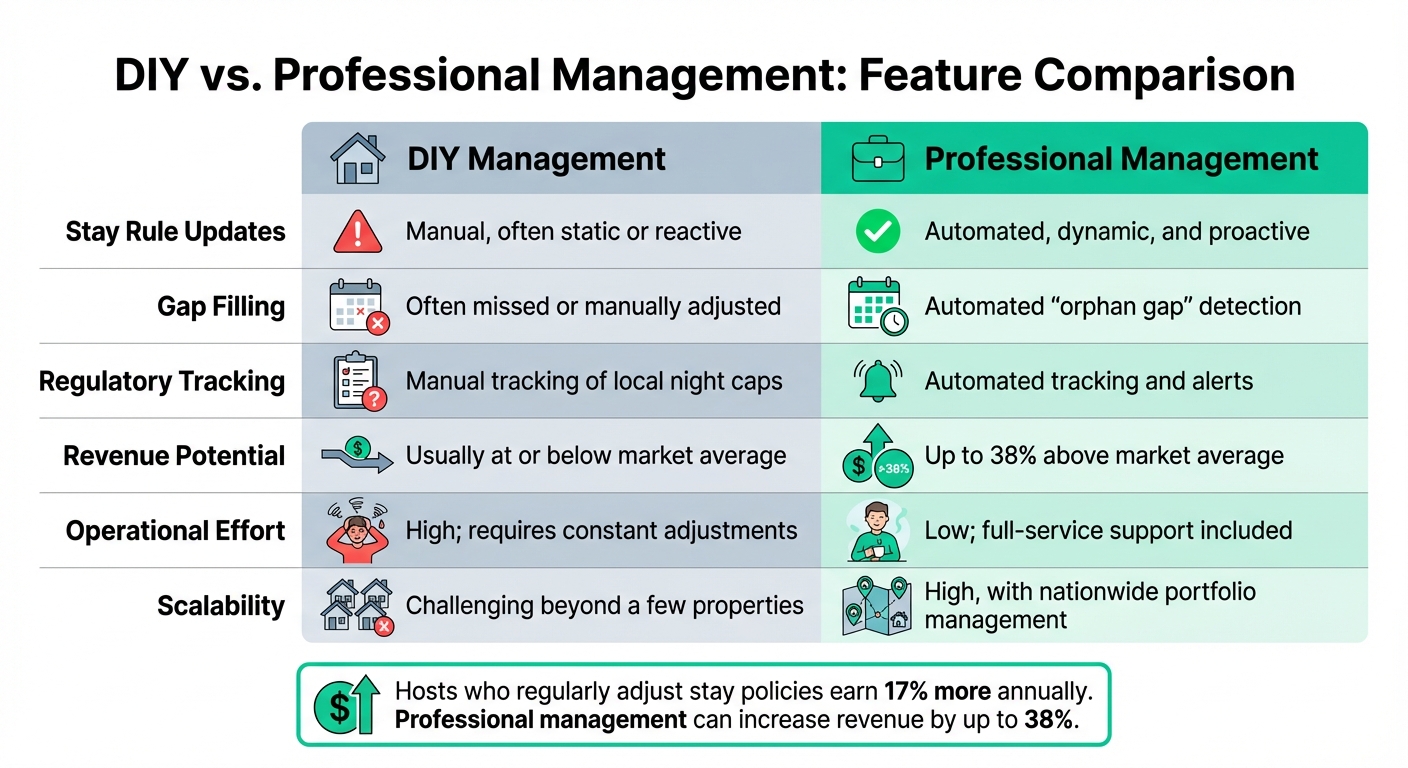
DIY vs Professional Airbnb Management: Revenue Impact and Features Comparison
Strict stay limits and evolving local rules can be tricky for property owners to manage. Professional management offers a way to handle these challenges effectively, helping hosts avoid compliance risks and missed revenue opportunities that often come with a DIY approach.
Dynamic Pricing and Market-Specific Strategies
Professional management platforms use automated tools to identify gaps in bookings (often called "orphan gaps") and adjust minimum stay rules to fill those dates. For example, if a property’s occupancy rate drops 10–20% below the local market average, the system reduces the minimum stay requirement by one night. If the drop exceeds 20%, it lowers the requirement by two nights [15]. This kind of real-time adjustment ensures properties stay competitive and can outperform market averages.
Gaurav Bundel from PriceLabs highlights the benefits:
"Dynamic Min Stay delivered even higher revenue, without the operational challenges. It smartly adapts stay lengths based on demand patterns, booking gaps, and your listing’s performance." [15]
In cities like Charleston, where short-term rentals are capped at 144 days annually, professional managers pivot to a 30-day minimum stay once the cap is reached [12][1]. This approach keeps properties compliant with local laws while ensuring a steady income stream throughout the year. By automating these processes, professional management simplifies operations and provides property owners with seamless support.
Full Support for Property Owners
Companies like Rank One Stays take care of everything from listing optimization and dynamic pricing to guest support, housekeeping, and even handling damage claims. Properties managed by Rank One Stays typically earn 38% more revenue than the market average, all while charging management fees that start at just 10%. Operating in key markets such as Scottsdale, Arizona; Denver, Colorado; Pittsburgh, Pennsylvania; and Lighthouse Point, Florida, they combine local expertise with automated tools to help properties adapt to stay limit regulations without losing profitability.
DIY vs. Professional Management
Managing stay limits on your own can be time-consuming and less effective compared to professional management. Here’s a quick look at how the two approaches stack up:
| Feature | DIY Management | Professional Management |
|---|---|---|
| Stay Rule Updates | Manual, often static or reactive | Automated, dynamic, and proactive |
| Gap Filling | Often missed or manually adjusted | Automated "orphan gap" detection |
| Regulatory Tracking | Manual tracking of local night caps | Automated tracking and alerts |
| Revenue Potential | Usually at or below market average | Up to 38% above market average |
| Operational Effort | High; requires constant adjustments | Low; full-service support included |
| Scalability | Challenging beyond a few properties | High, with nationwide portfolio management |
Data shows that hosts who manually review and adjust their minimum stay rules every few months see about 17% higher annual revenue [7]. Professional management takes this a step further by automating these adjustments with real-time data, allowing properties to maximize their potential with minimal effort.
Conclusion
The length of stay limits you set on Airbnb can have a direct effect on your revenue. For example, strict minimum stay limits might block short-term bookings and leave unbookable gaps in your calendar. On the other hand, maximum stay limits can push you toward accepting lower nightly rates. Striking the right balance is key. Properties with a 4–6 night minimum often see higher revenue per available room compared to those allowing 1-night stays – but this works best when combined with smart strategies to fill gaps in bookings [1].
Navigating these challenges requires active adjustments. Hosts who regularly review and tweak their minimum stay policies every few months tend to earn about 17% more annually than those who leave these settings untouched [7]. As Scott Sage from AirDNA explains:
"The most common minimum stay policies aren’t necessarily the most profitable. Our data shows that hosts who adapt their minimum stay policies to align with market demand and seasonality earn more revenue." [4]
For those looking to take optimization to the next level, professional management can be a game-changer. Services like Rank One Stays use advanced tools to automate adjustments in real time. These tools can help fill orphan gaps, comply with local regulations, and modify stay requirements based on booking lead times – all without requiring constant effort from property owners. With low management fees, professional services like these can increase revenue by as much as 38%.
FAQs
What’s the best minimum stay for my market?
The perfect minimum stay depends on your local market and is influenced by factors like demand, seasonality, and what guests are looking for. For instance, offering shorter stays (like 2 nights) can attract more bookings during busy periods. On the other hand, requiring longer stays (3 nights or more) might be a better strategy during slower seasons. Adapting your policies to these conditions can help optimize both revenue and occupancy. If you’re unsure how to adjust, professional management services like Rank One Stays can offer personalized advice for your property.
How do I avoid orphan nights without cutting rates?
To prevent orphan nights without cutting rates, consider implementing dynamic minimum stay policies that respond to demand and booking patterns. Relying on static rules can leave you with unbooked gaps, but adjusting minimum stay requirements based on real-time data, lead times, or market trends can help fill those empty nights. Additionally, using flexible policies during slower periods or for last-minute reservations can boost occupancy and revenue, all while maintaining your pricing strategy.
How can I stay compliant and still maximize revenue?
To balance compliance and maximize your Airbnb earnings, it’s crucial to set minimum and maximum stay policies that reflect market demand and seasonal trends. For instance, during peak travel seasons, you can increase minimum stay requirements to maintain high occupancy and drive revenue. On the flip side, offering shorter stays during slower periods can attract more bookings.
Setting maximum stay limits is equally important, as it helps you adhere to local regulations. If managing these adjustments feels overwhelming, working with a professional service like Rank One Stays can simplify the process. They can help you stay compliant while fine-tuning your revenue strategies.