
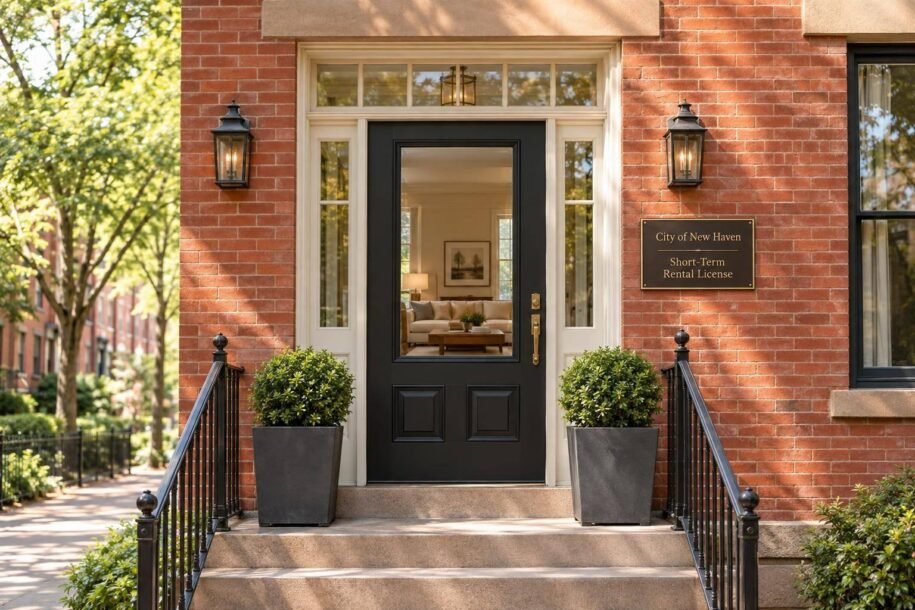
A proposal to license short-term rentals in New Haven is headed to the full Board of Alders, but lawmakers expect to revisit restrictions that residents say could prevent them from renting out parts of their homes to pay their bills.
The legislation committee voted 5–2 Thursday to advance the ordinance after a public hearing that lasted nearly six hours. Most speakers supported regulation, citing housing costs and neighborhood disruption, while opponents urged alders to distinguish resident operators from corporate investors.
All seven committee members agreed that short-term rentals need regulation. Their differences centered on who should qualify for a license.
Eligibility rules remain under review
The proposal would prohibit vacation rentals lasting less than 30 consecutive days from operating without a license. Only homeowners and longtime residents renting rooms in their primary residence would qualify for a three-year renewable license.
Operators would be allowed to host only one group at a time and would have to comply with protection codes. Occupancy would be limited to either two people per bedroom, excluding minors, or 10 people in total. In multi-family homes, operators could rent only the housing unit they occupy.
Committee Vice Chair and Ward 22 Alder Jeanette Morrison questioned how those rules would affect residents who rely on rental income.
"Listening to people say that they’re basically renting out their first floor so they can keep their whole house, that’s real", Morrison said.
Committee Chair and Ward 27 Alder Richard Furlow urged members not to amend the ordinance during deliberations because the city’s corporation counsel "did not give an opinion" on it. Assistant Corporation Counsel Michael Pinto had said earlier that his office had "not done a deep dive on the legality" of the proposal.
"I suspect that there’ll be some amendments by the time it hits the floor", Furlow said. "We need to take some steps back. There needs to be some research."
Ward 1 Alder Elias Theodore ’27 supported advancing the measure but said he would favor allowing licenses for operators who own multi-family homes or units next door to their primary residence.
"I really care about the composition of our neighborhoods and that people feel like they have neighbors", Theodore said. "At the same time, when I think about my ideal view of New Haven, we do have some short-term rentals."
Morrison and Ward 26 Alder Amy Marx LAW ’00 voted against sending the proposal to the full board.
sbb-itb-103bddb
Residents weigh housing costs against household income
Supporters argued that short-term rentals reduce the number of homes available to city residents.
"The economics are simple", Joseph Carroll, the senior warden at St. Luke’s Episcopal Church, said. "Every apartment or house converted into a short-term rental is one less home available for a New Haven resident or family."
Christopher June Zizzamia, an Edgewood resident and landlord, said real estate agents had encouraged him to increase rents because nearby Airbnb units "are determining marketing rate." He described neighbors being displaced, including one who was priced out of the neighborhood.
"Her unit is one of the many that’s been converted to an Airbnb", Zizzamia said. "Two doors down, the neighbors who I’d known for almost a decade were pushed out to not only convert part of their home into Airbnbs, but to remodel with the explicit purpose of raising rent."
Zizzamia also said "that you can feel the social fabric of our street deteriorating."
Research cited in the debate has identified correlations between short-term rentals and housing costs. A 2019 working paper found that a 1 percent increase in Airbnb listings nationwide correlated with a 0.018 percent increase in rents and a 0.026 percent increase in housing prices.
The paper reported larger price increases in areas with lower owner occupancy. New Haven’s owner-occupied housing unit rate between 2020 and 2024 was 28.4 percent, less than half the national rate during the same period. A 2022 study also found a correlation between increased short-term rentals and higher rental and housing prices in New York City.
Opponents of the ordinance acknowledged concerns about affordability and corporate profits but said the proposed restrictions could hurt residents who depend on hosting income.
Rafael Bayarri, a Dixwell resident who operates an Airbnb in his multi-family home, said the rental helps his family cover its expenses.
"Thanks to my Airbnb, I can actually pay the mortgage every month and I can afford to live in New Haven", Bayarri said.
Westville resident Stephanie Kilpatrick said her Airbnb features neighborhood artists’ work and a guidebook highlighting local businesses. She argued that guests sometimes need accommodations that hotels cannot provide.
"They’re not simply looking for separate hotel rooms", Kilpatrick said. "They’re looking for a home where they can gather, share meals and celebrate together."
Local property manager Edward Masse raised another concern about limiting alternatives to hotels.
"One of our properties is the only place in New Haven that is 100 percent allergen free and safe", Masse said. "We’ve had people that have been undergoing treatment at Yale New Haven Hospital that that’s the only place they can stay."
Corporate rentals and neighborhood complaints draw scrutiny
Taran Samarth GRD ’26 ’29, a member of UNITE HERE Local 33, alleged that the absence of regulation has encouraged investors and corporations to establish short-term rentals. Samarth claimed that Winchester Lofts, the Pierpoint, Westville Village, Twenty Fair, the Maddox, the Liberty and the Taft each list one or more "vacant, investor-owned" units on Airbnb.
Winchester Lofts, Pierpoint, Twenty Fair, Westville Village, the Liberty and the Taft did not respond to requests for comment. A spokesperson for RMS Companies, which owns Pierpoint and the Maddox, confirmed in an email to the News that the company offers a limited selection of fully-furnished short-term rental residences. The spokesperson did not specify whether those residences are in Pierpoint or the Maddox.
Samarth also alleged that Mandy Management "has converted numerous apartments in Wooster Square" into short-term rentals. Other residents, including Local 34 vice president and former alder Ellen Cupo, made similar allegations about properties near their homes.
Mandy Management general manager Yako Ma denied that the company operates short-term rentals in an email to the News.
"No Mandy Management unit has ever been listed on Airbnb, Vrbo or another short-term rental platform", Ma wrote. "Further, a review of current Airbnb listings in Wooster Square shows that they are hosted by individuals or hospitality businesses with no affiliation to Mandy Management."
Wooster Square residents Camila Bortolleto and Alex Rodriguez said 14 out of 31 units in their building had become short-term rentals. They described guests leaving foul-smelling trash in hallways and parking in residents’ spaces.
The pair said they had been unable to resolve those concerns with building owner Urban Haven Corp. The company did not respond to a request for comment.
Labor supporters favor hotel stays
Some supporters said restrictions would steer more visitors toward hotels and support hotel workers.
"As a proud union member, I prefer visitors to our city to use hotels staffed by workers with union jobs that compensate them fairly and that treat them with dignity", Ellie Browne GRD ’29 said.
Shams Goodwin, a worker at the Omni New Haven Hotel, said he believed the ordinance "provides dignity" to hotel workers like him.
New Haven Rising, a social justice community organization affiliated with four locally-based UNITE HERE unions, organized support through an online petition and a City Hall rally last Tuesday. Local 217, one of those unions, represents hotel workers.
Airbnb spokesperson Ivan Valladares, responding to the committee’s decision in an email to the News, said the company is "encouraged by the many residents who spoke out against the proposal and urge city leaders to consider their concerns, as well as study the impact on local businesses, before moving forward."
The proposal now goes to the full Board of Alders, with committee members planning to revisit eligibility after receiving input from the city’s corporation counsel.