
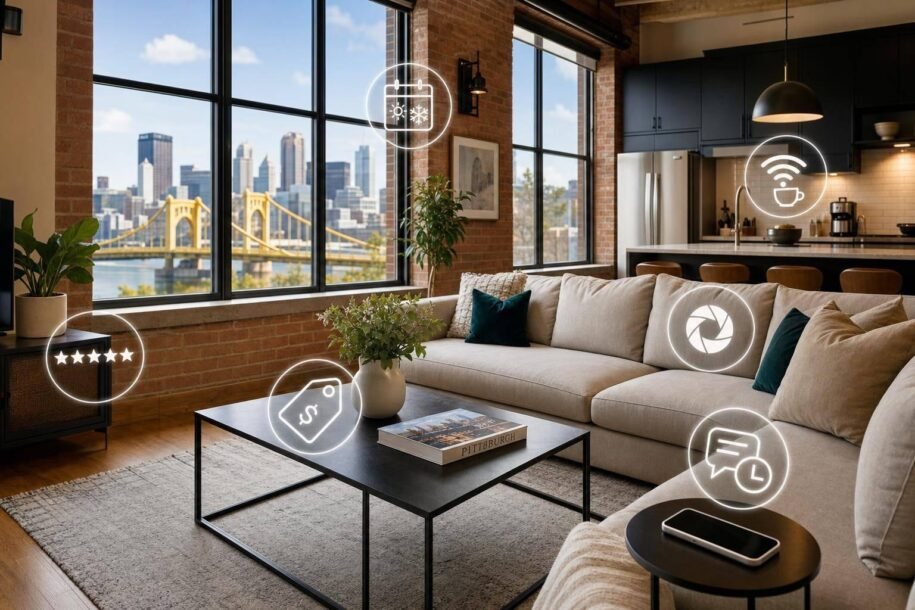
If your Pittsburgh Airbnb has too many empty nights, the problem is usually not demand. It is usually one of six fixable issues.
From what I see in this article, the biggest problems are simple: flat pricing, weak seasonal planning, poor photos, too few reviews, missing amenities, and slow replies. Pittsburgh still has demand, but it changes fast by weekday vs. weekend, winter vs. spring, and around sports, graduations, and city events.
Here’s the short version:
- I’d check pricing first, because Pittsburgh ADR can swing from $183 in slow months to $343 at peak.
- I’d fix seasonal setup next, since winter bookings often come later and spring books farther out.
- I’d look at photos and listing quality, because weak images can hurt clicks and lower search placement.
- I’d work on reviews and ratings, since the local average sits at 4.78/5.
- I’d match amenities to the guest type, like parking for sports fans or fast Wi-Fi for work trips.
- I’d tighten up response time, because guests often book fast and slow replies can cost the stay.
The main point: if you want more bookings, I’d treat the listing like an active business and fix these six areas in order.
| Cause | What it hurts | Simple fix |
|---|---|---|
| Flat pricing | Revenue and occupancy | Use night-by-night pricing |
| Same setup all year | Slow-month performance | Change rates, discounts, and stay rules by season |
| Weak photos | Click-through rate | Update cover photo and photo order |
| Low reviews or ratings | Guest trust | Ask for reviews after each stay |
| Missing amenities | Search visibility and conversion | Add and mark all must-have items |
| Slow replies | Booking conversion | Use auto-replies, templates, and Instant Book |
Below, I’d break down how each issue leads to lower bookings in Pittsburgh and what to do about it.
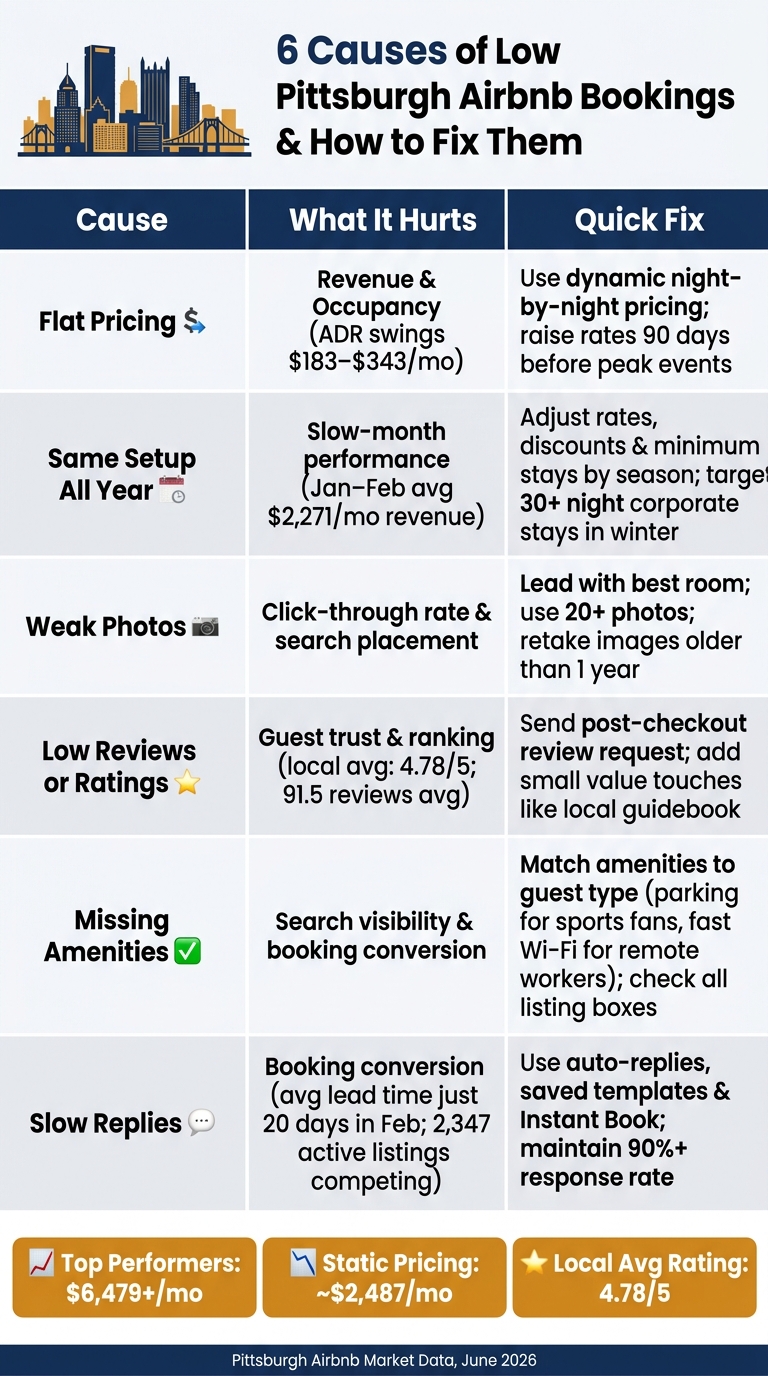
6 Causes of Low Pittsburgh Airbnb Bookings & How to Fix Them
1. Weak Pricing and Poor Seasonal Planning
Cause 1: Flat Rates Miss Pittsburgh Demand Swings
Pittsburgh demand shifts hard by day and by season. Midweek nights often depend on hospital staff, university visitors, and corporate travelers. Weekends, on the other hand, jump around Steelers games, graduations, and big local events like the Pittsburgh Marathon in May and the Three Rivers Arts Festival in June.
A flat rate misses both sides of that pattern. It’s too high on slow nights and too low when demand jumps. Pittsburgh’s average nightly rate (ADR) moves from $343 at peak down to $183 in the slowest months [1]. If your rate sits somewhere in the middle, you end up leaving money on the table either way.
Fix: Use Dynamic Pricing, Longer-Stay Discounts, and Event Adjustments
The fix is pretty simple: stop using one price for every night.
Start with a floor based on nearby comps, then adjust rates by 5%–10% based on occupancy. If you’re above 70% booked, push the rate up a bit. If you’re below 40%, bring it down.
For high-demand dates – like Steelers home games and university graduation weekends – raise rates and set 2–3 night minimums at least 90 days in advance [2]. For Sunday through Thursday gaps, switch to a 1-night minimum so you can pick up short-stay business travelers. A 5–10% weekly discount can also help fill the average 5.4-night stay common in this market [1].
The payoff can be huge. Dynamic pricing can lift Pittsburgh revenue in a big way, with top performers reaching about $6,479+ in monthly revenue versus roughly $2,487 with static pricing [1].
Even then, pricing alone won’t do the job if the listing doesn’t earn the click. Rank One Stays handles dynamic pricing and listing optimization for Pittsburgh hosts.
Cause 2: Treating Every Month the Same
Seasonality changes more than price. It also affects how far out people book and how long they want to stay. That’s where many flat-rate hosts get stuck.
Pittsburgh has clear seasonal patterns, and January and February are the softest months. Average revenue drops to around $2,271/month, and booking lead times shrink to just 20 days [1]. February guests tend to book late and care a lot about price.
Winter needs its own playbook. Lowering rates helps, but it shouldn’t be the only move. It also makes sense to offer weekly or monthly discounts, go after corporate or medical travelers who need 30+ night stays, and use a more flexible cancellation policy for late bookings.
Then spring changes the picture. In April, lead times stretch back to 66 days, and ADRs climb toward $343 [1]. That’s the point where hosts should hold the line on price and protect high-demand weekends with longer minimum stays.
Next, the listing has to turn that demand into bookings through photos, reviews, and trust signals.
sbb-itb-103bddb
2. Listing Problems That Hurt Clicks and Bookings
Cause 3: Poor Photos Make the Property Look Low Value
Pricing can get a guest to the search results page. Photos are what push them to click – or move on.
Your cover photo does most of the heavy lifting. It should instantly show what kind of place this is and give some sense of the neighborhood around it [4]. Guests often decide in less than two seconds whether a listing is worth a click, and that first image drives a big part of that choice [4]. If click-through is weak, search placement usually slips too.
A simple fix is to lead with your best room, then show any skyline view or outdoor space early. After that, arrange the rest of the photos in the order a guest would see the home in person. If any image is more than a year old, retake it.
Pittsburgh listings average 30.1 photos, and listings with 20 or more photos tend to do better in both search rankings and conversion [1]. It also helps to turn on the exact location setting. That can reduce hesitation and make the listing easier to spot on the map.
Photos and pricing can earn the click. Trust signals are what turn that click into a booking.
Cause 4: Few Reviews or Low Ratings Reduce Guest Trust
Even a listing with strong photos can lose bookings if it doesn’t have enough reviews or if the rating lags behind the local norm.
Pittsburgh’s average guest rating is 4.78 out of 5 [1]. Listings with fewer than five reviews or a rating below 4.7 tend to lose trust and ranking strength [4]. That badge matters too: 39.8% of active Pittsburgh listings have "Guest Favorite" status, and it can improve both click-through and booking rates [1].
The average Pittsburgh listing has 91.5 reviews [1]. Airbnb tends to reward listings that keep turning views into bookings. If a listing gets traffic but guests don’t book, the system can start to pull back its visibility [3].
The best way to get more reviews is pretty straightforward: make the stay easy to rate well, then ask. Send a short, friendly note after checkout thanking the guest and inviting them to share their experience. Small touches can help shape how guests view the stay too. A good coffee maker or a local guidebook can improve value perception [1].
How Professional Listing Help Can Close the Gap
Rank One Stays helps Pittsburgh owners with professional photography, listing optimization, dynamic pricing, and 24/7 guest support. If a listing still struggles after that, the next issue is often amenity fit or slow response times.
Even strong photos and reviews can only go so far if the amenities don’t match what guests want or replies take too long.
3. Amenity Gaps and Slow Guest Communication
Cause 5: Wrong Amenities Hurt Bookings
Different Pittsburgh guests look for different things. A sports fan heading in for a game does not shop the same way as a parent visiting CMU or Pitt, and neither of them thinks like a remote worker staying for a few days.
Here’s the simple part: if your listing misses a must-have item, you can lose the booking before the guest even sends a message.
| Guest Profile | Must-Have Amenities |
|---|---|
| Sports Fans | Parking, self-check-in, TV |
| University Parents | Comfortable beds, kitchen basics, proximity to CMU/Pitt |
| Business/Remote Workers | Fast Wi-Fi, dedicated workspace, coffee maker |
| Families/Groups | Full kitchen, washer/dryer, smoke/CO alarms |
There’s another catch here. Having the amenity is not enough if it is not marked properly in the listing settings. If the box is not checked, filtered search results may leave your property out entirely.
Low value ratings usually point to the same issue: guests do not feel the stay matches the price. Rank One Stays handles listing optimization, amenity positioning, and 24/7 guest support for Pittsburgh hosts.
Cause 6: Slow Guest Replies Lose Bookings
Amenities get attention. Fast replies help win the booking.
In Pittsburgh, the average booking lead time is 42 days, but that window shrinks to just 20 days in February [1]. That means many guests are making decisions fast. If your reply drags, they move on.
Airbnb also watches response rate over a 30-day period. If it falls below 90%, it can hurt trust and visibility [4]. And with 2,347 active listings in Pittsburgh as of June 2026 [1], guests have plenty of other places to choose from.
The fix is not fancy. It is a repeatable message system:
- Auto-replies
- Saved templates for common questions
- Instant Book to keep response times fast [4]
Fix: Build Repeatable Systems or Outsource Guest Support
Amenity gaps and slow replies usually come from the same place: weak operations. These are not one-and-done issues. They need systems that work every day, not just when the host has time.
That usually means having a messaging workflow, a pre-arrival checklist, a process for maintenance issues, and solid cleaner coordination between back-to-back stays.
Pittsburgh listings average 27.1 bookings per year [1]. That is a steady flow of arrivals, departures, and turnover. When there is no repeatable process, small problems stack up fast. A missing amenity gets missed for weeks. A late reply costs a booking. A cleaner mix-up leads to a bad review.
Good systems keep the listing running well after the initial setup is done. For owners who want a hands-off approach, Rank One Stays handles 24/7 guest support, housekeeping coordination, and operations for Pittsburgh hosts.
Conclusion: 6 Fixes That Can Recover Pittsburgh Airbnb Bookings
Low bookings in Pittsburgh usually don’t come from one big mistake. More often, it’s a few smaller issues piling up at the same time.
Maybe your rate is off during a Steelers weekend. Maybe your cover photo looks too dark and people scroll past. Maybe there’s no workspace, so you miss out on midweek guests. Or maybe a slow reply sends someone to a different listing. Pricing comes first, but photos, reviews, amenities, and response time often decide who actually books.
That’s the big shift here: treat your listing like an active business, not something you set up once and leave alone. Work through these five levers in order, and bookings often start to come back.
Key Takeaways for Owners and Investors
Use this order: pricing, photos, reviews, amenities, then response time.
- Reset pricing to the current comp set.
- Refresh the cover photo and photo order, or elevate your space with professional design.
- Ask for reviews after every stay.
- Match amenities to your target guest.
- Keep response times under control.
If you’d rather have someone handle those fixes for you, Rank One Stays offers Pittsburgh vacation rental management with dynamic pricing, listing optimization, 24/7 guest support, housekeeping, and damage claims.
FAQs
How do I know if pricing is my main problem?
Compare your occupancy and ADR with local benchmarks to figure out whether the problem is your listing or the broader Pittsburgh market. If market occupancy and ADR are holding steady but your bookings are slipping, your pricing may be the issue.
Before you cut rates, check that your base rate is within 15% of the median for five similar properties in your ZIP code. Also look at your cleaning fees to make sure they’re in line with nearby listings.
Which amenities matter most for Pittsburgh guests?
For Pittsburgh guests, focus on the amenities that matter most to both business and leisure travelers:
- Reliable high-speed internet
- A dedicated workspace
- Parking
- Laundry access
- A well-stocked kitchen
These are the basics many guests look for first, especially if they’re staying for work, a long weekend, or more than a few days.
If your place has extra perks, make sure those stand out too. Walkable locations, outdoor space, and skyline or landmark views can help your listing catch more attention and give guests one more reason to book.
When should I update my Airbnb listing for each season?
Update your listing often. If your calendar hasn’t been refreshed in more than two weeks, it can look stale and may hurt search visibility.
Plan rate and stay-rule changes 60 to 120 days before major Pittsburgh events. That gives you a better shot at higher nightly rates and longer minimum stays when demand starts to build.
Winter is a different game. During slower months, put occupancy first with discounts and longer bookings. You can also use those quieter stretches for maintenance and small fixes.