

If your unit does not work at 60% occupancy, the deal is weak from day one. In rental arbitrage, rent is fixed every month, so pricing mistakes, bad stay rules, and the wrong channel mix can wipe out margin fast.
Here’s the short version: I would treat revenue management as a 4-part system:
- Check the deal before signing: test rent, fees, utilities, cleaning, and repairs at 60%, 75%, and 90% occupancy
- Set rate guardrails: use a base rate, floor, and ceiling instead of one flat price
- Control your calendar: use minimum stays, orphan-night rules, and channel sync
- Review results every month: track ADR, occupancy, RevPAR, RevPAN, LOS, booking window, gap nights, and channel mix
A few numbers matter right away:
- Airbnb fees: about 3%
- VRBO fees: about 5%
- Booking.com fees: up to 15%
- Hot tubs and pools can push ADR about 20%–25% , especially when paired with professional interior design
- Dynamic pricing tools can improve revenue by about 19%–23%
- A $1,000–$2,000 repair reserve helps cover surprise issues
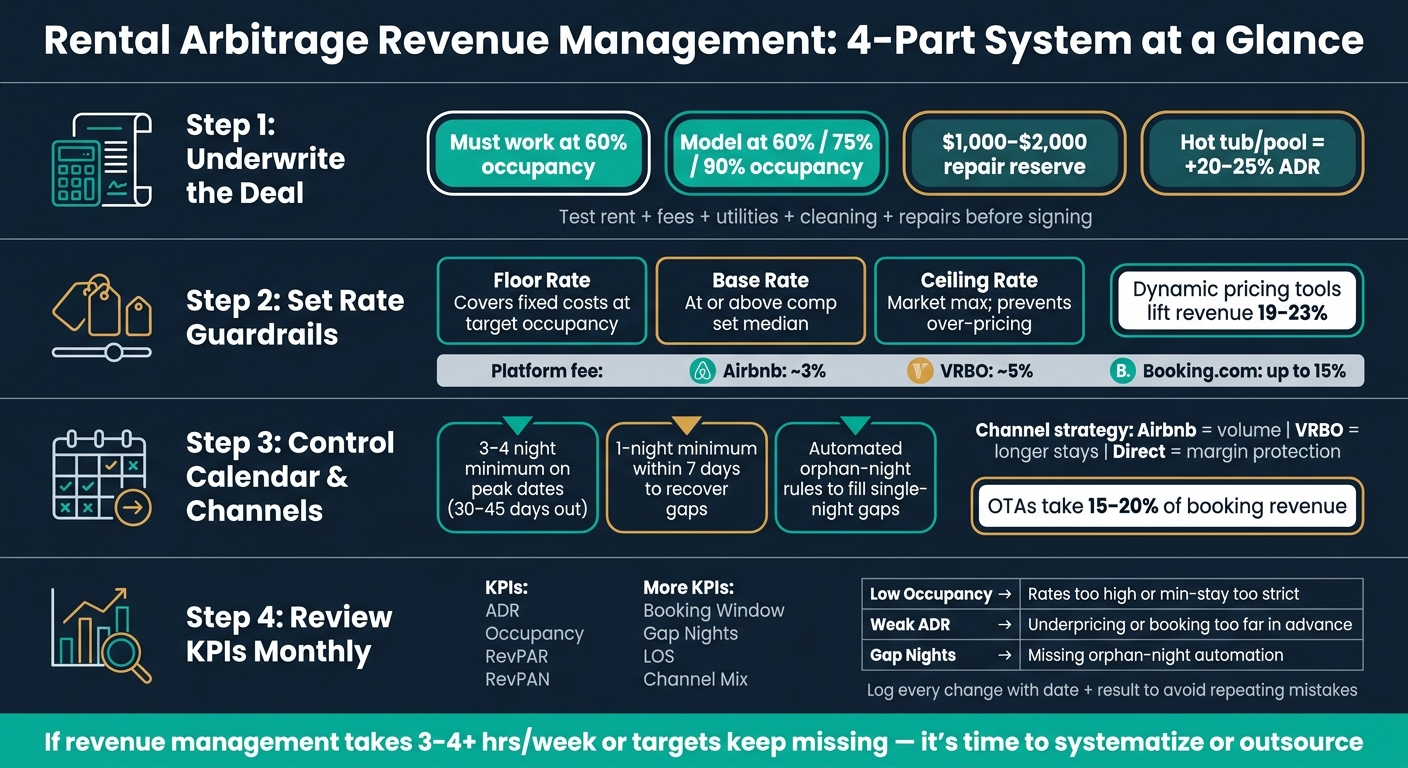
Rental Arbitrage Revenue Management: 4-Part System at a Glance
Airbnb Arbitrage 2026: Is It Still Profitable? (Must Watch!)
sbb-itb-103bddb
Quick comparison
| Area | What I’d focus on | What can go wrong |
|---|---|---|
| Deal math | Break-even rate and monthly costs | Unit only works in peak season |
| Pricing | Base rate, minimum rate, max rate | High occupancy but weak profit |
| Stay rules | 3–4 nights on peak dates, 1 night close-in | Empty gap nights or low-value bookings |
| Channels | Airbnb, VRBO, and direct bookings | Double bookings and high fee drag |
| Review process | Monthly KPI check and change log | Repeating the same pricing mistakes |
This guide explains how I’d test a deal, set pricing rules, shape the calendar, and review performance so the unit has a better shot at staying profitable month after month.
1. Market research and deal math before you sign a lease
The lease is the moment you’re on the hook. So before you sign anything, check the basics first: local STR rules, zoning, permits, landlord terms, and any HOA limits. If the property clears the legal side, the next step is simple: find out whether the numbers work.
Build a comp set and estimate realistic revenue
Start with 8–15 comparable listings within a 1–2 mile radius. Match them as closely as you can by bedroom count, guest capacity, parking, and amenities [3]. If one listing has a hot tub or pool and another doesn’t, that gap matters. Investing in professional Airbnb design services can help bridge that gap and justify higher rates. Those features can push ADR up by 20% to 25% compared with similar listings without them [3].
Then break your pricing model into parts instead of using one flat average:
- Weekday rates
- Weekend rates
- Seasonal rates
In markets driven by events or universities, separate peak dates from normal demand [1][3]. That gives you a cleaner view of what the property can earn most of the year, not just during the big weekends. Your comps show the top end of revenue. Your expense model shows whether the deal can carry its own weight.
Calculate your minimum viable nightly rate and monthly break-even
Run the full cost stack, not just rent. Include utilities, Wi-Fi, STR insurance, software, cleaning, consumables, a maintenance reserve, and platform fees. Those fees add up fast: about 3% on Airbnb, 5% on VRBO, and up to 15% on Booking.com [1].
After that, model the deal at 60%, 75%, and 90% occupancy to see where break-even lands and how much margin is left [2]. It also helps to keep a $1,000–$2,000 repair reserve for urgent fixes [6]. A busted lock, leaking toilet, or failed AC unit never shows up at a good time.
At that point, you’re not guessing anymore. You’re deciding whether the lease deserves a yes.
When to move forward, renegotiate, or walk away
Move forward only if the property still makes money at 60% occupancy and demand holds up outside peak season. If the deal only works during the busiest stretch of the year, that’s not much of a business. It’s more like a coin flip.
Renegotiate when lower rent or lower operating costs would change the outcome in a meaningful way [4][2].
Walk away if a small tax increase, one slow quarter, or a drop in rates would push the deal into the red.
"A tax that hits your whole market uniformly is not a reason to exit. It becomes a problem only if your margins were already too thin to survive any cost pressure at all." – James Svetec, Founder, BNB Mastery [4]
Once the deal works on paper, set pricing rules that protect profit.
2. Set up pricing rules that protect margin and lift revenue
Once the lease makes sense on paper, turn your break-even point into a clear pricing system: a floor, a ceiling, and a day-to-day rate plan. The aim isn’t to fill every night. It’s to drive maximum RevPAN, not maximum occupancy.
Choose a base rate, minimum rate, and maximum rate
Start with your comp set and lock in three numbers: your base rate, your floor, and your ceiling.
Set your base rate at or a bit above the median for that group, then price up for premium features. If the unit has a hot tub or swimming pool, it can often sit 20%–25% above a similar listing without those features [3].
Set your minimum rate at the lowest nightly price that still covers fixed costs, turnover, fees, and cleaning at your target occupancy.
Your maximum rate is your guardrail on the high end. Without one, pricing on peak nights can drift too far and hurt bookings that would have produced more total revenue. Set a ceiling based on what your market will actually pay, then let demand push rates toward that number instead of beyond it [5].
Update all three when comps shift, supply changes, or your review scores move up or down [3].
Use dynamic pricing tools and manual overrides correctly
Use dynamic pricing software to adjust rates each day, then step in manually for moments the software may miss. These tools often lift revenue compared with static pricing, and they help protect margin by reacting faster than a person usually can [3].
| Tool | Pricing Model | Automation Level | Best For | Practical Limitations |
|---|---|---|---|---|
| PriceLabs | $19.99 per listing/month [1][5] | High (granular) | Portfolios & single units | Advanced rules require setup time [5] |
| Beyond | 1% of booking revenue [1][5] | High (hands-off) | Simplicity seekers | Cost scales with revenue [1][5] |
| Wheelhouse | $19.99 per listing/month or 1% of booking revenue [1][5] | Moderate | Scalable portfolios | Requires disabling Airbnb Smart Pricing [5] |
| DPGO | $1 per listing/night or 0.5% commission [5] | Moderate–High | Cost-sensitive hosts | Smaller integration network [5] |
| Guesty PriceOptimizer | Custom quote [5] | High (native) | Existing Guesty users | Not available standalone [5] |
Watch booking pace, too. If the unit is booking out more than 30 days early, push rates up. If fewer than 20% of nights are booked 14 days out, cut rates or loosen stay rules [3].
A good example is the FIFA World Cup 2026 schedule release. Host markets saw ADR growth of more than 25% [3]. Software trained mostly on past data won’t always spot that kind of jump in the moment. For seasonal surges and major events, use event-based changes instead of broad seasonal markups [3].
Pricing also works better when it’s tied to channel rules and stay controls that keep your calendar in good shape.
Apply discounts and promotions without hurting RevPAN
Use discounts only when they improve RevPAN. The numbers can change fast once you add cleaning costs and platform fees for each extra stay [3][1].
A few offers tend to make sense:
- 10%–15% long-stay discounts for gap weeks
- Shoulder-season midweek promos when demand is soft
- Last-minute discounts only if the final rate still stays above your floor [3]
A higher base rate paired with a visible long-stay discount can make the offer feel stronger without cutting rates across the full calendar [3].
Skip blanket discounts across all dates. Track RevPAN, not occupancy, to see if a promo is doing its job [3].
The next lever is channel control: where you list, how long guests stay, and which bookings you accept.
3. Control channels, stay rules, and guest segments
Once you’ve set your rates, the next piece is the calendar. This is where a lot of operators leak profit. The wrong channel mix, a missing minimum-stay rule, or a bad fit between property and guest type can eat into margin fast, especially when fixed monthly rent is due no matter what.
Set a channel strategy that fills the calendar without losing control
Use Airbnb for booking volume and VRBO for longer, higher-value stays. That mix can work well, but it comes with a clear risk: double-booking. A channel manager like Hospitable, which starts at $40/month for two properties, or Hostaway can sync your calendar across platforms in under 2 minutes and help stop booking conflicts before they happen [1].
Direct bookings matter too. OTA fees usually take 15%–20% of booking revenue [3][7]. That’s a big slice. A simple way to think about it: OTAs bring demand, but direct bookings protect margin over time. Use the platforms to get found, then build your own demand where you can.
For full-service revenue management, Rank One Stays can manage Airbnb and VRBO distribution, guest messaging, and calendar controls for arbitrage operators who want the upside without handling the daily workload.
Use minimum stays, orphan-night rules, and event restrictions
Static minimum stays can cost you money. A 3–4 night minimum set 30–45 days before a high-demand weekend helps protect those dates from getting blocked by low-value one-night bookings [3]. Then, within 7 days of arrival, dropping to a 1-night minimum can help recover revenue on nights that might otherwise go empty, even if cleaning costs take a bigger bite out of that booking [3].
Automated orphan-night rules help fill single-night gaps by relaxing stay limits when needed. Without them, a one-night gap between two bookings can sit vacant. In an arbitrage model, that means you’re still paying fixed rent for a night that brings in nothing.
Here’s how the main stay-rule setups change the trade-offs for an arbitrage unit:
| Stay-Rule Setup | Occupancy Stability | Cleaning Frequency | Revenue Predictability | Operational Workload |
|---|---|---|---|---|
| Short-Stay (1–2 nights) | Low (fills gaps quickly, but higher churn) | High (frequent) | Variable | High |
| Balanced (3–5 nights) | Moderate | Moderate | Stable | Moderate |
| Mid-Term (30+ nights) | High | Low (monthly) | Very High (fixed monthly income) | Low |
For demand spikes you can see coming – NFL home games, major festivals, or events like the FIFA World Cup – use event-specific pricing multipliers and minimum stays instead of broad seasonal rules. That approach is much tighter. In host markets after the FIFA World Cup 2026 schedule release, ADR growth topped 25% [3]. A blanket seasonal markup would have missed that window.
Target the guest segments that fit your property and market
Guest mix matters just as much as pricing. Match the property to the type of traveler your market pulls in.
Business travelers and remote workers can help fill the Sunday-through-Thursday gap that leisure guests often leave behind. They tend to book with shorter lead times and usually cause less wear-and-tear than large groups. To pull in that segment, lower your minimum stay to 1–2 nights on weekdays [3].
Weekend leisure guests often bring the highest ADR, but they also need stricter minimum-stay rules. If not, one-night bookings can break up your calendar and crowd out better reservations. Mid-term guests – traveling nurses, corporate relocations, and families between homes – bring steadier occupancy and less turnover [8].
Pittsburgh is a good example. Hospital systems and corporate demand support steady mid-week and mid-term bookings from traveling medical staff and people in relocation stays [8]. Your channel settings and stay rules should line up with the local demand you’re most likely to get.
Track each rule by month, then adjust stay length, channels, and guest targets fast.
4. Run a monthly performance review and adjust fast
Once pricing and stay rules are live, the next job is simple: check if they actually increased profit. Review pacing every week, then do a monthly profit review.
Track the KPIs that show whether the unit is performing
Start with net revenue. Then track ADR, occupancy, RevPAR, RevPAN, booking window, gap nights, cleaning frequency, and channel mix. Compare each number to your original underwriting and your comp set, not just to last month.
That matters because high occupancy with a low ADR can earn less than lower occupancy with a higher ADR. Watch for shifts in booking window and gap nights too. Those changes often point to pricing problems or stay-rule issues before the bigger numbers make it obvious.
Diagnose low occupancy, weak ADR, and poor booking pattern
Use the pattern, not just the raw number, to pick the fix.
| Problem | Likely Cause | Corrective Action |
|---|---|---|
| Low occupancy | Rates too high or restrictive min-stays | Lower base rate; reduce min-stay for weekdays and last-minute dates [3] |
| Weak ADR | Underpricing; booking too far in advance | Raise base rate; set 3–4 night minimums for peak event dates [3] |
| Poor booking pattern | High orphan-night percentage | Automate orphan-night rules to allow 1-night stays in gaps [3] |
| Low click-to-book conversion | Weak photos or poor review score | Invest in professional photography; improve guest communication [3][2] |
| Slow booking velocity | Market softening or new competition | Recalibrate your comp set; activate last-minute discounts 7–10 days out [3] |
A few examples make this easier to spot in practice:
- If occupancy is soft but your comp set is booking, your rates or min-stay rules may be too aggressive.
- If ADR looks weak and reservations keep coming in far ahead of stay dates, you may be priced too low.
- If you keep seeing unbooked single nights between stays, orphan-night rules probably need work.
Log changes and decide when to bring in full-service management
Log every rate change, minimum-stay update, and channel shift with the date and the result. If you don’t track changes, you end up making the same guess every month. That log also shows when it’s time to exit the lease or walk away at renewal if the unit keeps missing targets [1].
And sometimes the answer isn’t another small tweak. If manual rate changes and rule updates are taking more than 3–4 hours a week, or the unit still misses targets, hand off revenue management to Rank One Stays.
Conclusion: Build a revenue system, not just a listing
Rental arbitrage comes with one hard truth from day one: rent is due every month, no matter what. That fixed cost is why a passive approach usually falls flat. If you set a price, leave the listing alone, and hope bookings show up, you’re playing defense from the start.
The operators who make money on a steady basis do something different. They build a system around the unit, not just a profile on Airbnb. The answer isn’t reactive pricing. It’s a simple system you can run week after week.
That system has four layers: underwrite with caution, price within clear guardrails, control your channels and stay rules, and review KPIs every month. When those parts work together, the gains stack up over time.
Dynamic pricing tools have lifted revenue 19% to 23% by reacting to demand shifts that manual pricing often misses [1]. Across a 12-month lease, that gap adds up fast.
If you want that system handled for you, Rank One Stays can run it. If managing everything is taking more than 3–4 hours a week, or your monthly review keeps showing weak RevPAR, ADR, or occupancy, that’s usually the point where outside help makes sense. Rank One Stays handles dynamic pricing, listing optimization, channel management, guest support, housekeeping, and damage claims. Local execution is what turns revenue management into profit.
FAQs
How do I know if a rental arbitrage deal is worth signing?
Run careful due diligence before you sign anything. Map out every cost: rent, utilities, cleaning, insurance, taxes, platform fees, and a maintenance reserve. Then calculate your break-even rate so you know the minimum you need to charge just to cover the bills.
Next, stack that against projected revenue using conservative occupancy assumptions, not best-case math. It’s easy to make a deal look good on paper if you assume full weekends and nonstop bookings. That’s where people get burned.
You also want enough buffer for market swings, slower seasons, and surprise costs. And before moving forward, confirm the property is legal for short-term rentals. If the margins are thin, walk away.
What KPIs matter most for revenue management?
Focus on three core KPIs: RevPAR, ADR, and occupancy rate.
RevPAR is the clearest all-in metric because it shows how your nightly rate and booking frequency work together. A high rate means less if nights sit empty. Strong occupancy alone doesn’t say much either if you’re filling the calendar at prices that are too low. RevPAR helps you see both at once.
Track these numbers every month against market benchmarks, not just your own past results. Looking only at last month or last year can give you a false sense of progress if the market moved faster than you did.
It also helps to keep an eye on a few early warning signs:
- Booking pace to see how fast future dates are filling
- Calendar saturation to spot periods with too many open nights
- Gap night percentage to catch short vacancies between bookings
- Conversion rate to see whether views are turning into reservations
These signals can help you spot pricing problems early, before they show up in your top-line numbers.
When should I manage revenue myself versus hire Rank One Stays?
Self-management can make sense if you have one to three properties, live within 60 minutes, and can put in 2 to 4 hours per week to keep things running.
Rank One Stays tends to be a better fit if you manage four or more properties, live more than 2 hours away, or put your time at $75 to $100 per hour. It also makes sense if you want to step away from 24/7 guest issues and bring in more revenue.