
SEO for Airbnb arbitrage is about making your listing visible to potential guests. Here’s why it matters: 80% of bookings come from first-page listings, and properties on page three or beyond get less than 2% of clicks. For arbitrage hosts with fixed costs like leases, visibility is key to staying profitable.
To improve your ranking, focus on these essentials:
- Titles and Keywords: Use terms like "hot tub", "downtown", or "romantic" to attract the right audience.
- Photos: Professional images can double or triple booking rates.
- Amenities: Tag everything – Wi-Fi, parking, workspace, etc. – to match guest searches.
- Dynamic Pricing: Adjust rates based on demand to maintain steady bookings.
- Guest Experience: Fast responses, good reviews, and a clean space boost rankings.
A combination of smart content updates, daily management, and guest satisfaction can significantly increase your bookings and revenue. If scaling your portfolio feels overwhelming, professional property managers can handle SEO, pricing, and operations for you.
How Airbnb Search Actually Works in 2026 (copy what I do)
sbb-itb-103bddb
Understanding Search Demand and Target Guests
To optimize your Airbnb listing, it’s crucial to understand who’s searching and why they’re interested in your area. Airbnb’s algorithm connects guests with listings that meet their needs, so identifying your ideal guests is a key first step before making any updates to your listing.
Identifying Key Guest Segments
Think about what attracts visitors to your area. A property near a bustling downtown will appeal to a different audience than one by a serene beach or a national park. By identifying the main reason people visit your market, you can better align your amenities and descriptions with their preferences.
Here are some common guest segments and what they typically prioritize:
- Business travelers: They value fast Wi-Fi, a dedicated workspace, and hassle-free check-in.
- Families: Practical features like high chairs, pack ‘n plays, and extra sleeping space are essential.
- Digital nomads: Long-stay options, reliable internet, and a comfortable remote work setup are key for this group.
Focusing your listing on one primary group helps Airbnb’s algorithm understand who your property is best suited for, increasing your chances of connecting with the right guests. After defining your target audience, the next step is to analyze search trends in your area.
Researching Local Airbnb Search Trends
Take a close look at the top 10–20 listings in your market. Pay attention to how they craft their titles, which amenities they highlight, and the tone of their descriptions. These details often reveal what local guests are searching for and the keywords that resonate most.
Keyword choice can have a big impact. For instance:
- Listings with "parking" in the title average a 48.1% occupancy rate.
- Descriptions using words like "romantic" or "charming" tend to perform slightly better, with occupancy rates of 50.0% and 48.5%, respectively.
- Specific property labels also matter – listings described as a "Penthouse" average 47.0% occupancy, while a "Treehouse" performs slightly better at 47.7%. These terms often outperform generic labels like "Apartment" or "House" [3].
"Airbnb’s search algorithm now weights listing quality signals – clarity, completeness, photo quality, content consistency – much more heavily than it used to." – Mike, 13-year Airbnb Superhost [1]
Here’s a quick guide to keyword performance:
| Keyword Type | Examples | Impact |
|---|---|---|
| High Revenue | hottub, spa, heated pool, oceanview | Correlates with $60K–$72K trailing 12-month revenue [3] |
| High Occupancy | parking, romantic, downtown, charming | Correlates with 45%–50% occupancy [3] |
| Property Type | Penthouse, Treehouse, Villa, Cabin | Outperforms generic "Apartment" or "House" labels [3] |
| Style/Vibe | chic, stylish, historic, modern | Correlates with 45%–47% occupancy [3] |
Once you’ve identified effective keywords, it’s time to assess your property’s SEO strengths.
Evaluating Properties for SEO Potential
Every property has different strengths when it comes to search optimization. Location is the most critical factor – it can’t be changed, so choose wisely when selecting or marketing a property. Your target guest segment can guide you toward locations with built-in keyword advantages. For example, properties near restaurants, public transit, or popular attractions can naturally include high-performing keywords like "walkable" or "downtown."
Proximity to specific demand drivers also helps define your target audience early. A property near a convention center in Denver is ideal for business travelers, while a waterfront property in South Florida appeals to leisure guests seeking a beach getaway. The clearer your property’s appeal, the easier it is to create a listing that ranks well for relevant searches.
Optimizing Your Airbnb Listing for More Bookings
Once you’ve identified your target audience and their preferences, the next step is to make sure your listing not only appears in searches but also convinces potential guests to book. Every detail in your listing – titles, photos, amenities, and pricing – affects Airbnb’s algorithm. Even small tweaks can improve your visibility and booking rates.
Writing Clear Titles and Descriptions
Your title is limited to 50 characters, so every word matters. A good formula to follow is: one searchable feature + one standout detail + property type. For instance, "Mountain View Hot Tub Cabin" is clear, descriptive, and uses relevant search terms. Avoid wasting space on generic words like "Beautiful", "Cozy", or "NEW", as they don’t add value or help with rankings [1].
Descriptions give you up to 500 characters, but the first 150 are the most important – especially since over 60% of bookings are made on mobile devices, where text often gets cut off [1]. Use this space to highlight the biggest benefit for guests, rather than focusing on logistical details like the number of bedrooms or check-in times.
"The first 150 characters appear on mobile search cards before truncation. They have one job: stop the scroll." – Mike, 13-year Airbnb Superhost [1]
After your opening hook, structure the rest of your description by focusing on the experience first, then describing the space and neighborhood, leaving logistical details for the end. Consistency is key – if your title mentions a "modern" design, but your photos show outdated decor, it can hurt your ranking [1].
New listings get a temporary visibility boost for their first 2–6 weeks [2]. This is your chance to gain traction, so make sure your title and description are fully polished before launching.
Next, let’s talk about how visuals can make or break your listing.
Using Professional Photos to Drive Bookings
Photos play a major role in booking decisions – around 75% of a guest’s choice depends on them [1]. Your cover photo is especially important, as it’s the first thing potential guests see. Meanwhile, the first five "hero" images should convince them to book. Listings with professional photos often convert at 2–3 times the rate of those with amateur images, and hiring a professional photographer typically costs $150 to $400 [2].
Here’s a recommended order for your first five images:
- A standout feature (like a pool, view, or unique space)
- Living room
- Master bedroom
- Kitchen
- Exterior shot
Beyond these, aim for 20–30 high-quality photos that showcase every room, amenity, and unique feature. Mixing professional photos with lower-quality ones can harm guest trust and signal lower quality to Airbnb’s algorithm.
"The cover photo… must be a wide, well-lit, professionally composed shot of your property’s most distinguishing visual feature." – Mike, 13-year Airbnb Superhost [1]
For the best results, schedule your photo shoot during golden hour for warm lighting, and update your gallery anytime you add new amenities or refresh your interior design and decor.
Listing Amenities That Guests Search For
Amenities do more than enhance your listing – they help align it with guest searches. These tags act as filters, so if you don’t list an amenity, your property might not appear when someone uses that filter [1].
"Amenities are the single most underutilized lever in listing optimization." – Mike, 13-year Airbnb Superhost [1]
Completing all 50+ amenity options can significantly impact your ranking [2]. Take the time to review Airbnb’s full amenity checklist and make sure nothing is overlooked. Be specific: instead of just selecting "outdoor space", include details like a firepit, hammock, or ping pong table. In the kitchen, mention extras like an espresso machine alongside a standard coffee maker. For family-friendly listings, highlight items like high chairs or pack ’n plays to stand out [1].
Using Dynamic Pricing to Stay Competitive
Airbnb’s algorithm rewards listings that maintain steady booking momentum. Pricing plays a crucial role in this. Properties that are consistently booked tend to rank higher, while those that sit idle drop in visibility.
To keep up, you need to adjust your prices based on demand, which fluctuates due to local events, seasonality, and even the day of the week. Dynamic pricing tools can analyze market data in real time and automatically adjust your rates. Overpricing during a slow week can lead to fewer bookings and hurt your ranking, while underpricing during peak demand can mean lost revenue.
Day-to-Day Practices That Support Your Search Ranking
Your daily actions as a host play a critical role in maintaining and improving your Airbnb search ranking. Once your listing is live, consistent habits can keep you visible in search results. Airbnb’s algorithm evaluates how active, reliable, and responsive you are, and adjusts your ranking based on these factors. These practices complement your broader optimization efforts, ensuring your listing remains competitive.
Responding to Guests Quickly
Quick responses are key to higher rankings. Listings with response times under an hour typically perform better [2]. Airbnb prioritizes listings that are more likely to lead to bookings, and a fast reply signals to the algorithm that you’re a dependable host.
To stay on top of guest inquiries, enable push notifications and set up automated quick replies. Airbnb’s built-in messaging tools or apps like Hospitable can help you respond instantly [2] [4]. This not only boosts your rankings but can also lead to more bookings.
Managing Your Calendar and Booking Settings
Your calendar and booking settings have a direct impact on your visibility. Enabling Instant Book is one of the most effective changes you can make, potentially increasing search visibility by 20% to 40% [2]. Keep your calendar updated – ideally, open it at least 12 months in advance and make updates to pricing or availability weekly. If your calendar remains untouched for over two weeks, the algorithm may consider it "stale", which could lower your ranking [2].
Avoid canceling confirmed bookings, as this can severely affect your search placement for weeks [2] [5]. Maintaining an acceptance rate above 90% also strengthens your listing’s reliability in the eyes of the algorithm.
"The algorithm favors Instant Book listings because they reduce friction in the booking process and improve the guest experience." – StayStrat Team [2]
Beyond these technical adjustments, guest satisfaction is another major factor in securing a high ranking.
Getting Good Reviews Through Consistent Service
Reviews are one of the most powerful ranking signals on Airbnb [5]. It’s not just about having a high star rating – both the number of reviews and their recency matter. For example, a listing with 200 reviews at 4.9 stars will usually rank higher than a newer listing with only a few perfect 5.0 ratings [2].
"A 4.7 average sounds strong. In practice, it puts your listing at a disadvantage relative to properties holding a 4.9 or higher." – Adam Knight, Founder & CEO, Recreation Stays [5]
To consistently earn 5-star reviews, ensure your listing meets or exceeds guest expectations. Start with accurate photos and descriptions. If your listing advertises a "modern, fully equipped kitchen", make sure it delivers. Cleanliness is another critical factor – negative reviews often cite cleanliness issues [2]. Adopting a thorough and consistent cleaning routine is one of the most effective ways to avoid bad reviews.
Consider a mid-stay check-in to address any potential issues before they escalate. Finally, after checkout, send a polite review request within 24 hours. Most happy guests won’t leave a review unless prompted, so a timely reminder can make all the difference.
Scaling Your Arbitrage Portfolio With Professional Management
Self-Management vs. Professional Airbnb Management: Key Differences
Once you’ve optimized your listings and gained visibility, the next challenge is scaling your operations. Growth brings complexity, and professional management can help you stay ahead by handling the increasing demands of a larger portfolio.
Managing a few listings on your own might be feasible, but as your portfolio grows, tasks like responding to guest inquiries, coordinating cleaning schedules, updating content, and setting dynamic pricing can eat into both your time and profits.
What Full-Service Management Includes
A full-service property manager takes care of both day-to-day operations and ongoing SEO maintenance, ensuring your listings remain competitive without requiring constant attention. For example, Rank One Stays provides end-to-end services, including listing optimization, advanced pricing strategies, 24/7 guest communication, professional housekeeping, maintenance coordination, and even handling damage claims.
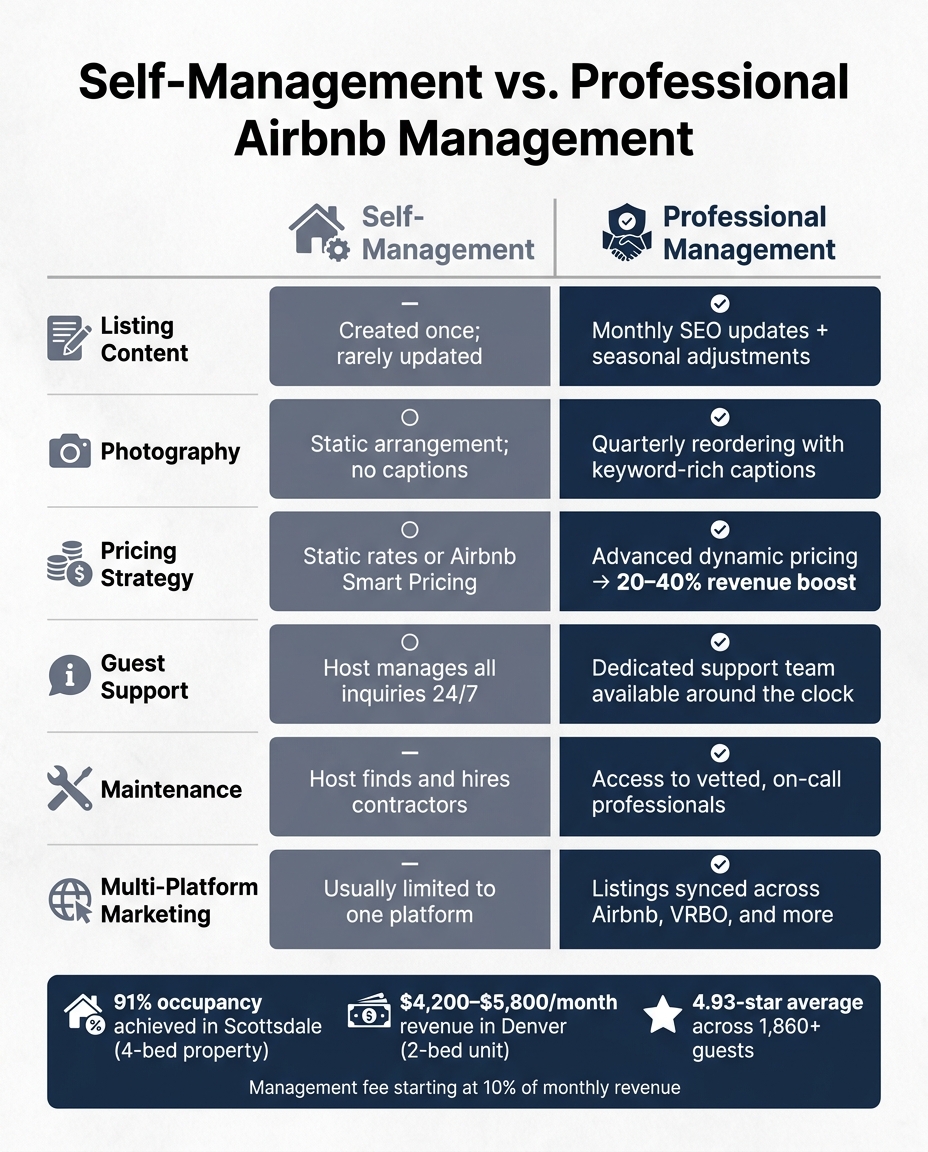
On the SEO side, managers regularly update listing titles, descriptions, and photo arrangements to align with seasonal trends and avoid penalties from outdated content. These updates are typically done monthly or quarterly. Advanced pricing tools – far more sophisticated than Airbnb’s Smart Pricing – can increase revenue by 20% to 40% compared to static rates [7]. Rank One Stays maintains a 4.93-star average across more than 1,860 guests [7], demonstrating the kind of consistent service that boosts both reviews and search rankings.
This level of management not only maximizes the performance of individual listings but also makes expanding into new markets much smoother.
Expanding Into New Markets
Every market has its own unique characteristics, from seasonal trends and local laws to guest preferences. Professional management simplifies market entry by offering local expertise and tailored strategies from the start.
Rank One Stays operates in diverse locations such as Scottsdale, Arizona, Denver, Colorado, Pittsburgh, Pennsylvania, and Lighthouse Point, Florida. Each market has different drivers of demand. For instance, professionally managed 4-bedroom properties in Scottsdale have achieved 91% occupancy and $135,000 in annual revenue [7]. Meanwhile, in Denver, a well-managed 2-bedroom arbitrage unit can bring in $4,200 to $5,800 per month [8]. Without local expertise, entering new markets can result in slower growth and reduced initial income.
Self-Management vs. Professional Management
Deciding between self-management and hiring a professional service boils down to balancing time, consistency, and potential revenue. Here’s a side-by-side look at the differences:
| Factor | Self-Management | Professional Management (e.g., Rank One Stays) |
|---|---|---|
| Listing Content | Created once; rarely updated | Monthly SEO updates and seasonal adjustments [6] |
| Photography | Static arrangement; no captions | Quarterly reordering with keyword-rich captions [6] |
| Pricing Strategy | Static rates or Airbnb Smart Pricing | Advanced dynamic pricing (20–40% revenue boost) [7] |
| Guest Support | Host manages all inquiries 24/7 | Dedicated support team available around the clock |
| Maintenance | Host finds and hires contractors | Access to vetted, on-call professionals [7] |
| Multi-Platform Marketing | Usually limited to one platform | Listings synced across Airbnb, VRBO, and more |
Rank One Stays charges a management fee starting at 10% of monthly revenue [7], making it a scalable option that grows with your income rather than adding fixed costs. With this level of support, you can focus on expanding your business while maintaining high performance across your portfolio.
Conclusion and Key Takeaways
Airbnb SEO plays a crucial role in determining how often your listing gets seen and booked. At its core, it’s about one thing: visibility. Without it, profitable arbitrage becomes nearly impossible.
To stand out, focus on the essentials: a clear and engaging title, high-quality photos, a mobile-friendly description, accurate amenity tagging, and dynamic pricing. These five elements form the backbone of a competitive listing [1]. Beyond that, maintaining a fast response rate, keeping your calendar updated, and consistently earning strong reviews signal reliability to Airbnb’s algorithm. Together, these factors drive measurable improvements in performance.
"A listing that performs well on price alone is increasingly rare. Modern Airbnb hosts who succeed are the ones whose listings clear Airbnb’s quality bar and then get priced competitively." – Mike, 13-year Superhost [1]
Even small tweaks can generate big results. For example, just a 0.1-star improvement in your review score can increase booking conversions by 5–8% [2]. Similarly, enabling Instant Book has been shown to boost search visibility by 20–40% [2]. These small changes, when combined, can lead to significant revenue growth over time.
FAQs
What keywords should I use in my Airbnb title?
To craft a standout Airbnb title, zero in on specific features that set your property apart and draw in potential guests.
- Emphasize standout amenities like "Ocean View," "Hot Tub," or even the name of a sought-after neighborhood.
- Mention the property type if it adds appeal, such as "Cottage" or "Loft."
- Steer clear of overused words like "Beautiful" or "Cozy," and aim to keep the title under 50 characters to ensure it looks great on mobile devices.
How many photos should my listing have?
Your Airbnb listing needs at least 20 high-quality photos to stand out. The best-performing listings often go further, including 25-35 images that highlight every room, outdoor spaces, and any unique features your property offers. Great visuals not only make your listing more attractive but also increase its visibility to potential guests.
Should I turn on Instant Book?
Enabling Instant Book on your Airbnb listing can improve your search visibility by 20–40%. This feature simplifies the booking process for guests, making it easier for them to secure a reservation without waiting for host approval. Plus, Airbnb’s algorithm tends to favor listings with Instant Book turned on, pushing them higher in search results.
To maintain control and reduce potential risks, you can set specific guest requirements. These filters help ensure that only guests who meet your criteria can book instantly. By combining Instant Book with these safeguards, you can enhance your listing’s performance while still managing who stays at your property.