
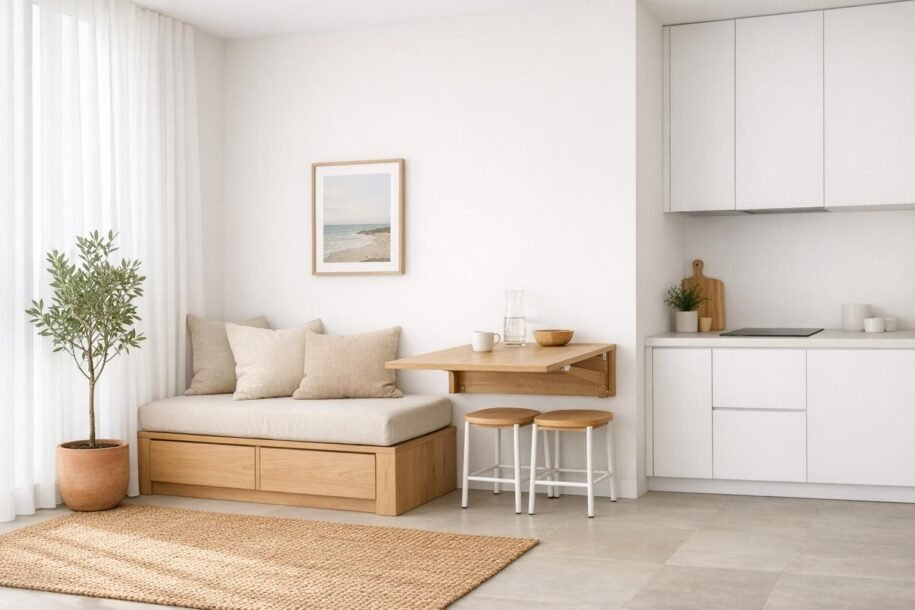
Want to boost your vacation rental bookings and revenue? Start with smart design.
Here’s why it matters:
- 90% of guests decide based on photos.
- Stylish interiors can lead to 30% more bookings and up to 40% higher revenue.
- Small upgrades, like better lighting or bedding, can increase rates by 10–15%.
This guide covers:
- Optimizing layouts for small spaces.
- Choosing multifunctional furniture.
- Storage tricks to maximize space.
- Design tips to make rooms feel bigger.
Whether you’re managing a studio or a one-bedroom rental, these strategies can make your property stand out in a competitive market while increasing profitability. Let’s dive in.
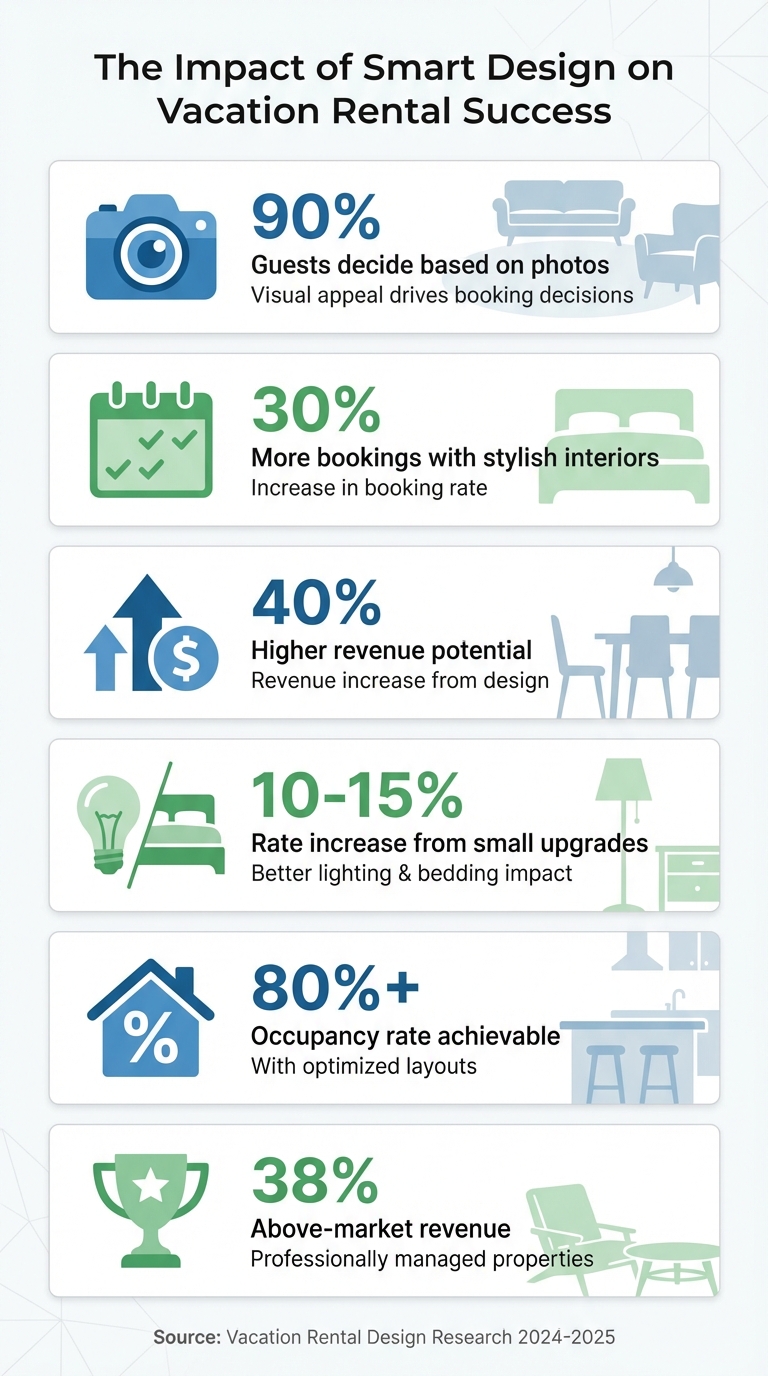
Small Vacation Rental Design Impact: Key Statistics on Bookings and Revenue
Ask A Designer: How To Design A Vacation Rental
sbb-itb-103bddb
How to Plan Your Small Vacation Rental Layout
The layout of your vacation rental can make or break the guest experience – and your revenue. For example, an 800-square-foot apartment with a well-thought-out layout can comfortably accommodate six guests. But if the space is poorly arranged, you might only fit four, potentially cutting your nightly income by 33% [7]. Planning your layout with purpose ensures you make the most of your space and stand out in a crowded rental market. The key? Creating functional zones that allow guests to move freely while maximizing every square foot.
Creating Functional Zones and Traffic Flow
Before you even think about furniture, take a step back and map out how guests will use the space. Start by identifying primary circulation paths – the main routes from the entrance to key areas like the bathroom, bedroom, or balcony. These pathways should remain completely clear of furniture or clutter [5]. Secondary paths branch off these main routes, leading to larger furniture pieces like sofas or beds.
"You could have the most beautiful furniture in the world, but if you bang your shin on the coffee table every time you try to get to the sofa, you’re not going to be happy with your space." – Madelaine Mayer, Founder and Principal, AD:ROIT Architecture & Interior Design [5]
Use visual cues to define zones for sleeping, dining, and relaxing. Area rugs can anchor spaces, while pendant lights over a dining table or a statement art piece above the sofa create clear focal points [3][6]. This approach maintains open sightlines and allows natural light to flow, making the space feel larger and more inviting.
Add a drop zone near the entrance with hooks, a mirror, and a small bench. This keeps luggage, shoes, and keys from cluttering the rest of the rental [7][3]. In tight spaces like bathrooms or closets, consider replacing swinging doors with sliding or pocket doors to save precious floor space [6]. Combining these zoning techniques with an open-concept design can take your layout to the next level.
Using Open Concept and Flexible Layouts
Open-concept layouts remove physical barriers, making small spaces feel brighter and more connected [9]. Instead of walls, use furniture placement and lighting to define areas. For instance, position the back of a sofa to face the kitchen – this creates a natural separation between living and cooking spaces without blocking light or views [8].
Floating furniture is another game-changer. Pull pieces slightly away from the walls to create depth and a more layered look [5]. Opt for furniture with slim, exposed legs, which keeps floor sightlines open and prevents the space from feeling cramped [9][3].
One example of this approach in action comes from Homevy, a Dubai-based property management company. In 2024, they hosted over 2,000 guests across their studio and one-bedroom rentals. By using rugs to define sleeping areas and pendant lights for dining zones, they achieved an occupancy rate of over 80%. Interior designer Shinnel, who led the project, also swapped out bulky furniture for streamlined pieces to improve traffic flow [3].
"Function first. The layout must support how someone will realistically use the space, whether they’re working from home, entertaining guests, or using it as a base between travel." – Shinnel, Interior Designer, Homevy [3]
Maximize vertical space with floor-to-ceiling shelving, wall-mounted desks, or hanging storage. This keeps the floor clear for guest movement while providing essential storage [6][8]. If you’re managing a Denver vacation rental or a Scottsdale property, consider adding a floating desk or wall-mounted workspace for remote workers.
Layout Examples for Studios and One-Bedroom Rentals
For studio apartments, place the bed in the farthest corner from the entrance to create a sense of privacy. Position the sofa perpendicular to the wall, with its back toward the sleeping area, to define the living zone [10]. Use rugs strategically – place a 5×8-foot rug under the bed and an 8×10-foot rug under the seating area to separate these spaces visually [10].
A wall-mounted drop-leaf table ($45–$120) can double as a workspace or dining area, folding away when not in use to save floor space [10]. Install shelving 12–18 inches from the ceiling to draw the eye upward, making the room feel taller [10]. For added privacy, use ceiling-mounted curtain tracks or folding screens that guests can adjust as needed.
In one-bedroom rentals, focus on making the bedroom feel like a retreat. A platform bed with built-in drawers ($200–$500) eliminates the need for bulky dressers [10]. In the living room, opt for a slim-profile sofa instead of a large sectional to keep the space flexible while accommodating guests during gatherings [5][3]. A tall bookshelf can serve as both a room divider and storage solution, keeping the floor plan open while maximizing vertical space [10].
Before buying any furniture, measure everything. Use apps like MagicPlan or RoomScan to map out dimensions, window placements, and electrical outlets [10]. Apply the "3-Question Test" to every design decision: Does it look good? Does it feel good? Does it serve a purpose? If it fails any of these, skip it [3]. For expert help, consider professional vacation rental design services to ensure your property is both functional and appealing. Up next: how multifunctional furniture and smart storage can elevate your rental even further.
Multifunctional Furniture and Storage Solutions
Furniture has the power to transform small studios into open, inviting spaces for guests. The key lies in selecting pieces that do double duty without compromising on style or comfort.
Best Multifunctional Furniture Pieces
Murphy beds, also known as wall beds, are a top choice for saving space in small vacation rentals. These beds fold into a cabinet during the day, freeing up valuable floor space. Interior designer Ashley Macuga from Collected Interiors highlights their versatility:
"It [a Murphy bed] gives you a comfortable guest bedroom when needed, then easily folds away to create a gym or workout space in minutes." [12]
Other space-saving stars include lift-top coffee tables, which double as dining or work surfaces, and storage ottomans, which combine seating with hidden compartments. For dining areas, wall-mounted drop-leaf tables collapse flat against the wall when not in use, while nesting tables stack neatly but expand to offer extra surface area when needed.
A standout example of multifunctional design comes from interior designer Minna Haapakoski. In May 2025, she reimagined a 9-square-meter guest room with a custom birch platform. This platform housed a 120-centimeter-wide futon mattress that folded into a sofa and featured deep drawers for bedding, paired with a modular String shelving system to create a workspace [11].
For additional sleeping options, convertible sleeper chairs are perfect for tight spaces, offering a bed without crowding the layout. Similarly, daybeds with trundle drawers provide flexibility, serving as seating by day and extra sleeping space by night.
Tech-savvy travelers appreciate connectivity. Side tables and nightstands with built-in charging ports can eliminate the clutter of power strips. Adding these tech-friendly features to properties like a Pittsburgh vacation rental or a Lighthouse Point property can make your listing stand out.
Multifunctional furniture is only part of the equation – smart storage solutions are essential for keeping small spaces tidy and functional.
Smart Storage Ideas for Small Rentals
Utilizing vertical space not only increases storage capacity but also creates the illusion of higher ceilings. Floating desks with integrated shelving are a clever way to clear floor space while offering a dedicated workspace.
Under-bed storage is another must-have for small rentals. Platform beds with built-in drawers are a great alternative to bulky dressers, saving 6–8 square feet [10]. In kitchens and bathrooms, over-the-door racks are practical for organizing toiletries and cleaning supplies.
Window seats are a triple threat: they serve as seating during the day, an extra bed at night, and hidden storage for linens underneath. Similarly, placing a storage bench at the foot of a bed not only adds functionality but also ties the room together visually, especially when the bench’s width matches the bed’s [12].
Built-In vs. Modular Storage
Deciding between built-in and modular storage depends on your budget, timeline, and whether you need a permanent or flexible solution. Built-in storage is custom-made to fit every inch of available space, making it ideal for awkward corners, sloped ceilings, or areas under stairs [13]. Architect Scott Specht of Specht Novak demonstrated this approach by designing a kitchen booth with built-in storage that doubled as a dining table and workspace in a 1,100-square-foot accessory dwelling unit. The surrounding floor-to-ceiling storage eliminated the need for standalone cabinets [12].
"In small spaces, you can really pack a functional punch by opting for pieces that offer multiple uses. Additionally, furnishings that offer hidden storage can work extra hard to hide your things at arm’s length."
– Kristen Cuthbert, Interior Designer [12]
On the other hand, modular storage systems consist of components that can be rearranged or expanded. These systems are perfect for adapting layouts based on guest feedback or changing needs. They’re also quicker to install – modular construction can reduce setup times by up to 80% compared to traditional methods [14].
| Feature | Built-In Storage | Modular Storage |
|---|---|---|
| Flexibility | Low; fixed to the structure | High; can be rearranged or expanded |
| Customization | Unlimited; tailored to exact dimensions | Limited to pre-made sizes |
| Installation Speed | Slower; requires on-site labor | Faster; often flat-pack or pre-assembled |
| Cost | Higher upfront investment | Typically more budget-friendly |
| Space Optimization | Maximizes every inch, including awkward spaces | May leave gaps due to fixed dimensions |
| Durability | High; designed for permanent use | Variable; intended for mobility |
For vacation rentals that need to adapt to guest preferences, modular systems offer unmatched flexibility. However, in extremely tight spaces, built-in solutions can maximize every inch. Professional design services, like those provided by Rank One Stays, can help determine the best fit for your property’s layout and guest needs.
These storage approaches create a strong foundation for designing small spaces. Up next, we’ll dive into design tricks that can make even the smallest areas feel much larger.
Design Tricks to Make Small Spaces Feel Bigger
Transforming a small space into a welcoming, open environment often comes down to clever design choices that play with light, color, and perspective.
Using Color, Light, and Finishes
The right colors can do wonders for making a space feel larger. Light shades like off-white, beige, and soft gray help reflect natural light, creating the illusion of a more expansive area – sometimes by as much as 20% [15]. A whopping 72% of designers agree that monochromatic color schemes are among the most effective ways to achieve this effect [15].
The Light Reflectance Value (LRV) of paint is a key factor here. For example, Benjamin Moore’s White Dove, with an LRV of 85, reflects significantly more light than a darker shade like Farrow & Ball’s Hague Blue, which has an LRV of just 5 [18]. Darker colors absorb light, making spaces appear 20% to 30% smaller [15].
"Lighter wall colors are going to help with adding an illusion of depth and expansiveness." – Kathy Kuo, Interior Designer [17]
Monochromatic palettes take this a step further by using varying shades of the same color across walls, trim, and furniture. This technique eliminates visual interruptions, helping the eye glide smoothly through the room and increasing the sense of spaciousness by up to 30% [15]. Cool tones like soft blues or sea greens can further enhance the feeling of openness and calm [15].
The finish of your paint is just as important as the color. Semi-gloss or high-gloss finishes on trim and ceilings bounce light around the room, amplifying the sense of space [15][17]. For ceilings, a flat finish painted two to three shades lighter than the walls creates a recessed effect, making the room feel taller [17][18].
Mirrors and reflective surfaces are another powerful tool. Position a large mirror – ideally 40 by 60 inches – directly opposite a window at eye level (57 to 60 inches from the floor) to double the light and depth in your room [16][18]. Research from the Lighting Research Center at Rensselaer Polytechnic Institute highlights how higher levels of light can make spaces feel larger, regardless of their actual size [18].
"Hanging a statement mirror in a space… has the added benefit of making a room feel more vast since it reflects light and creates the visual illusion of a more expansive space." – Natasha Nyanin, Creative Consultant [16]
Layered lighting is just as crucial. Instead of relying on a single overhead fixture, mix ambient, task, and accent lighting to eliminate dark corners that can shrink a space visually [18][2]. Amanda Wiss, Founder of Urban Staging, underscores this:
"Lighting is massively important in small rooms. Chandeliers, slim floor lamps, and plenty of tabletop lamps will help brighten and open up the space." [19]
For window treatments, opt for sheer linen or cotton curtains instead of heavy blackout drapes. Dense fabrics can block 60% to 95% of natural light, collapsing the room’s visual depth [18]. Hang curtain rods 4 to 6 inches above the window frame and extend them 8 to 12 inches beyond the sides to give the illusion of taller and wider windows [18].
| Paint Finish | Visual Effect | Best Use Case |
|---|---|---|
| High-Gloss | Reflects the most light; adds depth | Trim, doors, or statement ceilings [15] |
| Semi-Gloss | Bright, airy, and durable | Kitchens, bathrooms, and window frames [15] |
| Matte / Flat | Absorbs light; hides imperfections | Ceilings to make them "disappear" [4][18] |
| Eggshell | Soft, sun-washed effect | Main walls in coastal-style homes [4] |
These techniques with color and light set the stage for choosing furniture that complements the space.
Choosing the Right Scale and Proportion
Furniture selection plays a huge role in optimizing a small room. Oversized or undersized pieces can throw off the balance, disrupting both flow and comfort. The secret lies in choosing furniture that fits the room’s proportions perfectly.
"Scale everything down, but style everything up. In small apartments, the wrong scale can disrupt flow, function, and comfort." – Shinnel, Interior Designer [3]
Pieces with exposed legs – like sofas, beds, and dressers – create an airy feel by revealing floor space and allowing light to pass underneath [20][18]. In contrast, skirted or solid bases can make furniture feel heavy and block visual flow [18].
Transparent materials like glass or acrylic (Lucite) are excellent for reducing visual weight. Ghost chairs and glass coffee tables, for instance, maintain functionality while keeping sightlines open, preventing the room from feeling cluttered [18][22].
In dining areas, pedestal-base tables are a smart choice. Their design takes up less visual space and makes it easier to move around [18]. For sofas, aim to occupy about one-third to two-thirds of the wall it faces to maintain balance [18].
Interior designer Nicole Choate offers this tip:
"Floating the sofa away from the perimeter can often create the illusion of more space." [21]
When it comes to decor, bigger often works better. A single large piece of art or a bold statement item can make the room feel expansive, while a gallery wall of small items can create visual clutter [20][18][21].
Decluttering and Minimal Styling
Minimalism is key for small spaces. By emphasizing texture over quantity, you can create a warm, inviting environment without overcrowding the room.
Intentional minimalism focuses on tactile elements like linen throws, bouclé pillows, and natural wood accents. These layers add depth and warmth without creating visual chaos [3]. Closed storage solutions – like built-in cabinets or furniture with hidden compartments – are essential for keeping clutter out of sight. Katherine Cunningham, Design Principal at Light and Dwell, highlights the importance of simplicity:
"Embrace negative space between objects. This visual breathing room makes small areas feel intentionally curated rather than cramped." [22]
The 60-30-10 rule is a helpful guideline for balancing colors: dedicate 60% of the room to a primary color, 30% to a secondary color, and 10% to a bold accent [15][4]. This keeps the design cohesive while adding interest.
Clear pathways are another must. Ensure at least 30 to 36 inches of space between furniture pieces to maintain an open feel [18]. In studio apartments, use visual dividers like rugs or pendant lights to define separate areas without adding physical barriers [3].
For vacation rentals, such as those in Denver or Scottsdale, professional vacation rental design services can help implement these strategies while preserving the property’s character. Together, these design tricks create a space where guests feel relaxed and comfortable, no matter the square footage.
Room-by-Room Design Strategies
Building on the ideas of maximizing tiny vacation rentals with design, let’s dive into specific strategies for designing each key room in your rental. Every area in a small vacation rental has its own needs, so tailoring your design choices to living spaces, bedrooms, and high-traffic zones like kitchens and bathrooms can create a space that feels both functional and inviting.
Living and Dining Areas
The living and dining areas are where guests will spend much of their time, so it’s crucial to get the layout just right. Start by planning pathways – ensure 30 to 36 inches for main walkways and at least 18 inches between the sofa and coffee table to prevent awkward collisions [23][5].
Positioning furniture a few inches away from walls (4 to 6 inches) creates subtle shadow lines that add depth, making the room feel more spacious [23][5]. Sofas with track or slim arms and elevated legs allow for more visible floor space, which helps the area feel open [23][3]. Instead of a large sectional, consider a 60 to 72-inch loveseat or a 72 to 80-inch compact sofa with a lightweight accent chair for flexibility [23][3].
For dining, choose a small table that can double as a workspace to attract remote workers [24][3]. Use rugs and pendant lights to define the dining area without adding physical barriers [3]. Storage ottomans, nesting tables, or trunks that double as coffee tables help keep clutter at bay while maintaining functionality [24][5].
Lighting plays a key role in these spaces. Aim for 100 to 200 lux of ambient lighting in living areas and 300 to 500 lux for task lighting in reading zones [23]. For TVs, position screens 7 to 9 feet away from seating for 55 to 65-inch displays to ensure comfortable viewing [23].
"Start by making a list of how you envision using the living room… Use these answers to guide your planning so that the overall layout and all the furniture within the room are determined by how you intend to use it."
- Autumn Pochiro, Autumn Dawn Design [24]
In competitive markets like Denver or Scottsdale, these thoughtful layouts can help small Airbnb listings achieve 90% occupancy rates by creating shared spaces that feel intentional [25]. Next, let’s explore how to refine private spaces like bedrooms.
Bedrooms
Bedrooms should feel restful while maximizing storage. A queen-sized bed with built-in storage is a smarter choice than a king-sized bed, which can disrupt traffic flow and offers no additional storage [3]. Placing a rug under the bed helps define the sleeping space without adding walls [3].
Instead of bulky dressers, opt for wall-mounted hooks, hanging shelves, or clothing racks to free up floor space and make closets more efficient [3][25]. Adding full-length mirrors on walls not only saves space but also makes the room feel larger [25][3]. For any seating in the bedroom, stick to ergonomic dimensions: seat heights of 17 to 19 inches and seat depths of 20 to 22 inches [23].
To create a calming atmosphere, stick to light neutral tones like beige, cream, or soft gray, which keep the room feeling open and timeless [23]. Add warmth through layered textures like linen throws, bouclé pillows, and natural wood accents, avoiding visual clutter [3]. Consider consulting vacation rental design services to implement these ideas with a professional touch.
Kitchens and Bathrooms
Kitchens and bathrooms are high-use areas where durable materials and smart storage are essential. In kitchens, one-wall and galley layouts are the most efficient for small spaces, maximizing storage along a single plane [26]. For open-plan studios, L-shaped layouts can help separate dining areas [26].
Compact appliances are your best friend here. Choose 19-inch mini-fridges, two-burner stoves, and convection microwaves to save wall space [27]. A narrow fridge alone can free up 10 to 20 inches of linear wall space compared to standard models [27]. For kitchenettes, small sinks as compact as 9 inches deep by 15 inches wide are sufficient [27].
| Feature | Small Space Solution | Standard Solution | Benefit for Rentals |
|---|---|---|---|
| Refrigeration | 19-inch mini-fridge | 28-39 inch full fridge | Saves ~10-20 inches of wall space [27] |
| Cooking | Two-burner cooktop | Four-burner range | Increases counter prep area [27] |
| Doors | Sliding/Pocket doors | Swinging doors | Reclaims "swing zone" space [6] |
| Cabinetry | Handleless/Flat fronts | Decorative hardware | Reduces visual clutter [26] |
Use "appliance garages" to keep toasters and coffee makers out of sight, and swap traditional cabinets for deep base drawers, which improve visibility and storage volume [26][27].
"Every inch of space is important and should be utilized. Knife racks, spice racks, hooks for mugs, shelving for plates – all of it helps."
- MacKenzie Cain, Interior Designer at Habitar Design [27]
In bathrooms, replace swinging doors with sliding or pocket doors to save space [2][6]. Glass partitions and open-concept shower rooms create a sleek, spa-like feel while eliminating visual interruptions [2][6]. Mirrors play a big role too – install a mirrored backsplash in the kitchen or a large mirror opposite a bathroom window to amplify light and depth [27][6][4].
For countertops, quartz is an excellent choice for rentals. It’s stain-resistant, non-porous, and more durable than granite or laminate [27]. Layer lighting by combining under-cabinet task lights with ambient sources to avoid shadows and make these spaces feel more open [26][27]. These practical solutions ensure that even the smallest kitchens and bathrooms remain functional and stylish.
Working with Professional Design and Management Services
Designing a small vacation rental comes with its own set of challenges, especially when it comes to balancing limited space with guest expectations. Professional designers and property managers bring more to the table than just good looks – they know how to make every inch count, boosting both revenue and guest satisfaction.
By building on design fundamentals, these experts fine-tune every detail to make the most of your rental’s potential.
What Professional Designers Can Do for Your Rental
Professional designers start with precise floor plans, ensuring that every piece of furniture is the right fit. They focus on scale and proportion, selecting furnishings that create a sense of balance without overcrowding the space. Taking concepts like multifunctional layouts and smart storage to the next level, they make your rental both practical and inviting.
Beyond design, professionals handle procurement, installation, and even professional photography to get your listing ready quickly [28].
Staging is another game-changer. Well-designed rentals can command nightly rates that are 20% to 40% higher [28]. Additionally, properties with thoughtfully curated interiors often see a 40% increase in revenue and a 20% boost in return on investment [1].
"Professional Airbnb interior design allows hosts to command higher nightly rates, while properties with generic staging must compete primarily on price." – Rank One Stays [28]
Durability is also key. Designers recommend using materials that can handle heavy use while remaining easy to clean. They maximize vertical space with shelves and hooks to keep floors clear and use area rugs to define different zones in open layouts – ideal for small studios.
How Rank One Stays Handles Design and Management
Rank One Stays takes professional design a step further, offering tailored solutions for vacation rental owners.
Rank One Stays provides three service tiers to meet varying needs. Full Service Design includes everything from purchasing to installation and waste removal. Virtual Design offers consultations, mock-ups, and detailed shopping lists for owners who prefer a hands-on approach. Lastly, the Ask the Experts option provides hourly advice on management and listing optimization.
Their turnkey furnishing packages, priced between $15,000 and $50,000 for 2–4 bedroom properties [28], cover furniture, décor, linens, and installation. But they don’t just fill a space with furniture – they create experiences. Using market research, they identify features that drive 5-star reviews. For instance, in September 2024, they revamped a cramped downtown Scottsdale rental, swapping out bulky furniture for multifunctional pieces like a sofa bed and coffee table with storage. Sheer curtains and a bold geometric wallpaper accent wall were added to brighten the space. The results? A 40% increase in occupancy, a 20% rise in nightly rates, and "Superhost" status within just two months [29].
"Rank One redesigned my home and now my calendar is fully booked. Because of them, I can breathe easier knowing that my properties are well taken care of." – Keon P, Property Owner [28]
Rank One Stays-managed properties earn 38% more revenue than the market average, with management fees starting at just 10% of rental income [28]. Operating in Scottsdale, Arizona; Denver, Colorado; Pittsburgh, Pennsylvania; and Lighthouse Point, Florida, they combine local expertise with proven strategies. Whether you need a full makeover or just targeted design services, professional help ensures your rental competes at the top tier.
Conclusion
Designing a small vacation rental requires creating a space that’s functional, inviting, and thoughtfully arranged. The right design choices can transform a property, boosting occupancy rates and even allowing for higher rental pricing. By using well-scaled furniture, defining areas without adding walls, and focusing on what guests actually need, you can make a big impact.
"Function first. The layout must support how someone will realistically use the space, whether they’re working from home, entertaining guests, or using it as a base between travel." – Shinnel, Interior Designer, Homevy [3]
Well-designed interiors can lead to up to 40% higher revenue [1], and studios or one-bedroom rentals with smart furnishing often achieve occupancy rates above 80% [3]. These details can turn an average rental into a highly profitable investment.
Before adding anything to your space, consider: Does it look good? Does it feel good? Does it serve a purpose? Stick to a balanced color scheme – 70% neutral tones, 20% muted shades, and 10% bold accents [4]. Position mirrors across from windows to amplify natural light and create a sense of openness [4]. These small, cost-effective tweaks can make a rental feel larger and more inviting, without requiring major renovations.
For property owners looking for expert help, Rank One Stays offers professional vacation rental design services. From planning layouts to managing installations, they handle it all. Whether you’re outfitting a studio in Denver or a one-bedroom in Scottsdale, partnering with Rank One Stays can elevate your rental’s appeal and profitability.
FAQs
What upgrades boost bookings the fastest?
Strategic updates like professional photography, smart locks, and eye-catching interior design choices – think bold colors or unique statement pieces – can boost your booking rates. These upgrades enhance the overall guest experience and raise the perceived value of your property, making it stand out to potential renters.
How many guests should my small rental accommodate?
A smaller vacation rental typically works best for 2 to 4 guests. This range hits the sweet spot – it allows you to optimize occupancy, boost revenue potential, and attract a wide variety of travelers in most markets.
Should I choose built-in or modular storage?
When deciding between built-in and modular storage, it all comes down to your specific needs and design preferences. Built-in storage offers a clean, space-saving, and permanent solution, making it a great fit for compact or uniquely shaped spaces. On the other hand, modular storage is all about flexibility – it’s easy to rearrange or upgrade, which works well for ever-changing rental properties. Many vacation rentals smartly mix the two, balancing practicality with a guest-friendly design that feels both functional and inviting.