

Seasonality can make or break your vacation rental’s ROI. Demand fluctuates based on factors like weather, holidays, and local events, creating peaks and slow periods that directly affect revenue, costs, and long-term profitability. Key takeaways:
- Revenue Variance: Many properties earn 40–60% of their yearly income in just 4–5 months. Occupancy rates can swing from 35% in off-peak seasons to 90% during peak months.
- Pricing Matters: Dynamic pricing tools adjust rates in real-time to maximize earnings during high-demand periods and attract bookings during slow months.
- Operational Costs: Expenses like cleaning and maintenance rise during busy seasons but drop during off-peak times, requiring careful planning and professional property management to manage cash flow.
- Data Analysis: Tools like AirDNA help identify seasonal patterns, enabling better pricing, marketing, and operational strategies.
- Guest Diversification: Targeting groups like remote workers or offering longer stays during off-peak months can stabilize income.
Understanding and planning for these seasonal shifts ensures steadier returns, even in unpredictable markets.
What’s a Good ROI for Airbnb? | STR Investment Metrics Explained
sbb-itb-103bddb
How to Diagnose Your Property’s Seasonal Demand Patterns
To tackle seasonal revenue challenges, you first need to pinpoint when and how they affect your property. A beach rental in Lighthouse Point, Florida will have a vastly different demand pattern compared to a mountain cabin near Denver, Colorado. Understanding these patterns through data is key to adjusting pricing, operations, and marketing strategies for steady returns.
Collecting and Analyzing the Right Data
Start by reviewing 12–36 months of booking history to establish benchmarks for occupancy, average daily rate (ADR), and monthly revenue [3]. This baseline helps you understand your property’s performance over time. Then, widen your perspective by using tools like AirDNA or PriceLabs to analyze competitor activity, submarket trends, and regional demand signals. This will help you distinguish between property-specific slowdowns and broader market trends [4].
Don’t overlook external factors like local event calendars, school vacations, and weather patterns, as these can heavily influence demand. For a more streamlined approach, connect your property management system with an analytics tool. This integration lets you monitor key metrics like occupancy, ADR, RevPAR, pacing, and forward projections all in one place, making it easier to identify trends and act quickly [3].
Sorting Your Calendar into Peak, Shoulder, and Off-Peak Seasons
Once you’ve gathered your data, break the year into three categories: peak, shoulder, and off-peak seasons. Peak seasons are periods of consistently high demand, such as June through August in many U.S. markets and major holidays. Shoulder seasons fall in between, offering moderate demand and more pricing flexibility. Off-peak months, on the other hand, see a significant drop in bookings, often with occupancy dipping below 55% [3].
Here’s a quick guide to managing each season:
| Season | Demand Level | Pricing Approach | Operational Focus |
|---|---|---|---|
| Peak | High | Maximize ADR, enforce stricter cancellation policies, and set longer minimum stays | Maintain full housekeeping capacity and secure backup vendors |
| Shoulder | Moderate | Slight discounts, added amenities, and mid-range minimum stays | Staff training and linen replenishment |
| Off-Peak | Low | Use deeper discounts, flexible stay options, and consider monthly rentals | Schedule deep cleaning, preventive maintenance, and update listing photos with professional staging |
Pacing reports are another useful tool. These compare how fast bookings are coming in now versus the same time in previous years. For example, if June bookings are trailing 15% behind last year’s pace by April, it’s a sign to adjust pricing or marketing strategies right away [3]. This proactive approach helps you adapt to shifting seasonal trends.
Measuring the Intensity of Seasonal Swings
Seasonal patterns vary significantly between properties. Some experience sharp revenue fluctuations, creating cash flow challenges, while others maintain steadier earnings. To measure this, calculate a seasonality index by dividing each month’s revenue by the annual monthly average. A score of 1.0 means the month aligns with the yearly average, while values above 1.25 or below 0.75 highlight strong peaks or dips [2].
The larger the variance, the more important it becomes to plan ahead. For instance, schedule maintenance during low-occupancy months and ramp up housekeeping during high-demand times like summer. Setting alerts for occupancy drops – such as below 40% within a 21-day window – can also help you address potential issues before they snowball [3].
How Seasonality Affects Revenue, Costs, and ROI
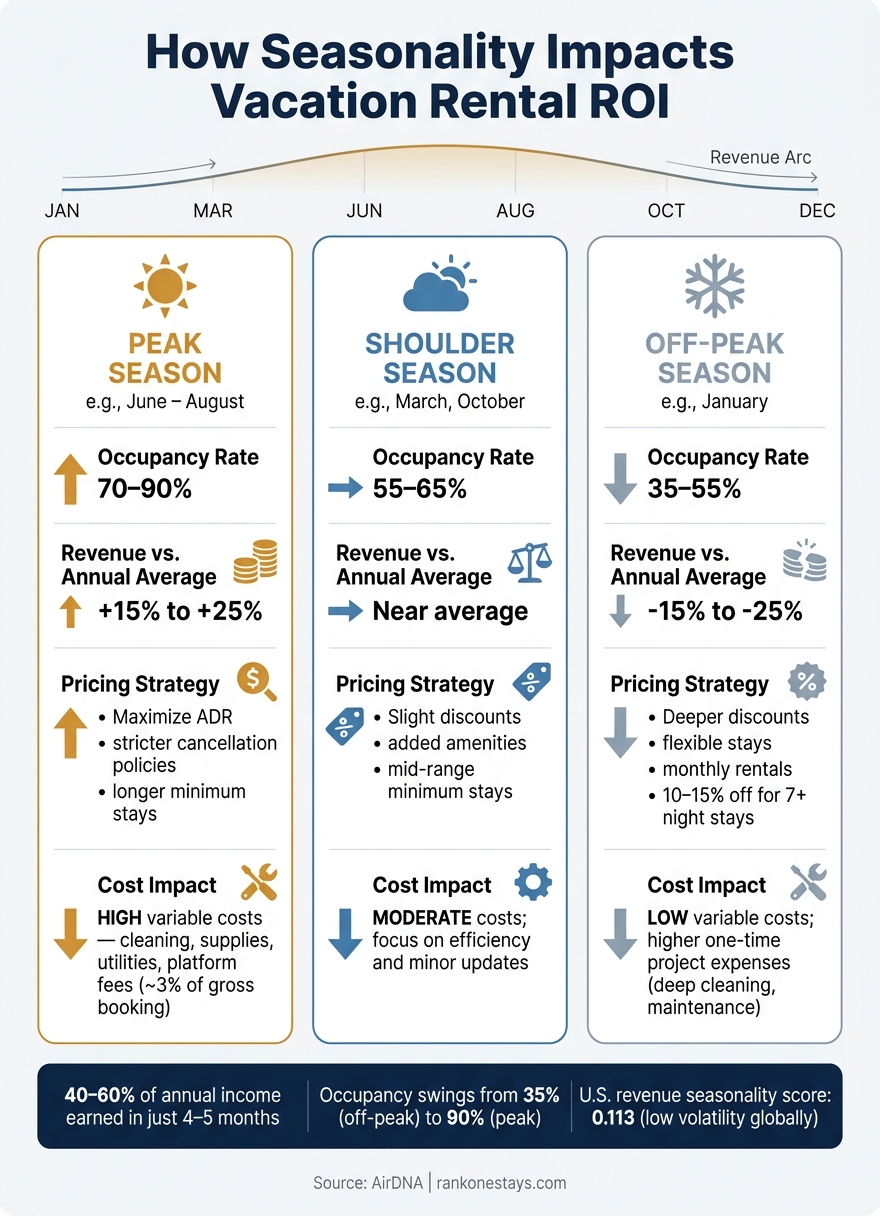
Vacation Rental Seasonality: Peak vs. Shoulder vs. Off-Peak Season Breakdown
How Seasonal Demand Shifts Drive Revenue Volatility
Once you’ve identified your property’s seasonal trends, it’s crucial to understand how these patterns affect your financial performance. The interplay between occupancy rates and Average Daily Rate (ADR) creates a rollercoaster effect on cash flow, making revenue unpredictable throughout the year.
During peak seasons, occupancy and ADR rise together, boosting revenue. But in slower months, both metrics drop, creating a double hit to your income. For example, in major U.S. markets, summer revenue (June–August) often exceeds the annual monthly average by 15% to 25% [2]. Conversely, winter in beach destinations or summer in ski towns can see revenue dip just as sharply below the average.
On a positive note, the U.S. has one of the lowest revenue seasonality scores globally, with a standard deviation of just 0.113 [2]. This stability largely stems from the country’s varied climates and strong domestic travel market. However, properties in single-season destinations can experience much larger swings than the national average, making local market dynamics critical to consider.
How Seasons Change Your Operating Costs
While revenue fluctuations are critical, your operating costs also ebb and flow, often in ways that aren’t immediately obvious. These cost patterns further shape your return on investment (ROI).
In peak months, variable costs spike due to higher guest turnover. Cleaning, laundry, and maintenance expenses rise, along with rapid consumption of supplies and increased wear on furniture and appliances. If you hire additional staff for the busy season, labor costs climb too. Platform fees – usually around 3% of the gross booking amount [6] – also increase automatically with higher nightly rates, driving up your per-booking costs.
During off-peak months, daily operating expenses drop, but this is often when savvy property owners tackle deep cleaning, appliance inspections, and preventive maintenance. These are real costs, but they’re one-time expenses rather than recurring ones. As AvantStay notes, "maintenance costs rise faster than general inflation for vacation rentals due to accelerated wear from frequent guest turnover" [7]. A good rule of thumb is to budget 1% to 1.5% of the property’s total value annually for maintenance [7].
| Season | Occupancy Trend | Cost Impact |
|---|---|---|
| Peak | 70–90% | High variable costs: cleaning, supplies, utilities, platform fees |
| Shoulder | 55–65% | Moderate costs; focus on efficiency and minor updates |
| Off-Peak | 35–55% | Lower variable costs; higher one-time project expenses |
These fluctuating costs, combined with fixed expenses, directly influence your annual ROI.
What Seasonal Patterns Mean for Annual ROI
When you combine seasonal revenue shifts with cost variations, fixed expenses amplify cash flow challenges during slower months. Your mortgage, insurance, and property taxes remain constant whether your property is fully booked in July or only seeing 35% occupancy in January. During these lean periods, fixed costs take up a much larger share of your revenue, which can even lead to negative cash flow for the month.
For instance, a property generating 80% of its annual revenue during four peak months may show a strong ROI on paper. However, this concentration of earnings leaves it vulnerable to cash flow issues during the rest of the year [9]. That’s why relying solely on a 10% annual yield – a common benchmark for short-term rentals [8] – doesn’t provide the full picture. Metrics like net operating income (NOI) and cash-on-cash return offer a more detailed view of how seasonality affects returns. As Scott Sage, Senior Vice President at AirDNA, explains:
"A 10% yield is a good ROI for your short-term rental, but you should also look at other metrics – like cap rate, NOI, and cash-on-cash return – to get the full picture of performance." [8]
Pricing missteps can make these challenges even worse. Underpricing during peak seasons or slashing rates too much in off-peak months can eat into your annual margins, making it harder to cover year-round expenses. Successful properties typically keep off-peak rates within 15% to 25% of peak-season prices to maintain rate integrity and protect their annual ROI [9].
Strategies to Reduce Off-Peak Revenue Dips and Stabilize ROI
Seasonal revenue swings are a challenge for many property owners, but there are actionable strategies to help smooth out those dips and keep returns consistent year-round.
Using Dynamic Pricing to Match Seasonal Demand
Static pricing can leave money on the table. Dynamic pricing, on the other hand, adjusts nightly rates based on real-time factors like local events, booking trends, day of the week, and occupancy rates compared to previous years. Tools like PriceLabs and Beyond Pricing use AI algorithms to automate these changes. For instance, if occupancy falls below 35% within 21 days of a stay, you could apply a 12% discount and offer a length-of-stay incentive. On the flip side, if a citywide event is detected, increasing rates by 25% and requiring a two-night minimum stay can help you capitalize on the demand. Setting floor and ceiling rates for each season ensures your pricing stays competitive while avoiding undervaluation or missed opportunities. Monitoring pacing – comparing current bookings to the same time last year at intervals like 7, 30, 60, and 90 days – provides an early signal to adjust rates effectively [3].
"The goal isn’t to fight seasonality – it’s to forecast it and prepare for it. That mental shift stops reactive discounting and turns busy and slow periods into planned revenue opportunities." – Aishwarya Iyer, PriceLabs [3]
Dynamic pricing is just one piece of the puzzle – targeted marketing is another key element.
Seasonal Marketing and Targeting the Right Guests
During off-peak times, consider shifting your focus to alternative guest segments like remote workers and digital nomads. With longer stays becoming more common, properties offering high-speed Wi‑Fi and dedicated workspaces can stand out. Highlight these features in your listing and consider offering discounts, such as 10–15% off for stays of seven nights or more. Limited-time promotions can also drive urgency – for example, a special rate for January bookings made before mid-December [5].
Adjusting Operations to Fit Seasonal Occupancy
Your operational expenses should align with occupancy levels. During slower periods, reduce cleaning and staffing hours to match the lower workload. Use the downtime for tasks like staff training, deep cleaning, and minor renovations. Preparing for peak times is also critical – stock up on consumables and linens in advance to avoid last-minute costs.
| Month Type | Forecasted Occupancy | Operational Focus |
|---|---|---|
| Low (e.g., January) | ~40% | Deep cleans; appliance checks; rate testing |
| Rising (e.g., March) | ~60% | Linen replenishment; vendor coordination |
| Peak (e.g., June–August) | 85–90% | Maximize housekeeping; secure backup vendors |
| Shoulder (e.g., October) | ~55% | Minor renovations; update listing photos |
| Event-Driven (e.g., December) | ~75% | Upgrade amenities; prep guest communications |
Expanding Your Guest Mix to Reduce Peak-Season Dependence
Diversifying your guest base is another way to stabilize cash flow. Relying too heavily on a single type of guest increases revenue risk. Offering longer-term stays – 30 days or more – can attract groups like traveling nurses, corporate relocations, or remote workers on extended assignments. Highlighting amenities like a fully equipped kitchen, fast internet, and a quiet location can help your property appeal to these guests, reducing reliance on peak-season travelers.
How Professional Management Helps with Seasonal Challenges
Implementing these strategies can be time-intensive, but professional management companies can simplify the process. They handle everything from optimizing listings and adjusting pricing to coordinating housekeeping and tracking booking trends. The use of market data services among property managers has grown significantly, from 13% pre-pandemic to 40% by 2022 [5], reflecting the shift toward data-driven decision-making.
Rank One Stays specializes in combining local market expertise with advanced revenue tools to help property owners navigate seasonal demand. Operating in markets like Scottsdale, Arizona, Denver, Colorado, Pittsburgh, Pennsylvania, and Lighthouse Point, Florida, they help owners earn 38% more revenue than the market average. With management fees starting at just 10%, their success is aligned with yours.
Conclusion: How to Build a More Stable Year-Round ROI
Seasonality is one of the most predictable aspects of vacation rental investing. Once you understand your property’s demand cycles, you can move away from reacting to slow months and instead focus on planning for them. This approach creates a solid foundation for steady, year-round returns.
Even though the U.S. rental market has a low revenue volatility score of 0.113 – indicating relative stability – seasonal revenue shifts can still be significant [2]. In thriving markets, these seasonal changes often bring sharp revenue peaks. The U.S. market’s consistent revenue profile, reflected in this low volatility score, highlights the effectiveness of strategies aimed at managing these fluctuations. This data provides a clear path forward for property owners.
"Understanding seasonality helps hosts optimize pricing, attract diverse guest segments, and stay profitable across different times of the year." – Bram Gallagher, Director of Economics and Forecasting, AirDNA [1]
The key takeaway? Dive into seasonal trends, adjust pricing dynamically, align your operations with occupancy patterns, and expand your guest base. These steps build on each other, transforming unpredictable cash flow into a more dependable annual return. By adopting these strategies, property owners can shift from a reactive mindset to proactive management.
Of course, managing these factors takes consistent effort. As discussed, tools like dynamic pricing, targeted marketing, operational alignment, and guest diversification are essential. Companies like Rank One Stays offer a comprehensive approach, combining pricing tools, local expertise, and operational support to keep property owners ahead of seasonal demand. Whether you’re in Scottsdale, Denver, Pittsburgh, or Lighthouse Point, their services can help you stay ahead of the curve. Check if your property qualifies today.
FAQs
How do I forecast my slow season months?
To predict slow season months, dive into seasonal demand patterns by examining data such as occupancy rates, booking trends, and market signals. Pay attention to both global and local influences, like holidays or significant events, that might impact demand. Keeping a close eye on these factors allows you to spot potential low-demand periods early. With this knowledge, you can tweak your pricing and marketing strategies in advance to help offset revenue declines during off-peak times.
What ROI metrics matter most with seasonal swings?
Key metrics to track return on investment (ROI) during seasonal fluctuations are occupancy rates, revenue per available rental (RevPAR), and cash-on-cash return. These indicators reveal how your property performs during both busy and slower seasons, offering insights to spot trends and adjust strategies to boost returns throughout the year.
How can I fill off-peak dates without slashing rates?
To attract guests during off-peak times without lowering rates, focus on adding extra perks or improving the overall experience. For instance, you could include complimentary services, enhance your property’s amenities, or implement seasonal pricing that matches demand patterns. Another smart move is working with a professional management company like Rank One Stays. They specialize in boosting revenue through strategies like dynamic pricing, effective marketing, and top-notch guest support, helping your property remain competitive and profitable throughout the year.