

A first-year cost segregation study can shift about 20% to 35% of an STR’s depreciable basis into shorter tax lives, which may create a much larger Year 1 deduction than standard 27.5-year depreciation. If your short-term rental has furniture, appliances, a pool, decks, landscaping, or other outdoor features, the tax write-off in the first year can be far larger than many owners expect.
Here’s the short version:
- I can often move parts of an STR into 5-, 7-, or 15-year property
- With 100% bonus depreciation for qualifying property placed in service after January 19, 2025, much of that amount may be deducted in Year 1
- A formal study often costs about $5,000 to $8,000
- The math tends to work better when depreciable basis is around $300,000 to $500,000+
- To use losses against W-2 or other active income, the average stay usually must be 7 days or less and I must meet material participation rules
- I also need to think about depreciation recapture, state tax treatment, and recordkeeping before moving ahead
In plain English: this is a timing play. I’m not creating a new deduction out of thin air. I’m pulling more of it into the first year.
A simple example shows why people look at this. On a $500,000 property with 20% land value, a rough estimate could produce about $114,545 in Year 1 depreciation and about $40,090 in federal tax savings at a 35% tax rate. But that only matters if I can use the loss this year and the study fee makes sense.
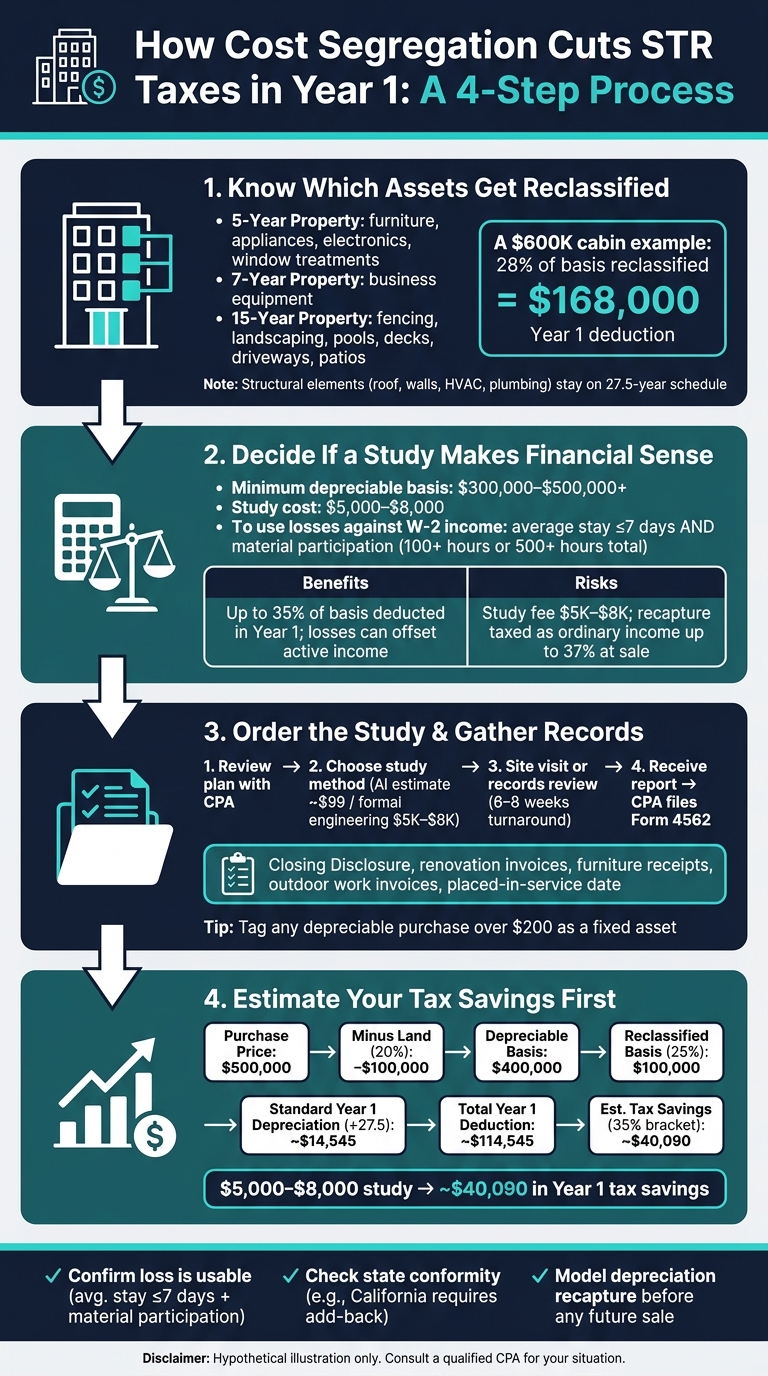
Cost Segregation Study: 4-Step Process to Cut STR Taxes in Year 1
How Cost Segregation Works for Short Term Rentals (and When It Makes Sense)
sbb-itb-103bddb
Quick comparison
| Item | Standard depreciation | Cost segregation in Year 1 |
|---|---|---|
| Main tax life | 27.5 years | 5, 7, 15, and 27.5 years |
| Year 1 write-off | Often modest | Often much larger |
| Best fit | Plain rental with fewer assets | STR with furnishings and site improvements |
| Upfront cost | None beyond normal tax prep | Study fee, often $5,000 to $8,000 |
| Main risk | Slower deductions | Recapture and misuse of losses |
So before I order a study, I’d check four things: how much basis can be reclassified, whether I can use the loss, what the study costs, and how recapture may affect a future sale.
Step 1: Know Which Assets Get Reclassified in a Vacation Rental
Cost segregation shifts part of an STR’s purchase price into shorter-life asset classes, which can push more depreciation into Year 1. Put simply, instead of treating almost everything as one long-term building asset, the study pulls out parts that qualify for faster write-offs. Those are the buckets to look at first when you’re deciding if a first-year study is worth the fee.
5-, 7-, and 15-Year Assets Commonly Found in STRs
Five-year property usually includes furniture, appliances, electronics, window treatments, and other removable components. Seven-year property covers business equipment used to run the rental [6]. Fifteen-year property usually includes fencing, landscaping, irrigation, driveways, patios, decks, pools, spas, and outdoor lighting [5][6].
Here’s why that matters: these shorter schedules can front-load depreciation in a big way. In one $600,000 cabin example, cost segregation reclassified 28% of basis and produced a $168,000 Year 1 deduction [3].
The more furniture, outdoor features, and site upgrades a vacation rental has, the more likely the study leads to meaningful Year 1 tax savings.
What Stays on the Longer Depreciation Schedule
The building structure and permanent systems – foundation, roof, walls, plumbing, wiring, HVAC, and windows – generally stay on the 27.5-year residential rental schedule [2][6]. If the property is classified as nonresidential, those same structural items generally fall under a 39-year schedule.
So no, cost segregation doesn’t speed up everything. Only the parts that qualify get moved into shorter recovery periods.
Standard Depreciation vs. Cost Segregation: A Side-by-Side Look
The table below shows how the same hypothetical $1,000,000 STR looks under each approach in Year 1.
| Feature | Standard Depreciation | Cost Segregation (with 100% Bonus) |
|---|---|---|
| Recovery period | 27.5 years (straight-line) [1][6] | 5, 7, 15 years for reclassified assets |
| Year 1 deduction | ~$36,364 (~3.6% of building value) [1][6] | $250,000–$350,000 (20%–35% of basis) [4][6] |
| Asset treatment | Entire building as one bucket | Separated into personal property, land improvements, and structure |
That Year 1 deduction gap is the whole reason this step matters. Once you know how much basis can shift into shorter-life property, you can start sizing up whether the study fee pays for itself fast enough in Year 1.
Step 2: Decide Whether a Study Makes Sense in Year 1
Not every STR should get a cost segregation study in Year 1. The numbers need to pencil out. And that comes down to three things: what you paid for the property, how much you spent furnishing or upgrading it, and whether you can use the losses in the current tax year.
The key issue isn’t just whether the study creates deductions. It’s whether those deductions are big enough to justify a $5,000 to $8,000 fee.
Property Cost, Furnishing Budget, and Amenity Level
A formal study usually makes more sense when you have $300,000 to $500,000 of depreciable basis or more. Below that range, the study fee can eat up a big chunk of the tax savings [3][5].
Amenity level matters too. A vacation rental with a pool, landscaping, paving, and nicer furniture or decor will often have more basis tied to 5-, 7-, and 15-year assets than a plain unit. And that’s the whole point of cost segregation: pulling those assets out and speeding up depreciation on them [6].
So if the property clears the fee test, there’s another hurdle: can you use the losses this year?
When Year 1 Losses Can Offset Active Income
A big deduction only helps if you can use it in Year 1. To offset W-2 income or other active income, the STR must average 7 days or less per stay for the tax year, and you must materially participate. In most cases, that means:
This is one area where people get tripped up. The IRS can audit material participation claims, so keep contemporaneous time logs. Also, don’t assume these losses will offset your salary without checking with a CPA who knows STR rules well.
Benefits vs. Trade-Offs of Ordering a Study
A cost segregation study can create a big Year 1 deduction. But it’s not free money. The upside is real, and so are the costs and risks.
| Benefit | Trade-Off / Risk |
|---|---|
| Large Year 1 deductions – up to 35% of basis – can cut or wipe out federal tax bills [3][4] | Formal study fees run $5,000–$8,000; on smaller properties, that can cancel out much of the savings [3][5] |
| Losses can offset W-2 or business income if you meet material participation rules [4][6] | Accelerated depreciation on 5-, 7-, and 15-year assets is recaptured as ordinary income, up to 37%, when the property is sold [3] |
| Upfront deductions can outweigh the study fee on larger properties | You need strict records: time logs, asset records, and proof of average stay length [4][6] |
One issue that catches a lot of owners off guard is depreciation recapture. When you sell, the IRS recaptures the accelerated portion as ordinary income at rates up to 37%. That’s different from the 25% cap that applies to standard real property under §1250 [3].
If the numbers still make sense after fees, participation rules, and recapture, the next step is getting the records your study provider will ask for.
Step 3: Order the Study and Gather the Right Records
If the Year 1 numbers check out, the next step is simple: pull together the records that show basis, assets, and timing.
The Process from Placed-in-Service Date to Final Report
Start with two dates:
- Acquisition date: when you closed on the property
- Placed-in-service date: when the property was first available to rent
That second date matters most because it’s what starts depreciation.
From there, the process usually goes like this:
- Review the plan with your CPA so you can confirm average stay length and material participation before you order anything.
- Pick a study method. Formal engineering studies tend to make sense for larger or more complex STRs. AI-powered software estimates can work well for smaller properties or for a fast screen before you move ahead with a formal study. AI-powered reports can cost about $99 and return results in minutes [3].
- Finish the records review or site visit. Formal studies may include a physical or virtual walkthrough. Turnaround for a full engineering study is usually 6 to 8 weeks [3].
- Get the final report and send it to your CPA, who will use it to complete Form 4562 on your tax return.
Once the workflow is clear, the next piece is cost – and the paperwork the provider will want.
Typical Fees and the Records Providers Usually Request
Formal engineering studies for residential STRs usually cost $5,000 to $8,000, though fees for smaller single-family properties can fall into the low thousands depending on complexity [3][5]. Good records can help move the report along.
Most providers will ask for documents like these:
| Document Category | What to Provide |
|---|---|
| Acquisition | Closing Disclosure or HUD-1 settlement statement, purchase contract, appraisal if available |
| Improvements | Renovation invoices, contractor scopes of work, floor plans or site drawings |
| Furnishings | Furniture receipts, appliance bills, staging invoices |
| Outdoor Work | Landscaping, paving, and pool invoices |
| Placed-in-Service | First date the property was available for guests, utility connection records |
One smart habit is to tag any depreciable purchase over $200 as a fixed asset in your bookkeeping software. Sofas, appliances, and other capital items are much easier to track that way [5]. When the paper trail is clean, the report usually moves faster.
How Organized Management Records Can Support the Study
Rank One Stays clients often already have furnishing invoices, staging receipts, inventory lists, and improvement records on file [5]. If you want a cleaner paper trail from day one, that kind of organization helps a lot.
And there’s a bonus: the same records you gather here are also the ones you’ll use to estimate tax savings before you pay for a study.
Step 4: Estimate Your Tax Savings Before Paying for a Study
Once you have the property records, do a quick estimate before you order the report. The goal is simple: see if the tax upside is big enough to cover the cost of a formal engineering study.
A Five-Step Estimate Owners Can Run on Their Own
Start with your total depreciable basis. That usually means the purchase price, plus closing costs and capital improvements, minus land value. After you back out the land value, you have your depreciable building basis.
From there, apply a cautious 20% to 25% reclassification rate to the building basis. Then compare that figure with standard Year 1 depreciation by dividing the building basis by 27.5. The difference between those two numbers is your Year 1 tax advantage. Multiply that gap by your federal tax rate to get a rough estimate of first-year cash savings [3][6].
A Hypothetical Example for a U.S. Vacation Rental
The following is a hypothetical illustration only. Actual results will vary based on property type, location, and tax situation.
In this example, a $5,000–$8,000 study could unlock about $40,000 in first-year tax savings. Here’s the math:
| Step | Calculation | Result |
|---|---|---|
| 1. Purchase Price | Base value | $500,000 |
| 2. Land Allocation (20%) | $500,000 × 0.20 | ($100,000) |
| 3. Depreciable Building Basis | $500,000 − $100,000 | $400,000 |
| 4. Reclassified Bonus-Eligible Basis | $400,000 × 0.25 | $100,000 |
| 5. Standard Year 1 Depreciation | $400,000 ÷ 27.5 | ~$14,545 |
| 6. Total Year 1 Deduction | Bonus + Standard | ~$114,545 |
| 7. Est. Tax Savings (35% Bracket) | $114,545 × 0.35 | ~$40,090 |
That’s a big spread. On the other hand, if your own estimate comes out much smaller, it may make sense to pause before paying for a formal study [3][5].
Conclusion: Key Decisions to Make Before Ordering a Study
Before you move ahead, check three things:
- Confirm the loss will be usable. Your average guest stay, material participation, and any passive income limits all matter [4][6].
- See whether your state follows federal bonus depreciation rules. California, for example, requires a tax add-back, which can shrink the net tax result [3].
- Run the numbers on depreciation recapture before a sale [3][6].
It also helps to keep your purchase, land, furnishing, and improvement records in one place. That way, when it’s time to order the study, you’ll have the backup ready for the numbers behind it. If the estimate clears both the fee test and the tax-rule check, ordering the study starts to look like a smart move.
FAQs
Can I use Year 1 loss against my W-2 income?
Yes – if you qualify for the short-term rental loophole. Your property must average guest stays of seven days or less, and you must show material participation in day-to-day operations.
If you meet both rules, the rental can be treated as non-passive. That means Year 1 losses from accelerated depreciation through a cost segregation study may offset W-2 income.
What assets in an STR qualify for faster depreciation?
In a short-term rental, a cost segregation study can move parts of the property out of the standard 27.5-year residential depreciation schedule and into shorter asset classes, most often 5-year, 7-year, and 15-year property.
That usually includes personal property such as furniture and appliances, along with some structural improvements and other non-permanent components. The big upside is simple: owners may be able to use bonus depreciation and take larger deductions in the first year.
How do I know if a cost segregation study is worth the fee?
It’s usually worth paying for a cost segregation study if your property basis is at least $300,000. Below that point, the fee can eat up too much of the tax savings.
It can also make sense if you plan to offset active income through the short-term rental loophole or real estate professional status. A formal study often costs $5,000 to $8,000, while $99 AI-driven tools can give you a rough savings estimate before you pay for the full study.