
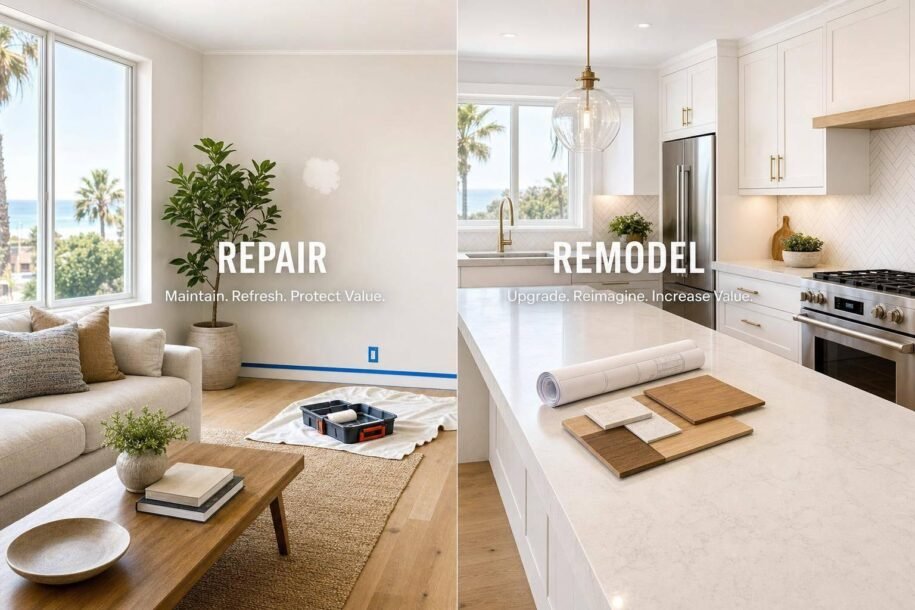
One tax call changes everything: if a short-term rental cost is a repair, I usually deduct it this year. If it’s an improvement, I usually recover it over time through depreciation.
Here’s the short version for me as an STR owner:
- Repairs keep the place working, like fixing a leak or patching drywall.
- Improvements add to the property, extend its life, or change its use, like a new roof or a full kitchen redo.
- I can sort most projects with the IRS BAR test:
- Betterment
- Adaptation
- Restoration
- If the work meets any of those tests, I usually capitalize it.
- Then I match it to the right tax life:
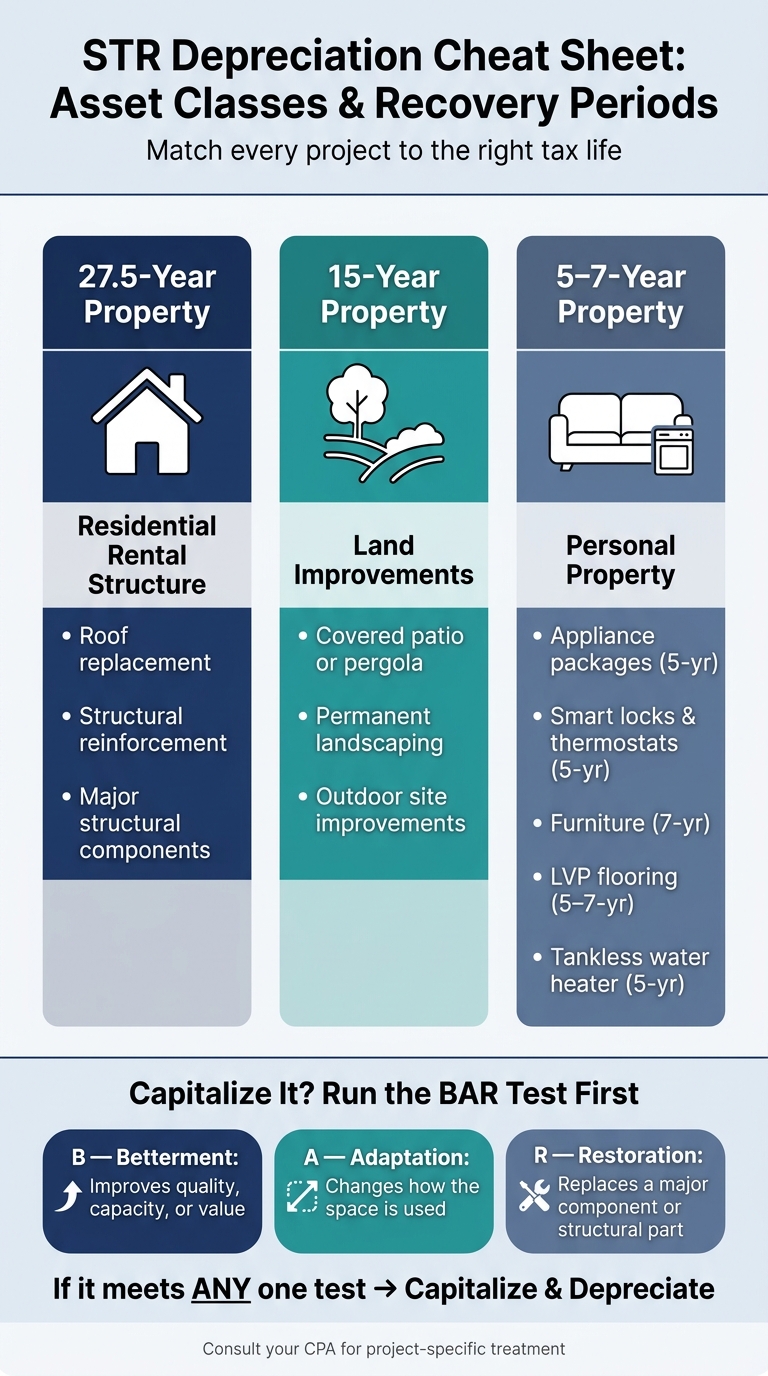
- 27.5 years for much of the building
- 15 years for many outdoor site items
- 5 or 7 years for many items like appliances, locks, and furniture
- Timing matters too:
- Depreciation starts when the property is ready and available for rent
- Work before launch often goes into basis
- Mixed personal and rental use means I split expenses
- If one invoice includes both repair work and improvement work, I should split the bill by line item
- Good records matter: invoices, photos, permits, payment proof, and depreciation schedules
About 15 to 20 hours per month per property can go into self-managing an STR, and tax records are part of that workload. That’s why clear classification and clean documentation matter.
STR Tax Guide: Repair vs. Improvement & Depreciation Periods
Understanding Repairs and Improvements For Real Estate Investors
sbb-itb-103bddb
Quick Comparison
| Item | Repair | Improvement |
|---|---|---|
| Main purpose | Keeps property in working order | Adds to property, extends life, or changes use |
| Tax treatment | Usually deduct now | Usually depreciate over time |
| Effect on basis | Usually no change | Usually increases basis |
| Common example | Fixing a faucet | Replacing a roof |
If I’m unsure, I ask one plain question: did this job just keep the rental running, or did it make it better, restore a major part, or change how space is used? That answer usually points me to the right tax treatment.
1. Repair vs. improvement: the IRS tests STR owners should apply

Use the IRS tests to sort each project the right way. Start with the BAR test. That test tells you whether a cost can be deducted now or needs to be capitalized. In plain English: before you write anything off, run the project through BAR.
The BAR test: betterment, adaptation, or restoration
If a project meets any one of these tests, capitalize it:
- Betterment – The work materially improves quality, capacity, or value. Upgrading to a high-efficiency HVAC system is a common example [3].
- Adaptation – The work changes how the property or space is used. Converting an attic into a bedroom or adding a room fits here [6].
- Restoration – The work replaces a major component or structural part. Examples include replacing a roof or repairing major structural damage [3][6].
What usually counts as a repair in a short-term rental
Repairs bring the property back to normal working condition without adding value or extending useful life. For STRs, that usually means routine maintenance work like touch-up painting, patching drywall, fixing a leaking faucet, and replacing worn parts [6][4].
A simple rule of thumb helps here: if the job changes the property’s value, use, or structure, it likely belongs on the improvement side.
What usually counts as a capital improvement
Capital improvements change the structure, layout, or function of the property. Moving walls or changing a layout are classic examples [6]. A new roof lands here too because it restores a major component [3][6].
Some projects sit in a gray area. When that happens, the BAR test is the tie-breaker. Once you classify a project as an improvement, the next move is to match it to the right recovery period.
2. Depreciation periods and asset classes for STR projects
Once a project is capitalized, the next step is simple in theory but easy to mess up in practice: put it in the right recovery period.
For most short-term rental work, that usually means sorting the cost into one of three buckets:
- 27.5-year residential rental property
- 15-year land improvements
- 5- or 7-year personal property
27.5-year property vs. shorter-life assets
The residential building itself, along with structural parts of the property, usually falls under 27.5-year residential rental property [6][5].
Items like furniture, appliances, and other personal property often fall into 5- or 7-year recovery periods. Land improvements often use 15 years [1][8].
That split matters. A roof and a sofa may both cost money in the same remodel, but they do not get depreciated the same way.
Common STR projects and their usual tax treatment
Use this table as a quick map for common STR projects and the recovery period they usually trigger.
| Project | Usual recovery period / asset class |
|---|---|
| Roof replacement | 27.5-year residential rental property [6][8] |
| Structural reinforcement | 27.5-year residential rental property [6] |
| New appliance package | 5-year personal property [8] |
| Smart locks and thermostats | 5-year personal property [1][8] |
| Furniture | 7-year personal property [1][8] |
| New LVP flooring throughout | 5- or 7-year personal property [8] |
| Covered patio or pergola | 15-year land improvements [8] |
| Permanent landscaping | 15-year land improvements [8] |
| Tankless water heater | 5-year personal property [8] |
Your CPA should confirm the treatment based on the exact facts of each project.
After the asset class is set, the next issue is timing – specifically, when depreciation begins.
3. Placed-in-service dates, pre-rental work, and mixed-use timing
Timing matters just as much as classification.
When an STR is placed in service
Depreciation starts when the property is ready and available for rent – not when the first guest actually checks in. So if the unit is furnished, listed, and open for bookings, the depreciation clock can start at that point. The same rule applies to later upgrades too: each improvement begins its own depreciation period when it is ready for use [1].
Pre-launch renovations vs. post-launch repairs
Work done before the property is ever listed usually gets added to the property’s basis instead of being deducted right away. Put simply, pre-launch work is usually capitalized into basis. After the rental is up and running, repairs that meet the rules are generally deductible in the current year [1].
That timing line matters more than many owners expect. The same type of job can land in two very different tax buckets depending on whether it happened before launch or after the property was already operating as a rental.
Owner use creates another timing issue: mixed-use allocation.
Owner use, seasonal gaps, and between-booking work
If you rent the property for 14 days or fewer during the calendar year, the rental income is tax-free. The tradeoff is that you can’t deduct rental expenses or depreciation. Once you rent it for more than 14 days, that de minimis rule no longer applies, and deductions for depreciation, repairs, and other rental costs may be allowed [1].
If the property has both personal use and rental use, you have to split expenses between those two uses. Only the rental share is deductible [1].
Vacancy by itself does not stop depreciation, as long as the property stays listed and available for rent [1][10]. The same goes for routine maintenance between bookings – it can still be deductible if the property is actively listed and available to rent [1].
When a project includes both repair work and improvement work, it helps to split invoices and track costs by line item. That makes it much easier to give each expense the right tax treatment.
4. Partial upgrades, bundled invoices, and how to allocate costs correctly
How partial replacements are evaluated
The IRS looks at the unit of property involved, such as the roof, HVAC, an appliance, or another separate asset[3][4]. That’s the starting point for how a cost gets treated.
Here’s the basic idea: replacing a few damaged shingles is usually a repair to the roof system. Replacing the whole roof is usually a capital improvement. HVAC works the same way. If you fix one part, that’s often a repair. If you replace the entire unit, you’re usually dealing with an improvement.
When one project includes both kinds of work, split the costs before you assign tax treatment. If you lump everything together, it gets much harder to deduct the right amount now and depreciate the rest later.
How to split bundled invoices on mixed projects
One contractor invoice can easily include repair work and improvement work on the same bill. That’s where itemized invoices help. Ask the contractor to break out labor and materials by task so each line can be classified on its own[10].
Classify each line item separately.
| Work Type | Classification | Tax Treatment |
|---|---|---|
| Replacing a few broken shingles or fixing a leak | Repair | Deduct in current year |
| Full roof or window replacement | Improvement | Depreciate over time |
| Fixing a leaky faucet or toilet | Repair | Deduct in current year |
| Kitchen countertop replacement as part of a remodel | Improvement | Depreciate over time |
| Patching and painting a small hole in drywall | Repair | Deduct in current year |
This part matters more than many owners think. The way you allocate the bill affects both your current-year deduction and your capitalized basis. In plain English: the split on the invoice can change how much you write off now versus later.
When cosmetic work becomes part of a larger remodel
Cosmetic work like painting is often deductible when it stands on its own. But if that same painting is done as part of a larger renovation, it’s usually capitalized with the rest of the project[5].
That’s why it helps to separate small standalone repairs from work wrapped into a remodel. A clean, itemized invoice makes that much easier and keeps your depreciation records organized. After the split, track each cost line by repair, improvement, and depreciation schedule.
5. Recordkeeping workflow for owners and managers
What records to keep for every repair and remodel
Once you classify the work, the next job is simple: document it well enough to back up the deduction.
Good records can make the difference between a clean tax file and a messy one. For every repair or improvement at your STR, keep a dedicated digital folder sorted by property and project date [7][11].
| Record Type | Examples to Keep | Purpose |
|---|---|---|
| Proof of Work | Contractor scopes of work, change orders | Supports classification |
| Financial | Dated invoices, receipts, proof of payment, bank statements, 1099-NEC copies | Substantiates amounts for tax reporting |
| Legal/Compliance | Permits, inspection sign-offs, registration certificates, correspondence with local code compliance offices | Supports code compliance and legal operation |
| Visual | Timestamped before-and-after photos | Provides physical evidence of work and condition changes |
| Operational | Pest control logs, pool inspection records, utility bills | Supports routine maintenance deductions |
Tag each expense to the right property and the right project. That sounds basic, but it saves a lot of cleanup later. Keep the 1099-NEC for contractors paid $600 or more [2].
For major work, save timestamped photos and any required permits. If work is done without permits, it can lead to insurance and resale issues [9]. It also helps to photograph the space before walls, floors, or other areas are closed up, since that gives you a clear record of the original condition and what changed [7][11].
How to track repairs, capital improvements, and depreciation schedules
Once the paperwork is stored, your books need to match the tax treatment.
Code expenses separately so repairs, improvements, and depreciation land in the right places [2]. Use separate categories in your books to make Schedule E and Form 4562 easier to prepare [2].
A good setup might split costs into repair expense, capital improvement, and depreciable assets. That way, when tax time comes around, you’re not guessing what belongs where.
Reconcile bank records, bookkeeping records, and guest records every month. Doing this monthly helps you catch duplicate charges and miscategorizations early, before they turn into a bigger problem [2].
How professional STR management helps with documentation and reporting
Self-managing an STR often takes 15 to 20 hours a month per property [10]. That time adds up fast, especially when maintenance issues, contractor invoices, and owner reporting all hit at once.
Rank One Stays centralizes owner reporting, housekeeping, and maintenance triage, which helps keep repair and improvement records tax-ready.
This kind of centralized reporting matters most when projects happen often and the paperwork needs to stay consistent across the year.
Conclusion: A simple decision framework for STR depreciation and deductions
Once you’ve worked through BAR, asset class, timing, and cost allocation, the last call is pretty simple. For any STR project, ask this: does the work keep the property running, or does it improve, adapt, or restore it? If it keeps the place operating, it’s likely a repair. If it improves, adapts, or restores the property, it’s a capital improvement that must be depreciated over time.
Before filing, check four things:
- The BAR test
- The placed-in-service date
- The correct asset class
- Proper cost allocation on mixed invoices
Good records protect your deductions and back up your depreciation schedules. Keep one project file for each property with invoices, photos, dates, and contractor records. That’s where centralized STR management can make life a lot easier. If records are getting messy across several properties, Rank One Stays can help keep reporting, maintenance, and damage records organized.
FAQs
How do I handle a project that includes both repairs and improvements?
Separate these costs for tax purposes.
Repairs are usually deductible in the year you pay for them. Improvements, on the other hand, need to be capitalized and depreciated because they add value or extend the life of the property. For residential real estate, that depreciation usually runs over 27.5 years.
If a contractor gives you one bundled invoice, ask for an itemized breakdown. It makes your records cleaner and helps you split the deductible repair work from the capitalized improvement work.
Keep solid documentation, such as:
- Invoices
- Before-and-after photos
- Notes that show what was fixed versus what was upgraded
That paper trail can help support both the repair deduction and the capitalized portion.
When does depreciation start for a short-term rental?
Depreciation starts when the short-term rental is placed in service. That means the property is ready and available to rent.
Once that happens, you can start the standard 27.5-year depreciation schedule for the building’s value. It’s smart to keep clear records of the placed-in-service date, along with any capital improvements, so your tax reporting stays accurate.
What records should I keep for repairs and remodels?
Keep a digital project folder for each property. Add dated records for inspections, repairs, and vendor visits, along with contracts, change orders, receipts, permits, and final inspection reports.
It also helps to save before-and-after photos, document wall cavities before they’re closed up, track material choices and spending, and sort each transaction into the right Schedule E category. That way, repairs and capital improvements stay clearly separated.