
If you run rental arbitrage, personal insurance usually isn’t enough. In most cases, you need a stack that covers guest injuries, your furniture and supplies, lost income, staff risks, and local hazards.
Here’s the short answer:
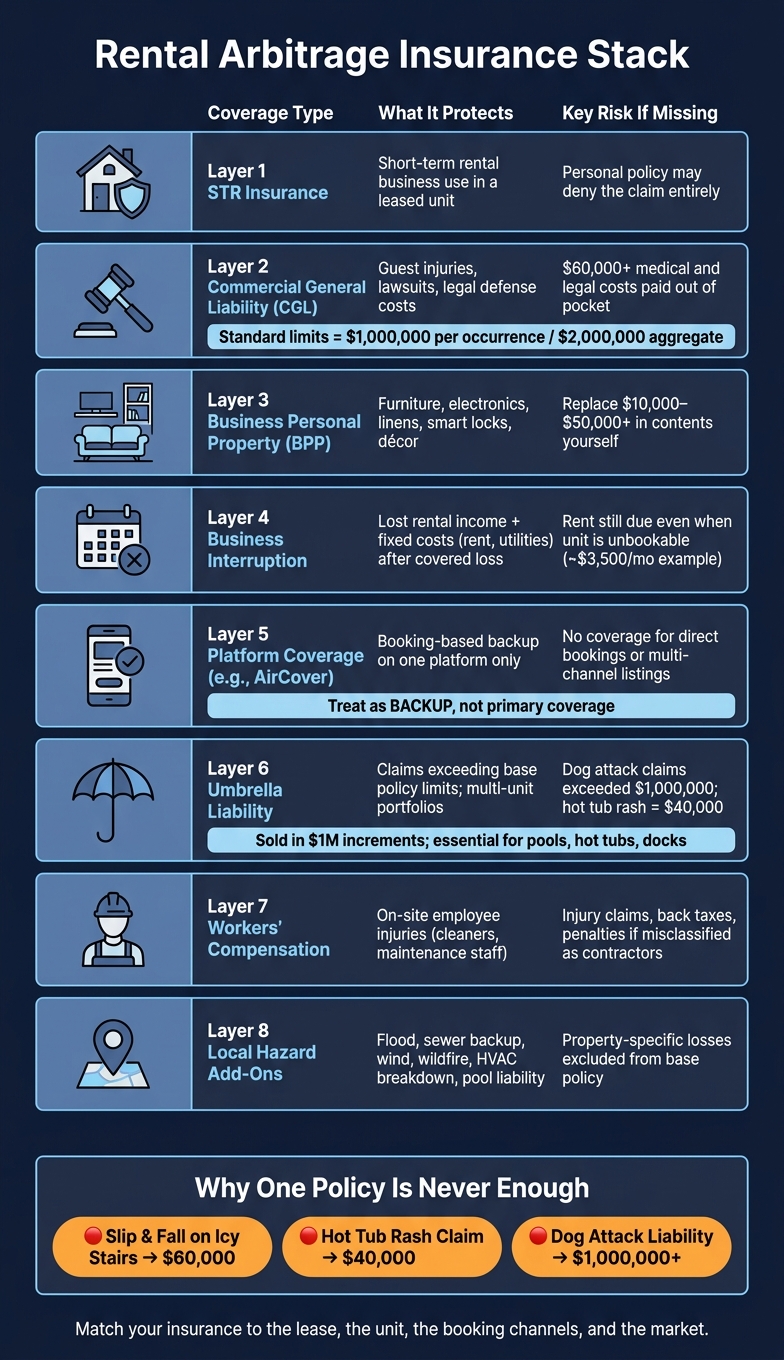
- I’d start with short-term rental insurance for a leased unit
- I’d add commercial general liability, often at $1,000,000 per occurrence and $2,000,000 aggregate
- I’d protect my setup with business personal property coverage for items that can cost $10,000 to $50,000+
- I’d add business interruption in case a covered loss stops bookings and rent is still due
- I’d treat platform coverage like Airbnb AirCover as a backup, not my main policy
- I’d look at umbrella liability if I had more units or high-risk features like pools or hot tubs
- I’d carry workers’ comp if I employed cleaners or maintenance staff directly
- I’d add local coverage for things like flood, sewer backup, wind, wildfire, or HVAC breakdown
A claim can get expensive fast. The article points to examples like a slip-and-fall costing $60,000, a hot tub claim costing $40,000, and a dog attack going past $1,000,000. That’s why the right setup is not one policy. It’s layers.
Rental Arbitrage Insurance Stack: Coverage Types, Costs & Gaps
Rental Arbitrage 101: What It Is, Is It Legal, and How to Insure It the Right Way
sbb-itb-103bddb
Quick comparison
| Coverage type | What I’d use it for | Main gap if missing |
|---|---|---|
| STR insurance | Short-term rental business use in a leased unit | Personal policy may deny the claim |
| General liability | Guest injuries, lawsuits, legal defense | Medical and legal costs come out of pocket |
| Business personal property | Furniture, linens, electronics, smart locks | I pay to replace damaged items myself |
| Business interruption | Lost income and fixed bills after a covered loss | Rent and utilities still have to be paid |
| Platform protection | Extra booking-based backup on one platform | No coverage for direct bookings or all channels |
| Umbrella liability | Extra liability limit above base policy | Big claims can exceed base limits |
| Workers’ comp | Injuries to employees | Injury claims, penalties, and payroll issues |
| Local add-ons | Flood, sewer backup, wind, wildfire, pool risks | Property-specific losses may be excluded |
Bottom line: I’d make sure the insurance matches the lease, the unit, the booking channels, and the market before listing the property.
1. Short-Term Rental Insurance and General Liability
The first layer is dedicated short-term rental insurance paired with commercial general liability. Rental arbitrage needs commercial coverage because frequent guest turnover and business use usually sit outside most personal policies.
Dedicated STR Policies for Leased, Non-Owner-Occupied Units
A dedicated STR policy is written as a commercial business policy, not a personal one. That difference matters. Standard homeowners or renters insurance often excludes business activity, which can leave rental arbitrage operators exposed.
For leased, non-owner-occupied units, this kind of coverage can help pay for guest damage, liability claims, and lost income after a covered loss [6].
Once that base is in place, the next piece is protecting the unit’s contents and the income tied to it.
Commercial General Liability for Guest Injuries and Legal Defense
Commercial general liability (CGL) covers guest injuries, legal defense, and claims tied to your rental business. Standard limits for STR operators are $1,000,000 per occurrence and $2,000,000 aggregate [6].
That legal defense piece matters more than many operators think. CGL can cover defense costs even if a claim is groundless or later dismissed [6]. In plain English, you may still face legal bills even when you did nothing wrong.
A simple example: a guest slips on icy stairs. That kind of accident can lead to $60,000 in medical and legal costs, and without CGL, those costs can land on the operator [7].
Platform Protection vs. Third-Party Insurance
Platform programs like Airbnb’s AirCover are not the same as dedicated insurance. They can help, but they don’t replace a policy built for your business.
As of March 1, 2025, Airbnb’s $1,000,000 commercial general liability protection has limited scope for managers or co-hosts with 6 or more active listings [7]. Platform coverage also does not include professional liability, also called errors and omissions, and it may leave gaps for incidents tied to amenities you provide, such as bicycles, kayaks, or golf carts [6][7].
| Feature | Platform Coverage (e.g., AirCover) | Dedicated STR + CGL Insurance |
|---|---|---|
| Booking sources covered | That platform only | All channels, including direct bookings |
| Professional liability (E&O) | Not included [7] | Often included or available as an add-on |
| Off-premises amenities | Limited or excluded [6] | Can extend to bicycles, kayaks, and golf carts [6] |
| Multi-unit operators | Limited scope for managers or co-hosts with 6+ active listings as of March 1, 2025 [7] | No unit-count restriction |
That last point is the big one. If you take direct bookings or list on more than one channel, platform protection is a backup – not your main safety net.
2. Contents Coverage, Business Personal Property, and Income Protection
Once liability is covered, the next thing to protect is the stuff inside the unit and the income the unit brings in.
Coverage for Furniture, Electronics, Linens, and Hosting Supplies
In rental arbitrage, you own the contents inside the leased unit. The landlord owns the walls. That split matters because the items you bring in – furniture, electronics, linens, smart locks, décor, and hosting supplies – are usually treated as Business Personal Property (BPP), not personal belongings [3][1].
That’s a big deal. Standard renters or personal policies often limit or leave out contents used for business purposes [2]. And the numbers add up fast. Furnishings and tech alone can run $10,000 to $50,000 or more [3]. If your coverage is too low, you could be stuck paying the difference out of pocket after a loss.
So the goal is simple: set your BPP limit high enough to cover the full replacement cost of what’s in the unit.
Use BPP to replace the unit’s contents. Use business interruption to protect the income tied to those contents.
Business Interruption When a Covered Loss Stops Bookings
If a covered loss makes the unit unbookable, the bills don’t stop. Rent is still due. Utilities still hit your account. That’s where business interruption coverage, also called loss-of-income coverage, comes in.
This coverage is meant to help replace lost rental revenue and pay fixed costs like rent and utilities during the restoration period [2][5]. For a sense of scale, a 3-bedroom short-term rental in a market like Houston can bring in about $42,000 in gross annual revenue [5]. That comes out to roughly $3,500 per month.
The table below shows what each coverage type usually includes, what it often leaves out, and what insurers tend to ask for when you file a claim.
| Coverage Category | Typically Covered | Often Excluded | Required Documentation |
|---|---|---|---|
| Contents / BPP | Furniture, electronics, linens, décor, kitchenware, smart locks [3][1] | Normal wear and tear, gradual deterioration, guest theft (unless specified) [3][5] | Purchase receipts, professional photos of staged rooms, itemized inventory lists [1] |
| Business Interruption | Lost rental income, fixed lease payments, essential utilities [2][5] | Losses from bad reviews, platform delisting, market downturns, or regulatory shutdowns [2][5] | Historical booking history from your PMS, tax returns, signed lease agreement [1] |
| Restocking Supplies | Bulk toiletries, linens, cleaning supplies, coffee and tea [3][4] | Perishable food, items used personally by the host | Inventory logs, supply invoices, restocking records [4] |
Keep turnover photos and inventory records. When a claim is filed, payment usually comes down to proof of condition and proof of ownership.
3. Umbrella Coverage and Workers’ Compensation
After you’ve protected contents and income, the next weak spots are large liability claims and injuries involving people who work at the property.
Umbrella Liability for Larger Claims and Multi-Unit Portfolios
Umbrella coverage sits on top of your STR and CGL limits and adds $1 million or more when a claim goes past your base policy. It’s usually sold in $1 million increments [7].
This starts to matter a lot more once a property has a pool, hot tub, dock, or more units. The risk can jump fast. In one case, a dog attack at a vacation rental led to a liability claim of more than $1,000,000 [7]. In another, a guest developed a rash from a hot tub, which turned into $40,000 in legal and medical costs [7].
The table below links portfolio size and risk level to base liability needs and shows when it makes sense to talk with a broker about umbrella coverage [7].
| Portfolio Size / Risk Profile | Suggested Base Liability | Umbrella Discussion Trigger |
|---|---|---|
| Small (1–5 units) | $1,000,000 CGL | Recommended if the property has a pool or hot tub |
| Growing (6–10 units) | $1,000,000+ third-party CGL | Essential once platform-provided coverage limits are reached |
| Large (10+ units) | $2,000,000+ commercial policy | $1,000,000–$5,000,000 umbrella to protect business assets across the portfolio |
| High-risk amenities | $1,000,000+ specialized STR policy | Immediate need due to higher tort exposure |
Workers’ Compensation and Employer Liability for Staff and Recurring Vendors
Liability insurance handles guest claims. Workers’ comp handles injuries involving people you pay to work on-site.
If you directly employ cleaners, a handyman, or other on-site staff, workers’ compensation is required. Employees need workers’ compensation and employer liability coverage. Independent contractors, on the other hand, should carry their own insurance and provide a COI. If you label workers as contractors when they should be treated as employees, you can end up with back taxes, penalties, and injury claims that aren’t covered [7].
For recurring vendors, ask for a Certificate of Insurance (COI) before they step onto the property [7]. A good vendor file should include:
- A signed service agreement
- Proof of general liability coverage
- Confirmation of the vendor’s own workers’ compensation policy
That paperwork may feel boring, but it can save you from a mess later if someone gets hurt on the job.
4. Market-Specific Add-Ons Based on Property Risk
Even if you already have core STR, liability, contents, and umbrella coverage in place, local hazards can still leave holes. Base STR and liability policies cover the basics. But once you look at the property itself, the market, and the amenities on-site, you often need extra endorsements.
Flood, Wind, Wildfire, and Other Hazard-Based Coverage
Standard policies usually exclude flood damage. Coverage for wind, hail, and wildfire can also change based on the carrier and the property’s location, and those risks may come with separate deductibles.
Pittsburgh operators face a very different risk profile than most. Older buildings often mean a higher chance of pipe leaks and sewer backups. Then winter piles on snow and ice exposure. A standard policy usually won’t cover sewer backup unless you add that protection on purpose. Ordinance or law coverage also deserves a close look. If an older building is damaged and local code requires upgrades to bring it up to current standards, that extra bill can land on you if you don’t have the endorsement.
Scottsdale operators deal with a different set of problems. Monsoon season can bring wind and hail. Wildfire risk exists in desert-fringe areas. And extreme heat can turn an AC failure into a guest emergency fast. In that case, equipment breakdown coverage for HVAC makes a lot of sense.
Amenity Endorsements for Pools, Hot Tubs, Docks, and Other Outdoor Features
High-risk amenities change the insurance picture. Pools and hot tubs often need their own endorsements. Docks and other outdoor features can create the same kind of gap if the policy doesn’t line up with what the property actually has.
The right add-ons come down to three things: climate, building age, and amenities.
| Market | Key Hazards | Likely Add-Ons | Expected Premium Impact |
|---|---|---|---|
| Pittsburgh, PA | Snow/ice, aging infrastructure, sewer backup | Sewer backup, ordinance or law, snow removal rider | Moderate |
| Scottsdale, AZ | Extreme heat, monsoon wind/hail, wildfire, pool accidents | Pool liability, equipment breakdown (HVAC), wind/hail, wildfire endorsement | High |
One practical move: keep detailed maintenance logs for any high-risk amenity. If a guest gets hurt at a pool or hot tub and you need to file a claim, those records can matter a lot in how the claim gets handled.
Match endorsements to the property instead of relying on generic coverage. The point is simple: line up the policy with the lease, the property, and the market.
Conclusion: Build an Insurance Stack That Fits the Lease, Property, and Market
Once your core policies are in place, the next move is making sure they fit your lease, your property, and the market you operate in.
Build your insurance stack in layers: STR coverage, commercial general liability, contents coverage, business interruption, umbrella liability, workers’ comp, and local endorsements.[6][7] Each one handles a different kind of risk. If one layer is missing, that cost can land on you.
It also helps to coordinate with the landlord before you list the unit. That way, your STR policy and the building policy work together instead of leaving a gap.
Before Listing
Before going live, review the basics below.
| Review Item | What to Confirm |
|---|---|
| Lease permission | Written authorization for STR use |
| Landlord coordination | No gaps between the landlord’s building policy and your dedicated STR policy |
| Liability limits | Commercial general liability in place |
| Contents inventory | Documented list of furniture, electronics, and linens for replacement cost claims |
| Income protection | Business interruption coverage active for documented lost income |
| Vendor documentation | Proof of insurance from all cleaners and contractors |
| Hazard endorsements | Local risks like flood, wind, and wildfire, plus amenity-specific coverage for pools, hot tubs, or docks |
If you manage more than one unit or operate in more than one market, Rank One Stays can help line up property setup, claims workflows, and market-specific operations with your insurance plan.
FAQs
Do I need insurance if my platform offers coverage?
Yes. You still need independent insurance.
A standard homeowners policy often doesn’t fully cover short-term rental activity. And while platform coverage can help, it may leave important gaps.
There’s another issue too: claims can be denied if risk-management requirements aren’t met. That’s why professional management matters. A company like Rank One Stays can help coordinate the short-term rental insurance you need and lower day-to-day operating risk.
How much liability coverage should I carry?
The right amount of coverage depends on your property, your market, and how your business is set up.
That’s why it helps to talk with an insurance agent who knows short-term rentals. A standard homeowners policy often leaves out short-term rental activity, which can create a nasty surprise when you file a claim. You’ll want a landlord or short-term rental policy that clearly covers liability and property damage.
Claims can also get messy fast. Between paperwork, guest issues, and repair follow-up, there’s a lot to juggle. Because of that, many owners bring in a professional management company. Rank One Stays supports owners by helping handle damage claims and maintenance.
Which add-ons depend on my property’s location?
Location-specific add-ons usually hinge on local short-term rental rules and your property’s risk profile.
For example, city or county rules can affect how much liability coverage you need. And if your place is in a coastal area or somewhere with severe weather, you may need extra property-damage riders.
Properties in homeowners associations can also call for added liability coverage.
Rank One Stays can help you navigate these local requirements.