

Vacation rental tax mistakes can drain profit fast. I’d fix these first: report all gross booking income, track personal vs. rental days, file on the right tax form, pay local lodging taxes, and claim depreciation and routine deductions the right way.
If I had to sum up the whole article in one short list, it would be this:
- Report gross income, not just Airbnb or VRBO payouts
- Track owner-use days and guest nights
- Know when to use Schedule E vs. Schedule C
- Don’t assume platforms handle every local tax
- Separate repairs from improvements
- Keep personal and rental spending apart
- Don’t misuse the 14-day rule
- Log deductions monthly, not in April
- Use a CPA if the setup gets hard or consider professional property management to handle the logistics
A few numbers make the risk clear: short-term rental costs can eat up 45% to 65% of gross revenue, and cleanup from bad books can run from $3,000 to $15,000. That’s why clean records matter.
Quick Comparison
| Mistake Area | What goes wrong | What I’d do instead |
|---|---|---|
| Income reporting | Using net payouts only | Report gross receipts and deduct platform fees separately |
| Personal use | No day tracking | Log every owner stay and rental night |
| Tax form | Wrong filing choice | Use Schedule E for basic rentals, Schedule C if guest services go far beyond basic turnover cleaning |
| Local taxes | Assuming Airbnb/VRBO covers all tax duties | Check city, county, and state filing rules yourself |
| Depreciation | Skipping write-offs | Depreciate the building and major upgrades |
| Expense tracking | Mixing personal and rental costs | Use separate bank and card accounts |
| 14-day rule | Misreading tax treatment | Track days closely before filing |
| Deductions | Missing repeat expenses | Review fees, supplies, insurance, utilities, and repairs each month |
| Year-round planning | Waiting until tax season | Reconcile monthly and keep receipts organized |
The big idea is simple: most tax problems start with messy records, not rare tax rules. This article walks through the 10 mistakes that cut into cash flow and how I’d avoid them.
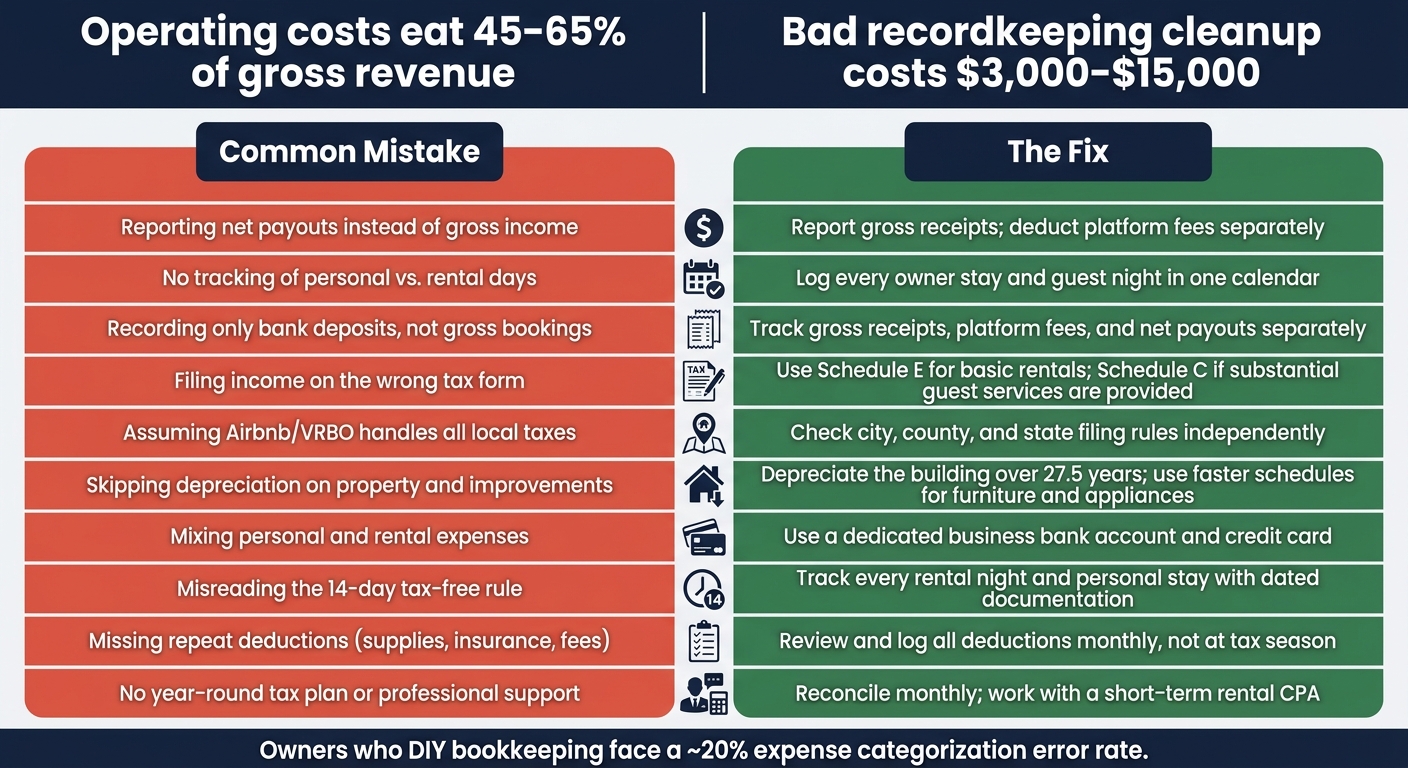
10 Vacation Rental Tax Mistakes: What Goes Wrong vs. What to Do Instead
The Short-Term Rental Tax Strategy Most People Get Wrong
sbb-itb-103bddb
Why Tax Errors Cut Into Short-Term Rental Profits
High bookings don’t guarantee profit. In short-term rentals, money can come in fast and still disappear just as fast. Operating costs can eat up 45% to 65% of gross revenue before loan payments even enter the picture [7]. That leaves little room for tax mistakes.
And most tax problems don’t start with anything dramatic. They usually start with small filing errors that pile up over time.
The hit to cash flow often comes from three places: missed deductions, penalties, and interest. If local taxes go unpaid, owners can face back taxes, penalties, and interest that can climb past the original amount owed [6]. Bad records create another problem. They can make refinancing harder and can slow down, or even derail, a new acquisition.
It also helps to keep one thing straight: federal, state, and local tax rules do not work the same way. Each one touches a different part of your income and creates a different kind of risk.
| Tax Obligation | Authority | What It Taxes | Cash Flow Risk |
|---|---|---|---|
| Federal Income Tax | IRS | Net rental profit | Lowered by deductions and depreciation |
| State Income Tax | State government | Net rental profit | Varies by state and reduces overall net income |
| Transient Occupancy Tax (TOT) | City/County | Gross booking amount | Non-compliance can lead to fines and interest |
| Self-Employment Tax | IRS | Net earnings if the rental is reported on Schedule C | Can apply if you provide substantial services |
Each mistake below can hit one or more of these tax layers. So before getting into the more complicated stuff, start with the most basic issue: missing income.
1. Not Reporting All Airbnb and VRBO Income
Treat every guest payment as taxable income. If your records are messy, IRS trouble can show up fast.
Taxable income includes:
- Nightly rates
- Cleaning fees
- Pet fees
- Kept cancellation payouts
Security deposits are different. They are not income unless you keep part or all of the deposit for damages or cleaning.
You also need to report gross guest receipts, not the lower payout you get after Airbnb or VRBO takes platform fees. Those fees may be deductible, but they do not lower the amount of income you must report. Gross reporting is the base for every deduction that comes after it.
This matters for more than income alone. It also helps support your deductions. Depreciation, mortgage interest, repairs, and day-to-day operating costs all depend on a properly reported income base. If you underreport income, you also make your deduction claims weaker.
Once income is reported the right way, the next risk is mixing personal use with rental use.
2. Mixing Personal Use and Rental Use Without Tracking the Split
After you report income the right way, the next job is simple: separate personal use from rental use.
If you stay at the property yourself and also rent it out, you need to track every personal day and every rental day. Those totals affect how you divide expenses and can also shape local tax or licensing rules.
In some cities, day counts can change licensing thresholds and local tax duties. Poor tracking can lead to misallocated deductions and local tax mistakes, and both cut into profit [3][8].
The easiest fix is to keep every owner stay and guest booking in one calendar or property system that syncs across Airbnb and VRBO. That way, your record stays current all year instead of turning into a messy rebuild at tax time.
Once the day split is clear, the next step is tracking gross income separately from platform fees.
3. Relying on Net Payouts Instead of Tracking Gross Income
Once you’ve tracked personal-use days, the next step is to separate gross bookings from net payouts. If you record only the amount that lands in your bank account, you’re tracking the net payout after platform fees and commissions, not the full amount the guest paid.
That gap matters. The IRS matches 1099-K reporting to gross receipts [1][4]. Platforms like Airbnb and VRBO report the gross amount on Form 1099-K [1][4]. So if your tax return shows only the lower net figure, the IRS sees a mismatch. And that can lead to an IRS notice or an audit [1][9].
There’s another problem too. When you lump everything into the bank deposit, you can’t clearly deduct platform fees as separate business expenses. In plain English: you may end up paying tax on money you never even kept [1][4].
The fix is pretty simple. Track these pieces on their own:
- gross receipts
- platform fees and commissions
- net payouts
Don’t rely on the deposit alone. Use accounting software and reconcile each month against your bank records, platform statements, and books. That gives you a way to catch errors early, before they turn into a year-end mismatch [9].
That split also decides whether the next filing goes on Schedule E or Schedule C.
4. Filing Income on the Wrong Form: Schedule E vs. Schedule C
Once you’ve recorded gross income the right way, the next call is how the IRS views the rental. For short-term rentals, that comes down to the services you provide.
In most cases, Schedule E is used for standard rental activity. Schedule C comes into play when the guest experience includes enough extra service that the rental starts to look more like a business than a plain rental.
Here’s the basic split:
- Schedule E usually fits things like turnover cleaning between stays and basic utilities.
- Schedule C usually fits services such as daily housekeeping, concierge help, regular linen changes, and hands-on check-in or check-out support.
| Service Type | Schedule E or C? |
|---|---|
| Cleaning between guest stays | Schedule E (maintenance) |
| Daily housekeeping during a stay | Schedule C (substantial service) |
| Concierge or tour booking services | Schedule C (substantial service) |
| Around-the-clock guest support | Schedule C (substantial service) |
| Basic utilities | Schedule E (standard rental activity) |
That line can get blurry fast. A host might think, “I’m just helping guests out,” while the IRS may see something else. If you’re not sure where your setup falls, use a short-term rental tax professional.
Once the filing form is right, the next mistake is ignoring local lodging and occupancy taxes.
5. Ignoring Local Lodging, Occupancy, and Short-Term Rental Taxes
Filing the right federal form is only part of the job. Local lodging taxes are a separate issue, and they often catch hosts off guard first because charges can pile up at the state, county, and city levels.
The name changes by location. You might see Transient Occupancy Tax (TOT), Tourist Development Tax (TDT), bed tax, or tourism tax. But the basic rule stays the same: collect the tax from guests and send it to the right local office on time.
Airbnb or VRBO may collect some local taxes for you. But that doesn’t mean you’re off the hook. Hosts still have to pay any tax the platform doesn’t collect, and they still have to follow local registration and filing rules. In some places, returns are due every month even if you had zero bookings. That’s the part many people miss. Check your Airbnb or VRBO tax settings, then check your local tax portal too. Platform settings don’t cancel local filing duties.
If local tax filings are late or wrong, the cost can snowball fast: back taxes, interest, fines, and in more serious cases, listing suspension.
| Tax Level | Common Name | Example | Who’s Responsible |
|---|---|---|---|
| State | Sales Tax / Lodging Tax | Florida (DBPR) | Owner or manager [10] |
| County | Tourist Development Tax (TDT) | St. Johns County, FL (6%) | Owner [11] |
| City | Transient Occupancy Tax (TOT) | San Diego, CA | Owner or platform [1][8] |
Owners dealing with more than one jurisdiction often use Rank One Stays to keep bookings, records, and compliance tasks in order.
Once local taxes are handled, the next profit leak is missed depreciation.
6. Skipping Depreciation on the Property and Major Improvements
After local tax filings, the next profit leak is missed depreciation.
This is a big rental deduction. It cuts taxable income without cutting cash on hand. So when owners skip it, they often pay more tax than they should. And that happens a lot.
Here’s the basic idea: the building is usually depreciated over 27.5 years. Major improvements get added to the property’s basis and written off over time. And items like mattresses, smart TVs, and kitchen appliances can often be depreciated on a shorter schedule.
There’s also an important line between repairs and improvements. Repairs are usually deducted in the year you pay for them. Improvements, like a remodel, have to be depreciated over time.
| Asset Category | Examples | Tax Treatment |
|---|---|---|
| Building | Main structure, attached garage | Depreciated over 27.5 years |
| Capital Improvements | New roof, HVAC system, flooring | Added to basis and depreciated |
| Personal Property | Mattresses, smart TVs, appliances | Often eligible for faster depreciation |
| Land | The lot the house sits on | Not depreciable |
This is where messy bookkeeping causes trouble. If your records aren’t clean, it’s easy to put assets in the wrong bucket and miss deductions.
Once depreciation is recorded the right way, the next mistake is mixing personal and rental expenses.
7. Blending Personal and Rental Expenses Without Proper Allocation
After depreciation, the next leak is sloppy expense allocation. A lot of owners mix personal and rental costs in the same accounts. That hurts the bookkeeping side of tax planning.
If your records aren’t separate, you can’t clearly show which costs belong to the rental. That makes substantiation weaker and can draw IRS questions [4].
The fix is pretty simple. Open a dedicated business bank account and use a dedicated business credit card for rental spending. That way, each transaction stays easy to trace [4]. It also helps to use accounting software that auto-categorizes rental activity and keeps the records you need to report income and expenses the right way [4].
These costs are deductible only when they’re documented the right way. Without clean records, claiming those deductions gets a lot harder [5].
| Expense Category | Tracking Method | Why It Matters |
|---|---|---|
| Cleaning | Per-stay logs | Ties costs to rental income |
| Supplies | Dedicated business card receipts | Separates personal and rental purchases |
| Maintenance & Repairs | Dated work orders or task logs | Confirms rental purpose |
| Professional Fees | Annual invoices | Supports deductible business expenses |
Once expenses are separated, the next mistake is misreading the 14-day tax-free rental rule.
8. Misreading the 14-Day Tax-Free Rental Rule
Even if your expense split is clean, the 14-day rule can still change how the IRS treats the property. The rule is narrow: if you rent the property for 14 days or fewer, the federal tax result changes. Local rules can add their own day limits too. San Diego, for example, uses a separate threshold for rentals under 20 days a year [8]. If your day-count records are sloppy, you’re not just risking a tax problem. You could also run into licensing trouble, and those penalties come straight out of cash flow.
Track every rental night and every personal stay. Keep dated photos, check-in and check-out logs, and cleaner messages so you can prove the day count [1][12]. It’s also smart to have a tax professional review the total before you file.
Once the day count is right, the next risk is missing deductions you can legally claim.
9. Missing Legitimate Tax Deductions Available to Rental Owners
Many rental owners leave money on the table and end up paying more tax than they should. In most cases, the missed write-offs are the boring, repeat charges that hit month after month. Then there are the one-off upgrades owners pay for, use, and forget to log.
Common misses include guest supplies, platform and management fees, short-term rental insurance, software, utilities, and routine repairs. A standard homeowner’s policy usually won’t cover guest stays, so the premium on a short-term rental policy is fully deductible [5].
Professional photography, staging services, and smart-home devices can also count as deductible business expenses.
The fix is pretty simple: track deductions every month, match each charge to a receipt, and sort everything before tax season shows up. Most deductions don’t get missed because owners lack eligible expenses. They get missed because receipts are scattered, charges sit uncategorized, and platform statements slip through the cracks [4][1].
And even if every deduction is recorded the right way, owners still need a year-round tax plan to keep records organized and defensible.
10. Having No Year-Round Tax Plan or Professional Support
Taxes get expensive when owners put everything off until April. By then, receipts are all over the place, transactions still need to be sorted, and the cleanup bill is higher than it would’ve been with steady tracking during the year. The answer is a year-round system, not a last-minute scramble.
Owners who do their own bookkeeping run into about a 20% error rate when categorizing expenses [9]. That can snowball fast. One small mistake turns into filing errors, missed deductions, and added audit risk. And if the books have to be rebuilt from the ground up, professional cleanup can cost anywhere from $3,000 to $15,000, depending on how messy the records are [9].
A simple setup goes a long way:
- Use bookkeeping software made for tracking income and expenses
- Reconcile accounts every month
- Keep receipts and records organized as you go
Staying current all year helps you avoid tax-season chaos. It also gives you cleaner records if you ever need to back up what you reported.
Once the books are in good shape, the next move is picking the right tax help. If you own more than one property or hold property in an LLC or trust, work with a CPA who knows short-term rentals. A specialist can spot deductions that a generalist may miss, including faster depreciation on furniture and equipment. They can also help you choose the most tax-efficient ownership setup for your situation [2].
If you want fewer moving parts during the year, Rank One Stays can handle the day-to-day operations that make clean recordkeeping easier. That cuts down on compliance drag and helps tie together the nine mistakes already covered. Use the reference tables below to keep your reporting, forms, and tax duties organized.
Reference Tables for Vacation Rental Tax Reporting
Use these tables as a quick check for the two reporting mistakes that show up all the time: picking the wrong form and putting a cost in the wrong bucket.
Schedule E vs. Schedule C
Use this table to sort out your filing form fast.
| Feature | Schedule E (Supplemental Income and Loss) | Schedule C (Profit or Loss from Business) |
|---|---|---|
| Primary Use | Standard short-term rentals with basic services | Rentals providing substantial guest services |
| Guest Services Covered | Utilities, cleaning between stays, routine maintenance | Daily cleaning, meals, concierge, tours |
| Self-Employment Tax | Does not apply | Applies – Social Security and Medicare (15.3%) [9] |
| Key Form | Schedule E | Schedule C |
| Depreciation | Reported on Schedule E | Reported as a business expense on Schedule C |
Once you’ve got the form nailed down, the next job is sorting each expense the right way.
Operating Expenses vs. Capital Improvements
Repairs usually count as current-year expenses. Improvements, on the other hand, are usually capital costs that you deduct over time through depreciation.
| Category | Tax Treatment | Common Examples |
|---|---|---|
| Operating Expenses | Deductible this year | Cleaning fees, utilities, HOA dues, minor repairs, insurance, platform commissions, management fees |
| Capital Improvements | Depreciated over time | New roof, HVAC system, furniture, kitchen remodel, swimming pool |
| Supplies | Deductible this year | Toiletries, coffee pods, linens, cleaning products |
One detail trips people up a lot: platform commissions are operating expenses. Report the full amount the guest paid, then deduct the platform fees on their own [1][4][5].
Conclusion
Most vacation rental tax mistakes come from three simple problems: messy records, the wrong tax setup, and the idea that the platform takes care of everything.
Airbnb and VRBO make hosting easier, but they don’t file your taxes or remit every local lodging tax for you [1][3]. That part is still on you. The good news? Fixing it usually comes down to better habits, not more paperwork.
A few basics go a long way:
- Keep monthly records
- Use separate bank accounts
- Confirm local tax remittance
- Talk with a short-term rental tax pro before you file
If you want less month-end cleanup, management support can take some of that work off your plate.
If bookkeeping and compliance are eating up too much time, Rank One Stays can help with monthly owner statements that itemize income and expenses and make tax prep easier.
Once the right systems are in place, tax season feels a lot less chaotic. These mistakes are common, but they’re avoidable. Build solid habits now, and taxes are less likely to chip away at your profit.
FAQs
How do I count personal vs. rental days?
Track each night your property is unavailable.
Rental days are nights booked by guests. Personal days are nights you block for your own use or for family and friends.
Don’t count nights blocked only for maintenance, cleaning, or renovations as available rental days. A separate calendar can help you avoid mistakes in performance tracking and tax reporting.
When should I use Schedule E instead of Schedule C?
Most vacation rental owners report income and expenses on Schedule E. That’s usually the right form for passive rental real estate activity.
Use Schedule C only when the rental works more like a hands-on business. In plain English, that means you’re offering substantial guest services beyond a standard rental, such as:
- Daily maid service
- Concierge services
- Meals
When those kinds of services are part of the stay, the IRS may treat the activity as a business instead of a passive rental.
Does Airbnb or VRBO handle all local lodging taxes?
No. Airbnb and VRBO may collect and send lodging taxes for you in some areas, but they do not handle every local lodging tax.
You still need to check the rules where your property sits. In many places, the owner has to collect, track, and file these taxes on their own. If you miss this step, you could face fines or even have your listing suspended. Rank One Stays can help owners stay in line with these rules.