

A good Airbnb manager can help you earn more by fixing the parts most owners underwork: pricing, listing setup and design, guest screening, reviews, upsells, and day-to-day follow-through. In many cases, dynamic pricing alone can lift yearly revenue by 10% to 40%, and one cited study found listings using PriceLabs made 36.3% more gross revenue per unit than listings with flat pricing.
If I had to sum up the article in plain English, it comes down to this:
- Price by demand, not by habit
- Use better photos and sharper listing copy
- Screen guests and reply fast
- Get more 5-star reviews
- Add paid extras like early check-in or pool heat
- Keep cleaning, maintenance, and guest service steady
The article also shows that local timing matters. In Scottsdale, peak season often runs January through April, with many homes reaching $300 to $400+ per night and luxury homes hitting $500 to $800+ during top weeks. In Pittsburgh, event weekends can support premiums of 30% to 60% above a normal weekend rate.
A few numbers stand out:
- Listings with 21+ reviews averaged 71% occupancy
- Listings with 1 to 5 reviews averaged 57% occupancy
- Ratings of 4.8 stars or higher can lead to up to 40% higher booking conversion
- Upsells can add about 15% to 30% more revenue per stay
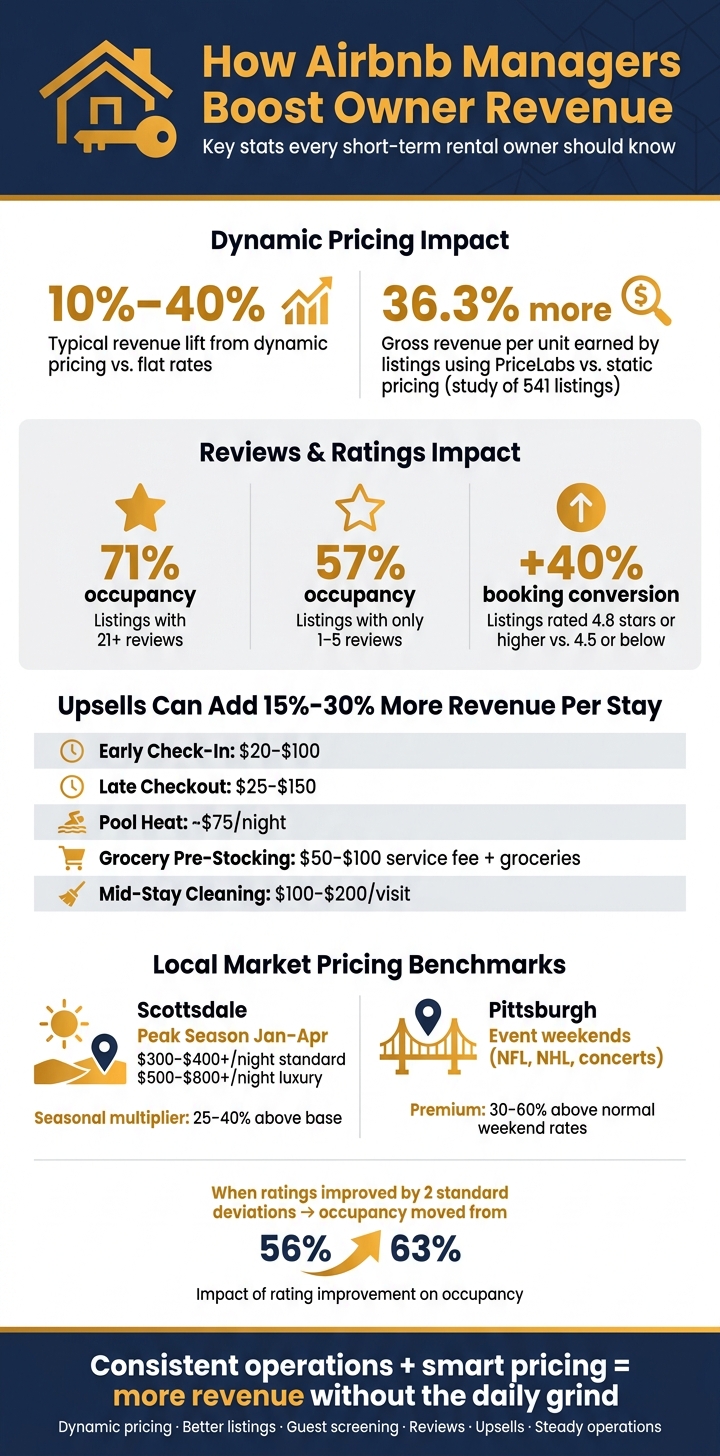
How Airbnb Managers Boost Owner Revenue: Key Stats & Numbers
How This Airbnb Manager Outperforms Every Competitor
sbb-itb-103bddb
Quick Comparison
| Revenue Driver | What a manager does | Why it matters |
|---|---|---|
| Pricing | Adjusts rates by season, events, and booking pace | Helps grow occupancy and nightly rate |
| Calendar rules | Sets minimum stays and fills gap nights | Cuts empty nights and protects peak dates |
| Listing setup | Improves photos, title, and description | Turns more clicks into bookings |
| Guest screening | Checks guests before approval | Lowers damage risk and review issues |
| Reviews | Follows up and fixes guest issues fast | Helps search ranking and conversion |
| Upsells | Offers extras for added fees | Grows revenue beyond base rent |
| Property follow-through | Oversees cleaning, repairs, and guest issues | Keeps ratings high and calendars full |
Bottom line: I’d say the article’s main point is simple: owners tend to earn more when a manager runs the revenue levers and keeps the property in good shape without the owner having to handle every booking, message, cleaner, or repair.
1. Revenue starts with pricing and calendar control
Keeping the same rate all year is one of the costliest mistakes self-managing owners make. It sounds simple, but it often means missing peak-demand pricing and giving up income. Professional managers fix that with dynamic pricing and calendar rules, so owners don’t need to babysit rates every day.
Use dynamic pricing to lift nightly rates and occupancy
Good managers don’t pull numbers out of thin air. They start with a market-based base rate and set firm floor and ceiling limits, so the pricing tool can move rates without cutting too deep or pushing too far.
Then they watch booking pace by date. That’s where the money is. If March weekends are filling 60 to 90 days in advance, that’s a sign the home is priced too low, and rates should go up. If weekdays are still open 10 to 14 days before check-in, a small last-minute discount – usually 10–15% – can help book the night without dragging down the rest of the calendar.
The point isn’t just to chase occupancy. And it isn’t just to chase the highest nightly rate either. The target is total revenue per available night.
The numbers back this up. Industry data shows dynamic pricing often lifts vacation rental revenue by 10–40% per year compared with flat rates. And one study of 541 listings found that properties using PriceLabs dynamic pricing earned 36.3% more gross revenue per unit than those using static pricing.[4][5]
Set stay rules that protect revenue on high-demand dates
Minimum-night rules have a direct effect on revenue. In Pittsburgh, demand jumps around Steelers home games and major concerts at Acrisure Stadium. On those weekends, managers will often set a 2-night or 3-night minimum.
Gap nights matter too. These are the awkward 1- or 2-night openings between longer bookings. Left alone, they often go empty. Good managers use pricing tools to lower minimum stays for those dates for a short period and add a light discount, usually around 10–15%, to make the stay more appealing without weakening pricing on the nights around it.[3]
They also change minimum stays and discounts based on the booking window. That way, short gaps get filled while peak dates keep their pricing power.
Match pricing strategy to local market conditions
This is where local knowledge pays off.
In Scottsdale, the main revenue season runs from about January through April. Spring training, golf season, and events like the WM Phoenix Open push nightly rates to $300–$400+ for well-located properties. Luxury homes in North Scottsdale can hit $500–$800+ per night during peak weeks.[1] Managers often apply seasonal multipliers of 25–40% above the annual base rate during that stretch. Then they dial rates down in July through September, when temperatures often top 100°F and leisure demand slows.
Pittsburgh moves on a different schedule. Demand tends to follow the NFL and NHL calendars, college football, and major concerts. Managers who stay on top of those dates and load in event-based premiums – often 30–60% above normal weekend rates – pick up revenue that flat pricing misses.[2]
After pricing and calendar control, the next lift usually comes from better photos, sharper copy, and stronger listing conversion.
2. Better listings turn more clicks into booked nights
Pricing gets you in the door, but the listing is what gets the booking. A lot of self-managing owners miss how much money a weak listing leaves on the table. It doesn’t just mean fewer reservations. It can also limit the nightly rate you can charge.
Professional managers treat each part of the listing like a conversion tool. That includes the cover photo, the title, and the description. They also work to show up better in platform search by keeping response rates high and turning on Instant Book [6][8]. When the listing is dialed in, more search traffic turns into booked nights, and the property can often support a higher rate.
Improve photos, titles, and descriptions that drive bookings
The cover photo is the first thing a traveler sees. In many cases, it decides whether they click or keep scrolling. That is why managers use professional photography instead of phone shots, and why they choose the lead image with care [6][8]. They also swap the main photo based on the season and whichever feature gives the home its best shot at standing out.
Titles matter too. The best ones follow a simple structure: property type + standout feature + location [7][9]. For example, "Spacious Denver Loft with Private Rooftop Near Union Station" tells a guest what the place is, what makes it stand out, and where it sits. A title like "Nice Place to Stay" says almost nothing, so it tends to get skipped.
Descriptions play a similar role. They should be clear, specific, and built around what guests care about most. If a place has a rooftop, a hot tub, mountain views, or walkable access to top spots, that should be easy to spot right away.
Use design and staging to support a higher nightly rate
Photos have limits. If the property looks plain or unfinished in person, the listing will feel the same way online. Managers who work with investors early often suggest staging and design before the listing even goes live [6][7]. That usually means durable, guest-friendly furniture and décor that looks good on camera without making the space feel stiff.
Staging is not just about looks. It is a revenue move. A well-staged property feels finished, stands out in search, and gives guests a reason to accept a higher nightly rate. Rank One Stays offers vacation rental interior design and staging services for investors who want a turnkey, cash-flowing property without the guesswork of furnishing it themselves.
Comparison table: DIY listing setup vs. professionally managed listing setup
You can see the difference pretty fast when you compare a DIY listing with one set up by a professional manager.
| Listing Element | DIY Setup | Professionally Managed Setup |
|---|---|---|
| Photography | Often amateur or phone photos; static | Professional, magazine-quality; seasonally rotated [6][8] |
| Titles and descriptions | Generic or vague | SEO-optimized headlines and descriptions [6][8] |
| Visibility and ranking | Depends on the owner’s limited time and effort | High response rates, Instant Book, and SEO-optimized copy support ranking [6][8] |
| Staging and design | Basic furnishings that may not photograph well | Professional staging that makes travelers stop scrolling and helps justify a higher nightly rate [6][7] |
| Amenity emphasis | Key amenities buried or missing from the listing | Amenities highlighted in titles, descriptions, and photos to match guest search intent [6][8] |
| Conversion rate | Lower | Higher |
Once the listing is doing its job, the next gains usually come from guest screening, better reviews, and paid extras.
3. Guest screening, reviews, and upsells grow revenue after the listing goes live
A strong listing brings in traffic. But traffic alone doesn’t pay the bills. Professional managers help protect revenue in three main ways: they screen guests, build reviews, and add upsells. The first job starts before a booking is approved.
Screen guests and respond quickly to protect ratings and reduce damage risk
Good screening helps protect ratings and cut down on costly damage claims. Professional managers often use a mix of government ID checks, complete guest profiles, past-review checks, message screening, and house-rule acknowledgments before they confirm a reservation. For larger groups or local guests, they may also ask pre-booking questions about the purpose of the trip and group size. That extra step can catch red flags early.
Clear rules matter too. Limits on occupancy, quiet hours, parties, smoking, pets, and peak-date minimum stays give guests a written agreement they accept before arrival. Managers may also use noise sensors, smart locks, and detailed before-and-after photos to help prevent problems and support claims, without making the owner watch the property day to day.
Fast communication matters just as much. Airbnb tracks 24-hour response rate, and that can affect search placement [10]. Managers usually send confirmations and arrival details through automated messages, while still keeping a live contact available for urgent issues like lockouts, Wi-Fi problems, or cleanliness concerns.
Turn five-star stays into stronger rankings and more future bookings
Higher ratings can lead to better search visibility and more bookings. Properties with 4.8 stars or higher can see up to 40% higher booking conversion than those rated 4.5 or below [13]. Managers build that track record by fixing issues before checkout, sending a polite thank-you message after the stay, and replying professionally to every review, including negative ones.
The idea is simple: make the stay smooth, then follow up in a polite, human way. A calm public reply to a complaint tells future guests a lot. It shows that the host pays attention and works to solve problems.
Once that trust is in place, managers can grow revenue per stay with add-ons.
Add paid extras that increase revenue per booking
Upsells can increase revenue per reservation. When done well, upselling in vacation rentals can add 15%–30% beyond nightly rates [11]. The key is to keep each add-on optional, useful, and clearly priced.
| Upsell Type | Typical Fee | Operational Requirements | Why It Works |
|---|---|---|---|
| Early check-in | $20–$50 in standard markets; $75–$100 in luxury settings [11] | Housekeeping schedule coordination | Helps guests arriving early |
| Late checkout | $25–$75 in standard markets; $75–$150 in premium markets [11] | Housekeeping schedule coordination | Useful for weekend and leisure stays |
| Pool heat | About $75 per night [12] | Equipment check, energy-cost tracking | Valuable in warm-weather markets with pools |
| Grocery pre-stocking | $50–$100 service fee plus groceries [11] | Local sourcing process, guest order form | Convenient for family trips and longer stays |
| Mid-stay cleaning | $100–$200 per visit [11] | Housekeeping availability, scheduling | Helpful for longer bookings |
Rank One Stays handles guest support, housekeeping, and damage claims so owners stay hands-off.
Those gains depend on steady operations behind the scenes.
4. Why owners earn more when operations run consistently
Strong pricing and polished listings can only take you so far. If turnovers get missed, maintenance slips, or guest replies slow down, revenue starts leaking fast. Those levers work best when cleaning, upkeep, and guest communication happen the same way every time.
That’s the part many owners underestimate. Consistent operations are what turn a short-term rental into steady income instead of a second full-time job. When the day-to-day runs smoothly, owners can earn more without being pulled into every message, repair, or same-day issue.
Consistent operations keep good reviews and booked calendars
You can see this in the data. Listings with more reviews and stronger ratings book more nights. Properties with 21+ reviews averaged 71% occupancy, compared with 57% for listings with 1–5 reviews. And when ratings increased by two standard deviations, occupancy moved from 56% to 63%.[17][16]
That doesn’t happen by accident.
Professional managers usually rely on room-by-room checklists after each stay. They check that linens were replaced, surfaces were cleaned, consumables were restocked, and core systems like locks, Wi-Fi, HVAC, and appliances are all working. They also inspect the home after checkout to spot damage before the next guest arrives. That helps with claims, and it helps protect first impressions too.
Maintenance works the same way. Small problems tend to get expensive when nobody catches them early. Scheduled checks for plumbing, HVAC filters, smoke detectors, and exterior lighting can stop minor issues from turning into mid-stay headaches. And even a small safety problem can drag down occupancy and price per reserved night.[14][15] Preventive maintenance helps protect both occupancy and nightly rates.
Comparison table: DIY hosting vs. full-service management
Here is the gap in operating burden and revenue control.
| Area | DIY Hosting | Full-Service Management |
|---|---|---|
| Time per week | Several hours for messages, cleaners, and issues | Minimal – owner reviews monthly reports |
| Pricing expertise | Often static or reactive | Data-driven, adjusted to market and demand |
| Guest communication | Depends on owner availability | Near-real-time, 24/7 coverage |
| Cleaning oversight | Hard to monitor remotely | Checklists, inspections, vendor coordination |
| Review growth | Slower and less systematic | More likely to improve through consistent service |
| Damage handling | Owner investigates and coordinates | Manager documents, reports, and pursues claims |
| Reporting visibility | Informal, platform dashboards only | Regular reports in USD: revenue, expenses, occupancy, ADR |
| Revenue potential | Exposed to operational errors | Better positioned to protect occupancy and ADR |
Conclusion: The main ways managers increase Airbnb revenue for owners
Dynamic pricing, stronger listings, careful guest screening, review systems, upsells, and calendar control can each add revenue on their own. But the gains stack up when the operation under them stays steady. A well-priced listing only delivers if the property is clean, stocked, and free of problems every single stay.
Rank One Stays manages listing optimization, pricing, guest support, housekeeping, maintenance, and damage claims across the U.S. With local support in markets like Scottsdale, Denver, Pittsburgh, and Lighthouse Point, the team helps owners put these systems in place without daily involvement. Managers increase Airbnb revenue by protecting pricing power, review quality, and booking consistency without requiring the owner to run the business day to day.
FAQs
How much more can a manager realistically earn me?
A realistic upside is about 38% more revenue than the market average, while management fees usually start at 10%.
More broadly, DIY pricing can leave 30%–50% of potential revenue on the table. Rank One Stays says a big share of that lift comes from dynamic pricing, listing optimization, and professional photography.
Is hiring a manager worth the fee?
Often, yes. DIY management can leave 30% to 50% of potential revenue on the table because of pricing mistakes and day-to-day gaps. And with management fees starting at 10%, hiring a pro can make sense if it helps protect ADR and bring in more income.
Rank One Stays helps owners earn 38% more revenue than the market average through dynamic pricing, strong listing presentation, steady 5-star reviews, and fully hands-off daily operations.
What does a manager handle day to day?
A professional manager takes care of the day-to-day work of your vacation rental, so ownership feels much more hands-off.
That usually covers pricing updates, listing tweaks, photo refreshes, guest messages, housekeeping, maintenance, inventory, and damage claims. Instead of juggling all of that yourself, you’ve got someone handling the moving parts for you.
They also keep an eye on reviews and property ratings, which can have a direct effect on your listing’s pricing power and ability to compete. Rank One Stays offers this type of full-service management for owners.