

Yes, you may be able to use short-term rental losses against W-2 or business income – but only if two tests are met first. If your rental’s average guest stay is 7 days or less and I materially participate, the activity may avoid the passive loss limits that block many landlords.
Here’s the short version:
- Depreciation can create a tax loss
- Most rental losses are passive under IRC §469
- Passive losses usually cannot offset active income
- A short-term rental may avoid that rule if:
- the average stay is 7 days or less
- the owner materially participates
- After that, cost segregation can move more depreciation into earlier years
- If the loss is non-passive, that first-year deduction may offset current income
- If not, the loss often becomes a suspended passive loss
Put simply: the tax break is not cost segregation by itself. The tax break is getting the rental out of passive-loss treatment before I claim accelerated depreciation.
A few points matter most:
- Average stay formula: total rented nights ÷ total bookings
- Material participation: common tests include 500+ hours, substantially all participation, or 100+ hours and more than anyone else
- 27.5-year property: the building itself is still depreciated over time
- Cost segregation: parts of the property may be moved into 5-, 7-, or 15-year classes
- Bonus depreciation: may allow a large first-year deduction on qualifying assets
- Owner use, family stays, and weak logs can damage the tax position
Example: If I have 180 rented nights over 40 bookings, my average stay is 4.5 nights. That clears the 7-day test. But I still need records that show my hours, tasks, booking data, and support for the cost segregation report.
| Topic | What I need to show | Why it matters |
|---|---|---|
| STR status | Average stay of 7 days or less | Keeps the activity from being treated as a rental activity under the passive-loss rules |
| Participation | Hours and task logs | Helps show the loss is non-passive |
| Cost segregation | Formal study and asset breakdown | Supports faster depreciation |
| Bonus depreciation | Property placed in service and qualifying assets | Drives larger first-year deductions |
| Personal use | Owner/family day tracking | Too much personal use can limit deductions |
One more thing: REPS and the STR loophole are not the same. Many short-term rental owners focus on REPS, but this rule can work without real estate professional status if the property meets the short-stay test and I meet material participation.
This article is about one idea: first qualify the short-term rental, then use cost segregation. If I reverse that order, the deduction may still exist, but I may not be able to use it this year.
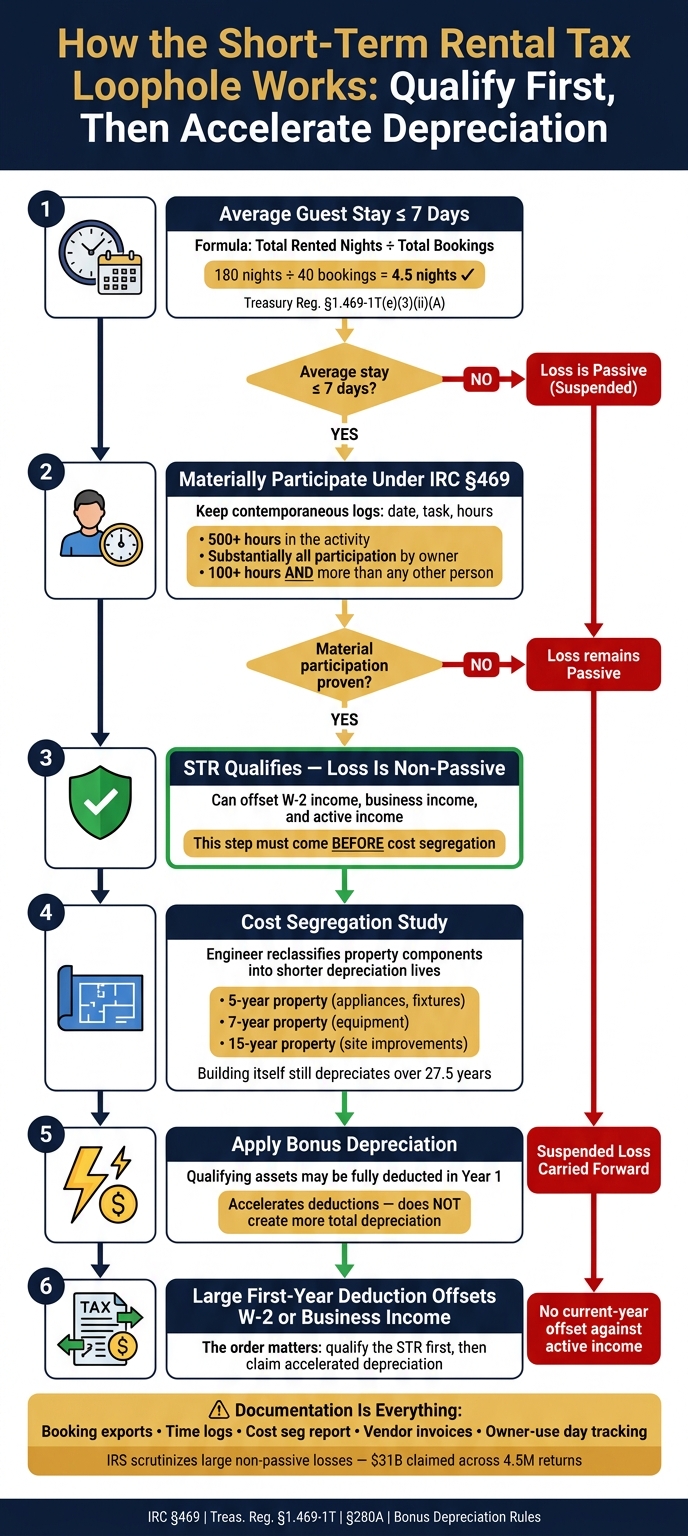
STR Tax Loophole: Step-by-Step Qualification & Cost Segregation Strategy
The Short-Term Rental ‘Loophole’ & Bonus Depreciation – What Actually Works
sbb-itb-103bddb
Problem: Passive Loss Limits Block Many Owners from Using Depreciation
Passing the STR test, by itself, doesn’t fix the tax issue. A lot of rental owners hit the same wall: they create a depreciation loss, but they can’t use it right away.
Under IRC §469, rental activities are usually treated as passive. That means losses can offset passive income only. If you don’t have passive income, the loss gets suspended and carried forward. So even a big first-year depreciation write-off from a cost segregation study only matters if that loss is usable in the current tax year.[20][21]
When a Short-Term Rental Is Not Treated as a Rental Activity Under Section 469
Under Treasury Regulation §1.469-1T(e)(3)(ii)(A), an activity is not treated as a rental activity if the average period of customer use is 7 days or less.[6][10][8][14]
The math is simple: divide total rental days by the number of separate bookings during the tax year. Say you had 180 rented nights across 40 bookings. That gives you a 4.5-night average.
The IRS looks at actual guest stays, not rough estimates. So you’ll want clean records from Airbnb, VRBO, direct bookings, or your PMS, plus a spreadsheet that shows exactly how you got the number.[2][1][9][14]
Material Participation: The Gatekeeper for Non-Passive Loss Treatment
Meeting the 7-day average test does not automatically turn the loss into a non-passive one. You also need to materially participate under Temporary Reg. §1.469-5T.[2][10][12][14]
The tests that tend to matter most in practice are:[10][11][12]
- More than 500 hours
- Substantially all participation – you do almost all the work yourself, with little outside help.[10][12]
- More than 100 hours and more than any other person – this can work well if you use some help but still spend more time on the activity than anyone else.[10][11][12]
Keep logs as you go: date, task, and hours. If those records are missing, the loss gets much harder to defend.[3][18][19]
STR Loophole vs. Real Estate Professional Status
REPS is a separate test, and most STR investors don’t need it. The STR loophole applies at the property level. REPS applies at the taxpayer level and calls for 750 hours in real property trades or businesses, plus more than 50% of your total working time.[15][16][4][17]
So if your short-term rental averages 7 days or less and you materially participate, you may qualify without REPS.[5][6][10][13][14] That said, the whole thing rests on your records. You need support for both the average-stay calculation and your participation hours before cost segregation becomes useful in a tax filing. That paper trail is what helps make accelerated depreciation defensible.
Solution: Apply Cost Segregation and Bonus Depreciation After the Short-Term Rental Qualifies
Once the STR qualifies under Section 469, cost segregation and bonus depreciation can pull more deductions into the current tax year. At that point, the issue isn’t whether you can use the loss. It’s when you can use it.
How Cost Segregation Creates Larger First-Year Deductions
With standard straight-line depreciation, the cost of a residential building is spread over 27.5 years. For most properties, that means a fairly small deduction each year.
A cost segregation study changes that timeline. It breaks out parts of the property into shorter-life assets, such as 5-, 7-, or 15-year property. That can include appliances, built-ins, specialty lighting, window treatments, and site improvements.
Here’s how it works: a specialist reviews the property, assigns costs to those shorter-life categories, and prepares a formal report to support the deductions. That reclassification is what makes bonus depreciation hit right away.
Why Bonus Depreciation Is More Useful When Losses Are Non-Passive
If those assets qualify for bonus depreciation and the loss is non-passive, a big part of the deduction can land in year one.
That’s the core advantage of pairing the STR loophole with cost segregation. But there’s a catch: it only works after the loss is confirmed as non-passive and usable in the current year.
Straight-Line Depreciation vs. Cost Segregation
Straight-line depreciation spreads deductions across 27.5 years. Cost segregation speeds them up, but it also calls for tighter records and can bring more audit exposure.
One point matters here: cost segregation speeds up depreciation; it does not create more depreciation. You’re getting the same total deduction, just on a faster schedule.
This setup tends to fit investors who have strong records and high active income. The more deductions you front-load, the more your documentation needs to hold up.
Risk Control: Audit Red Flags, Owner-Use Mistakes, and Documentation Gaps
Once you speed up the deduction, the next issue is simple: can your records hold up in an audit? This strategy usually falls apart because of weak files, not because the tax idea itself is wrong.
Audit Triggers the IRS May Focus On
Large non-passive losses from cost segregation can draw attention when the STR classification is thin or poorly documented. The IRS pays close attention when large non-passive losses offset W-2 income or business income, especially in the first year after purchase. It also flags accelerated depreciation claimed without a formal, engineering-based cost segregation study.[26]
Schedule E errors can add to that scrutiny. Missing property addresses, incomplete reporting, or changing between personal-use and rental treatment from one year to the next can all put the return under a microscope.[26]
When those issues show up alongside weak proof of average guest stay or material participation, audit risk jumps.[26][27] At that point, the fight is less about tax law and more about proof.
Good support looks like this:
- A booking export with check-in and check-out dates for every stay
- The annual stay summary used for the return
- Invoices and receipts tied to specific tasks
- Guest messages
- A time log kept during the year, not rebuilt later at tax time[22][23][24][25][26]
IRS Publication 925 says any reasonable method can be used to substantiate hours, but the burden of proof stays with the taxpayer.[1][7]
Vague notes like "worked on rental" don’t help much. Specific entries do. For example:
responded to three guest inquiries, adjusted weekend pricing, scheduled HVAC maintenance.
Owner-Use Rules That Can Limit Deductions or Break the Strategy
Owner-use mistakes can wreck both the short-term rental classification and the timing of the deduction. Under Section 280A, personal use can limit deductions fast. If personal use goes over the Section 280A threshold, deductions are limited to rental income.[28]
Family stays are a common trap. If family uses the property for free or at below-market rent, those days count as personal use by law, even if the owner thinks of them as rental days.[28] And even one personal-use day means expenses must be split between rental and personal days. Skipping that allocation step is a common and expensive mistake.[29][30][31]
You also need to track the date the property was ready and available for rent, along with the at-risk limits under Section 465. Bonus depreciation applies only after the property is ready and available for rent, so listing dates and marketing records matter.[26][28] Section 465 matters too because the owner must have real economic exposure to the property’s debt and operations before losses can be deducted.[1][28]
These errors usually show up first in the return, the logs, and the vendor records.
Common Short-Term Rental Tax Mistakes and How to Correct Them
| Mistake | Tax Rule Affected | Why It Fails | Fix |
|---|---|---|---|
| Reconstructed or vague time logs | Section 469 material participation | Late-built logs are weak proof of material participation | Start a weekly log with date, property, specific task, and hours; tie entries to receipts and messages |
| No annual stay summary | Section 469 short-term rental classification | Missing proof of classification without a documented calculation | Export Airbnb/VRBO booking history annually; build a spreadsheet showing total rental days divided by number of stays; include direct bookings |
| Family or personal stays counted as rental days | Section 280A | Free or below-market family stays are personal use by law, not rental days | Log owner and family days separately; charge fair market rent when required; prorate expenses correctly |
| Cost segregation claimed without a formal study | Bonus depreciation and accelerated depreciation | Self-allocated asset categories without an engineering-based report are hard to defend | Engage a qualified cost segregation provider; retain the full report, asset schedule, and basis allocation |
| No vendor-hour records | Section 469 participation tests | If vendors do more work than the owner, the activity can be treated as passive | Request annual hour summaries from vendors; keep invoices showing visit frequency; adjust operations so owner hours clearly exceed any single provider |
The strategy works best when the way you run the property, the records you keep, and the tax position on the return all line up.
Conclusion: Build a Defensible Short-Term Rental Tax Strategy with Better Operations and Local Support
Once the guardrails are in place, this comes down to execution.
The order matters: qualify the STR under Section 469, prove material participation, and then use cost segregation and bonus depreciation to speed up non-passive losses. If the property is still treated as passive, that accelerated depreciation doesn’t give you a current-year write-off. It turns into suspended losses instead.
Taxpayers claimed about $31 billion in net rental real estate losses across 4.5 million returns[32], so the IRS pays close attention to records. In plain English, your paperwork matters just as much as your tax position.
Where Rank One Stays Fits for Owners in Pittsburgh and Scottsdale
For owners in Pittsburgh and Scottsdale, those systems matter because booking patterns and vendor activity need to be easy to show. Rank One Stays can centralize:
- booking data
- guest messages
- vendor records
- owner reports that support average-stay and participation logs
If you’re trying to materially participate, a full-service manager changes where your hours go. Strategic decisions, pricing oversight, major vendor selection, and property-level reviews can still count. And if you also want to improve the property’s income potential, Rank One Stays’ vacation rental design and staging services can help lift both occupancy and average daily rate.
Key Takeaways Before You Act
The STR loophole works only when both classification and material participation hold. If they don’t, cost segregation simply speeds up suspended losses.
Owner-use mistakes can sink the deduction. Have a CPA who knows Section 469, cost segregation, and bonus depreciation review the plan before you move ahead. Set up operations that produce clean records first, then claim the tax benefit.
FAQs
What counts toward material participation?
The search results provided do not define material participation or spell out which activities count for tax purposes.
If you want help with day-to-day operations and guest communication while you focus on work that may support non-passive loss treatment, Rank One Stays can help keep your rental on track as you work through these rules.
Can I qualify without REPS?
The source you shared doesn’t mention REPS or explain whether someone can qualify without it.
So based on that text alone, this can’t be answered.
If you send the part that covers REPS or the tax eligibility rules tied to it, I can give you a direct answer based on the source.
What records should I keep for an audit?
Keep records that back up your short-term rental income, personal use, and the business reason for each deduction.
That means holding on to records of gross rental revenue from every income source, including nightly rates, cleaning fees, and other guest charges. It also means keeping booking calendars, related records, and logs that show personal use or owner-blocked nights.