

I start rental arbitrage with written landlord approval – not furniture or bookings. Before signing, I check local laws, building rules, insurance, and cash flow. I budget 2–3 months of fixed costs as reserves and test whether I can cover a 30–90-day launch delay.
My process is simple:
- Screen the address: Check Pittsburgh or Scottsdale requirements, lease restrictions, guest access, and costs.
- Show the landlord my plan: Disclose short-term stays and provide proof of funds, references, insurance details, and guest rules.
- Put duties in writing: Define rent, repairs, taxes, permits, liability, and exit terms before listing.
- Keep approval intact: Track deadlines, report problems, and confirm permission before hiring a manager.
- Grow from results: Add units only after documenting rent payments, property care, compliance, profit, and enough reserves.
The goal isn’t just to get a yes. I want a lease I can follow and renew. That means starting renewal talks 60–90 days before expiration – or earlier if required – and treating <u>each new address as a separate approval</u>.
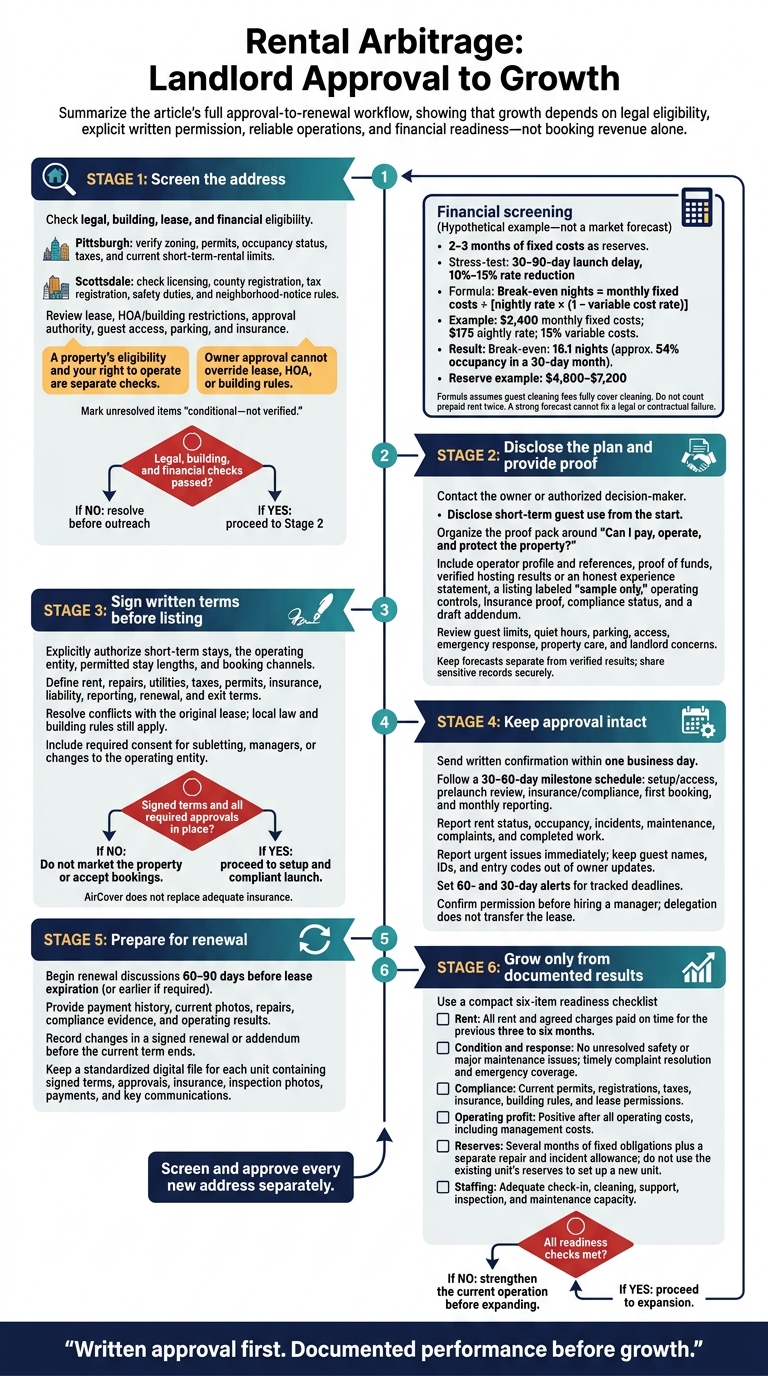
Rental Arbitrage: Landlord Approval to Growth
Screen Properties Before Contacting Landlords
Check Pittsburgh and Scottsdale Rental Requirements
Check each address for legal, building, lease, and financial issues before scheduling a tour. This gives you a lower-risk proposal to bring to the landlord. In Pittsburgh, verify zoning, permits, occupancy status, taxes, and current short-term-rental limits.[5][6] In Scottsdale, check licensing, county registration, tax registration, safety duties, and neighborhood-notice rules.[1][2][8]
Use official city, county, and state sources to confirm stay limits, caps, and residency rules. A property’s eligibility and your right to operate are separate checks. If the unit meets local rules, review the building documents before contacting the landlord.
Keep a record for each unit, along with supporting documents. Include the official source URL, rule reviewed, verification date, responsible party, application status, renewal date, and unanswered questions. The landlord should handle ownership and building-document checks; the operator should handle licensing and taxes. Send unclear legal questions to a qualified local professional. Mark unresolved items “conditional – not verified.”
Review Building Rules and Lease Restrictions
Request the full lease, addenda, HOA or condominium documents, amendments, and operating rules. Confirm who has authority to approve the intended use – a leasing agent may not be able to amend the lease.
Use these documents to check whether you can run the unit without violations. Owner approval cannot override lease, HOA, or building rules.
| Issue | Verification source | Allowed | Blocked |
|---|---|---|---|
| Transient occupancy | Declaration, bylaws, amendments | Intended stay lengths are allowed | Short stays, transient use, or short-term rental use are prohibited |
| Subletting and business use | Lease and proposed addendum | Authorized signer can expressly permit the operation | Lease, bylaws, or declaration prohibit the intended use |
| Approval authority | Ownership records, management authorization, board requirements | All required approving parties are identified | Required approval is unavailable or signer lacks authority |
| Guest access and parking | Fob, elevator, registration, and parking policies | Guest access and parking comply with building rules | Guests cannot lawfully obtain access or required parking is unavailable |
| Noise and security | House rules and building procedures | Turnovers, quiet hours, and emergency response are workable | Operation would require rule violations |
| Insurance | Lease requirements and insurer confirmation | Coverage applies to the intended activity | Material short-term-rental exclusions remain |
If the lease and building rules permit the use, test cash flow before reaching out.
Calculate Cash Flow and Startup Reserves
Run the numbers only for units that pass the legal and building checks. Build a monthly model in U.S. dollars, separating gross booking revenue from guest-paid cleaning charges. Deduct rent, utilities, insurance, platform fees, cleaning overruns, management fees, permits, maintenance, supplies, and reserve contributions. Record furnishings and interior design separately as startup spending.
Airbnb or Vrbo tax remittance is not revenue, and you should not deduct the same tax twice. Confirm any remaining tax filings with the relevant tax agency.[7][8]
Break-even nights = monthly fixed costs ÷ [nightly rate × (1 − variable cost rate)], assuming guest cleaning fees fully cover cleaning.
Hypothetical example – not a market forecast: With $2,400 in monthly fixed costs, a $175 nightly rate, and 15% variable costs, break-even is 16.1 nights, or approximately 54% occupancy in a 30-day month.
Before approving outreach, test slow months, a 10%–15% rate reduction, higher expenses, and a 30–90-day delayed launch. Use actual quotes for deposits, first rent, furnishings, permits, insurance, and prelaunch costs.
Budget enough reserves to cover weak months and launch delays. Add 2–3 months of fixed-cost reserves – $4,800–$7,200 for the hypothetical unit above – without counting prepaid rent twice. Mark any deal that works only during peak demand financially fragile. Even a strong forecast cannot fix a legal or contractual failure.
sbb-itb-103bddb
Plan Landlord Outreach and Meetings
Send a Clear Proposal to Owners
Once a property passes screening, contact only the owner or authorized decision-maker. Build your prospect list from owners, property managers, referrals, real estate agents, and buildings that already allow short-term rentals.
Rank prospects with a scorecard that covers written building permission, local regulatory eligibility, unit suitability, landlord responsiveness, rent, parking and access, and willingness to review a formal operating plan. Track each property’s address, contact details, status, objections, and next follow-up in a spreadsheet or CRM.
Disclose short-term guest use from the start. Permission for furnished housing, corporate housing, or subletting does not authorize nightly stays. The lease or addendum must explicitly permit transient guest use.
Example email:
Hello [name],
I’m interested in leasing [property address] under a written agreement that allows furnished short-term guest stays through Airbnb or Vrbo. I would handle rent, utilities, guest conduct, cleaning, maintenance coordination, and compliance. I can share my operator profile, financials, references, insurance, sample listing, house rules, and proposed addendum. Are you open to a brief call to confirm whether this use is permitted?
Replace the placeholders with your actual credentials and intended stay range.
Keep the initial call under two minutes. Explain the guest use, state your rent and property-care obligations, and ask to schedule a follow-up call. If you hear nothing after several business days, make one call and send one final follow-up asking whether the owner wants the documents. If they decline, thank them, update the prospect’s status, and move on.
Use the first reply to choose which proof documents to send.
Build a Landlord Proof Pack
Show that you can pay rent and run the property – not just predict booking revenue. Keep verified hosting results separate from forecasts, and be honest about limited experience. Label any sample listing “sample only.”
Share sensitive financial and identity records through a secure portal or encrypted transfer. Redact account numbers that aren’t needed.
Build the pack around three questions: Can I pay, operate, and protect the property?
| Checklist document | Concern addressed | Preparation stage | Update frequency |
|---|---|---|---|
| ☐ Operator profile and records | Identity, accountability, and reliability; include profile, ID, entity documents, and references | Before outreach; share sensitive records before approval | Review annually and when information changes |
| ☐ Bank statement, proof of funds, or financial summary | Ability to pay rent and fund setup | Before meeting | Monthly or when requested |
| ☐ Hosting results or honest experience statement | Ability to run the property | Before meeting | Quarterly |
| ☐ Labeled sample listing and photos | How the unit will be marketed | Before meeting | Before each launch |
| ☐ Operating controls and reporting | Guest screening, house rules, occupancy, cleaning, inspections, emergency response, maintenance, damage claims, and owner updates | Before approval; finalize before launch | Review quarterly and after incidents or rule changes |
| ☐ Insurance proof | Liability and property risk | Before signing | At renewal and policy changes |
| ☐ Compliance status | Permits, registrations, and taxes | Before listing | Check before launch and renewal |
| ☐ Draft addendum | Clear written permission and responsibilities | Before signing | Review with counsel before execution |
Bring only the documents that answer the landlord’s risk questions.
Lead the Meeting With Written Permission
Start by stating that the unit will host short-term guests and that you’ll proceed only with written approval.
Follow a set agenda: confirm the decision-maker, explain the guest model, and review restrictions, operations, risk controls, insurance, and permits. Then discuss concerns specific to the property and agree on next steps.
Ask which requirements are non-negotiable. These may include minimum stays, maximum occupancy, quiet hours, parking limits, guest registration, key-control rules, inspection rights, or restrictions on cameras and smart locks. Also discuss rent safeguards, property care, compliance duties, and exit conditions.
Address concerns with clear controls: ban parties, document damage between stays, log complaints, and reserve rent funds regardless of occupancy. Don’t promise risk-free operations or guaranteed revenue. Verbal approval is preliminary; list the property only after the terms are signed and required approvals are in place.[10][11]
Send a recap the same day. Name the decision-makers, missing documents, legal-review needs, and response date. Once you’ve documented the concerns, move to written terms.
The BEST way to Pitch a Landlord for Airbnb Arbitrage (step-by-step)
Sign Written Terms Before Listing
Once the landlord agrees in principle, put the agreement in writing. Before marketing the property or accepting bookings, sign a lease, amendment, or addendum that explicitly permits short-term stays. Resolve conflicts with the original lease before signing. Local law and building rules still apply.
Define Rental Permission and Each Party’s Duties
Name the property, landlord, operating entity, permitted stay lengths, and approved booking channels, including Airbnb, Vrbo, or direct bookings. Spell out who handles advertising, guest communication, cleaners, and smart locks. Include any required consent for subletting or using professional property management.
Use this table to settle business terms before legal review.
| Clause | Operator responsibility | Landlord concern | Attorney-review issue |
|---|---|---|---|
| Short-term stays and operating entity | Use approved channels, stay lengths, entity, and subcontractors | Use without permission or an unknown operator | Conflicting lease terms; consent for subletting, assignment, and managers |
| Term, renewal, and rent | Track renewal deadlines; pay rent, increases, deposits, and agreed fees | Missed payments, vacancies, or holdover | Notice requirements, rent increases, deposit handling, and revenue-sharing terms |
| Reserves | Keep agreed funds for rent, utilities, repairs, deductibles, taxes, and refunds | Ability to pay during cancellations or suspensions | How reserves are verified and whether rent remains due during interrupted operations |
| Occupancy and building rules | Enforce guest caps, stay limits, quiet hours, parking, and building rules | Overcrowding, complaints, and fines | Alignment with zoning, fire rules, and governing documents |
| Utilities and furnishings | Pay assigned bills; maintain furniture, linens, and inventory | Excess usage, alterations, and replacement costs | Utility caps, ownership, fixtures, and move-out duties |
| Cleaning and repairs | Document turnovers; report defects; follow repair-approval limits | Sanitation, wear, and delayed repairs | Vendor responsibility, cost allocation, and duties that cannot legally be shifted |
| Inspections and access | Coordinate inspections, required notices, and emergency access | Access for maintenance and safety | Lawful entry, guest privacy, and condition records |
| Approvals | Assign applications, payments, renewals, inspections, and records for each permit, license, tax account, and building approval | Expired or missing authorization | Owner-only applications and consequences of denial or revocation |
Set Liability, Insurance, and Exit Terms
Airbnb’s AirCover does not replace homeowners or renters insurance, or adequate liability coverage.[12][9] Ask an insurance professional to verify coverage for short-term guests and check exclusions. State coverage limits, proof of renewal, cancellation-notice requirements, and any additional-insured endorsement.
Have counsel review indemnity terms, including operator-caused injuries and damage, exclusions, and how those terms work with insurance.
Set deadlines for reporting incidents and requirements for preserving evidence. Specify emergency repair authority, spending limits, who pays deductibles, and who controls claims.
Assign responsibility for tax collection, remittance, records, and audit responses. Don’t assume booking platforms handle every tax obligation. Identify who maintains each permit and license, and require prompt notice of denial, expiration, or suspension. Licensing and permitting requirements vary by state, county, city, business activity, and location.[13][14]
Spell out what happens when regulations or building rules change. Require unlawful bookings to stop, assign guest-refund costs, and identify lawful alternatives, such as longer minimum stays or a conventional lease.
Set default notices, cure periods, and termination rights under applicable law. Clarify whether rent remains due during a suspension. Address existing bookings, guest communication, cancellation or relocation costs, furnishing removal, restoration, final inspection, keys, deposits, and unresolved claims.
Require written consent for any assignment, entity change, or manager change. Hiring a manager does not transfer the lease.
After signing, establish a communication and compliance routine to keep approval intact.
Manage Landlord Relationships and Plan Growth
Set a Post-Signing Communication Schedule
Send written confirmation within one business day, then follow a 30–60-day milestone schedule. Name a primary contact and backup, provide an emergency number, and set a monthly reporting date. These check-ins help the owner verify that you’re running the unit as agreed.
| Milestone | Message content | Responsible person | Required confirmation |
|---|---|---|---|
| Signed-term summary | Approved use, rent, dates, permitted platforms, occupancy limits, utilities, maintenance duties, reporting, and termination rights | Operator | Landlord confirms the summary matches the signed agreement |
| Setup and access | Key or smart-lock access, utility accounts, internet, parking, trash procedures, emergency contacts, and vendor access | Operator and landlord | Access and contact details are verified in writing |
| Prelaunch review | Listing draft, photographs, house rules, pricing approach, guest limits, and launch date | Operator | Landlord approves any contractually required prelaunch items |
| Insurance and compliance | Required insurance evidence, permits or registrations, and any building or municipal approvals | Operator | Landlord confirms receipt; local authority requirements are independently checked |
| First booking | Booking dates, expected payout or rent treatment, and any required operating details | Operator | Landlord acknowledges receipt without receiving unnecessary guest information |
| Monthly reporting | Rent status, occupancy, incidents, maintenance, complaints, and completed work | Operator | Landlord confirms receipt or identifies questions by an agreed deadline |
Report urgent issues immediately. Include facts, photos, corrective action, who’s responsible, and when you’ll send the next update. Follow phone calls with written notes, and leave out guest names, IDs, and entry codes. Track inspections, renewals, rent notices, insurance expirations, and compliance deadlines on a calendar with 60- and 30-day alerts.
Clear records make renewals, referrals, and the next unit easier. Once communication with the landlord is working well, delegate day-to-day work to a full-service manager to free up time for the next property.
Consider Rank One Stays After Approval
Rank One Stays provides full-service Airbnb/Vrbo management, pricing, guest support, housekeeping, maintenance coordination, claims help, and staging.[15]
Before handing over the landlord-approved plan, check that the lease and local, building, and insurance requirements allow delegation, platform use, vendor access, and the required insurance arrangement. Ask how fees are calculated, what extra charges apply, and whether service is available locally. Also confirm reporting, contract length, termination rights, and who handles incidents.
Use the first 30–60 days to show that the unit is stable enough to renew or expand.
Check Readiness Before Adding Units
Decide whether you can handle another lease using the checks below – not booking revenue alone. Add units only after the first one meets the landlord’s expectations, local rules, and financial targets.
Once you’ve documented reliable performance, send the landlord a short update covering payment history, inspections, repairs, and resolved complaints before asking for another property or referral. Screen every new address separately and get written authorization for each one, even if the landlord is the same.
- Rent: All rent and agreed charges paid on time for the previous three to six months.
- Condition and response: No unresolved safety or major maintenance issues. Complaints are infrequent and resolved on time, with a named emergency responder and backup coverage in place.
- Compliance: Permits, registrations, taxes, insurance, building rules, and lease permissions are current.
- Operating profit: Results are positive after rent, platform fees, cleaning, supplies, utilities, labor, insurance, taxes, repairs, and management costs.
- Reserves: Several months of fixed obligations are covered, plus a separate repair and incident allowance based on actual costs. Setting up a new unit should not use the existing unit’s reserves.
- Staffing: Confirm daily check-in capacity, cleaning turnaround, support coverage, inspections, and open work orders before taking on more work.
Conclusion: Repeat the Approval-to-Renewal Process
Follow the same approval-to-renewal workflow for every unit: screen the property, disclose guest use, share your proof pack, address owner concerns, and get written approvals before listing.[4][3]
After approval, keep one standardized digital file for each unit. Use consistent file names and folders to store signed terms, approval records, insurance certificates, inspection photos, payment confirmations, and key communications. This helps you answer questions faster, keep renewals organized, and reduce disputes.[16]
Use that file to guide renewal conversations. Start discussions 60–90 days before the lease expires, or earlier if the lease requires it. Your renewal packet should include payment history, current photos, repairs, compliance evidence, and operating results. Record every change in a signed renewal or addendum before the current term ends.[17][18]
Treat renewal readiness as your test for growth: expand only after you’ve documented reliable rent payments, property care, compliance, and profit.
FAQs
How can I win landlord approval without hosting experience?
Build your pitch around control and performance. Explain how you’ll handle pricing, listings, photography, cleaning, maintenance, damage claims, inventory, and 24/7 guest support. Show how proven processes protect the property and keep guest ratings high.
Start with pricing slightly below market to attract bookings and reviews, then adjust rates.
Rank One Stays handles the full service, with management fees starting at 10% and a track record of above-market revenue.
Should I offer fixed rent or revenue sharing?
Fixed rent is generally the preferred option for rental arbitrage. It gives landlords predictable, guaranteed income, which lowers their perceived risk and makes them more likely to approve the arrangement. Revenue sharing, on the other hand, makes income less predictable. It can also strain relationships and make it harder to keep operating costs and dynamic pricing transparent.
To improve profitability with fixed rent, consider Rank One Stays’ professional management. It uses dynamic pricing and AI-driven optimization to help you earn 38% more revenue than the market average.
How do I negotiate an exit if rental rules change?
Add a change-in-law clause to your lease that lets you terminate it or renegotiate rent if local ordinances, homeowners association rules, or zoning regulations prohibit short-term rentals. Getting this protection upfront reduces your risk of being stuck in a lease for a property that can no longer generate income.
Rank One Stays offers professional oversight to help you handle day-to-day challenges and maintain property performance.