

AirCover’s $3 million damage limit isn’t a promise to pay every loss. My advice: consider professional property management, confirm your insurance permits short-term rentals, document each stay, and track claim deadlines before you need reimbursement.
Host Damage Protection is not insurance. It reimburses eligible guest-caused losses. Separate Host Liability Insurance offers up to $1 million for covered claims when you’re legally responsible.
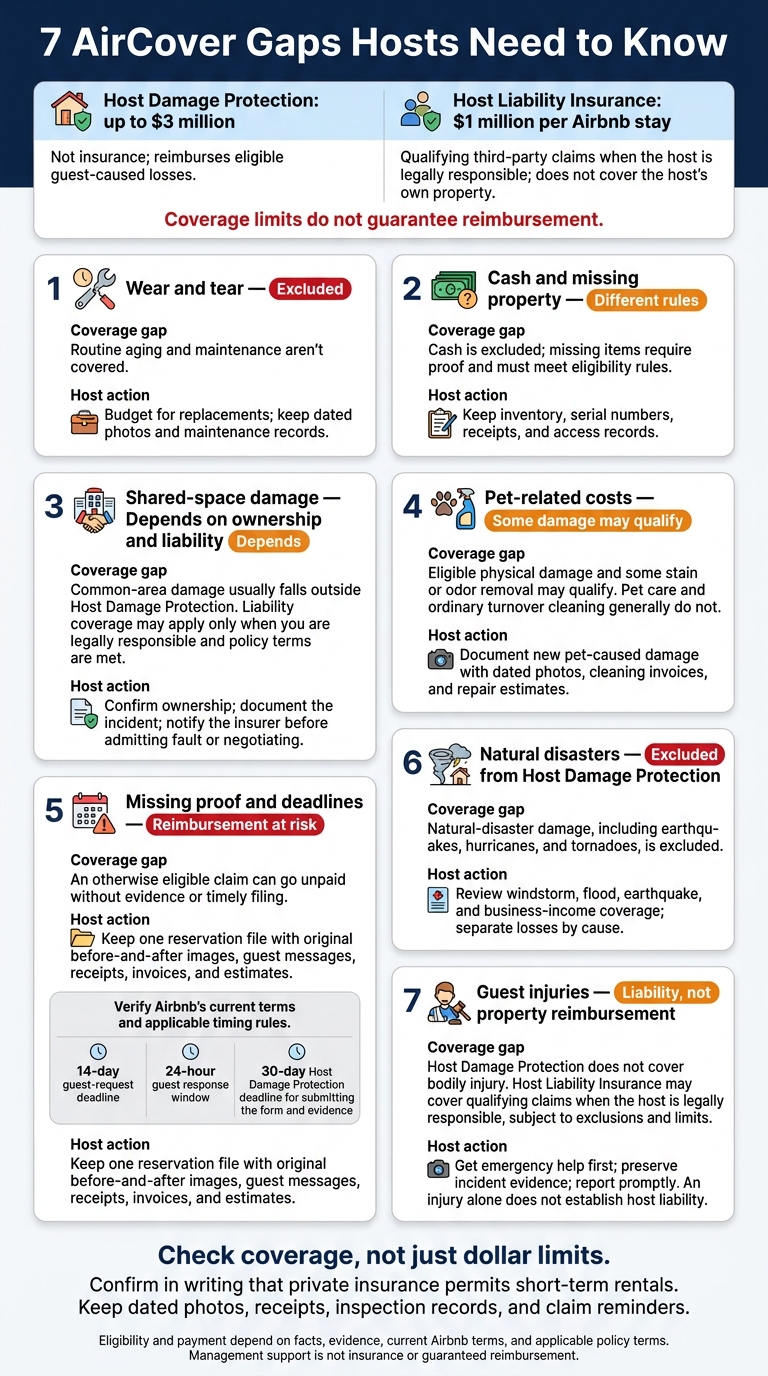
Here are the seven gaps I’d check:
- Wear and tear: Routine aging and maintenance aren’t covered.
- Cash and missing property: Cash is excluded; missing items require proof.
- Shared-space damage: Coverage depends on ownership, legal responsibility, and policy terms.
- Pet-related costs: Some physical damage may qualify; pet care and routine cleaning generally don’t.
- Missing proof and deadlines: An otherwise eligible claim can go unpaid.
- Natural disasters: Host Damage Protection excludes disaster damage.
- Guest injuries: Liability coverage may apply, but exclusions and limits still matter.
My bottom line: <u>check coverage, not just dollar limits</u>. Keep dated photos, receipts, and inspection records – and verify Airbnb’s current filing rules. Private rental insurance may fill some gaps, but it won’t cover everything either.
7 AirCover Gaps Hosts Need to Know
Airbnb Host Insurance: Why AirCover and Your Home Policy Won’t Protect You!
sbb-itb-103bddb
Host Damage Protection vs. Host Liability Insurance
Whose property was damaged – and who may be legally responsible – determines which protection to review. Host Liability Insurance does not cover the host’s own home or belongings. It covers qualifying third-party claims, and an injury alone does not establish host liability.[3][4] Each gap below falls under a different protection – or neither.
| Component | Purpose | Potential limit | Key restrictions |
|---|---|---|---|
| Host Damage Protection | Reimburse eligible guest-caused damage to the host’s property, plus qualifying extra cleaning and lost-income costs | Up to $3 million[4][6] | Excludes normal wear and tear, lost currency, and natural-disaster damage.[6] |
| Host Liability Insurance | Cover qualifying legal liability for guest bodily injury or damage, loss, or theft of guest property | $1 million per Airbnb stay[3] | Does not cover the host’s own property. Payment depends on legal responsibility, policy terms, and exclusions.[3][4] |
| Private short-term-rental insurance | Provide property, liability, and income coverage | Depends on the policy | Must explicitly cover short-term rentals. Deductibles, exclusions, sublimits, state requirements, and reporting rules apply.[9] |
Filing a claim still requires following Airbnb’s current proof and deadline rules.[6] Check that the reservation, location, property type, and hosting entity qualify under the applicable terms.[8] Also check whether those terms protect the owner, co-host, manager, or business entity.
For liability incidents, notify Airbnb and your insurer promptly, and document the claim.[4]
Ask a licensed insurance professional to confirm in writing that your policy covers short-term rentals and each rental address, and to explain how it works with platform protection. A standard homeowners or landlord policy may exclude rental business activity.[9]
If you use professional vacation rental management, agree on who inspects after checkout, gathers evidence, and submits claims. Management support does not replace insurance. The first gap to check is normal wear and tear.
1. Normal Wear and Tear
Routine aging is a host’s operating cost – not a loss caused by a guest.
Program scope and exclusions
Wear and tear means gradual deterioration from use, age, or poor maintenance – not a single guest incident. To make a claim, hosts must link the loss to a specific guest event. Showing that an item needs replacing isn’t enough.[6][10]
Financial exposure for hosts
You’re responsible for routine replacement costs; they aren’t claimable damage. Estimate the replacement cost of each item, then spread that amount across your booked nights.
Evidence and claim prerequisites
AirCover requires proof that a guest caused the loss, so claim records matter more here than they do for routine maintenance. Keep dated photos from before check-in and after checkout, original files, receipts, maintenance logs, and repair estimates.
Record the reservation details and when you found the issue. Photograph the damage before repairing or disposing of the item. Airbnb’s terms require evidence of the item’s condition, acquisition date, and estimated repair or replacement costs. Having those records doesn’t guarantee payment.[7]
Private coverage and risk controls
Build a maintenance reserve for routine replacements, since these aren’t covered losses. Set aside a fixed amount per booking or a share of monthly revenue.
Review your private insurance for coverage of sudden accidental losses – not gradual deterioration. Most policies treat deterioration as maintenance rather than a covered loss. Have cleaners report defects with photos, and schedule preventive maintenance.[5]
Next, look at whether AirCover treats missing cash and valuables differently from damaged property.
2. Cash Loss and Missing Property
Theft and disappearance come with different coverage rules.
Program scope and exclusions
Host Damage Protection excludes cash. Coverage for gift cards, prepaid cards, and vouchers may be unclear, so get Airbnb’s written determination before filing.[7][5]
A missing television, appliance, or similar item can qualify only if it meets Airbnb’s eligibility and proof rules.[7][5]
Financial exposure for hosts
Hosts pay for missing cash entirely out of pocket under Host Damage Protection. Missing property can also mean replacement costs, guest disputes, and time spent seeking reimbursement.[2][7]
Evidence and claim requirements
Check inventory before and after each stay. Keep serial numbers, card numbers, and purchase records, and track cash separately from household items. Before filing a theft claim, review cleaner and co-host access logs. If you suspect theft, file a police report that identifies the missing property and keep the report number.[7][10]
Private coverage and risk controls
Ask your insurer whether theft and contents coverage allows short-term rentals. Check exclusions for unexplained disappearance, cash sublimits, gift-card coverage, and deductibles. If you use professional vacation rental management, put one person in charge of checking inventory and reporting discrepancies after checkout.
Next: shared-space damage, where ownership and responsibility can be harder to separate.
3. Shared-Space and Third-Party Property Damage
Damage in shared spaces may happen outside your unit. What coverage applies depends on who owns the property and who is at fault.
Program scope and exclusions
Common-area damage usually falls outside Host Damage Protection. Damage in a hallway, lobby, elevator, or neighboring unit generally involves liability coverage rather than reimbursement for host property. Host liability insurance may apply only if you’re legally responsible and the claim meets the policy’s terms. Guest damage alone does not make you liable.[4][3]
Financial exposure for hosts
Common-area damage can leave hosts facing repair bills, deductibles, defense costs, settlements, and higher premiums. Ask the HOA, condominium association, or landlord who owns and maintains the damaged area. Get written repair estimates, too. Agreeing to liability in a lease does not automatically mean your insurance covers it.[7][3]
Evidence and claim prerequisites
Document the reservation code, time, location, witness statements, and manager report. Save photos, guest messages, invoices, and any security footage you can legally access. Report liability claims promptly through Airbnb’s intake process, and notify your private insurer. Don’t admit fault or negotiate before notifying the insurer.[7][3]
Private coverage and risk controls
Get your HOA’s, condominium association’s, or landlord’s insurance requirements in writing. Ask your insurer about short-term rentals, neighboring-property damage, legal defense, and loss assessments. Check coverage limits, deductibles, and exclusions. Get written confirmation that your policy covers common-area claims and meets any additional-insured requirements.[9]
Give guests parking and amenity rules before check-in, track access cards, and promptly report hazards in shared areas to building management.[3]
Pet damage presents the same challenge of proving what happened, but different exclusions apply.
4. Pet Damage and Animal-Related Costs
Program scope and exclusions
Pet damage may be covered, but pet-care costs usually aren’t. Host Damage Protection may cover direct physical damage to eligible host property caused by a responsible guest’s pet. It may also cover some stain or odor removal costs after a pet accident.
Veterinary care, boarding, medication, and costs related to a pet’s injury are separate animal-care expenses. Ordinary turnover cleaning is excluded.[6][7]
Financial exposure for hosts
Hosts may still face bills for repairs and specialty cleaning, plus lost income while repairs take place. They may also face liability if someone is injured.[6][7]
Evidence and claim prerequisites
Show that the pet caused new damage – not just that a pet stayed. Inspect the property immediately after checkout. Have cleaners document chewing, scratches, stains, and odors separately.
Submit your request through the Resolution Center within 14 days of checkout, subject to current terms and any separate evidence deadlines.[6][7]
Private coverage and risk controls
Set clear rules for pet disclosure, waste, and damage while following disability-access requirements. Ask your short-term-rental insurer about exclusions for animals, breeds, bites, gradual damage, and biohazard cleanup. Get the answers in writing.
Rank One Stays can coordinate inspections, housekeeping, and damage claims.
Next, review how missing proof and missed deadlines can block otherwise valid claims.
5. Missing Proof and Missed Claim Deadlines
Even covered damage can go unpaid if you miss a deadline or lack proof.
Program scope and exclusions
An otherwise valid claim can be denied if you file late or can’t document the amount, leaving you with the bill. Submit a reimbursement request through Airbnb’s Resolution Center with the reservation, amount, reason, and evidence. If the guest refuses, pays only part, or doesn’t respond, escalate the request to Airbnb.
Airbnb checks whether the claim meets its terms and whether the evidence supports the amount. Tie each amount to a receipt, invoice, or repair estimate – not an upgrade.[6][7][11]
Evidence and claim prerequisites
Check the terms that apply to your reservation and track three separate time limits: the 14-day guest-request deadline, the 24-hour guest response window, and the 30-day Host Damage Protection deadline for submitting the form and evidence.[6][7] Set reminders and escalate unresolved requests promptly.
Keep one reservation file with timestamped before-and-after photos or videos, reservation details, inspection notes, guest messages, receipts, invoices, and estimates. For each damaged item, record its make, model, acquisition date, pre-stay condition, and repair or replacement cost.
Without these records, Airbnb can reject an otherwise valid loss. Keep the original files, too. A photo alone doesn’t prove when damage happened or who caused it.[7][10]
Private coverage and risk controls
Ask your insurer about guest-caused damage, theft, lost rental income, reporting deadlines, deductibles, and exclusions. Also ask whether an AirCover claim affects your policy.
For Rank One Stays clients, inspection and claim workflows can keep evidence, inventory, and guest messages in one reservation file. Rank One Stays does not provide insurance or guarantee Airbnb approval or reimbursement.
Next, check what AirCover does when the loss comes from weather or other natural events.
6. Natural Disaster Damage
Program scope and exclusions
Airbnb’s Host Damage Protection excludes damage from natural disasters, including earthquakes, hurricanes, and tornadoes.[6][7] The $3 million limit does not cover disaster damage.[7][2]
Financial exposure for hosts
Hosts may have to pay for emergency work to limit damage, structural repairs, and replacement furniture and appliances. They may also lose rental income while the property is unavailable during repairs. Flood coverage often requires a separate policy.[12]
Evidence and claim prerequisites
When storm damage overlaps with guest damage, the cause of each loss matters. Separate losses by cause rather than labeling everything found after a storm as guest damage.
Compare pre-stay photos with weather alerts, guest messages, housekeeping reports, and emergency records. Ask your contractor to document the cause, timing, and affected components in writing. File any separate guest-damage claim promptly.
Private coverage and risk controls
Check your policy’s flood, wind, named-storm, wildfire, and earthquake coverage. Review how claims are valued and paid, deductibles, debris removal, and ordinance-or-law coverage. Also check whether short-term rental income qualifies for business-interruption coverage.
Choose safeguards that fit your location, such as hurricane shutters, wildfire defensible space, earthquake bracing, or elevated utilities.
Guest injuries involve a different issue: liability, not property reimbursement.
7. Guest Injuries and Liability Limits
Program scope and exclusions
Unlike the previous gaps, this one concerns legal liability, not property damage – a clear dividing line in AirCover. Host Damage Protection does not cover guest bodily injury. Host Liability Insurance may cover qualifying injury claims up to $1 million when the host is legally responsible. Intentional acts and other policy exclusions can still apply.[3][4]
Financial exposure for hosts
Injury claims can involve medical care, lost wages, pain and suffering, and legal defense. The $1 million limit does not eliminate your financial risk, especially if an exclusion applies. Check how the policy handles defense costs and multiple claims from a single incident.[4][7]
Evidence and claim prerequisites
Get emergency help first. Then record the time, location, conditions, and witnesses. Keep original scene photos, witness statements, incident logs, and any footage. Report the incident promptly through Airbnb’s liability process so the claim reaches the right team. Do not admit fault or negotiate independently before reporting the incident through Airbnb’s liability process.[4]
Private coverage and risk controls
Get written confirmation that your private liability coverage permits short-term rentals and matches how you use the property. An umbrella policy may add coverage limits, but business-use exclusions and underlying-policy requirements still apply. Also check workers’ compensation obligations for employees and any local short-term-rental insurance or minimum-liability requirements.[7]
Keep dated records of safety checks for stairs, handrails, smoke and carbon monoxide alarms, pools, and other hazards. If you use Rank One Stays, require written inspection logs and incident-reporting procedures. Verify insurance responsibilities separately.[7]
Next, review which AirCover exclusions private insurance can actually fill.
AirCover Gaps and Private Insurance to Review
Use this table to see where AirCover may fall short and which private coverage to check.
| Risk or loss | AirCover limit | Proof needed | Private insurance to review |
|---|---|---|---|
| Wear and tear | Ordinary wear is excluded. | Dated photos and maintenance records. | Budget for routine replacements and inspections. |
| Cash loss and missing property | Currency is excluded. | Inventory records and proof of purchase for missing items. | Check contents, theft, and guest-caused-loss coverage. |
| Shared-space damage | Coverage depends on ownership and liability. | Ownership records, photos, and incident reports. | Check property, premises liability, and common-area coverage. |
| Pet-related loss | Some pet damage may qualify. | Dated photos, cleaning invoices, and repair estimates. | Check exclusions for animal-related damage and liability. |
| Proof failures | Missing evidence or missed deadlines can prevent reimbursement. | Follow Airbnb’s current filing deadline and keep complete claim records.[6][7] | Check your private policy’s notice requirements. |
| Natural disasters | Natural-disaster losses are excluded. | Event records, damage photos, and repair estimates. | Check windstorm, flood, earthquake, and business-income coverage. |
| Guest injury | Up to $1 million for eligible liability, subject to exclusions.[8][4] | Incident records, photos, witness details, and prompt notice. | Check premises liability, umbrella/excess, and medical-payments coverage. |
Your private policy must permit short-term rentals and guest occupancy.[9]
Conclusion: Check Coverage and Document Every Stay
The seven gaps – wear and tear, cash or missing property, shared-space damage, pet-related costs, proof failures, natural disasters, and guest injuries – call for documentation and appropriate private coverage, not just high limits. Before each booking:
- Save the Airbnb terms, confirm short-term rental coverage in writing, and check local permits, hazards, and liability rules.
- Maintain a room-by-room inventory with photos, receipts, and serial numbers. Inspect the property at every turnover, organize timestamped files by reservation, and put every claim deadline on your calendar.[6][7]
If you outsource property management, you still need those records. Rank One Stays can help with inspections, inventory management, housekeeping coordination, and damage claims – but that support is not insurance or guaranteed reimbursement.
Coverage limits do not guarantee reimbursement: payment depends on the facts, evidence, Airbnb terms, and private-policy terms.[7]
FAQs
Can I appeal a denied AirCover claim?
The information provided doesn’t confirm whether you can appeal a denied AirCover claim.
Damage claims and coverage gaps can be hard to navigate. Rank One Stays handles damage claims on your behalf, managing the documentation, inventory records, and communication that protection programs require.
Should I file with Airbnb or my insurer first?
Start with Airbnb, which requires reimbursement requests within 14 days of checkout [1]. But Airbnb’s host damage protection does not replace private insurance with broad coverage [1].
Coverage gaps and strict proof requirements can make claims difficult to navigate. Rank One Stays handles the entire claims process for owners, from detailed documentation to managing potential coverage overlaps, to help protect your investment.
Does AirCover reimburse depreciated or replacement value?
The provided search results don’t clarify whether AirCover reimburses depreciated value or replacement value. They cover general replacement-cost budgeting and state that Airbnb reimbursement requests must be submitted within 14 days of checkout, but they don’t explain how depreciation affects AirCover claims.